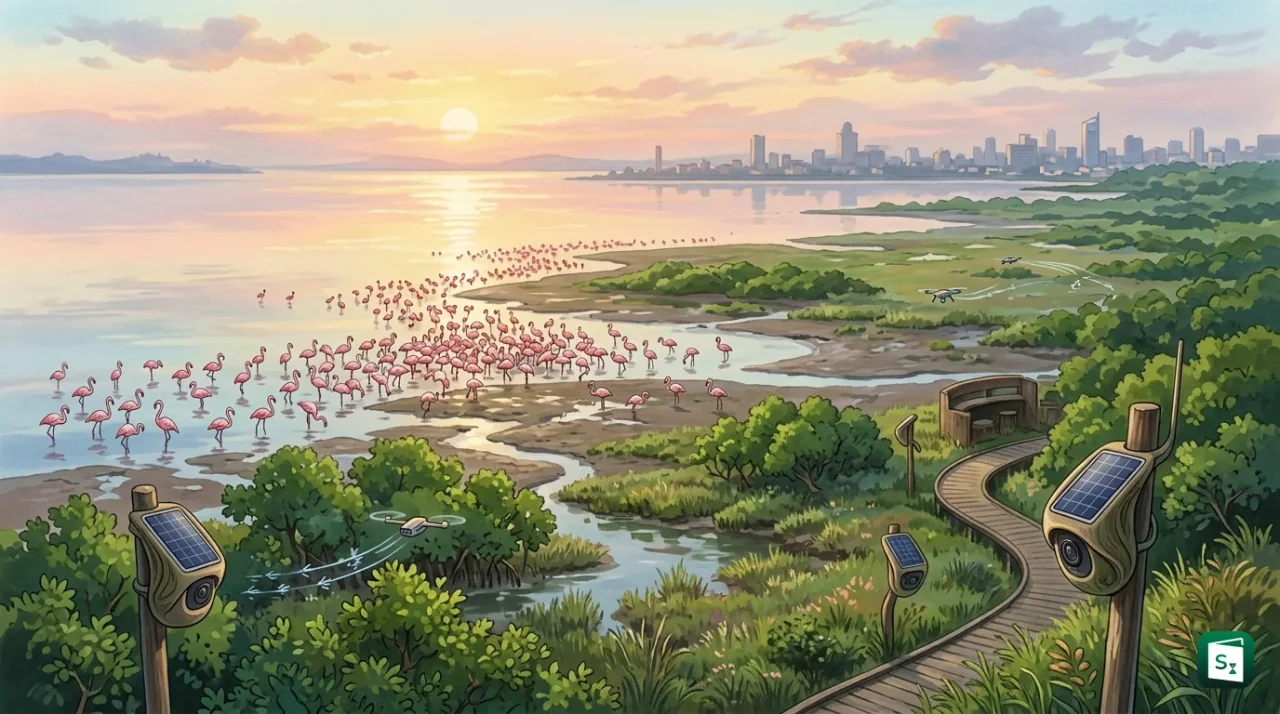
The Maharashtra government has approved India’s first AI-powered bird sanctuary, the Bhandup Bird Park, at the Thane Creek Flamingo Sanctuary (TCFS) in Mumbai. The project, estimated to cost ₹45 crore, will be developed across 20.09 hectares along the Thane Creek shoreline. It marks a significant step in integrating artificial intelligence with wildlife conservation, as the park will feature an AI surveillance system that tracks bird migration and identifies species in real time across a 1.5 km radius.
What Is the Bhandup Bird Park Project?
The Bhandup Bird Park is a proposed eco-nature park that will be built within the existing Thane Creek Flamingo Sanctuary, a designated Ramsar site of international importance. The project has received administrative approval and funding through the District Planning Committee’s special fund. Minister Ashish Shelar inspected the proposed site at Bhandup and confirmed that the project has secured clearances from the Maharashtra Eco-Tourism Development Board, technical clearance from the Mumbai Metropolitan Region Development Authority (MMRDA), and Coastal Regulation Zone (CRZ) sanction from the Ministry of Environment, Forest and Climate Change.
The park’s design prioritises minimal ecological disruption. Only 0.35 hectares of the total 20.09 hectare area will be used for physical infrastructure and tourist amenities. The remaining land will be preserved as natural habitat, including existing mangrove ecosystems and mudflats that support an estimated 250 native and migratory bird species.
Understanding the Thane Creek Flamingo Sanctuary (TCFS)
Location and Ecological Significance
Thane Creek is an estuary of the Arabian Sea and one of the two main distributaries of the Ulhas River in Maharashtra’s Konkan division. It forms the eastern boundary of Salsette Island, separating it from the mainland. The Thane Creek Flamingo Sanctuary was notified as a protected area under the Wildlife (Protection) Act, 1972 on 6 August 2015, making it Maharashtra’s second notified marine sanctuary after the Malvan Marine Sanctuary.
The sanctuary was designated as a Ramsar site on 13 April 2022, becoming India’s first Ramsar site located within a metropolitan city. The total area of the TCFS is 16.9 square kilometres, which includes 8.96 square kilometres of mangrove forests and 7.94 square kilometres of water body.
The sanctuary lies on the Central Asian Flyway (CAF), one of the major global migratory bird routes connecting Europe, Central Asia, and the Indian subcontinent. Every winter, thousands of migratory birds arrive here, including Greater Flamingos and Lesser Flamingos. In 2022, teams from the Bombay Natural History Society (BNHS) counted more than 130,000 flamingos at Thane Creek in a single season. The sanctuary also hosts 167 other bird species and small mammals such as golden jackals.
How AI Will Transform Bird Conservation
AI-Based Bird Detection and Monitoring
The Bhandup Bird Park will feature India’s first AI-based bird detection and monitoring centre. The system will use AI-enabled cameras and sensors operating across a 1.5 km radius to provide automated, real-time detection and identification of bird species. Traditional bird monitoring relies on manual observation by forest officials and periodic surveys, which are labour-intensive and limited in scope. The AI system changes this by enabling 24x7 surveillance, continuous data collection, and instant species recognition using machine learning algorithms.
The technology will include centralised data management, live synchronisation of information, and digital analytics to help researchers track population trends, migration patterns, and habitat changes over time. This creates a long-term digital record of the creek’s birdlife, allowing scientists to detect early warning signs of ecological stress, such as shifts in arrival timings or declining populations of specific species.
Infrastructure for Eco-Tourism and Research
Beyond the AI systems, the park will include several facilities designed for both conservation and public engagement. A 2.16 km mangrove nature trail will allow visitors to experience the coastal ecosystem up close, while multi-storey observation towers and viewing decks will provide elevated vantage points for birdwatching. A nature interpretation centre with interactive educational exhibits and a lecture hall for research and awareness programmes will serve as the educational hub. The park will also feature a butterfly garden to support local biodiversity, a boat jetty for guided tours along the creek, and off-site parking to keep vehicle traffic away from the core habitat.
Significance of This Initiative
Conservation Along the Central Asian Flyway
India plays a critical role along the Central Asian Flyway, hosting hundreds of migratory bird species that travel thousands of kilometres between breeding and wintering grounds. The TCFS is a key stopover point on this route. The AI-powered monitoring system will help scientists understand migration timing, population trends, and the impact of climate change and urbanisation on these fragile species.
The initiative also contributes to India’s commitments under the Central Asian Flyway Action Plan, a multilateral framework for conserving migratory waterbirds and their habitats across the flyway range countries.
Balancing Tourism with Ecological Protection
The project is designed to strike a balance between making the sanctuary accessible to the public and minimising human impact on sensitive ecosystems. By restricting physical infrastructure to just 0.35 hectares of the 20.09 hectare site, the design ensures that most of the park remains undisturbed. The AI system itself serves a dual purpose: it enhances scientific research while also improving the visitor experience through interactive displays and real-time bird identification at the interpretation centre.
This approach aligns with the principles of eco-tourism, a form of tourism based on natural areas that emphasises low-impact visitor facilities, environmental education, and the conservation of biodiversity. The park is expected to become a major attraction for birdwatchers, students, and researchers visiting Mumbai.
The Way Forward
The Bhandup Bird Park represents a new model for wildlife conservation in India, one that leverages technology to overcome the limitations of traditional monitoring methods. Several other states are also exploring similar approaches. Uttarakhand’s Haldwani forest division launched an AI initiative in June 2026 to analyse acoustic data for protecting rare bird habitats. Haryana began work on a technology-driven bird census at Sultanpur National Park using AI cameras on watchtowers and drone surveys.
If successful, the Bhandup model could be replicated at other protected areas across the country, particularly along the Central Asian Flyway where real-time data on migratory patterns is urgently needed. The project aligns with the National Action Plan on Climate Change (NAPCC) and the Digital India Mission, both of which emphasise the use of technology for environmental monitoring and sustainable development.
Key Takeaways
- The Maharashtra government approved India’s first AI-powered bird sanctuary, named the Bhandup Bird Park, at the Thane Creek Flamingo Sanctuary (TCFS) in Mumbai.
- The project costs ₹45 crore and will be developed across 20.09 hectares, with only 0.35 hectares used for physical infrastructure.
- The park will feature an AI surveillance system with a 1.5 km radius for real-time bird detection, species identification, and migration tracking.
- Thane Creek Flamingo Sanctuary was notified in August 2015 under the Wildlife (Protection) Act, 1972 and designated a Ramsar site in April 2022.
- The sanctuary lies on the Central Asian Flyway and hosts more than 130,000 flamingos annually along with 250 other bird species.
- Planned infrastructure includes a 2.16 km mangrove nature trail, observation towers, a nature interpretation centre, a butterfly garden, a lecture hall, and a boat jetty.