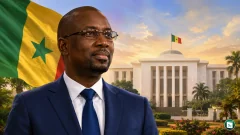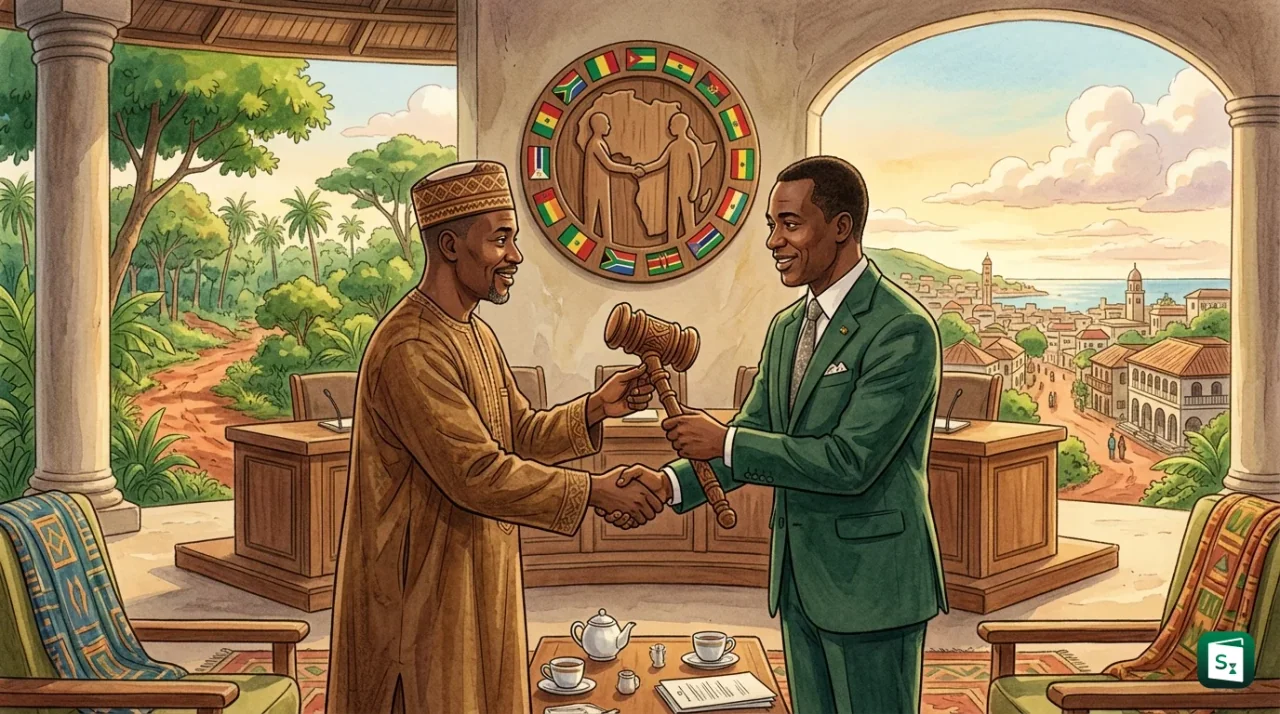
Senegal’s President Bassirou Diomaye Faye was unanimously elected the new Chairman of the Economic Community of West African States (ECOWAS) at the bloc’s 69th Ordinary Session of the Authority of Heads of State and Government held on July 19, 2026 in Lungi, near Freetown, Sierra Leone. He succeeds Sierra Leone’s President Julius Maada Bio and will serve a one-year rotational term. At 46, Faye is among the youngest leaders ever to chair the 15-member regional bloc, inheriting a mandate complicated by the recent withdrawal of three Sahel nations and persistent terrorist threats across the region.
What Is ECOWAS?
The Economic Community of West African States (ECOWAS), known by its French acronym CEDEAO, is a regional political and economic union of 15 West African countries. It was established on May 28, 1975 with the signing of the Treaty of Lagos in Lagos, Nigeria. The founding members were Benin, Burkina Faso, Cote d’Ivoire, Gambia, Ghana, Guinea, Guinea-Bissau, Liberia, Mali, Mauritania, Niger, Nigeria, Senegal, Sierra Leone, and Togo. Cape Verde joined later, while Mauritania withdrew in 2000.
The bloc’s headquarters is located in Abuja, Nigeria, and its three official working languages are English, French, and Portuguese. The Treaty of Lagos was revised in 1993 in Cotonou, Benin, to expand the community’s mandate beyond economic integration to include peace, security, and democratic governance.
Core Objectives of ECOWAS
The primary objectives include promoting economic cooperation and integration, creating a common market, establishing a monetary union, encouraging free movement of people, goods, and services, and maintaining regional peace and stability. The bloc has a zero-tolerance policy for unconstitutional changes of government, a principle backed by economic sanctions and suspensions enforced after military coups.
Institutional Structure
ECOWAS operates through several key institutions. The Authority of Heads of State and Government is the supreme decision-making body, chaired on a rotational basis by a member state president. The ECOWAS Commission, headquartered in Abuja, serves as the executive secretariat. Other institutions include the Community Parliament, the Community Court of Justice, and the ECOWAS Bank for Investment and Development (EBID).
Who Is Bassirou Diomaye Faye?
Bassirou Diomaye Diakhar Faye was born on March 25, 1980 in Ndiaganiao, a town in the Thies region of Senegal. He studied law at the Cheikh Anta Diop University of Dakar (UCAD) and later attended the National School of Administration (ENA) in Senegal, where he trained to become a tax inspector. Before entering politics, Faye served as a tax official in the Senegalese finance ministry.
Faye rose to political prominence as a close ally of opposition figure Ousmane Sonko. He was a key member of the PASTEF party (Patriots of Senegal for Work, Ethics and Fraternity), which was at one point dissolved by the government. In April 2023, Faye was arrested on charges including defamation and contempt of court, but was released from prison weeks before the presidential election under a general amnesty law.
In March 2024, Faye contested the presidential election and won with over 54% of the vote in the first round, becoming the fifth President of Senegal and taking office on April 2, 2024. At 44, he became Africa’s youngest democratically elected president. His victory was seen as a wave of youth-led political change in a country long dominated by established political dynasties.
The 69th Ordinary Session and the Election of Faye
The 69th Ordinary Session of the Authority of Heads of State and Government was held in Lungi, Sierra Leone, on July 19, 2026. The summit was preceded by the 96th Ordinary Session of the ECOWAS Council of Ministers on July 16 and 17 in Freetown, which prepared the agenda for the heads of state meeting.
At the summit, the heads of state unanimously elected President Bassirou Diomaye Faye as the new Chairman of the Authority, succeeding Sierra Leone’s President Julius Maada Bio. The chairmanship of ECOWAS rotates annually among member states, and Faye’s one-year term will run until the next summit in 2027.
The Lungi summit focused on several critical themes: the state of regional integration, the political and security situation in West Africa, institutional reform, the financial sustainability of the bloc, and relations with the three countries that announced their withdrawal from ECOWAS.
Appointment of a New Commission President
In a related development, Birame Diop, Senegal’s former Minister of the Armed Forces and former Chief of the General Staff of the Senegalese armed forces, was appointed as the President of the ECOWAS Commission for the 2026-2030 term. He will assume office on September 1, 2026 at the Commission headquarters in Abuja, Nigeria.
The Challenges Ahead for Faye’s Chairmanship
Faye assumes the ECOWAS chairmanship at a moment of immense strain for the bloc. The three most pressing challenges are the fallout from the Sahel withdrawals, the worsening terrorism threat, and the need for deep institutional and financial reform.
The Sahel Withdrawal and the AES Challenge
The most significant crisis facing ECOWAS is the formal withdrawal of Burkina Faso, Mali, and Niger from the bloc, which took effect on January 29, 2025. The three countries, all under military rule following successive coups, announced their intention to leave in January 2024 after ECOWAS imposed crippling sanctions on Niger following the July 2023 coup. Despite a year-long negotiation period, they followed through on their exit.
The departing nations have formed their own bloc, the Alliance of Sahel States (AES), and have begun circulating AES passports. Their withdrawal has diminished ECOWAS by 76 million people from its total population of about 446 million and has reduced the bloc’s geographical footprint by more than half. Importantly, the three countries are landlocked and their economies remain deeply tied to ECOWAS states, creating a complex web of unresolved trade, security, and migration issues.
Faye has signaled a conciliatory approach, urging the bloc to keep its doors open for the return of the three countries. He has emphasized the need for structured dialogue as opposed to confrontation.
The Terrorism Threat
West Africa, particularly the Sahel region, has become the global epicentre of terrorism. Faye himself described West Africa as “a region weakened by terrorism” during the summit. The Gulf of Guinea coastal states, including Senegal, face spillover violence from jihadist groups operating in the Sahel.
One of Faye’s key priorities is to operationalize ECOWAS’s regional counter-terrorism force and pool resources among member states to better protect communities affected by insecurity. This will require both political will and significant financial commitment from member states.
Institutional and Financial Reform
Faye has called for stronger financial autonomy for ECOWAS to reduce its dependence on external donors and member state contributions. The bloc needs to reform its institutional mechanisms to respond more swiftly to political crises and to enforce democratic norms without destabilizing entire economies through sanctions.
The new ECOWAS Commission headquarters in Abuja, inaugurated in July 2026, symbolizes the bloc’s institutional ambitions, but translating infrastructure into effective governance remains the real test.
Faye’s Vision for ECOWAS
During the summit, Faye described the regional economy as “resilient but still vulnerable” and stressed the need to accelerate regional integration to deliver tangible benefits to West African citizens. His vision focuses on three pillars: strengthening security cooperation, deepening economic integration through the customs union and free movement protocols, and reforming ECOWAS institutions to be more effective and financially self-reliant.
On the economic front, Faye has pushed for greater trade facilitation, regional infrastructure projects, and measures to improve household purchasing power across member states. His domestic agenda of economic reform and fiscal discipline is expected to shape his regional approach as ECOWAS chair.
Key Takeaways
- Bassirou Diomaye Faye, President of Senegal, was unanimously elected Chairman of ECOWAS at the 69th Ordinary Session in Lungi, Sierra Leone, for a one-year term.
- ECOWAS was established on May 28, 1975 through the Treaty of Lagos and has its headquarters in Abuja, Nigeria with English, French, and Portuguese as official languages.
- Faye succeeded Julius Maada Bio and took over a bloc facing the withdrawal of Burkina Faso, Mali, and Niger, which formed the Alliance of Sahel States (AES).
- Birame Diop, Senegal’s former Armed Forces Minister, was appointed President of the ECOWAS Commission for the 2026-2030 term, effective September 1, 2026.
- Faye, born March 25, 1980, is a former tax inspector who became Africa’s youngest democratically elected president in March 2024 after winning over 54% of the vote.