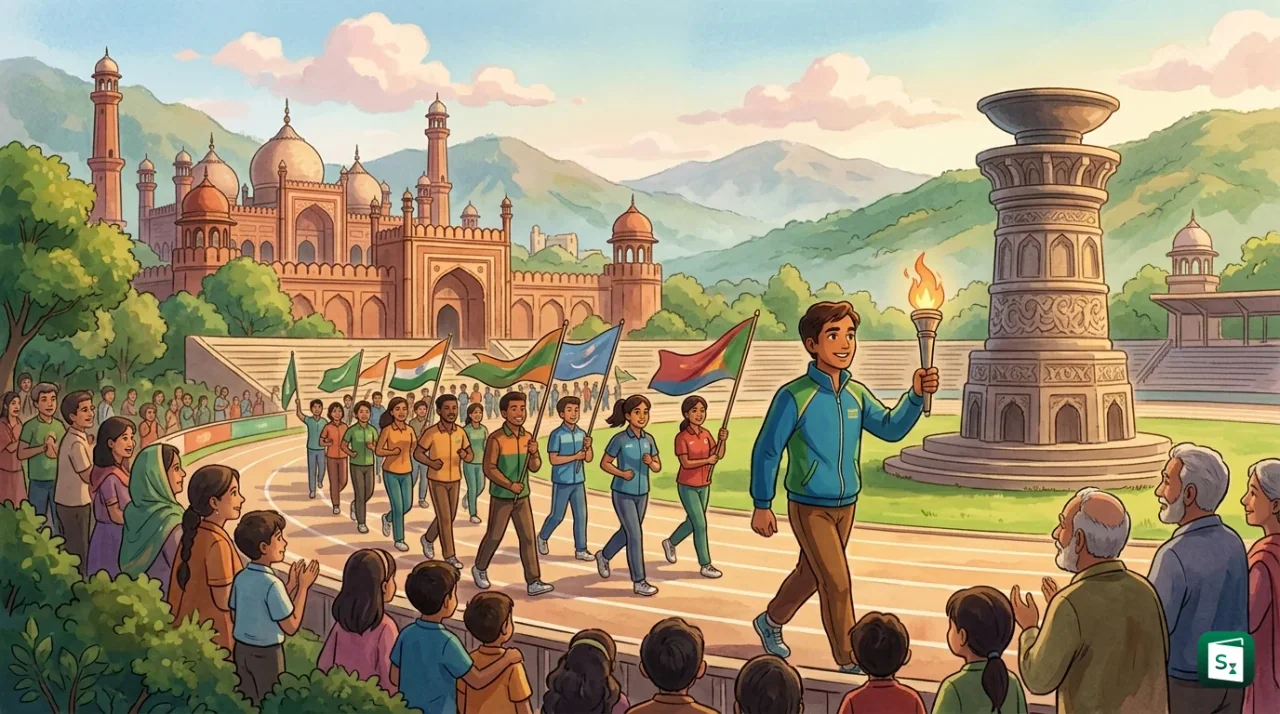
Pakistan will host the 14th edition of the South Asian Federation (SAF) Games in March 2027, marking the country’s return as the host of South Asia’s premier multi-sport event after a gap of over two decades. The Games, scheduled from 23 to 31 March 2027, will be held across three cities: Lahore, Islamabad, and Faisalabad. This edition gains added significance as it comes amid efforts to revitalise the South Asian Association for Regional Cooperation (SAARC), the regional bloc whose founding ideals of friendship and goodwill inspired the creation of the Games in 1981.
What Are the South Asian Games?
The South Asian Games (earlier called the South Asian Federation Games) are a quadrennial multi-sport event held among athletes from the member countries of the South Asian Association for Regional Cooperation (SAARC). The governing body for the Games is the South Asia Olympic Council (SAOC), which was formed in 1983.
The Games were conceived on 26 November 1981 in New Delhi to promote friendship, goodwill, and mutual understanding among the people of South Asia through sport. The first edition was held in Kathmandu, Nepal, in 1984 at the Dasharath Stadium. Seven countries participated with 373 athletes competing across five sports.
SAARC itself was formally established later, in 1985, with its charter signed in Dhaka. The organisation’s secretariat is based in Kathmandu, Nepal. The original seven founding members were Bangladesh, Bhutan, India, Maldives, Nepal, Pakistan, and Sri Lanka. Afghanistan joined as the eighth member in 2007 and participated in four editions of the Games before leaving the SAOC after the 2016 edition.
The Games were officially renamed from the South Asian Federation Games to the South Asian Games in 2004, a change adopted by the South Asian Sports Council to make the event more accessible to spectators. The motto of the Games is Peace, Perseverance and Progress.
The South Asian Games is one of five subregional Games under the Olympic Council of Asia (OCA). The other four are the Central Asian Games, East Asian Youth Games, Southeast Asian Games, and West Asian Games.
The 2027 Edition: Venues and Key Details
The 14th South Asian Games will be hosted by Pakistan for the third time, following the 1989 edition in Islamabad and the 2004 edition also in Islamabad. This time, the Games will spread across three cities: Lahore, Islamabad, and Faisalabad.
| Aspect | Details |
|---|---|
| Edition | XIV (14th) South Asian Games |
| Dates | 23 to 31 March 2027 |
| Host Nation | Pakistan |
| Host Cities | Lahore, Islamabad, Faisalabad |
| Expected Nations | 7 (Afghanistan is no longer a SAOC member) |
| Total Sports | 38 events across 27 sport disciplines |
| Debut Sports | Diving, water polo, chess, esports, lacrosse, gymnastics, cycling, equestrian, baseball, and cue sports |
| Main Venues | Punjab Stadium (Lahore), Jinnah Sports Stadium (Islamabad) |
| Government Allocation | Over ₹11 billion (Pakistan Rupees) approved for infrastructure |
The participating nations are expected to be Bangladesh, Bhutan, India, Maldives, Nepal, Pakistan, and Sri Lanka. Afghanistan, which had participated from 2004 to 2016, will not take part as it is no longer affiliated with the South Asia Olympic Council.
The Games were originally slated for March 2023 but faced multiple postponements due to infrastructural and administrative challenges before being finalised for March 2027. The Pakistan government has approved substantial funding for stadium upgrades and athlete facilities across the three host cities.
A notable feature of the 2027 edition is the introduction of several new sports, including esports, chess, gymnastics, cycling, equestrian, lacrosse, and cue sports (billiards and snooker). The inclusion of esports reflects a global trend of recognising competitive video gaming as a legitimate sport discipline.
Past Editions at a Glance
Since the inaugural Games in Kathmandu, 1984, the SAF Games have been hosted by every member nation at least once. India has hosted the event on three occasions: Calcutta (1987), Madras (1995), and Guwahati and Shillong (2016). Pakistan previously hosted in Islamabad (1989 and 2004).
| Edition | Year | Host City (Country) | Top Nation |
|---|---|---|---|
| I | 1984 | Kathmandu (Nepal) | India |
| II | 1985 | Dhaka (Bangladesh) | India |
| III | 1987 | Calcutta (India) | India |
| IV | 1989 | Islamabad (Pakistan) | India |
| V | 1991 | Colombo (Sri Lanka) | India |
| VI | 1993 | Dhaka (Bangladesh) | India |
| VII | 1995 | Madras (India) | India |
| VIII | 1999 | Kathmandu (Nepal) | India |
| IX | 2004 | Islamabad (Pakistan) | India |
| X | 2006 | Colombo (Sri Lanka) | India |
| XI | 2010 | Dhaka (Bangladesh) | India |
| XII | 2016 | Guwahati and Shillong (India) | India |
| XIII | 2019 | Kathmandu and Pokhara (Nepal) | India |
| XIV | 2027 | Lahore, Islamabad and Faisalabad (Pakistan) | TBD |
The most recent edition, the 13th South Asian Games, was held in Kathmandu and Pokhara, Nepal, from 1 to 10 December 2019. It featured 26 sports with 317 events and was the largest edition at that time in terms of disciplines offered.
India’s Dominance in the SAF Games
India has topped the medal tally in every single edition of the South Asian Games since the Games began in 1984. This is an unmatched record of consistency in regional multi-sport events anywhere in the world.
Across all 13 editions, India has won a total of 1,263 gold medals, 736 silver medals, and 379 bronze medals (2,378 total). To put this in perspective, India’s gold medal count alone is higher than the total medals of every other participating nation.
| Rank | Nation | Gold | Silver | Bronze | Total |
|---|---|---|---|---|---|
| 1 | India | 1,263 | 736 | 379 | 2,378 |
| 2 | Pakistan | 297 | 422 | 436 | 1,155 |
| 3 | Sri Lanka | 250 | 436 | 681 | 1,367 |
| 4 | Nepal | 124 | 186 | 380 | 690 |
| 5 | Bangladesh | 86 | 210 | 493 | 789 |
| 6 | Bhutan | 2 | 23 | 66 | 91 |
| 7 | Maldives | 1 | 3 | 13 | 17 |
At the 2019 edition, India set a new record with 312 medals (174 gold, 93 silver, 45 bronze), surpassing its own previous record of 309 medals set in the 2016 edition in Guwahati and Shillong. India remains the only nation to have crossed the 300-medal mark in a single edition of the Games.
Significance for Regional Cooperation
The decision to host the 14th SAF Games in Pakistan comes at a time when SAARC as an organisation has been largely inactive. The last SAARC summit was held in Kathmandu in 2014, and no summit has been convened since. Bilateral tensions between key member states have stalled the usual rhythm of regional dialogue.
Pakistan’s Deputy Prime Minister and Foreign Minister, Muhammad Ishaq Dar, framed the hosting of the Games as part of a broader effort to revitalise SAARC. During a meeting with the outgoing SAARC Secretary General, Ambassador Golam Sarwar of Bangladesh, Dar emphasised that robust regional partnerships are vital for socio-economic development, enhanced trade connectivity, and poverty alleviation across South Asia’s two billion people.
The Games serve as a Track II diplomacy initiative where sports provide a platform for people-to-people contact even when formal diplomatic channels face strain. Historically, the SAF Games have been credited with promoting cultural exchanges between member countries, cutting across cultural, religious, and political barriers. The federation’s hymn carries the message: “Sports is our life, Unity our strength, Our skills shine through perseverance.”
Sporting events of this nature also generate economic activity through tourism, infrastructure development, and job creation. Pakistan’s allocation of over ₹11 billion for stadium upgrades and related infrastructure is expected to leave a lasting sporting legacy in the host cities.
Key Takeaways
- Pakistan will host the 14th South Asian Games from 23 to 31 March 2027 across Lahore, Islamabad, and Faisalabad.
- The Games were established on 26 November 1981 in New Delhi to promote goodwill among SAARC member countries.
- The South Asia Olympic Council (SAOC), formed in 1983, governs the Games. The first edition was held in Kathmandu in 1984.
- India has topped the medal tally in all 13 editions of the Games, winning 1,263 gold medals in total.
- The 2027 edition will feature 38 events across 27 sport disciplines, including debut sports like esports, chess, gymnastics, and cycling.
- The Games serve as a platform for regional cooperation through sport, especially at a time when SAARC summits have been stalled since 2014.