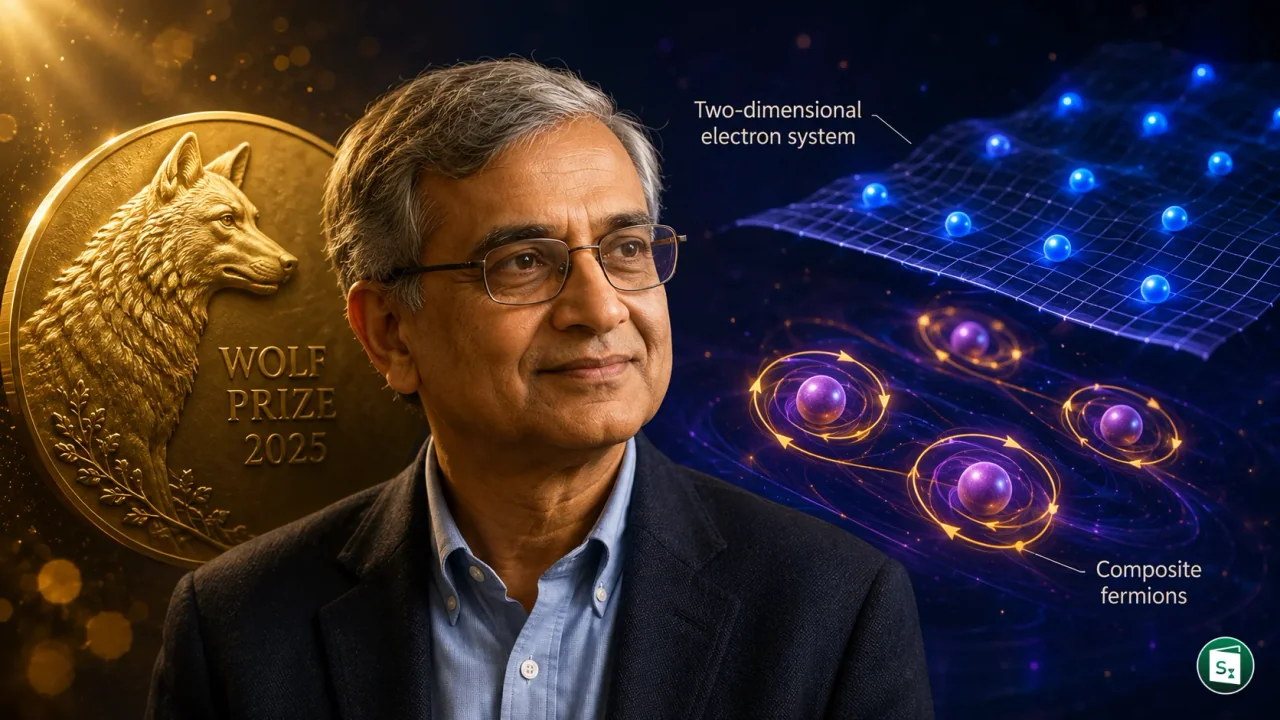
Indian-born theoretical physicist Dr. Jainendra K. Jain has been awarded the prestigious Wolf Prize in Physics for 2025 in recognition of his landmark 1989 discovery of composite fermions. Dr. Jain shared the award with experimental physicists Dr. James P. Eisenstein from the United States and Dr. Mordehai Heiblum from Israel. This recognition makes him the first Indian-born theoretical physicist to receive the honour, highlighting India’s contribution to global research in quantum physics.
Who Is Dr. Jainendra K. Jain?
Dr. Jainendra K. Jain was born on January 17, 1960, in Sambhar, a rural village in Rajasthan, India. Despite growing up in a region with limited educational resources, he pursued his interest in science. In his childhood, he suffered an accident resulting in the loss of a foot. He has frequently credited the Jaipur Foot, a low-cost prosthetic limb developed in Rajasthan, with helping him retain mobility to pursue his studies.
Dr. Jain completed his undergraduate education at Maharaja College, Jaipur, in 1979. He later moved to the Indian Institute of Technology (IIT) Kanpur for his Master of Science degree in Physics, which he received in 1981. In the same year, he moved to the United States and earned his doctorate in physics from Stony Brook University in 1985.
Currently, Dr. Jain is the Evan Pugh University Professor and the Eberly Family Chair in Physics at Pennsylvania State University. He also serves as the Founding Director of the Lodha Theoretical Physics Institute in Mumbai. Over his career, he has received numerous accolades, including the Oliver E. Buckley Condensed Matter Physics Prize from the American Physical Society in 2002. He is also an elected member of the US National Academy of Sciences and a Fellow of the American Academy of Arts and Sciences.
The 2025 Wolf Prize in Physics
The Wolf Prize is a highly prestigious international award presented annually in Israel. The Wolf Foundation announced the 2025 laureates on March 10, 2025. The laureates officially received their awards from Israeli President Isaac Herzog at a state ceremony held at the Knesset in Jerusalem on June 18, 2026.
The Physics category award was jointly presented to Dr. Jain, Dr. Eisenstein, and Dr. Heiblum for their contributions to the study of two-dimensional electron systems and composite fermions. The award carries a diploma and a cash prize of $100,000, which will be shared among the three recipients.
The Co-Recipients
The prize was shared with two other eminent physicists who contributed experimental breakthroughs:
- Dr. James P. Eisenstein: An experimental physicist from the United States, Dr. Eisenstein is a professor at the California Institute of Technology. He is recognised for his experiments on strongly interacting two-dimensional electron systems. He was a co-discoverer of the 5/2 fractional quantum Hall state and demonstrated exciton condensation in bilayer electron systems.
- Dr. Mordehai Heiblum: An experimental physicist from Israel, Dr. Heiblum is a professor at the Weizmann Institute of Science. He is celebrated for developing ultra-pure materials and electronic interferometers. His experiments provided concrete evidence for fractional charge carrying quasiparticles and neutral modes in two-dimensional systems.
Understanding Composite Fermions and the Fractional Quantum Hall Effect
To understand Dr. Jain’s discovery, one must look at the behavior of electrons in restricted dimensions. When electrons are confined to a two-dimensional plane, cooled to temperatures near absolute zero, and subjected to extremely strong magnetic fields, they interact intensely with one another. This gives rise to the fractional quantum Hall effect (FQHE), a quantum mechanical phenomenon where the electrical conductance of the system becomes quantized at fractional values of fundamental constants.
Initially, explaining the fractional quantum Hall effect was extremely difficult due to the complex, strongly interacting nature of the electrons. In 1989, Dr. Jain proposed a revolutionary theory: instead of trying to track individual, strongly interacting electrons, the system could be viewed through a new type of particle called a composite fermion.
A composite fermion is formed when an electron binds with an even number of magnetic flux quanta (the basic unit of magnetic field lines). The binding of these flux quanta shields the electron from the strong external magnetic field. As a result, the strongly interacting electrons behave as weakly interacting composite fermions. This elegant formulation mapped the highly complex fractional quantum Hall effect of electrons to the simpler, well-understood integer quantum Hall effect (IQHE) of composite fermions.
Analogy · Understanding Composite Fermions Expand analogy
Imagine a crowded room where people are pushing against one another, making it extremely difficult to track their movement. If each person is given a large, protective personal bubble, they no longer bump into each other directly. Instead, they move smoothly past one another. The composite fermion acts like an electron inside a protective magnetic bubble, simplifying the study of its behavior.
Significance of the Discovery in Modern Physics
Dr. Jain’s composite fermion model provided an elegant and unifying explanation for the fractional quantum Hall effect, which had puzzled condensed matter physicists since its discovery in 1982 by Robert Laughlin, Horst Störmer, and Daniel Tsui, who were awarded the Nobel Prize in Physics in 1998. Dr. Jain’s work introduced the concept of “Jain sequences” to identify the fractional values at which quantum Hall states occur.
The theory also laid the groundwork for research in topological quantum computing. The exotic quasiparticles emerging from two-dimensional electron systems are neither standard bosons nor fermions, but anyons. These particles exhibit fractional statistics and have potential applications in building fault-tolerant quantum computers. The experimental confirmation of these fractional states and their properties by Dr. Eisenstein and Dr. Heiblum has solidified the composite fermion model as a cornerstone of modern condensed matter physics.
The Wolf Foundation and the Prize Legacy
The Wolf Prize was established by the Wolf Foundation, which was founded in 1976 by Dr. Ricardo Wolf, a German-born inventor and diplomat who served as Cuba’s ambassador to Israel, and his wife, Francisca Subirana-Wolf. The first Wolf Prizes were awarded in 1978. The foundation recognises achievements in six fields: Agriculture, Chemistry, Mathematics, Medicine, Physics, and the Arts. The arts prize rotates annually between Architecture, Music, Painting, and Sculpture.
Historically, the Wolf Prize has been considered one of the most prestigious honours in the natural sciences and arts, often regarded as second only to the Nobel Prize in prestige. Many Wolf Prize laureates in physics, chemistry, and medicine have gone on to receive Nobel Prizes in their respective fields.
Key Takeaways
- Dr. Jainendra K. Jain has been awarded the 2025 Wolf Prize in Physics, making him the first Indian-born theoretical physicist to receive the honour.
- The prize was shared with Dr. James P. Eisenstein (USA) and Dr. Mordehai Heiblum (Israel) for their pioneering contributions to the study of two-dimensional electron systems and composite fermions.
- Dr. Jain is widely recognized for his 1989 discovery of composite fermions, which mapped the fractional quantum Hall effect of electrons to the integer quantum Hall effect.
- The Wolf Foundation was founded in 1976 by Dr. Ricardo Wolf and his wife, Francisca Subirana-Wolf, with the first prizes awarded in 1978.
- Each category of the Wolf Prize carries a diploma and a cash prize of $100,000, with the awards presented by the President of Israel at the Knesset in Jerusalem.