The Indian Air Force has retained the third spot among the world’s air forces for the fifth consecutive year in the WDMMA 2026 Global Air Power Rankings, staying ahead of China’s larger air fleet. Only the United States and Russia rank above the IAF in the assessment, which evaluates 129 air services across 103 countries. The ranking underscores that fleet quality, not just quantity, determines true air power.
What Is the WDMMA Global Air Power Ranking?
The World Directory of Modern Military Aircraft (WDMMA) is an independent online analytical platform that tracks, evaluates, and maps the strengths and weaknesses of military aviation worldwide. Its annual Global Air Power Rankings assess 129 air services across 103 countries, covering over 48,000 military aircraft in total. These services include not just independent air forces but also the aviation branches of armies, navies, and marine corps where applicable.
WDMMA separates military aviation branches rather than combining them into a single national score. This means the United States, for instance, has four entries in the top five: the US Air Force, US Navy, US Army, and US Marine Corps are evaluated independently. The rankings are designed for defence analysts, researchers, and media outlets seeking a comparative view of global air power.
How the True Value Rating System Works
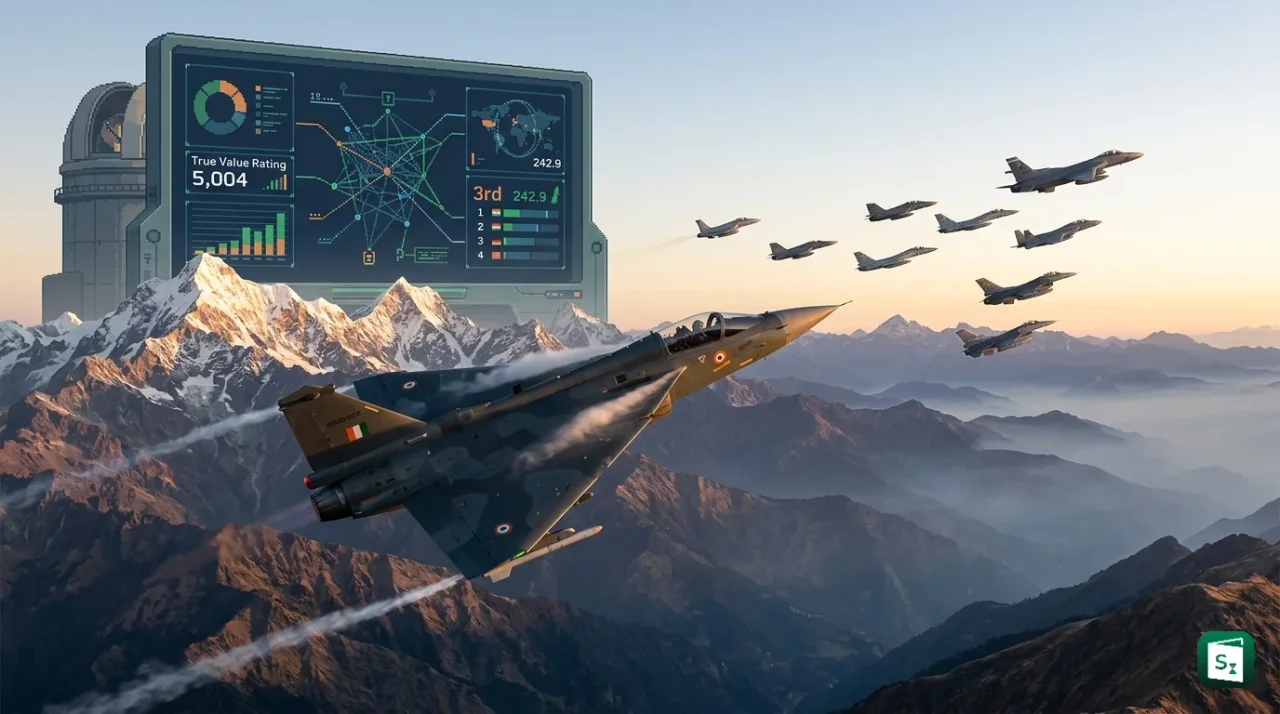
WDMMA uses a proprietary metric called the True Value Rating (TVR) to rank air services. Unlike rankings that rely purely on fleet size, TVR measures the overall fighting capability of an air arm by factoring in multiple qualitative and quantitative parameters.
The TVR formula considers aircraft mix, technological sophistication, modernisation levels, logistical support, and overall operational capability. Greater weight is given to categories often overlooked by simple fleet counts: special-mission aircraft (airborne early warning, intelligence gathering, aerial refuelling), dedicated bomber forces, close air support platforms, training units, and aircraft on order. The system also factors in a country’s local aerospace industry capabilities, inventory balance across different mission types, and operational experience.
This methodology explains why an air force with fewer aircraft can rank higher than one with a larger fleet. The highest attainable TVR score is 242.9, held by the United States Air Force, which combines a massive 5,004 aircraft fleet with an unmatched mix of strategic bombers, fighters, tankers, transports, and special-mission platforms backed by a robust domestic industrial base.
IAF Fleet: Composition and Strength
The IAF currently operates 1,716 aircraft in its active inventory, making it one of the largest air forces in the world by fleet size. Its combat arm consists of 542 fighter and attack aircraft spread across seven different types, ranging from the Russian-origin Su-30MKI to the indigenous Tejas and the French Rafale.
| Category | Count | Share of Fleet |
|---|---|---|
| Combat and Attack Aircraft | 542 | 31.6% |
| Helicopters | 498 | 29% |
| Trainer Aircraft | 374 | 21.8% |
| Transport Aircraft | 282 | 16.4% |
| Special Mission Aircraft | 20 | 1.2% |
The Su-30MKI forms the backbone of the IAF with roughly 260 aircraft across 12 squadrons. Built under licence by Hindustan Aeronautics Limited (HAL) at Nashik, it is a 4.5-generation twin-engine heavy fighter capable of carrying BrahMos cruise missiles and Astra beyond-visual-range air-to-air missiles. The IAF also operates 36 Rafale jets in two squadrons, acquired through a 2016 inter-governmental agreement with France. These aircraft provide a qualitative edge in electronic warfare and precision strike.
India’s indigenous fighter programme is represented by the Tejas Light Combat Aircraft. The IAF operates 40 Tejas Mk1 aircraft in two squadrons and has placed orders for 180 Tejas Mk1A fighters across two tranches (83 in 2021 and 97 in 2025). The Mk1A variant features an indigenous AESA radar, advanced electronic warfare suite, and beyond-visual-range missile capability. Legacy fleets include the MiG-29UPG (roughly 65 aircraft), Mirage 2000I (around 40 aircraft), and the SEPECAT Jaguar (around 120 aircraft, being phased out).
The helicopter fleet is led by 222 Mi-17 transport helicopters and 111 indigenously built HAL Dhruv and Rudra platforms. The IAF also operates 282 transport aircraft, including the American C-17 Globemaster and C-130J Super Hercules, alongside the newly inducted Airbus C-295. Twenty special mission aircraft handle airborne early warning, intelligence gathering, and mid-air refuelling tasks that extend the IAF’s operational reach.
Why India Outranks China
The most striking aspect of the 2026 rankings is that the IAF sits above the People’s Liberation Army Air Force (PLAAF) despite China operating more than double the number of aircraft. The PLAAF has 3,733 aircraft compared to India’s 1,716, yet its TVR of 63.8 trails India’s 69.4. This marks the fifth consecutive year that India has held this position.
The TVR system rewards several factors where India has an edge over China. First, the IAF benefits from a diverse supplier base that includes Russian, French, American, and indigenous platforms, giving it access to a wide range of technologies and operational doctrines. Second, the IAF’s operational experience through regular exercises, combat operations, and high-altitude deployments in regions like Ladakh adds to its force experience score. Third, India’s domestic aerospace industry, centred around HAL and increasingly the private sector, contributes to the local aero-industry capability metric that WDMMA factors into its ratings.
China’s PLAAF, while numerically superior and rapidly modernising with platforms like the J-20 stealth fighter, is assessed as having gaps in operational experience, engine technology maturity, and certain special-mission capabilities. The TVR system gives greater weight to balanced fleets with diverse mission capabilities rather than raw numbers alone.
The Top 10 at a Glance
The table below shows the top 10 entries in the 2026 WDMMA Global Air Power Rankings, which include individual US service branches ranked separately.
| Rank | Air Arm | Aircraft | TVR |
|---|---|---|---|
| 1 | US Air Force | 5,004 | 242.9 |
| 2 | US Navy | 2,504 | 142.4 |
| 3 | Russian Air Force | 3,677 | 114.2 |
| 4 | US Army | 4,333 | 112.6 |
| 5 | US Marine Corps | 1,211 | 85.3 |
| 6 | Indian Air Force | 1,716 | 69.4 |
| 7 | Chinese Air Force | 3,733 | 63.8 |
| 8 | Japan Air Self-Defense Force | 756 | 58.1 |
| 9 | Israeli Air Force | 581 | 56.3 |
| 10 | French Air Force | 511 | 55.3 |
Among independent air forces (excluding the separately ranked army, navy, and marine arms of the US), the IAF stands third globally behind the US Air Force and the Russian Air Force. The Pakistan Air Force was ranked 18th with a TVR of 46.3 and 879 aircraft. India’s naval aviation arm was placed 27th (232 aircraft, TVR 41.2), while the Indian Army’s aviation wing ranked 36th (540 aircraft, TVR 30.0).
Challenges: The Fighter Squadron Gap
Despite its high global ranking, the IAF faces a significant structural challenge: a severe shortage of fighter squadrons. The IAF has a sanctioned strength of 42 fighter squadrons but currently operates only 29 squadrons, the lowest level since the 1960s. Each squadron typically comprises 16 to 18 aircraft. This means the IAF is short by roughly 200 to 230 combat aircraft against its authorised strength.
The squadron strength has declined steadily from a peak of 41 squadrons in 1996 due to the retirement of older platforms like the MiG-21, MiG-27, and the upcoming phase-out of the Jaguar, Mirage 2000, and MiG-29 fleets. The retirement of the last MiG-21 Bison squadrons in September 2025 pushed numbers to historic lows. Meanwhile, induction of new aircraft has not kept pace with retirements.
This gap has strategic implications. China’s PLAAF operates approximately 66 fighter squadrons, giving it a numerical advantage of more than two to one over the IAF. The Pakistan Air Force fields around 25 squadrons, making the IAF’s numerical edge on the western front relatively thin. In a two-front scenario, the squadron deficit becomes a critical vulnerability.
The Ministry of Defence has appointed an Empowered Committee for Capability Enhancement of IAF to analyse and recommend measures to address this shortfall.
Modernisation Plans
The IAF has multiple procurement programmes underway that are expected to significantly boost its combat strength in the coming decade.
The most immediate addition is the Tejas Mk1A programme. The IAF has contracted 180 aircraft from HAL in two tranches, with deliveries ongoing. The Mk1A features an indigenous AESA radar, an advanced electronic warfare suite, and improved maintainability. HAL has opened an additional production line at Nashik to accelerate delivery to the target rate of 24 aircraft per year.
The Multi-Role Fighter Aircraft (MRFA) programme aims to acquire 114 new fighters through an open international tender estimated at over $20 billion. Contenders include the French Rafale, US F-15EX and F-21, Eurofighter Typhoon, Saab Gripen E, and Russian Su-35 and MiG-35. A decision on the winner is expected to determine the IAF’s fighter profile for the next three decades.
The Su-30MKI fleet, the IAF’s largest and most capable platform, is undergoing a mid-life upgrade dubbed the Super Sukhoi programme. This will equip the aircraft with new radars, electronic warfare systems, and mission computers to keep them relevant through the 2040s. India also plans to induct additional Su-30MKIs.
India’s fifth-generation fighter programme, the Advanced Medium Combat Aircraft (AMCA), is in the design and prototyping phase. The twin-engine stealth fighter is expected to have its first flight in the early 2030s and enter serial production by the mid-2030s. The AMCA will eventually replace the Mirage 2000 and Jaguar fleets and operate alongside the Su-30MKI and Rafale.
Beyond fighters, the IAF is also modernising its force multipliers. New airborne early warning and control aircraft, mid-air refuelling tankers, and additional C-295 transport aircraft are being procured to address critical gaps in reconnaissance, logistics, and aerial sustainment.
Key Takeaways
- The Indian Air Force was ranked 3rd among independent air forces globally and 6th overall in the WDMMA 2026 Global Air Power Rankings.
- The ranking uses the True Value Rating (TVR) system, which assesses fleet quality, balance, modernisation, logistics, and operational capability, not just aircraft numbers.
- The IAF achieved a TVR of 69.4 with 1,716 aircraft, ahead of China’s PLAAF which scored 63.8 despite operating 3,733 aircraft. This is the fifth consecutive year India has ranked above China.
- The IAF operates 542 combat and attack aircraft across seven different types, with the Su-30MKI (roughly 260 units) as its backbone and Rafale (36 units) as its most advanced platform.
- Despite the high global ranking, the IAF faces a critical shortage with only 29 fighter squadrons against a sanctioned strength of 42 squadrons.
- Key modernisation programmes include 180 Tejas Mk1A fighters from HAL, the MRFA for 114 new fighters, and the indigenous AMCA fifth-generation fighter programme.