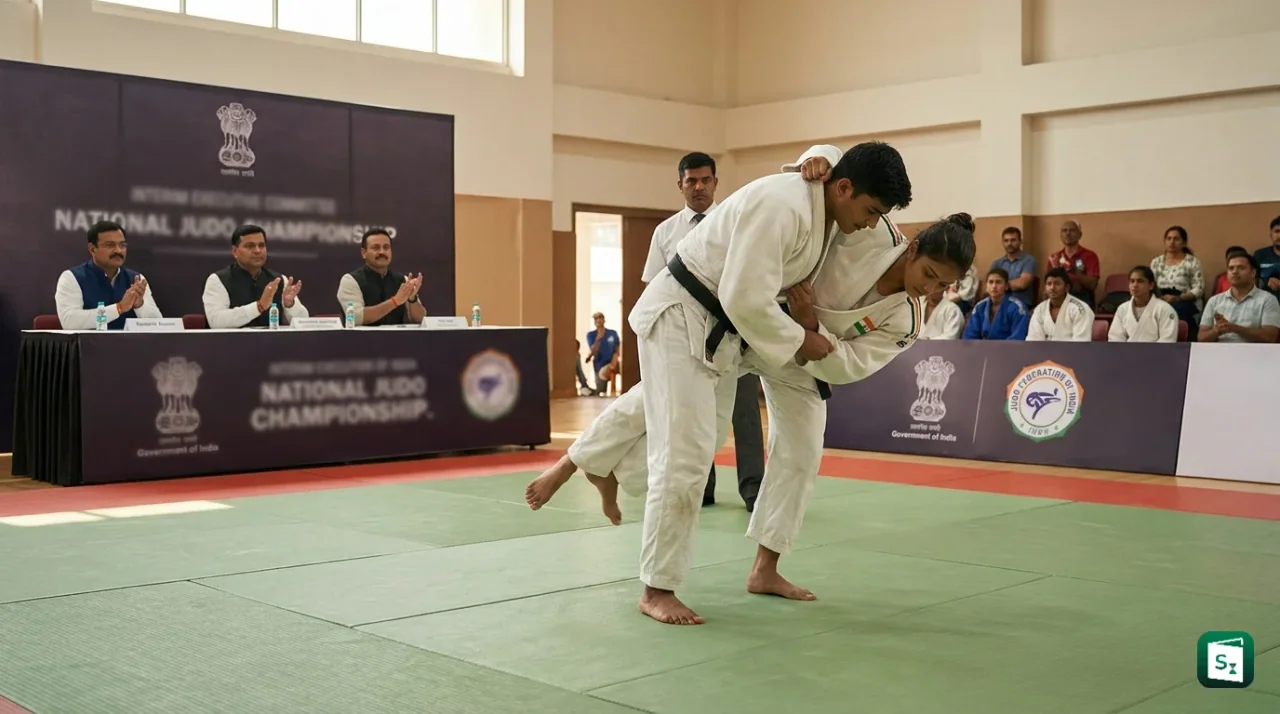
The Ministry of Youth Affairs and Sports (MYAS) has granted conditional recognition to the interim Executive Committee of the Judo Federation of India (JFI), ending more than four years of administrative uncertainty under a court-appointed administrator. The recognition, issued with immediate effect, restores the JFI’s status as the sport’s recognised National Sports Federation (NSF) and allows it to conduct national championships, select athletes, and coordinate international participation. The decision comes at a crucial time with the Commonwealth Games in Glasgow and the Asian Games both scheduled for later this year.
The Judo Federation of India: Role and Background
The Judo Federation of India (JFI) is the national governing body for the sport of judo in India. It was established in 1965 and received affiliation from the International Judo Federation (IJF) in the same year. The JFI is also affiliated with the Judo Union of Asia (JUA) and is headquartered at Jagatpuri in New Delhi.
The JFI organised the first National Judo Championship in Hyderabad in 1966. India made its international debut in judo at the 1986 Asian Games in Seoul, where the sport was included for the first time. Indian judokas won four bronze medals at that edition. Over the years, India has won a total of 5 bronze medals at the Asian Games and 11 medals (5 silver, 6 bronze) at the Commonwealth Games in judo. India is yet to win a gold medal in judo at either event. Notable Indian judokas include Tulika Maan and Sushila Devi Likmabam, both silver medallists at the 2022 Commonwealth Games in Birmingham.
The Governance Crisis: Court-Appointed Administrator Since 2022
The JFI has been mired in governance disputes for several years, leading to a breakdown in its administration. In June 2022, the Delhi High Court appointed an administrator to oversee the federation’s day-to-day affairs. Retired Allahabad High Court judge Justice Pankaj Naqvi was appointed as the administrator following an order passed on 2 June 2022.
For more than three years, the JFI operated under this arrangement without a duly elected executive committee or a constitution aligned with current legal requirements. This prolonged period of administrative limbo created serious challenges for the sport. National championships faced uncertainty, athlete selection for international events became complicated, and the JFI’s ability to receive government support was hampered. The situation also raised concerns about India’s representation in international judo events organised by the IJF and the JUA.
The National Sports Governance Act, 2025 and the Delhi HC Order
The turning point came with the enactment of the National Sports Governance Act, 2025 (NSG Act). The Act was passed by Parliament and received the assent of the President in August 2025. Key provisions of the Act came into effect from 1 January 2026. The NSG Act is a landmark legislation designed to bring transparency, accountability, and professionalism to the administration of sports in India.
Among its key provisions, the Act establishes a National Sports Board (NSB) as the apex oversight body for all recognised sports organisations. It creates a National Sports Tribunal (NST) for dispute resolution. It mandates that executive committees of National Sports Federations be limited to 15 members, with at least two Sportspersons of Merit (SOM) and four women members. It also brings recognised sports organisations under the ambit of the Right to Information Act, 2005.
In February 2026, the Delhi High Court issued a critical ruling directing the JFI administrator to call an Annual General Meeting and align the federation’s constitution with the NSG Act. The court ordered the General Body to elect an interim executive committee that would take charge from the administrator and oversee the transition to full compliance with the new legal framework.
The Interim Executive Committee: New Leadership
Following the Delhi High Court’s directions, the JFI held its elections in June 2026 and elected an interim Executive Committee. The committee is led by veteran sports administrator Mukesh Kumar as President. Kumar is a former official of the Sports Authority of India (SAI) and had previously served as the JFI’s General Secretary for more than a decade. Banee Brata Das from Assam was elected as Secretary General, and Shailesh Shrikant Tilak from Maharashtra as Treasurer.
The interim committee also includes four Vice Presidents (Aaesha Munawar, Manisha Malhotra, Ronnie Rosangavart, and Devi Shree Kadampatil) and four Joint Secretaries. In line with the NSG Act’s requirements, former Commonwealth Games medallists L Sushila Devi and Akram Shah were elected as Sportspersons of Merit. Manisha Malhotra, a former tennis player who won a medal at the Busan Asian Games and is the president of the Inspire Institute of Sport, also joined the committee.
One of the first decisions of the new committee was to reduce the annual registration fees for athletes from ₹1,000 to ₹500 and for officials from ₹3,000 to ₹1,000, effective from 1 July 2026.
What the Conditional Recognition Means
The MYAS recognition order, issued in July 2026, restores the JFI’s status as the recognised national governing body for judo. However, the recognition is conditional on several strict requirements.
First, the recognition remains subject to the outcome of the ongoing court cases concerning the JFI elections that are pending before the Delhi High Court and other courts. Second, the interim body must mandatorily amend the JFI constitution to bring it in full conformity with the NSG Act and the rules framed under it, within the timeline set by the Delhi High Court’s 12 February 2026 order. Third, the JFI must submit monthly compliance reports to the Ministry detailing progress in implementing the court’s directions. Fourth, the interim body must conduct elections for a final Executive Committee as directed by the court.
The Ministry has warned that any default or gross irregularities on the part of the interim body could lead to the suspension or revocation of the recognition. The JFI has also been directed to align its operations with the principles of transparency and accountability at all times.
With this recognition, the JFI can now carry out all functions of an NSF, including organising national competitions, conducting selection trials, coordinating with the IJF and JUA, and facilitating India’s participation in international events. It also becomes eligible to receive government funding and support.
Significance Ahead of the Commonwealth and Asian Games
The timing of the recognition is especially significant. The 2026 Commonwealth Games are scheduled to be held in Glasgow, Scotland, and the Asian Games later in the year. Both events are among the most important multi-sport competitions for Indian athletes. A functioning and recognised federation is essential for finalising athlete selections, sending entries, coordinating with the Indian Olympic Association (IOA), and ensuring that Indian judokas can compete under the national flag.
India has a mixed record in judo at these events. At the 2022 Commonwealth Games in Birmingham, India won 2 silver medals (Sushila Devi Likmabam in women’s 48kg and Tulika Maan in women’s +78kg) and 1 bronze (Vijay Kumar Yadav in men’s 60kg). At the 2023 Asian Games in Hangzhou, India won 4 bronze medals. The new JFI leadership has stated that preparing for these two major events is its top priority.
The conditional recognition also reflects the government’s broader push to reform sports governance in India. Multiple national sports federations have faced administrative disputes in recent years, and the NSG Act provides a legal framework to address these issues. The JFI’s case is being watched closely as a test case for how the government and courts can work together to restore stability in sports administration.
Key Takeaways
- The Ministry of Youth Affairs and Sports (MYAS) granted conditional recognition to the Judo Federation of India (JFI) in July 2026, restoring its status as a National Sports Federation.
- The JFI had been under a court-appointed administrator since June 2022, when retired Justice Pankaj Naqvi was appointed by the Delhi High Court.
- An interim Executive Committee was elected in June 2026 with Mukesh Kumar as President, Banee Brata Das as Secretary General, and Shailesh Shrikant Tilak as Treasurer.
- The recognition is conditional on compliance with the National Sports Governance Act, 2025, which came into partial effect on 1 January 2026.
- The JFI must submit monthly compliance reports to the Ministry and amend its constitution to align with the NSG Act, failing which recognition may be revoked.
- The 2026 Commonwealth Games in Glasgow and the Asian Games are the immediate major events for which the JFI must coordinate India’s participation.
- India has won 11 medals in judo at the Commonwealth Games (5 silver, 6 bronze) and 5 bronze medals at the Asian Games, but is yet to win a gold in either competition.