Meghalaya Chief Minister Conrad K Sangma inaugurated a Centre of Excellence for Eri Silk Weaving at the Integrated Textile Tourism Complex (ITTC) in Ri Sai, Nongpoh, on August 14, 2026. The facility, designed to preserve and promote the traditional skills of Eri weaving for future generations, was inaugurated as part of the 12th National Handloom Day celebrations and the culmination of National Handloom Week. The centre brings together training, design, tourism, and retail under one roof to strengthen Meghalaya’s indigenous textile heritage.
What Is Eri Silk (Ryndia)?
Eri Silk, known locally as Ryndia, is a handwoven fabric produced from the silk of the Eri silkworm (Samia cynthia ricini). Unlike conventional silk production, Eri silk extraction does not kill the silkworm. The mature moth is allowed to emerge naturally from the cocoon before the silk is harvested. This non-violent method has earned it the name “Peace Silk” or “Ahimsa Silk”. The name “Ryndia” comes from the Khasi word for the ryndia (castor) plant, whose leaves feed the Eri silkworms.
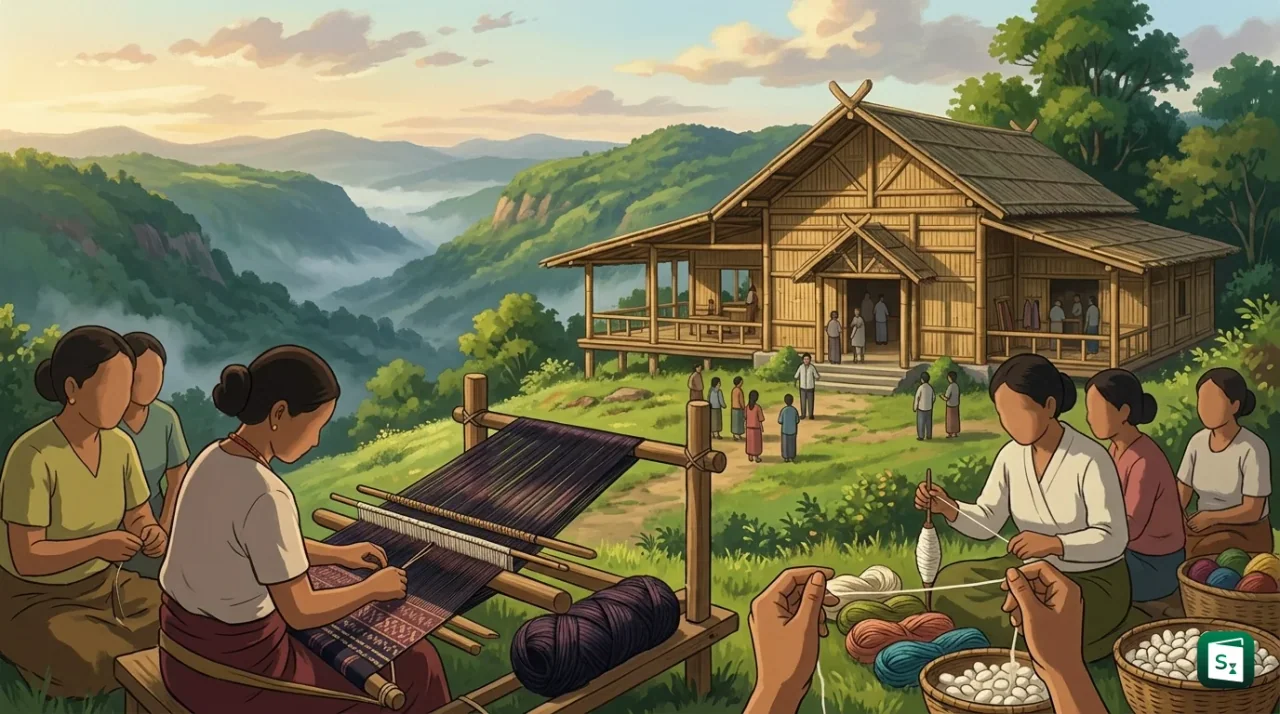
The fabric is hand-spun, naturally dyed using organic pigments derived from plants and minerals, and handwoven by artisans from the Khasi, Bhoi, and Jaintia communities. Ryndia has excellent thermal properties, keeping the wearer warm in winter and cool in summer. Its soft texture, durability, and eco-friendly production have made it a symbol of sustainable fashion in India and beyond.
Meghalaya is the second-largest producer of Eri cocoon in the country, generating nearly 500 metric tonnes annually, according to the Central Silk Board. The Ri-Bhoi district alone accounts for approximately 60 metric tonnes of cocoon production per year, with around 7,200 Eri farmers and about 1,000 active weavers in the region.
In April 2025, the Geographical Indications (GI) Registry under the Department for Promotion of Industry and Internal Trade (DPIIT) granted a GI tag to Meghalaya’s Ryndia silk and Khasi handloom products. This recognition, driven by the Meghalaya Department of Textiles over four years with support from NABARD, protects the uniqueness of Ryndia from imitation and enhances its market value nationally and internationally.
The Centre of Excellence at Ri Sai
The newly inaugurated Centre of Excellence at Ri Sai is designed to serve as a hub for preserving, training, and advancing the skills of Eri silk weaving. It aims to pass the craft on to future generations while creating sustainable economic opportunities for weavers, spinners, and rearers.
The centre includes an Ahimsa Silk training and design centre where artisans can learn traditional weaving techniques and develop contemporary designs. It is expected to provide a structured platform for skill development, documentation of traditional knowledge, and collaboration between farmers, weavers, designers, and researchers.
During the inauguration, Chief Minister Sangma interacted with weavers, spinners, and rearers, and highlighted the importance of supporting traditional artisans. He noted that Umden-Diwon and Ri-Bhoi are emerging as important hubs for Meghalaya’s indigenous textile traditions, combining craft, culture, cuisine, trade, and tourism.
The programme also featured awards for Best Textile Entrepreneur, Best Weaver, Best Eri Farmer, and Best Content Creators for branding and social media marketing, recognising contributions across the entire textile value chain.
The Integrated Textile Tourism Complex
The Centre of Excellence sits within the broader Integrated Textile Tourism Complex (ITTC) at Ri Sai, Nongpoh. The ITTC brings together various aspects of Meghalaya’s textile heritage on a single platform, including craft, cuisine, culture, trade, and tourism.
The complex houses exhibition stalls, a retail plaza for Meghalaya’s textile products, cottages for visitors, a restaurant, and an amphitheatre for cultural events. During the National Handloom Day celebrations, the ITTC hosted the India on Ryndia Exhibition at K.L. Bajoria College, along with fashion showcases including the Sakaru (Mother and Child) fashion sequence and the Looms to Legacy costume showcase.
The ITTC is part of a broader vision to create textile tourism in Meghalaya, where visitors can experience the entire journey from cocoon rearing to finished fabric. The state government also announced an upcoming “Tracing Our Roots” initiative to document and preserve the textile heritage of the Khasi-Jaintia and Garo communities.
National Handloom Day: Connecting Past and Present
National Handloom Day is observed every year on August 7 to honour India’s handloom weaving community and their contribution to the socioeconomic development of the nation. The Government of India declared this day in 2015, with the inaugural celebration held at the Centenary Hall of the University of Madras in Chennai. The date was chosen to commemorate the launch of the Swadeshi Movement on August 7, 1905, at the Calcutta Town Hall, which urged Indians to boycott foreign goods and revive indigenous industries, particularly handloom.
The 12th National Handloom Day in 2026 carried the theme “Weaving for Innovation and Sustainability”. Across India, the celebrations highlighted the handloom sector’s role in employment generation, with 35.22 lakh weavers and allied workers in the country, of which 72% are women. In Meghalaya alone, the textile sector supports over 50,000 households, with women comprising 70% of the workforce. In Ri-Bhoi district, nearly 90% of 4,000 registered weavers and 3,200 sericulture farmers are women.
Prime Minister Narendra Modi, in the 123rd episode of Mann Ki Baat in June 2025, highlighted Meghalaya’s Eri silk traditions, praising the state’s production methods that sustain Eri silkworms while respecting traditional weaving practices. He noted the growing global demand for eco-friendly and non-violent products, calling Eri Silk a perfect product for the international market.
Government Initiatives and the Road Ahead
The Meghalaya government has pursued a multi-pronged strategy to strengthen its textile and handloom sector. In May 2026, Chief Minister Sangma inaugurated the state’s first Eri silk yarn manufacturing unit, the Sai Lum Eri Silk Manufacturing Unit, at Lumdaitkhla in Bhoirymbong, Ri-Bhoi district. The unit, founded by Wallambok Pyngrope, received ₹50 lakh in zero-interest support under the PRIME Meghalaya programme. It produces around 20 kg of yarn per day and employs 15 local workers, impacting the livelihoods of over 2,000 weavers.
PRIME (Promotion and Incubation of Market-driven Enterprises) is the Government of Meghalaya’s comprehensive entrepreneurship programme, launched in 2019. It provides end-to-end support through incubation, mentorship, training, funding access, and market linkages via a network of PRIME Hubs across the state.
Key milestones in Meghalaya’s textile sector include:
| Milestone | Details |
|---|---|
| Umden-Diwon recognised as Eri Silk Village | February 12, 2021 |
| GI Tag for Ryndia and Khasi Handloom | April 2025 |
| First Eri silk yarn manufacturing unit inaugurated | May 2026 |
| Centre of Excellence inaugurated | August 2026 |
| Weavers supported with looms and yarn (2025-26) | 2,448 weavers |
The Textiles Minister Metbah Lyngdoh also called for establishing a Weavers’ Service Centre in Meghalaya and emphasised the need for stronger research, training, and infrastructure. The state government has signed an MoU with the Union Ministry of Textiles under the Samarth Scheme (Scheme for Capacity Building in Textile Sector) to enhance skill development and infrastructure in the handloom sector.
Key Takeaways
- Meghalaya CM Conrad K Sangma inaugurated a Centre of Excellence for Eri Silk Weaving at the Integrated Textile Tourism Complex (ITTC) in Ri Sai, Nongpoh, on August 14, 2026.
- Eri Silk (Ryndia) is also known as “Peace Silk” or “Ahimsa Silk” because the silkworm is not killed during silk extraction.
- Ryndia received a GI tag in April 2025 from the Geographical Indications Registry under DPIIT, after a four-year effort led by the Meghalaya Department of Textiles with NABARD support.
- Meghalaya is the second-largest producer of Eri cocoon in India, producing nearly 500 metric tonnes annually, with Ri-Bhoi district accounting for about 60 metric tonnes.
- National Handloom Day is observed on August 7 annually to commemorate the Swadeshi Movement of 1905. The 2026 theme was “Weaving for Innovation and Sustainability”.
- PRIME Meghalaya, launched in 2019, is the state’s comprehensive entrepreneurship programme supporting enterprises through PRIME Hubs with incubation, mentorship, training, and funding access.