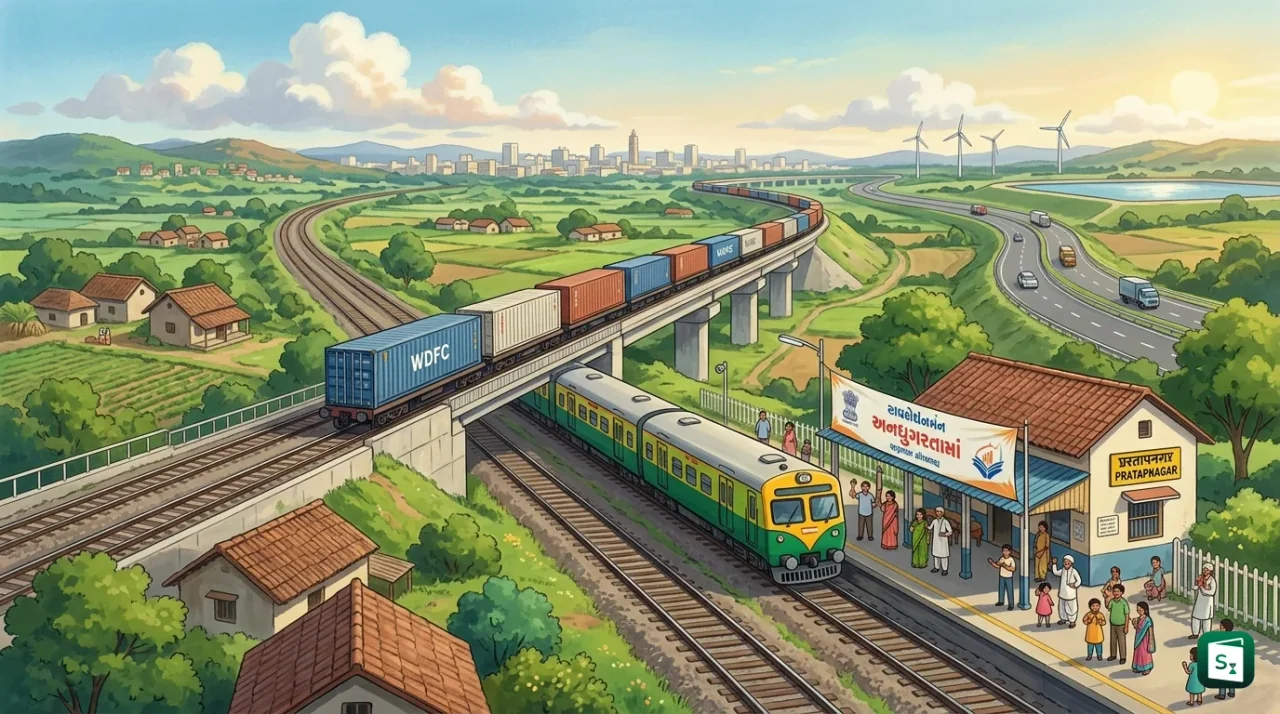
Prime Minister Narendra Modi dedicated development projects worth more than ₹35,000 crore in Vadodara, Gujarat, on 8 September 2026 under the ‘NaMo for Viksit Bharat’ programme, marking the full commissioning of India’s 2,843 km Dedicated Freight Corridor network. The centrepiece was the dedication of three final sections of the Western Dedicated Freight Corridor (WDFC) covering 326 route km at a cost of over ₹20,700 crore, which now provide direct freight rail connectivity to the Jawaharlal Nehru Port Authority (JNPA) in Mumbai. With the corridor network already handling more than 443 freight trains a day on average, the Vadodara launch combined freight, highway, railway and urban development projects into a single push to cut logistics costs and speed up trade.
What Was Launched in Vadodara Under NaMo for Viksit Bharat?
Prime Minister Narendra Modi visited Gujarat and Maharashtra on 8 September 2026 and unveiled the package at a public event in Vadodara, the third largest city of Gujarat and its cultural capital located on the banks of the Vishwamitri River. The programme was branded as ‘NaMo for Viksit Bharat’, a public outreach format that presents infrastructure inaugurations as milestones towards the national vision of Viksit Bharat by 2047, or a developed India by the centenary of independence. Vadodara was chosen not only for its location on the freight corridor alignment but also because it houses Gati Shakti Vishwavidyalaya, the university focused on transport and logistics, which the Prime Minister referenced as a symbol of connectivity led growth.
The total package was valued at more than ₹35,000 crore and included inaugurated, dedicated and foundation stone projects. The largest share, over ₹20,700 crore, was the commissioning of three final sections of the Western Dedicated Freight Corridor (WDFC). In addition, foundation stones were laid for three railway projects spanning 329 km at a cost of over ₹9,700 crore and three National Highway projects worth about ₹1,780 crore. State government projects worth around ₹2,600 crore were also included, such as Vadodara Urban Development Authority (VUDA) Ring Road Phase II, a 110 MW floating solar project at Kadana Dam, a new office for the Vadodara Municipal Corporation (VMC), housing under Pradhan Mantri Awas Yojana (PMAY), and a water supply project for 11 villages in eastern Vadodara. Freight train services were flagged off from New Sanand (North), New Makarpura, New Umbergaon and New JNPT at the same event.
What Is a Dedicated Freight Corridor and What Is WDFC?
A Dedicated Freight Corridor (DFC) is a railway line built only for goods trains, separate from the mixed traffic network where passenger and freight trains currently share tracks. The idea is simple. When freight is shifted to its own corridor, goods move faster and passenger trains on the main network face less congestion. The full form WDFC stands for Western Dedicated Freight Corridor, and EDFC stands for Eastern Dedicated Freight Corridor.
The two corridors were first conceived in the mid 2000s when high density trunk routes of Indian Railways were near saturation. A Task Force chaired by a Member of the Planning Commission prepared the concept in 2005, the project received in principle approval in February 2006 under the government led by then Prime Minister Manmohan Singh, and a dedicated implementing agency was created. That agency is the Dedicated Freight Corridor Corporation of India Limited (DFCCIL), a public sector undertaking under the Ministry of Railways, which was incorporated in October 2006 under the Companies Act, 1956.
DFCCIL was set up as a Special Purpose Vehicle to plan, build, finance, maintain and operate the corridors. It functions as an infrastructure manager that provides non discriminatory access to train operators. Initial construction was started after government approval in February 2008 and was funded through a mix of government budget, internal resources and external loans. The WDFC was largely financed with support from the Japan International Cooperation Agency (JICA), while parts of the EDFC received funding from the World Bank.
Today the combined network measures 2,843 km. This answers two common queries, how many dedicated freight corridors are there in India and is the dedicated freight corridor completed. There are two main corridors in operation, and with the Vadodara inauguration the entire network stands fully operational. The total sanctioned cost for both corridors was approved at about ₹1.24 lakh crore in June 2015.
Inside the Final 326 km Stretch: Route, Cost and JNPA Port Link
What was dedicated and where it runs
The three sections dedicated in Vadodara cover 326 route km and cost more than ₹20,700 crore. They are New Sanand (North) to New Makarpura, New Umbergaon to New Saphale and New Saphale to New JNPT. New Sanand and Makarpura lie in Gujarat, while Umbergaon, Saphale and the JNPT link are in Maharashtra near Mumbai. With these links, the WDFC now runs uninterrupted from Dadri in Uttar Pradesh near Delhi to Jawaharlal Nehru Port at Nhava Sheva in Raigad district, Maharashtra, over a total length of 1,506 km. The corridor passes through Uttar Pradesh (19 km), Haryana (177 km), Rajasthan (567 km), Gujarat (565 km) and Maharashtra (178 km) and runs generally parallel to existing lines, with detours at Diva, Surat, Ankleshwar, Bharuch, Vadodara, Anand, Ahmedabad, Palanpur, Phulera and Rewari. It includes a new alignment from Rewari to Dadri and a single line branch connecting Prithla in Palwal district to Tughlakabad in Delhi.
Technically, the WDFC is a double line, electrified corridor with 2 x 25 kV overhead catenary and Indian broad gauge of 1,676 mm. It is designed for heavy axle loads and is widely noted as the world’s first fully electrified corridor built for routine double stack container operation, where two containers are stacked on one wagon to move more cargo in a single train. Key junction stations where the WDFC meets the existing railway system include Vasai Road, Kosad or Gothangam near Surat, Makarpura (Vadodara), Amli Road (Sabarmati), Palanpur, Marwar Junction, Phulera, Rewari and Pirthala Road.
Why the JNPA link matters
Jawaharlal Nehru Port Authority (JNPA), also known as Jawaharlal Nehru Port Trust (JNPT) or Nhava Sheva Port, is India’s premier container port. The full form JNPA stands for Jawaharlal Nehru Port Authority and JNPT is its earlier name. The port is located at Navi Mumbai, Raigad district, Maharashtra, on the eastern shore of the Arabian Sea, and was commissioned on 26 May 1989. It handles about 50 percent of India’s containerised cargo across major ports, is ranked 23rd among the top 100 container ports globally and is connected to over 200 ports worldwide. It currently operates five container terminals and is India’s first 100 percent landlord major port. It achieved a handling of more than 6.35 lakh TEUs in August 2024, a monthly record at the time.
Until now the last stretch to the port relied on the congested conventional network around Mumbai. The new Saphale to JNPT link removes that bottleneck. Containers can now travel on a dedicated path from factories and inland container depots in Delhi NCR, Haryana, Rajasthan, Gujarat and western Uttar Pradesh directly to JNPA without competing with suburban passenger traffic. Officials noted that the average freight transit time between Dadri and JNPT has come down from about 66 hours to about 58 hours, a saving of roughly eight hours. The corridor mainly carries ISO containers from JNPT and ports like Mundra, Kandla, Pipavav and Hazira, along with petroleum products, fertilisers, food grains, salt, coal, iron and steel and cement. By easing the Mumbai network, the link also frees capacity on the main railway lines for more passenger and coaching services.
How Do the Eastern and Western Freight Corridors Compare?
Although both are part of the same national programme, the two corridors serve different goods and regions.
| Feature | Western Dedicated Freight Corridor (WDFC) | Eastern Dedicated Freight Corridor (EDFC) |
|---|---|---|
| Full form | Western Dedicated Freight Corridor | Eastern Dedicated Freight Corridor |
| Route | Dadri (Uttar Pradesh) to JNPT (Navi Mumbai, Maharashtra) | Ludhiana (Punjab) to Sonnagar (Bihar), with planned extension to Dankuni in West Bengal |
| Length | 1,506 km | 1,337 km |
| States covered | Uttar Pradesh, Haryana, Rajasthan, Gujarat, Maharashtra | Punjab, Haryana, Uttar Pradesh, Bihar, West Bengal, Jharkhand |
| Primary cargo | Containers, petroleum products, manufactured goods for export and import | Coal and steel, bulk minerals for power plants and steel plants |
| Design | Double line, fully electrified, double stack container capable | Electrified, double line on most sections, single line on Ludhiana to Khurja stretch |
| Port connectivity | Direct to JNPA and linked to Gujarat ports like Mundra, Kandla, Pipavav, Hazira | Connects to coal belts and links to eastern ports via Dankuni in future |
| Funding | Largely JICA (Japan) | Largely World Bank for Ludhiana to Mughalsarai section |
| Status | Fully operational from March 2026 with final 326 km dedicated on 8 September 2026 | Completed and commissioned in October 2023 |
Together they form a combined network of 2,843 km that now handles more than 443 trains a day. The corridors intersect at Dadri, where a 46 km branch line connects Khurja on the EDFC to Dadri on the WDFC, allowing freight to move between east and west. The WDFC also aligns with the Delhi Mumbai Industrial Corridor (DMIC) and is supported by planned Multi Modal Logistics Parks near Mumbai, Vapi, Ahmedabad, Gandhidham, Jaipur and the National Capital Region.
Beyond the Freight Corridor: Highways, New Rail Lines and Passenger Trains
Three National Highway projects
Foundation stones were laid for three National Highway projects costing around ₹1,780 crore and implemented through the National Highways Authority of India (NHAI), the statutory body set up in 1988 under the National Highways Authority of India Act, 1988, headquartered in New Delhi. A National Highway is a major road owned and maintained by the central government, while a State Highway is maintained by a state government, and an Expressway is an access controlled high speed road with grade separators and interchanges.
The Gujarat projects include six laning of the Kamrej to Chalthan section of NH 48 over 13.875 km at an estimated cost of ₹686.15 crore, with service roads on both sides to separate local traffic from through traffic. A second component provides additional structures, including major bridges over the Tapi and Narmada rivers on the Vadodara to Surat section of NH 48, which is part of the busy Delhi to Chennai corridor. The third component creates grade separated structures at Abhava, Mindhola and Khajod junctions on NH 53, which links Surat with the Maharashtra border and Hazira Port. National Highways in India are numbered under a systematic scheme where odd numbers generally run north to south and even numbers east to west, with NH 48 and NH 53 being key east west and north south arteries in western India. The upgrades are expected to cut travel time, reduce accidents on narrow bridges at Por, Jambuva, Bamangam and Vishwamitri and improve freight movement to ports and industrial hubs.
Three railway projects and a new passenger service
Three railway foundation stone projects together span 329 km and cost more than ₹9,700 crore. They include Vadodara to Ratlam third and fourth lines, Miyagam Karjan to Choranda to Malsar gauge conversion and Vishwamitri to Dabhoi doubling. These works will add passenger and freight capacity, ease congestion and strengthen connectivity between Gujarat and Madhya Pradesh.
In parallel, a new passenger train service between Tanda Road and Vadodara (Pratapnagar) was flagged off, benefiting commuters in Vadodara, Chhota Udepur and Alirajpur districts. The Prime Minister also dedicated the Jobat to Tanda Road new rail line, built as part of the Chhota Udepur to Dhar project. This line connects remote tribal areas of Alirajpur in Madhya Pradesh with the national rail network and provides an alternative north south link that bypasses congested routes. Six lane flyovers at Kandari Chokdi and Luvara Patia in Vadodara were also inaugurated as part of the urban road package.
Smart Administration and Water Security: Vadodara City Projects
What is a Smart City and what does the Command Centre do
A Smart City is a city where digital technology and data are used to improve governance, transport, safety and everyday services. The Smart Cities Mission was launched by the Government of India in 2015 to develop 100 smart cities with area based development and pan city solutions, implemented through city level Special Purpose Vehicles.
Vadodara was selected in the second round of the mission and created the Vadodara Smart City Development Limited (VSCDL) as its Special Purpose Vehicle, with the Vadodara Municipal Corporation (VMC) as the implementing agency. One flagship project is the Vadodara City Command Control Centre, also called the Integrated Command and Control Centre (ICCC), located at Badamadi Baug, Dandiabazar. The existing centre, built in 2017 at a cost of about ₹9.2 crore, has been upgraded under the mission.
The centre works as a single platform where data from different departments such as transport, water, fire, police, meteorology and e governance is collected and analysed together. It integrates feeds from CCTV cameras, Automatic Number Plate Recognition (ANPR), Area Traffic Control System (ATCS), Variable Messaging Sign Boards, Emergency Call Boxes, Public Address Systems, environmental sensors and GPS trackers for fire vehicles, connected through a citywide Optical Fibre Cable (OFC) network and a Water SCADA system for real time monitoring of water supply lines. Facilities include a video wall room with seating for about 50 persons, a war room for emergency meetings, a fire retardant data centre and an UPS room for secure data storage. The system helps with 24 by 7 administration, surveillance, disaster management, traffic control and faster emergency response.
Water supply and housing
Water projects were a second focus. The Waghodiya (augmented) Regional Water Supply Scheme and a dedicated water supply project for 11 villages in eastern Vadodara were inaugurated to improve drinking water access in rural and peri urban areas. Urban water management remains critical for Vadodara, which depends on the Mahi River, Panam Dam, Ajwa Reservoir and Narmada canal network for nearly half its supply and handles a system capacity of around 750 million litres per day (MLD). The city has faced stress from delayed monsoons and low reservoir levels in recent years, making additional Narmada water and efficient distribution a priority.
Other city projects dedicated or launched include housing units under the Pradhan Mantri Awas Yojana (PMAY), launched in 2015 to provide housing for all, and the Gujarat government package that also includes the 110 MW floating solar project at Kadana Dam, an innovative renewable installation where solar panels float on a reservoir to save land and reduce evaporation.
Why the Completion of the Freight Network Matters for India
The completion of the DFC network after nearly 20 years from first approval is a major logistics milestone. The project was first announced in April 2005 when the Railway Minister proposed high capacity freight corridors along the Golden Quadrilateral, and the planning task force was approved by the Committee on Infrastructure on 16 February 2006. Repeated land acquisition delays and contract challenges pushed the original 2011 target far behind, and the corridors were finally fully commissioned between October 2023 for EDFC and March to September 2026 for the full WDFC.
Three impacts stand out. First, lower logistics costs and faster transit. India’s logistics cost is estimated at about 13 to 14 percent of GDP, higher than many global peers. By moving bulk and container cargo to dedicated tracks with double stack capability, the DFC reduces time, fuel use and road congestion. Studies of the completed sections show transit reliability improving and an eight hour saving on the Dadri to JNPT run.
Second, modal shift and decongestion. Shifting freight from road to rail cuts emissions, as rail uses less energy per tonne km. It also frees the existing railway network, which previously ran mixed traffic, to run more passenger trains. In 2025 to 26, Indian Railways recorded freight loading of about 1,670 million tonnes (MT), making it the second largest freight carrying railway system in the world. The DFC is expected to raise rail’s share in freight movement further.
Third, industrial and port led growth. The WDFC forms the rail backbone of the Delhi Mumbai Industrial Corridor (DMIC) and the PM Gati Shakti National Master Plan launched in 2021 to integrate infrastructure planning. Direct JNPA connectivity helps exporters of textiles, chemicals, machinery, carpets and pharmaceuticals and importers of machinery, plastics and metals who depend on that port’s hinterland across Maharashtra, Gujarat, Madhya Pradesh and North India. The Budget for 2026 has already announced plans for a new freight corridor linking Dankuni in the east with Surat in the west, with detailed project report work underway, showing that the network will continue to expand.
For Vadodara itself, the package links national freight strategy with local urban needs, from faster trains to smarter traffic control and more reliable water, illustrating how corridor infrastructure and city infrastructure are planned together.
Key Takeaways
- Prime Minister Narendra Modi dedicated projects worth more than ₹35,000 crore in Vadodara, Gujarat on 8 September 2026 under the ‘NaMo for Viksit Bharat’ programme.
- Three final sections of the Western Dedicated Freight Corridor (WDFC) covering 326 route km at a cost of over ₹20,700 crore were commissioned, completing the 1,506 km WDFC and the combined 2,843 km DFC network.
- The new sections are New Sanand (North) to New Makarpura, New Umbergaon to New Saphale and New Saphale to New JNPT, providing direct rail connectivity to the Jawaharlal Nehru Port Authority (JNPA), commissioned on 26 May 1989 at Navi Mumbai.
- The Dedicated Freight Corridor Corporation of India Limited (DFCCIL) was incorporated in October 2006 under the Ministry of Railways and built the corridors with JICA support for WDFC and World Bank support for parts of EDFC.
- A new passenger train between Tanda Road and Vadodara (Pratapnagar) was flagged off and the Jobat to Tanda Road line of the Chhota Udepur to Dhar project was dedicated, alongside three railway projects covering 329 km worth ₹9,700 crore and three National Highway projects worth ₹1,780 crore on NH 48 and NH 53.
- Urban projects included the Vadodara City Command Control Centre at Badamadi Baug (built 2017) under the Smart Cities Mission (2015) and the Waghodiya Regional Water Supply Scheme, with the DFC network now handling over 443 freight trains a day and cutting Dadri to JNPT transit time from about 66 hours to 58 hours.