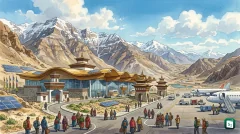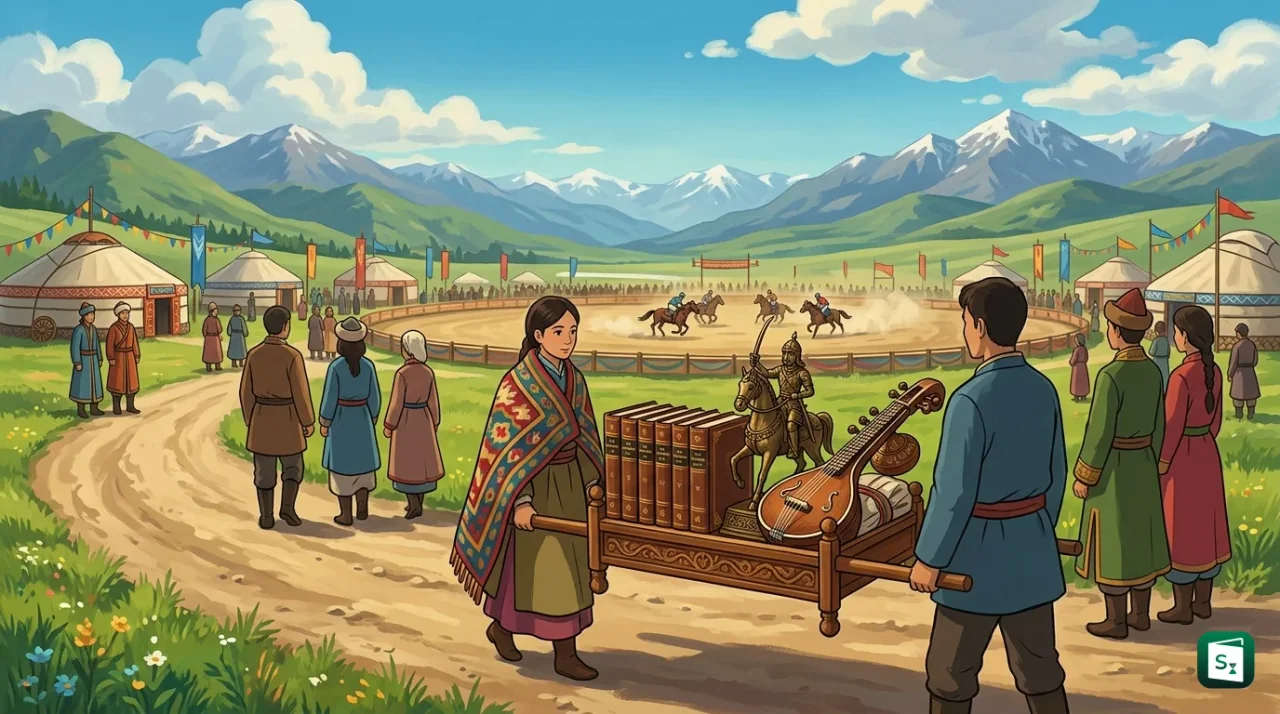
Prime Minister Narendra Modi visited Bishkek, Kyrgyzstan from 31 August to 1 September 2026 to attend the 26th meeting of the Council of Heads of State (CHS) of the Shanghai Cooperation Organisation (SCO) at the invitation of President Sadyr Japarov. The summit, held as the SCO marked 25 years since its founding in 2001, coincided with the opening ceremony of the 6th World Nomad Games at the new Bishkek Arena. Together, the two events turned Kyrgyzstan’s capital into a stage for both high-level multilateral diplomacy and celebration of Central Asia’s living nomadic heritage.
What Is the Shanghai Cooperation Organisation and Why Does It Matter?
The Shanghai Cooperation Organisation (SCO) is a Eurasian political, economic and security grouping whose full form is often asked in examinations. It was formally established on 15 June 2001 in Shanghai, China, by six founding members, China, Russia, Kazakhstan, Kyrgyzstan, Tajikistan and Uzbekistan. Its predecessor was the Shanghai Five, a mechanism created in 1996 by China, Russia, Kazakhstan, Kyrgyzstan and Tajikistan to build confidence and demilitarise their shared borders, and Uzbekistan joined in 2001 to create the SCO.
The SCO Charter, signed in June 2002 in St. Petersburg and entering into force on 19 September 2003, sets out its purposes, principles and structure. The organisation aims to strengthen mutual trust and good neighbourly relations, promote cooperation in politics, trade, economy, science, culture, education, energy, transport and environment, and maintain peace, security and stability in the region. Its working languages are Russian and Chinese, its Secretariat is located in Beijing, China, and its Regional Anti-Terrorist Structure (RATS) is headquartered in Tashkent, Uzbekistan.
Membership has expanded in stages. India and Pakistan became full members at the Astana Summit in 2017, Iran joined in 2023 and Belarus joined in 2024. As of the 2026 Bishkek Summit, the SCO has 10 full members, China, Russia, Kazakhstan, Kyrgyzstan, Tajikistan, Uzbekistan, India, Pakistan, Iran and Belarus, with Afghanistan and Mongolia as observer states and 14 dialogue partners including Armenia, Azerbaijan, Bahrain, Cambodia, Egypt, Kuwait, Maldives, Myanmar, Nepal, Qatar, Saudi Arabia, Sri Lanka, Turkiye and the United Arab Emirates. Taken together, member states cover about 40 percent of the world’s population and about 25 percent of global GDP.
The Council of Heads of State (CHS) is the supreme decision making body of the SCO and meets once a year. The Council of Heads of Government meets annually to discuss multilateral cooperation strategy, economic priorities and the budget. Other key bodies include the Council of Foreign Ministers and the Business Council established on 14 June 2006.
| Key Fact About SCO | Detail |
|---|---|
| Full form | Shanghai Cooperation Organisation |
| Formed on | 15 June 2001, Shanghai |
| Predecessor | Shanghai Five (1996) |
| Charter signed | June 2002, St. Petersburg, in force 19 September 2003 |
| Secretariat | Beijing, China |
| RATS Executive Committee | Tashkent, Uzbekistan |
| Official languages | Russian and Chinese |
| Members in 2026 | 10 members, 2 observers, 14 dialogue partners |
| 25th anniversary | 2026, theme at Bishkek Summit was “25 Years of the SCO: Together Towards Sustainable Peace, Development and Prosperity” |
SCO Summit 2026: Where Was It Held, Who Hosted It and What Was on the Agenda?
The 26th meeting of the SCO Council of Heads of State was held from 31 August to 1 September 2026 in Bishkek, Kyrgyzstan. This answers the most searched query, SCO Summit 2026 held in which country, with the answer being Kyrgyzstan, and the venue city being its capital Bishkek. The summit was chaired by President Sadyr Japarov, and it was the fourth time Kyrgyzstan hosted the CHS meeting. It concluded Kyrgyzstan’s 2025 to 2026 rotating chairmanship, after the 2025 Tianjin Summit hosted by China.
Kyrgyzstan holds a strategic place in Central Asia. The country is a landlocked, mountainous republic in Central Asia, bordered by Kazakhstan, Uzbekistan, Tajikistan and China. About 94 percent of its territory lies more than 1,000 metres above sea level, dominated by the Tien Shan range. Its capital and largest city is Bishkek, located in the Chu River valley at the foot of the Kyrgyz Ala Too mountains. The official languages are Kyrgyz and Russian, the currency is the Kyrgyzstani Som (KGS) with symbol c, the time zone is UTC+6 (KGT), which is 30 minutes behind Indian Standard Time (IST, UTC+5:30), and the calling code is +996. The population is about 7 million on a total area of about 199,951 sq km. Islam, mainly Sunni Islam, is the majority religion, followed by Russian Orthodox Christianity. Kyrgyzstan declared independence from the Soviet Union in 1991.
The 2026 summit agenda reflected both the anniversary and current regional challenges. Preparatory meetings during Kyrgyzstan’s chair included the security council secretaries meeting in Bishkek in May 2026, the energy ministers meeting in June 2026 which discussed energy security and a proposed SCO Energy Consortium, and the foreign ministers meeting in Cholpon-Ata on the shores of Lake Issyk-Kul. At Bishkek, leaders focused on counter terrorism, separatism and extremism, often called the three evils, along with regional stability, cross border threats, organised crime and drug trafficking.
Economy and connectivity were central. Discussions covered Eurasian transport and logistics corridors, trade and economic cooperation, energy security and digital transformation. Members discussed an SCO Agreement on Trade Facilitation, market access, value chain integration and financing mechanisms including a proposed SCO Development Bank. The summit adopted the Bishkek Declaration marking 25 years of the SCO. Other expected outcomes included 27 decisions and documents, approval of a 2026 to 2030 action plan for ports and logistics centres, cooperation against drug trafficking and organised crime, and creation of a Universal Center for Countering Challenges and Threats to the Security of SCO Member States. At the close, the rotating chair was handed to Pakistan, which will host the 2027 SCO Summit in Islamabad.
Prime Minister Modi arrived in Bishkek on 30 August 2026 after a bilateral visit to Uzbekistan on 29 to 30 August, part of a four day Central Asia tour from 29 August to 1 September. He was received at Manas International Airport by Adylbek Kasymaliev, Chairman of the Cabinet of Ministers of Kyrgyzstan. Leaders from all 10 member states attended, including Chinese President Xi Jinping, Russian President Vladimir Putin and Iranian President Masoud Pezeshkian, along with observers, dialogue partners and heads of international bodies such as the United Nations, CSTO, CIS and EAEU.
What Are the World Nomad Games?
The World Nomad Games is an international multi sport and cultural event dedicated to traditional sports, games and heritage of nomadic peoples. It was first launched in Kyrgyzstan in 2014 and has since been held in Kyrgyzstan (2014, 2016, 2018), Turkey (2022) and Kazakhstan (2024) before returning to Kyrgyzstan in 2026. The Games are recognised for preserving and promoting nomadic culture, fostering friendship and encouraging cultural dialogue among peoples whose history is linked to movement, pastoralism and horsemanship. The event typically combines sport, culture and science.
The 6th edition, officially the VI World Nomad Games, was held from 31 August to 6 September 2026 in Bishkek and Cholpon-Ata, Kyrgyzstan. The opening ceremony took place on 31 August 2026 at Bishkek Arena, a new 51,000 seat stadium inaugurated for the event, while competitions were staged mainly in the northern Issyk-Kul region including Cholpon-Ata and the Kyrchyn Gorge. The closing ceremony was scheduled for 6 September at the Cholpon-Ata Hippodrome. The date also coincided with Kyrgyzstan’s Independence Day.
Participation in 2026 was the largest so far. Organisers reported more than 3,000 athletes from 104 to 106 countries and about 2,355 athletes, coaches and delegation members at the opening parade. There were 43 sports and disciplines on the programme. Traditional sports included Kok Boru (a horseback game where riders compete for a goat carcass), horseback archery, Kurash, Mongol Bokh wrestling, Toguz Korgol (a nomadic board game), falconry and other equestrian events. The cultural programme featured yurt villages, epic poetry recitals, felt carpet weaving, folk music and ethnographic exhibitions, while the scientific programme brought together researchers studying nomadic civilisation.
Why Were SCO Leaders at the Nomad Games Opening?
The opening ceremony on 31 August was attended by visiting SCO leaders and guests, turning a cultural festival into a diplomatic gathering. Heads of delegation for the SCO Summit, including Secretary General Nurlan Yermekbayev, were present. President Sadyr Japarov opened the Games and described them as a showcase of Central Asia’s historical and cultural heritage. Leaders present included Prime Minister Narendra Modi, President Vladimir Putin, President Masoud Pezeshkian, President Shavkat Mirziyoyev, President Kassym-Jomart Tokayev and Prime Minister Shehbaz Sharif, among others. The Indian contingent comprised 87 participants, including 73 athletes, 10 cultural representatives and 4 scientific programme delegates, whom Modi greeted at the arena. Media noted that Chinese President Xi Jinping did not attend the ceremony, with reports linking his absence to concerns over flooding and landslides in Tibet.
The overlap was deliberate. By hosting the SCO anniversary summit and the Nomad Games together, Kyrgyzstan projected itself as a bridge for cultural diplomacy while advancing its chairmanship priorities of mutual understanding, humanitarian contacts and good neighbourliness.
Cultural Diplomacy Through Gifts: What Did PM Modi Present?
A distinct feature of Prime Minister Modi’s diplomacy is the use of cultural gifts to convey shared heritage. During the Central Asia tour covering Uzbekistan and Kyrgyzstan, he presented carefully curated items that linked Indian craft, literature and music with Central Asian traditions.
Gifts to the leadership of Kyrgyzstan
To President Sadyr Japarov, the Prime Minister gifted two items. The first was the 10-volume English translation of the Mahabharata by Bibek Debroy. Published by Penguin between 2010 and 2014, this is the first complete unabridged English translation based on the Critical Edition prepared by the Bhandarkar Oriental Research Institute (BORI) in Pune over nearly 50 years. The work covers about 80,000 shlokas, includes the principal narrative, philosophical reflections, genealogies and dialogues, and makes the epic accessible to contemporary readers. Traditionally attributed to Ved Vyasa, the Mahabharata explores themes of dharma, duty, justice, morality and statecraft through the story of the Pandavas and Kauravas. Officials noted its resonance with Kyrgyzstan’s Epic of Manas, one of the longest epic poems in the world and a pillar of Kyrgyz identity that preserves values and collective memory through oral storytelling. Both epics show how societies use grand narratives to transmit ethics across generations.
The second gift to President Japarov was a Ladakhi Tsugdul Blanket, also written as Tsug-dul or Tsug Dul. It is a traditional woollen textile from Ladakh, handwoven from locally sourced sheep and yak wool. It is known for vibrant colours and geometric, floral and stylised motifs. The textile reflects Ladakh’s pastoral and nomadic life in the high Himalayas, where communities such as the Changpa nomads of Changthang rear pashmina goats, sheep and yaks. Its wool based craftsmanship and mountain heritage directly echo Kyrgyzstan’s own nomadic traditions shaped by high pastures and textiles. Thikma tie dye and Nambu and Khulu weaves are other well known Ladakhi textiles, but Tsugdul is valued for its warmth, durability and everyday use in homes and tents.
To the Prime Minister of Kyrgyzstan, Adylbek Kasymaliev, Modi gifted a Dokra artwork depicting a pair of traditional musicians. Dokra, also spelled Dhokra, is an ancient lost wax metal casting technique, known as cire perdue, practiced for more than 4,000 years. The famous Dancing Girl of Mohenjo-daro from the Harappan Civilisation is an early example of this metallurgy. The craft is practiced by the Dhokra Damar tribes and Ojha metalsmiths in Chhattisgarh, Jharkhand, Odisha, West Bengal, Telangana, Rajasthan and Kerala, with each region having its own style. Each piece is made by creating a clay core, covering it with beeswax, carving the design, covering it again with clay, melting out the wax and pouring molten brass, and then breaking the mould, so no two pieces are identical. The gifted artefact showed two musicians with traditional instruments, highlighting the role of music in preserving folk stories. It matched Kyrgyzstan’s rich folk music heritage, where instruments such as the komuz carry similar cultural weight.
Gift to the President of Uzbekistan
To President Shavkat Mirziyoyev of Uzbekistan, Modi presented a sandalwood Shata Tantri Veena, popularly known as the Santoor. The name Shata Tantri Veena means hundred stringed lute in Sanskrit and is mentioned in ancient Sanskrit texts. The modern Santoor is a trapezoidal hammered dulcimer made of walnut or sandalwood, with 25 bridges and 100 strings tuned with a key called Dokur in Kashmir. It is played with light wooden mallets called mezrab. The instrument is central to the musical traditions of Jammu and Kashmir and was elevated to a classical instrument by Pandit Shiv Kumar Sharma, who expanded its range to three octaves and introduced techniques such as meend or glissando. Its resemblance to Uzbekistan’s traditional Chang, a similar hammered string instrument, made it a gesture of shared musical lineage rooted in Persian and Central Asian exchanges.
Other gifts during the same tour included two boxes of premium Kangra tea from Himachal Pradesh in a carved wooden case, containing Kangra First Flush Black Tea and Kangra Green Tea, a marble inlay casket with a Banarasi silk stole for the First Lady of Uzbekistan, a fine silver brooch for the President’s daughter and a marble inlay plate for Prime Minister Abdulla Aripov of Uzbekistan. Each item showcased a Geographical Indication or celebrated craft cluster, from Agra marble inlay to Varanasi silk weaving.
Why Was the Visit Important for India?
The visit underlined India’s growing engagement with Central Asia, a region that connects South Asia with Eurasia and is vital for energy, connectivity and security. In his departure statement, Modi said he looked forward to advancing India’s vision based on security, connectivity and opportunity and working with SCO members toward a region free from terrorism, separatism and extremism. At the summit plenary on 1 September, he called for dismantling the entire terror ecosystem and rejecting double standards, a reference to cross border terrorism that has been a consistent Indian position at the SCO. The Bishkek Declaration also included language strongly condemning the terrorist attack in Pahalgam on 22 April 2025, stating that perpetrators, organisers and sponsors must be brought to justice, reflecting India’s push for stronger collective action at the RATS level.
Bilateral engagement was equally important. On the sidelines, Modi held talks with President Sadyr Japarov, President Vladimir Putin, President Masoud Pezeshkian and Prime Minister Nikol Pashinyan of Armenia, among others. He also met members of the Indian diaspora in Kyrgyzstan, including academics, researchers, ITEC alumni and yoga practitioners. Kyrgyzstan hosts many Indian medical students, making people to people ties a practical pillar of the relationship. For culturally sensitive outreach, the gifts carried strategic meaning, linking Himalayan wool crafts with Kyrgyz nomadism, and Kashmir’s Santoor with Uzbek musical forms, thereby reinforcing goodwill beyond formal agreements.
Connectivity remains a long term interest. India supports greater Eurasian transport and logistics integration, including the International North South Transport Corridor (INSTC) and connectivity via Chabahar in Iran, an SCO member since 2023. Cooperation on trade facilitation, energy security and digital transformation within the SCO complements India’s broader efforts to diversify links to Central Asia despite limited direct land access. The summit also displayed geopolitical balance. With China, Russia, Iran and Pakistan at the same table, India used the platform to emphasise multipolarity without alignment against any third country, as stated in the Bishkek documents, while advancing counterterrorism and connectivity priorities.
For India, Kyrgyzstan is also an important partner in multilateral settings. The country sits at the crossroads of China, Kazakhstan, Tajikistan and Uzbekistan, and its capital Bishkek is host to regular interaction between SCO structures and observers. Strengthening ties with Bishkek and Tashkent during the same tour allowed India to pursue both bilateral and regional tracks, an approach that has defined its Connect Central Asia Policy, launched in 2012.
Key Takeaways
- The 26th SCO Council of Heads of State meeting was held from 31 August to 1 September 2026 in Bishkek, Kyrgyzstan, chaired by President Sadyr Japarov to mark the 25th anniversary of the SCO founded on 15 June 2001.
- The SCO currently has 10 full members, with India and Pakistan joining in 2017, Iran in 2023 and Belarus in 2024, and its Secretariat is in Beijing while RATS is in Tashkent and working languages are Russian and Chinese.
- The 6th World Nomad Games were held from 31 August to 6 September 2026 in Bishkek and Cholpon-Ata on Lake Issyk-Kul, with the opening at Bishkek Arena (51,000 seats) featuring more than 3,000 athletes from 104 to 106 countries in 43 sports.
- Kyrgyzstan is a landlocked Central Asian republic whose capital is Bishkek, currency is the Kyrgyzstani Som (KGS), time zone is UTC+6, official languages are Kyrgyz and Russian, and area is about 199,951 sq km.
- PM Modi gifted Kyrgyzstan President Sadyr Japarov a 10-volume English Mahabharata by Bibek Debroy based on the BORI Critical Edition (about 80,000 shlokas) and a Ladakhi Tsugdul woollen blanket, gifted PM Adylbek Kasymaliev a Dokra lost wax artwork of musicians, and gifted Uzbekistan President Shavkat Mirziyoyev a sandalwood Shata Tantri Veena (Santoor) linked to Jammu and Kashmir and resembling the Uzbek Chang.