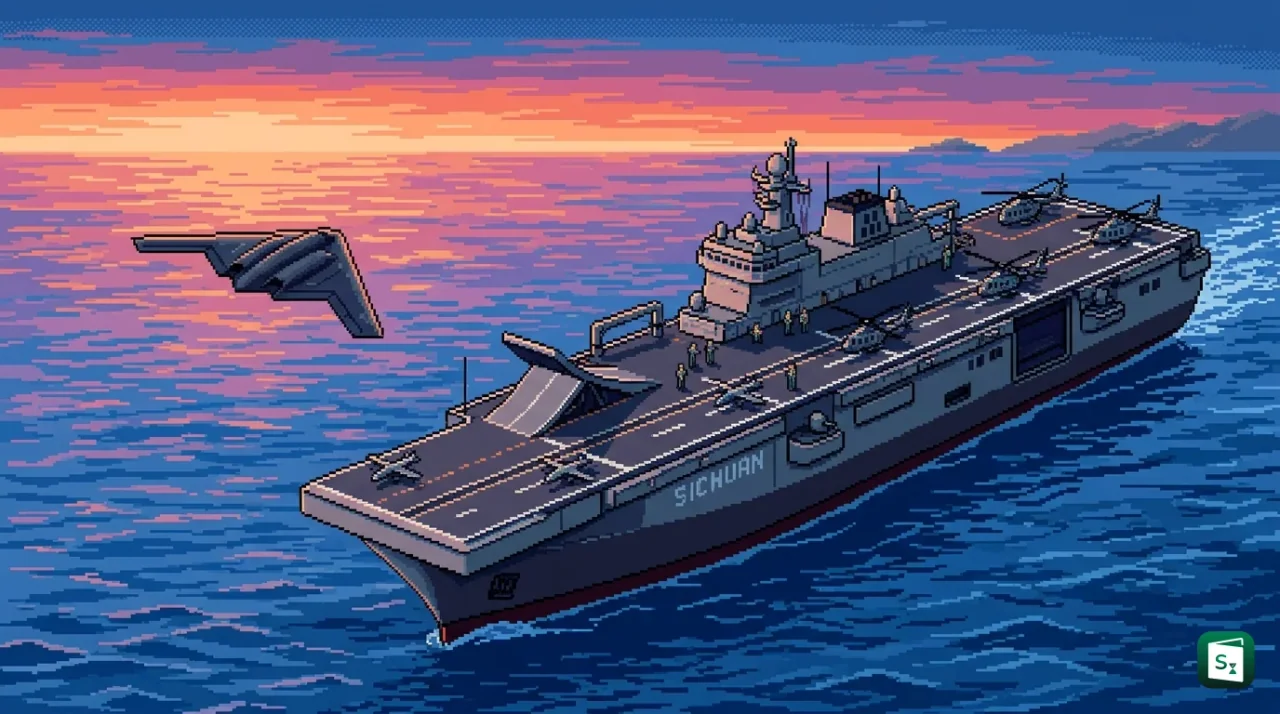
China has flight-tested its GJ-21 stealth UAV over Liaoning province in late August 2026 as its intended mother ship, the Type 076 Sichuan, entered the final phase of sea trials off the Qingdao naval base. The synchronised progress links the Hongdu GJ-21, a naval stealth drone with a flying wing design, with the Sichuan (Hull 51), the world’s first amphibious assault ship fitted with an electromagnetic catapult. Together they point to a new category of warship that China calls a drone carrier, built to launch fixed-wing unmanned combat aircraft from an amphibious hull.
What Is the GJ-21 Stealth UAV?
The GJ-21 is a carrier-based stealth Unmanned Aerial Vehicle (UAV) developed for the People’s Liberation Army Navy (PLAN). A UAV is an aircraft that flies without a pilot on board, controlled remotely or by autonomous systems, while stealth refers to design features that reduce detection by radar and infrared sensors. The GJ-21 is understood to be the naval variant of the GJ-11 Sharp Sword, also known as Gongji-11 Lijian. It is also referenced in some reports as GJ-11J.
The base GJ-11 was developed under the AVIC 601-S programme led by the Aviation Industry Corporation of China (AVIC). Design work was led by the Shenyang Aircraft Design Institute (SYADI) and manufacturing was undertaken by the Hongdu Aviation Industry Group (HAIG), both subsidiaries of AVIC. The technology demonstrator, called Lijian (Sharp Sword), made its maiden flight on 21 November 2013 at the Hongdu airfield, making China the fourth country to fly a stealth unmanned combat aerial vehicle after the United States, France and the United Kingdom. A redesigned production configuration was publicly displayed at the 2019 National Day parade in Beijing, and was later shown leading the unmanned formation at the Victory Day parade on 3 September 2025 with the number 21 on its fuselage. That appearance revealed folding wing hinges, a modification for shipboard storage.
The GJ-21 retains the tailless flying wing layout of the GJ-11. A flying wing means the aircraft has no distinct fuselage or tail fins and its entire body forms a single wing, which helps to lower radar reflection. Key naval adaptations observed in 2025 and 2026 include folding wings, a tail hook (arrestor hook) for engaging arresting wires on landing, a double nose wheel with a catapult launch bar for CATOBAR (Catapult Assisted Take-Off But Arrested Recovery) operations, strengthened landing gear, a dorsal air intake with an S-shaped duct that hides the engine compressor face, a flattened and shrouded exhaust to reduce infrared signature, and pitot tubes for flight data. These changes allow launch by electromagnetic catapult and recovery by arresting gear on a flat deck.
In terms of size and performance, open estimates place the GJ-11 family at about 12.2 metres in length, 14.4 metres in wingspan and 2.7 metres in height, with a maximum take-off weight around 10 to 20 tonnes depending on source. Payload is carried inside two internal weapons bays with an estimated capacity of up to 2,000 kg, preserving stealth by keeping munitions inside the airframe rather than on external pylons. Reported mission roles include intelligence, surveillance and reconnaissance (ISR), precision strike, and electronic warfare, with claims of acting as a loyal wingman alongside crewed fighters like the J-20 and J-16D. While exact range, endurance and radar cross-section figures are not officially confirmed, open assessments often cite a combat radius around 1,500 km and endurance of six to eight hours.
What Is Stealth Technology and How Does It Make Drones Undetectable?
A stealth UAV is an unmanned aircraft designed with low observable technology to reduce its visibility to enemy radar, infrared sensors and the human eye. Stealth does not make an aircraft invisible. It reduces the amount of energy returned to a radar receiver so that the aircraft appears much smaller than its physical size or blends into background noise, making it harder to detect, track and target.
Three principles work together to achieve this effect.
First is shaping. Radar waves reflect strongly when they strike flat surfaces at right angles. Stealth aircraft avoid flat vertical surfaces and use angled, blended shapes to deflect radar energy away from the transmitter. A central method is planform alignment, where major edges such as wing leading edges, trailing edges, inlet lips and control surfaces are aligned to a small set of common angles. This concentrates reflected energy into a few narrow spikes rather than scattering it in many directions. The flying wing configuration used by the GJ-21 and the American B-2 Spirit bomber takes this to the extreme by removing vertical tails entirely, which eliminates major corner reflectors where two surfaces meet at right angles.
Second is materials. Radar Absorbent Materials (RAM) and radar absorbent coatings, often containing iron-based particles, absorb a portion of incoming radar energy and convert it into heat. Composite structures, especially carbon fibre reinforced polymers, also help to absorb rather than reflect electromagnetic waves. Layered coatings are designed so that outer layers appear similar to air to incoming waves, while deeper layers trap and cancel reflected waves through destructive interference.
Third is detail management. Large radar reflectors must be hidden. The spinning fan blades of a jet engine are highly reflective, so stealth designs bury the engine inside an S-shaped inlet duct that blocks direct line of sight from outside. The dorsal intake on the GJ-21 and the S-duct on the B-2 serve this purpose. Weapons are carried in internal bays instead of external pylons, and panel gaps are filled and serrated to prevent energy leaking through gaps. Exhaust heat is also cooled and hidden, for example by placing the exhaust on the upper surface of the wing and using flattened nozzles to disperse the hot plume.
At high frequency radar bands, such as X-band (8 to 12 GHz) used by fire control radars and missile seekers, shaping is highly effective because the aircraft features are large compared to the wavelength. At very low frequencies such as VHF (30 to 300 MHz), wavelengths are similar to the aircraft size and energy bends around the shape rather than reflecting predictably, so shaping is less effective. This is why some long-range early warning radars operating at low frequencies, such as Russia’s Nebo-M or China’s JY-27A, can detect stealth aircraft at a general location, though they cannot provide precise tracking needed to guide a weapon to impact. A precise high-frequency radar lock is still required for a final intercept, and at that stage stealth shaping regains its advantage.
What Is the Type 076 Sichuan Amphibious Assault Ship?
The Type 076 Sichuan is the lead ship of China’s Type 076 class, known under the NATO reporting name Yulan class. It is classified as a Landing Helicopter Dock (LHD) and more commonly described as an amphibious assault ship. An amphibious assault ship is a warship designed to carry marines, armoured vehicles, landing craft and aircraft to conduct operations where forces move from sea to shore. The Sichuan is named after the southwestern province of Sichuan, following the Chinese Navy tradition of naming large amphibious ships and aircraft carriers after provinces. It carries hull number 51 and was built at the Hudong-Zhonghua Shipyard in Shanghai, a subsidiary of the China State Shipbuilding Corporation (CSSC), at its Changxing Island yard.
The ship was launched on 27 December 2024 and began its first sea trials on 14 November 2025 with a three day campaign focused on propulsion, navigation and stability. State media has stated its full-load displacement is over 40,000 tonnes, while open assessments by research bodies estimate 40,000 to 50,000 tonnes, with some analysts placing it near 50,000 tonnes. This makes it the world’s largest amphibious assault ship by displacement and considerably larger than its predecessor, the Type 075 which displaces around 36,000 to 40,000 tonnes.
A Drone Carrier with an Electromagnetic Catapult
What makes the Type 076 unique is that it is the world’s first amphibious assault ship equipped with an electromagnetic catapult and arresting gear. A catapult helps aircraft to take off from a short deck by accelerating them rapidly, while arresting gear uses wires on the deck to stop landing aircraft quickly. Traditional amphibious assault ships only operate helicopters and, in the case of the United States, short take-off and vertical landing jets like the F-35B. They do not have catapults.
The Type 076 uses a CATOBAR system, which stands for Catapult Assisted Take-Off But Arrested Recovery. The same basic technology is referred to as EMALS (Electromagnetic Aircraft Launch System) on the American Gerald R. Ford class carriers and on China’s own Type 003 Fujian aircraft carrier. Instead of steam pressure, the system uses linear induction motors that can adjust launch energy based on aircraft weight. This reduces stress on the airframe and allows heavier payloads. The catapult trench on the Sichuan is estimated at around 100 to 130 metres in length.
The flight deck is a full-length straight deck about 252 to 260 metres long and 45 to 52 metres wide, covering roughly 13,500 square metres. The deck has electromagnetic catapult tracks, arresting wires at the stern, and marking lines for helicopter and drone operations. Unlike the Type 075 which had deck-integrated elevators, the Type 076 has two large side-mounted aircraft elevators plus a forward internal elevator to move aircraft between the hangar and the flight deck. It also retains a floodable well deck at the stern capable of launching two Type 726 Yuyi class LCAC (Landing Craft Air Cushion) or other landing craft.
Size, Propulsion and Design Features
The ship features a twin-island superstructure, meaning it has two separate island structures instead of one. One island is focused on navigation and the other on flight operations, an arrangement seen on the British Queen Elizabeth class carriers and the Italian Trieste. This layout is linked to its gas turbine propulsion using two 21 megawatt QC-280 gas turbines plus six 6 megawatt diesel generators, for a total installed power of about 78 megawatts, operated under an Integrated Electric Propulsion (IEP) and medium-voltage direct current system. IEP means the engines generate electricity that drives both propulsion and ship systems rather than driving shafts directly. Analysts note this arrangement provides enough power to operate the electromagnetic catapult, which requires about seven megawatts per launch, while still powering navigation, radars and weapons.
Defensive systems are reported to include three Type 1130 close-in weapon systems (CIWS), three HHQ-10 short-range surface-to-air missile launchers with 24 rounds each, and decoy launchers for flares and chaff. The hangar and vehicle deck are designed to carry more than 1,000 marines, armoured vehicles, helicopters such as the Z-8, Z-18, Z-10, Z-9 and Z-21, and fixed-wing UAVs such as the WZ-7 and GJ-21. Some technical assessments suggest it could also operate crewed fixed-wing aircraft like the J-35 stealth fighter and KJ-600 airborne early warning aircraft, though this has not been demonstrated.
GJ-21 and Type 076 Together: Flight Tests and Final Sea Trials
This pairing was highlighted by two sets of events in August 2026 that unfolded almost simultaneously.
Social media videos showed the GJ-21 flying over a highway service area near Huludao in Liaoning province in northeastern China. One clip dated 19 August 2026 and another posted on 28 to 29 August 2026 showed the same flying wing drone from different angles. Geolocation of the footage confirmed the location around Huludao, a centre for Chinese naval aviation testing. A third video on the same day showed the aircraft with a slightly different flight path, and earlier imagery from November 2025 had already shown a GJ-21 prototype in flight with pitot tubes and a lowered tail hook, indicating preparation for arrested landing.
At the same time, the Type 076 Sichuan was advancing through its sea trials program. After its launch in December 2024, the ship completed its first sea trial on 14 November 2025, followed by a second trial in December 2025 and a second round of trials in early 2026. On 1 August 2026, footage broadcast by CCTV showed the Sichuan operating its electromagnetic catapult with a red dead-load test vehicle and launching countermeasures, the first official confirmation of EMALS testing. Earlier in July 2026, CCTV had aired computer-generated footage showing six GJ-21 drones lined up on the deck with one being catapulted, while military commentator Wei Dongxu told the broadcaster that the ship had entered the final testing phase because full deck markings were already visible.
By late August, the Sichuan was reported to be in the final phase of sea trials, the concluding stage of testing before active deployment and formal commissioning. Satellite imagery shared on 25 August 2026 by open-source observers appeared to show the Sichuan near the Qingdao naval base, the headquarters of the Northern Theatre Command of the PLAN, alongside two Type 052 destroyers and three Type 054 frigates. The proximity of China’s first aircraft carrier Liaoning in the same anchorage suggested the Navy may be exploring combined operations where a conventional carrier provides crewed fighters while the Type 076 provides drones, helicopters and landing craft.
Analysts note that no public footage has yet shown an actual catapult launch or arrested recovery of a GJ-21 at sea. The key milestones that remain include deck handling of unmanned aircraft, electromagnetic launch and recovery at sea, data link resilience under maritime conditions, and sustained sortie generation. Photographs circulating since 31 January 2026 had already shown a covered mock-up of the GJ-21 on the Sichuan’s deck near the stern, and test sites replicating the ship’s deck had been used for ground integration tests. The PLAN has indicated it expects to take delivery of the Sichuan by late 2026 after system-level tests in more demanding maritime environments.
The ship’s flight deck is about 250 metres long and 62 metres wide with markings now complete, and the PLAN confirmed in April 2026 that trials had moved to the South China Sea for more complex system testing. These steps indicate steady movement from power and navigation checks to aviation integration, which is the core of the Type 076 concept.
How Does Type 076 Compare with Other Amphibious Assault Ships?
A direct comparison helps to place the Type 076 in context. The most asked comparison is amphibious assault ship versus aircraft carrier. An amphibious assault ship is built around landing forces with a floodable well deck and vehicle decks, plus aviation facilities for helicopters and now drones. An aircraft carrier is built primarily around sustained fixed-wing air operations with a larger air wing and often a higher level of survivability due to armoured decks and compartmentalisation. The Type 076 blurs this line because it retains a well deck while adding carrier-style catapult and arresting gear, creating a hybrid that is best described as a drone carrier.
| Feature | Type 076 Sichuan (China) | Type 075 (China) | America class (United States) | Trieste (Italy) |
|---|---|---|---|---|
| Type | Amphibious assault ship and drone carrier | Landing Helicopter Dock (LHD) | Landing Helicopter Assault (LHA) | Landing Helicopter Dock (LHD) |
| Displacement | Over 40,000 tonnes, estimated 40,000 to 50,000 tonnes | About 36,000 to 40,000 tonnes | About 45,000 tonnes | About 38,000 tonnes |
| Flight deck | About 252 to 260 metres long, 45 to 52 metres wide, full length with catapult and arresting gear | About 235 metres long, 32 to 36 metres wide, no catapult | About 260 metres long, 32 metres wide, no catapult, operates F-35B short take-off and vertical landing jets | About 230 metres long, twin-island, ski-jump for F-35B |
| Launch system | Electromagnetic catapult (EMALS), single track, with arresting gear and CATOBAR operation | Helicopter only | No catapult, relies on short take-off and vertical landing | No catapult, relies on ski-jump |
| Aviation | Fixed-wing UCAVs (GJ-21), helicopters, possible J-35 and KJ-600 | 20 to 25 helicopters | Up to 20 F-35B in lightning carrier mode plus helicopters and MV-22B Osprey | Helicopters and F-35B |
| Well deck | Yes, for 2 LCACs | Yes, for 2 LCACs or 8 mechanised landing craft | Flight 0 ships have no well deck, Flight 1 ships have well deck | Yes |
| Propulsion | 2 x 21 MW gas turbines plus 6 x 6 MW diesels, IEP, about 78 MW total | Diesel, CODAD | 2 x LM2500+ gas turbines, about 60 MW | CODOG with gas turbines |
| Status | Sea trials since November 2025, final phase in August 2026 | Four ships built, three in service (Hainan, Guangxi, Anhui) | Two Ships in service (America, Tripoli), more building | One ship in service since 2024 |
For India, the comparison is also relevant. The Indian Navy currently does not operate a dedicated large amphibious assault ship of this class and has explored requirements for such vessels to support expeditionary and humanitarian operations. India’s own stealth unmanned combat aerial vehicle programme, DRDO Ghatak, led by the Aeronautical Development Establishment (ADE) of the Defence Research and Development Organisation (DRDO), is developing a flying wing stealth UCAV powered by the GTRE Dry Kaveri engine, with plans for first-wave strike roles similar in concept to the GJ-21. However, the Ghatak is intended for land-based operations and has not been linked to a naval catapult carrier. The contrast shows how China is pairing its stealth UCAV directly with a sea-based electromagnetic launch platform, while India’s system remains in land testing.
The broader distinction is that the American and Italian ships maximise manned vertical landing fighter capability, while the Type 076 maximises unmanned fixed-wing aviation via catapult. If successful, the Type 076 would provide persistent reconnaissance, surveillance, electronic warfare and strike coverage for an amphibious group without requiring a full aircraft carrier nearby.
Strategic Significance and Regional Implications
The convergence of the GJ-21 and the Type 076 matters for three reasons that extend beyond a single ship.
First, it changes the tactical model for amphibious operations. Traditional amphibious ships must close to within helicopter range to land troops, exposing them to shore defences, anti-ship missiles and artillery. A ship that can launch stealth drones from over the horizon can first conduct reconnaissance of beach defences, locate air defence systems, and carry out selective strikes on command nodes and artillery before landing forces approach. Chinese analysts have noted that less than five percent of Taiwan’s coastline is suitable for large flat beach landings, and that those beaches are heavily defended. Drones with long endurance could monitor such locations and extend the sensing and striking range of the landing group by dozens or hundreds of nautical miles.
Second, it offers a cost-effective complement to aircraft carriers. The Type 076 is estimated to displace about 40,000 to 50,000 tonnes, far less than a supercarrier like the Gerald R. Ford class at about 100,000 tonnes or even China’s own Type 003 Fujian at about 80,000 tonnes. Yet it can still provide an amphibious group with organic fixed-wing aviation. This allows the PLAN to hold its most valuable carriers back from the front line while still giving each expeditionary group a degree of carrier-like air capability. Observers expect the Sichuan to operate initially with the Northern Theatre Command near Qingdao and later with the Eastern or Southern Theatre Commands focused on Taiwan and the South China Sea, where its ability to launch drones for surveillance and electronic suppression could fill gaps in air superiority.
Third, it reflects China’s wider push into unmanned systems and intelligent combat. The Type 076’s integrated power system, supercapacitor-based energy storage, and AI-assisted command systems are designed to manage multi-platform operations across drones, helicopters and landing craft. State and technical reports highlight that each electromagnetic catapult could be supported by six sets of supercapacitors, each capable of multiple launches before recharge, allowing a high sortie rate even on a medium sized hull. If the GJ-21 achieves reliable electromagnetic launch and arrested recovery at sea, the PLAN would gain the world’s first operational ship-based stealth attack drone capability, a field where other navies are still testing demonstrators like the American X-47B.
There are clear limits. Large amphibious ships remain high value targets vulnerable to precision weapons and modern anti-access systems. The US Naval War College and other analyses have pointed to persistent challenges for the PLAN in joint training, contested logistics, and air superiority over the Taiwan Strait. The Sichuan’s survivability is lower than that of a supercarrier, and operations have so far been conducted in calm sea states of Sea State 1 to 2. Success would require coordinated multi-domain operations across air, sea, space and cyber domains, not just a single ship’s capability.
For neighbours and regional security planners, the development reinforces the need to track how quickly China can move from final sea trials to operational integration, including how many GJ-21s a single Type 076 can sustain, whether it can maintain high deck tempo in rough seas, and whether China will build additional ships of this class. Reports indicate a second Type 076 may already be under consideration, which would signal intent to scale this model beyond a technology demonstration.
The Way Forward
The next phase for the Sichuan is ship-aircraft integration training, the stage where the ship’s catapult, arresting gear, deck handling procedures and data links are tested together with actual aircraft. CCTV has stated that both the catapult system and the arresting gear have been completed, and that the ship’s full deck markings indicate entry into final testing. The PLAN is expected to take formal delivery by late 2026 after trials in more demanding maritime environments, including operations in the South China Sea.
For the GJ-21, the key test will be demonstrating electromagnetic catapult launch and arrested recovery at sea, not just land-based flight. This includes safe launch under sea motion, stable approach and hook engagement, rapid deck turnaround, and secure control links resistant to jamming. Observers will also watch for evidence of manned-unmanned teaming, such as control hand-offs from a two-seat J-20S or future carrier-based aircraft, which would extend the drone’s utility beyond independent missions.
If these milestones are met, the Type 076 is likely to become a regular component of Chinese expeditionary groups, training alongside Type 075 ships, Type 071 dock landing ships, Type 052 and Type 055 destroyers, and carrier strike groups built around Liaoning, Shandong and Fujian. Civilian roll-on/roll-off ferries, which China has integrated into recent large-scale amphibious exercises in August 2025, may also operate alongside such groups to provide additional lift.
The broader trajectory is toward a fleet where every major amphibious group carries some level of fixed-wing unmanned aviation. Whether that model proves effective at scale under contested conditions, night operations and high sea states will determine if the Type 076 remains a specialised platform or becomes a template for future Chinese and even global amphibious ship design.
Key Takeaways
- The GJ-21 stealth UAV is the naval variant of the GJ-11 Sharp Sword, developed by Hongdu Aviation Industry Group and Shenyang Aircraft Design Institute under the AVIC 601-S programme with first flight of the demonstrator on 21 November 2013.
- China flight-tested the GJ-21 over Huludao, Liaoning in August 2026 while the Type 076 Sichuan (Hull 51), launched on 27 December 2024 at Hudong-Zhonghua Shipyard, entered the final phase of sea trials before deployment expected by late 2026.
- The Type 076 Sichuan displaces over 40,000 tonnes (estimated 40,000 to 50,000 tonnes), measures about 252 to 260 metres long, and is the world’s first amphibious assault ship with an electromagnetic catapult and arresting gear for CATOBAR operations.
- The ship uses twin-island superstructure and Integrated Electric Propulsion with 2 x 21 MW gas turbines and 6 x 6 MW diesel generators (about 78 MW total) and retains a floodable well deck for 2 LCACs alongside a full-length flight deck.
- Stealth technology on the GJ-21 includes a tailless flying wing design, planform alignment, radar absorbent materials, S-shaped dorsal intake and internal weapons bays up to 2,000 kg to reduce radar and infrared signature, especially effective against X-band fire control radars.