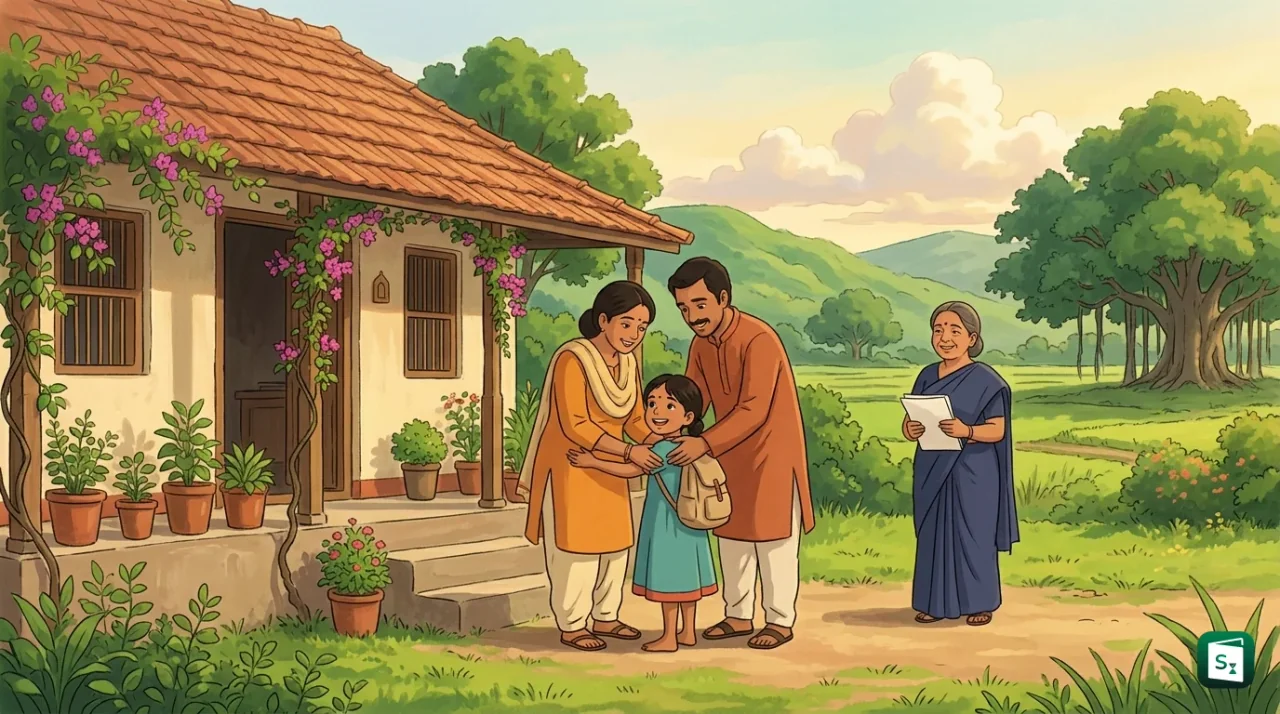
The Central Adoption Resource Authority (CARA) under the Ministry of Women and Child Development has launched the Adoption Awareness 2026 theme “Legal Adoption. Safe Childhood. Secure Future. Say No to Illegal Adoption” on 1 September 2026. The theme was formally unveiled by Bhavna Saxena, Chief Executive Officer of CARA, on a live morning show on DD National. It marks the start of a year-long, nationwide push to make every child adoption in India legal, transparent and child-centric.
What Is Adoption Awareness 2026 and Why Was It Launched?
Adoption Awareness 2026 is a year-long campaign built around the message “Legal Adoption. Safe Childhood. Secure Future. Say No to Illegal Adoption.” Earlier, CARA focused most of its outreach on November, which is observed as Adoption Awareness Month every year. From September 2026 onwards, that approach has been expanded into sustained, twelve-month engagement.
The shift comes from a clear problem. Despite a strong legal framework, cases of direct and illegal adoption are still reported. These happen through informal channels such as hospitals, nursing homes, unregistered homes, intermediaries, or after abandonment when a child is handed over without following the prescribed procedure. Such transfers bypass checks, break the law and leave both child and adoptive family exposed to legal and safety risks.
The 2026 theme therefore has two aims. First, to promote legal, safe, transparent and child-centric adoption as the only accepted route for orphaned, abandoned and surrendered children. Second, to actively prevent illegal practices by spreading awareness among families and frontline institutions. The campaign will run through State and Union Territory level Adoption Awareness Workshops starting September 2026, moving beyond a single-month observation.
A key early event under this plan is the Adoption Awareness Workshop in Delhi scheduled for Thursday, 10 September 2026 at the Delhi Secretariat, New Delhi, organised by CARA in collaboration with the Department of Women and Child Development, Government of Delhi and concerned authorities. Similar workshops will be rolled out across states to strengthen coordination, explain the statutory process, and reinforce that every decision must serve the best interest of the child.
What Is CARA and How Does It Regulate Child Adoption in India?
CARA stands for Central Adoption Resource Authority. It is the statutory apex body and nodal authority for adoption of Indian children, functioning under the Ministry of Women and Child Development (MoWCD) in New Delhi. The Ministry itself came into being as a separate ministry on 30 January 2006, after earlier functioning as a department under the Ministry of Human Resources Development since 1985.
CARA deals primarily with the adoption of orphan, abandoned and surrendered children through its network of recognised agencies. It is the only body that can declare a child legally free for adoption and match that child with families through the official system.
Legal Backing and Core Functions
CARA was first set up in June 1990 by the Ministry of Welfare to regulate and promote adoption. It was registered as a Society on 18 March 1999 after a Union Cabinet decision in 1998 and achieved full statutory status under Section 68 of the Juvenile Justice (Care and Protection of Children) Act, 2015, as amended in 2021. The Act was notified on 15 January 2016.
Since 2003, CARA has also been designated as India’s Central Authority under the Hague Convention on Protection of Children and Co-operation in Respect of Intercountry Adoption, 1993, which India ratified in 2003. This makes it the authority for both in-country and inter-country adoptions.
Its functions under Section 68 include promoting in-country adoption, facilitating inter-state adoption in coordination with State Adoption Resource Agencies (SARAs), regulating inter-country adoption, framing regulations on adoption from time to time, and carrying out the duties of the Central Authority under the Hague Convention.
In practice, CARA operates the centralised online platform CARINGS (Child Adoption Resource Information and Guidance System), now CARINGS 3.1 and integrated with Mission Vatsalya, for registration, referral, reservation and tracking. It monitors and accredits Specialised Adoption Agencies (SAAs) and coordinates with State Adoption Resource Agencies, Child Welfare Committees (CWCs), District Child Protection Units (DCPUs), Child Care Institutions (CCIs) and the judiciary. It also frames and updates Adoption Regulations, currently the Adoption Regulations, 2022, which govern eligibility, procedure and timelines, regulates adoption by Non-Resident Indians (NRIs) and Overseas Citizens of India (OCIs) through Authorised Foreign Adoption Agencies (AFAAs) and Indian diplomatic missions where no such agency exists, and promotes adoption of older children and children with special needs (Divyaang children), a priority that was highlighted in the 2025 theme on non-institutional rehabilitation of such children.
The Authority is headed by a Member Secretary and Chief Executive Officer and is supervised by a Steering Committee chaired by the Secretary, Ministry of Women and Child Development, as provided under Section 69 of the Juvenile Justice Act.
What Is Legal Adoption and How Is It Different From Illegal Adoption?
Adoption is a legal process through which a person becomes the lawful parent of a child who is not related by blood, with the same rights, duties and responsibilities as a biological parent. Once an adoption order is issued, the relationship is permanent and irrevocable and the child gains full inheritance and identity rights in the adoptive family.
Legal adoption in India means adoption completed only through the procedure laid down in law, through CARA and the designated authorities for orphan, abandoned and surrendered children. It requires registration on CARINGS (cara.wcd.gov.in or carings.wcd.gov.in), a Home Study Report, matching through the portal, acceptance of referral, filing of an application before the District Magistrate, and finally an adoption order from the District Magistrate under the amended Juvenile Justice framework. The child also receives an adoption certificate and a new birth certificate reflecting the adoptive parents.
Illegal adoption, by contrast, is any transfer of a child outside this system. It includes direct handing over of a baby by a hospital or nursing home, private deals through intermediaries or touts, buying or selling a child, informal custody after abandonment, and adoption without a District Magistrate order. Even arrangements within families or with the consent of birth parents are illegal if they involve an orphan, abandoned or surrendered child in institutional care and bypass CARA.
Illegal adoption is not a technical lapse. It is punishable under Section 80 of the Juvenile Justice Act, 2015, which provides imprisonment up to three years or fine up to ₹1 lakh or both for any person or organisation that offers, gives or receives such a child for adoption without following the prescribed procedure. If the offence is by a recognised adoption agency, its registration and recognition are withdrawn for at least one year in addition to action against the persons responsible. Such cases can also attract charges of trafficking and related offences.
A legal adoption, on the other hand, protects the child through counselling of birth parents, verification that the child is legally free for adoption by the Child Welfare Committee, health and background checks, confidentiality, post-adoption follow up, and a court-sanctioned identity. That is why the 2026 campaign repeatedly says “Say No to Illegal Adoption” and asks citizens to follow only the CARA route and report suspected illegal transfers.
How Does the Legal Adoption Process Work Through CARA?
For an orphan, abandoned or surrendered child under the Juvenile Justice framework, the only valid route is the CARA process through CARINGS. Religious customs alone do not make such an adoption legally secure. The process is designed to be online, transparent and queue-based.
Who Can Adopt? Eligibility Criteria in India
Eligibility is governed by Section 57 of the Juvenile Justice Act, 2015 (as amended in 2021) and Regulation 5 of the Adoption Regulations, 2022. Prospective Adoptive Parents, called PAPs, must be physically fit, mentally sound, emotionally stable and financially capable, with no life-threatening medical condition, and must not have a criminal conviction or pending case related to child rights violations. Couples must have completed at least two years of stable marital relationship, except for relative or step-parent adoption where this rule is relaxed, and both spouses must give consent when a married couple applies. A single woman can adopt a child of any gender, while a single man cannot adopt a girl child. Eligibility also depends on age criteria linked to the child’s age, assessed on the composite age of the couple at referral, and couples with two or more children are normally considered only for children with special needs or hard-to-place children, unless the adoption is by a relative or step-parent. For inter-country adoption, NRIs and OCIs are treated at par with resident Indians for waiting and referral under Regulation 15, while other foreign nationals follow the AFAA route.
Exact cut-offs depend on Regulation 5 and the child’s age group, so families are advised to check the current CARA guideline text on the portal before applying.
Step-by-Step Process on the CARINGS Portal
| Step | What Happens | Key Detail |
|---|---|---|
| 1. Registration | Resident Indian PAP registers online as Prospective Adoptive Parent on CARINGS at carings.wcd.gov.in | Choose correct category, general, relative, step-parent or foster, and save registration number |
| 2. Documents upload | Upload documents listed in Schedule VI of Adoption Regulations, 2022 | Includes identity, age, residence, marriage or marital status, health, financial and home details |
| 3. Home Study Report (HSR) | Social worker from authorised agency visits the home and prepares HSR | Assesses readiness, family environment and counselling needs, valid for a fixed period and needs revalidation if it lapses |
| 4. Seniority and waiting | PAP joins seniority queue | Wait time depends on seniority, child availability, and PAP preferences on age, gender, health and state |
| 5. Referral | CARINGS shows profile of a child legally free for adoption with Child Study Report and Medical Examination Report | PAP gets 48 hours to reserve the profile and later up to three referrals in total with a gap, subject to availability under Regulation 11 |
| 6. Acceptance and filing | On acceptance, agency files petition before the District Magistrate | Since the 2021 amendment, the District Magistrate, not the civil court, issues the adoption order, which has shortened final timelines |
| 7. Adoption order and follow up | District Magistrate issues adoption order, birth certificate is updated, and post-adoption follow up visits continue | No legitimate agent can sell a faster queue place or a referral, fees are fixed and grievances can be raised on the portal |
For step-parent, relative and inter-country relative adoption, the steps differ slightly. NRIs and OCIs must approach an Authorised Foreign Adoption Agency or Central Authority in the country of residence for the Home Study Report and online registration, or the Indian diplomatic mission if no such agency exists. Under the Hindu Adoptions and Maintenance Act (HAMA), a Hindu adoption through a registered adoption deed is valid only for a known child within family or personal connection and does not apply to institutional orphan children, who must still go through CARA.
What Are the Adoption Laws Governing Child Adoption in India?
India does not have a single adoption law for all situations. Instead, three frameworks operate, and the correct one depends on who the child is and who is adopting.
1. Juvenile Justice (Care and Protection of Children) Act, 2015 with Adoption Regulations, 2022: This is the secular, central law for adoption of orphan, abandoned and surrendered children. It applies to persons of any religion and is implemented through CARA, SARAs, SAAs, CWCs and DCPUs. The Supreme Court in Shabnam Hashmi vs Union of India (2014) held that the right to adopt under this Act is available to all Indians irrespective of religion and overrides personal law. The Act provides strong safeguards, including mandatory registration of Child Care Institutions, declaration of a child as legally free by the CWC, and punishment for illegal adoption under Section 80. CARA is reviewing the 2022 Regulations in 2026 to address procedural bottlenecks and improve placement of children with special and treatable conditions.
2. Hindu Adoptions and Maintenance Act, 1956 (HAMA): This personal law applies to Hindus, Buddhists, Jains and Sikhs and codified earlier custom-based practices. Enacted on 21 December 1956 as part of the Hindu Code Bills alongside the Hindu Marriage Act and Hindu Succession Act, it modernised adoption by giving legal certainty and protecting women and children. Under HAMA, a male Hindu needs his wife’s consent to adopt, an unmarried Hindu woman can adopt, and there are specific age-gap rules, such as a male needing to be at least 21 years older than a girl child he adopts. However, HAMA covers only direct adoption of a known child, not children in institutional care. Where a HAMA adoption involves taking the child abroad, CARA clearance is still needed.
3. Guardians and Wards Act, 1890: This law does not create a full adoption but a guardian-ward relationship. It is the route used by Muslims, Christians, Parsis and Jews, whose personal laws do not recognise full adoption, to take guardianship of a child. Under this Act, the ward can choose to end the relationship on reaching 21 years, and inheritance rights are not automatic. Muslims may practice kafala, or sponsorship and care, but for a legally secure parent-child status they can adopt under the secular Juvenile Justice Act route, as affirmed by the Delhi High Court in State vs Ashabuddin.
| Feature | HAMA, 1956 | JJ Act, 2015 with Adoption Regulations, 2022 | Guardians and Wards Act, 1890 |
|---|---|---|---|
| Applies to | Hindus, Buddhists, Jains, Sikhs | All religions, secular | Mainly Muslims, Christians, Parsis, Jews |
| Type of child | Known child, family or personal connection | Orphan, abandoned, surrendered children in institutions | Any child under guardianship |
| Authority | Registered adoption deed, no CARA referral needed | CARA through CARINGS and District Magistrate order | Court-appointed guardian |
| Single male adopting girl | Allowed with 21-year age gap condition | Not allowed | Not applicable as full adoption |
| Inheritance | Full rights as biological child | Full rights as biological child | No automatic inheritance, depends on will |
| Religious ceremony | Often involves customary ceremony | No religious ceremony required | No ceremony, court order only |
Understanding which law applies prevents families from entering an invalid arrangement that could later be challenged or penalised.
How Is Adoption Different From Foster Care and Guardianship?
Many searches confuse adoption with foster care and guardianship, but the three create very different legal bonds.
Adoption creates a permanent, irrevocable parent-child relationship. The adopted child becomes the lawful child of the adoptive parents for all purposes, name, inheritance and succession.
Foster care is temporary care for a child in need of care and protection, arranged through the child protection system. A foster parent looks after the child for a defined period but does not become the legal parent and cannot take independent decisions like a parent. CARA also maintains a separate track for foster care registration and promotes non-institutional rehabilitation, but foster care is not a shortcut to adoption.
Guardianship under the Guardians and Wards Act appoints a person as guardian of a child or the child’s property. The guardian has duties of care but the child does not automatically acquire the family name or inheritance rights. The ward may opt out at 21. Inter-country guardianship also requires court approval.
Choice depends on purpose. If the aim is a permanent family with full legal status, the CARA adoption route or a valid HAMA adoption for an eligible Hindu family case is required. If the aim is to support a child temporarily while the family is traced or rehabilitated, foster care or sponsorship is more appropriate.
Why Legal Adoption Matters and What Is the Way Forward?
An illegal adoption may look quicker, but it carries grave consequences. The child loses verification of being legally free, medical screening, documentation, and a legally recognised identity, which can lead to trafficking risks, statelessness in records, and future denial of succession or citizenship papers. Parents lose legal security, as the relationship can be declared void, and they may face criminal action, fines and social harm. For the child protection system, every informal transfer weakens the registry of Child Care Institutions and breaks the chain that links Child Welfare Committees, District Child Protection Units, Specialised Adoption Agencies, State Adoption Resource Agencies, police, health departments, judiciary, Legal Services Authorities, hospitals, ASHA and ANM workers and CARA.
That is why the 2026 campaign is built as a whole ecosystem effort, not a single poster or slogan. Planned actions include year-round State and UT workshops to train officials on the statutory CARINGS flow, inter-departmental coordination and identification of illegal practices, and sensitisation of hospitals and nursing homes, medical professionals, police and Child Welfare Committees to report abandonment or surrender immediately to the CWC and DCPU instead of facilitating private handovers. Community outreach will continue through MyGov campaigns, pledges, poster and mascot competitions and digital tracking to counter misinformation that legal adoption is impossible or too slow. There will be special focus on older children and children with special needs, whose adoption rates remain low, through targeted support and counselling for families, and further strengthening of the CARINGS portal, grievance redressal and fixed-fee system so families do not fall prey to agents who demand payment for a referral or a queue jump.
Citizens can contribute by registering only on cara.wcd.gov.in, verifying any agency against CARA’s list of recognised Specialised Adoption Agencies, refusing to pay for a child or a referral, and reporting suspected illegal adoption to the Child Welfare Committee, District Child Protection Unit or CARA directly. A legal adoption not only protects the child today, it secures the child’s dignity, identity, rights, safety and future, which is exactly what the 2026 promise of a Safe Childhood and Secure Future means.
Key Takeaways
- Adoption Awareness 2026 theme “Legal Adoption. Safe Childhood. Secure Future. Say No to Illegal Adoption” was launched on 1 September 2026 by CARA CEO Bhavna Saxena on DD National.
- CARA, the Central Adoption Resource Authority, is a statutory body under Section 68 of the Juvenile Justice Act, 2015 functioning under the Ministry of Women and Child Development and was first established in June 1990.
- Legal adoption of orphan, abandoned and surrendered children must go through CARA’s CARINGS portal (carings.wcd.gov.in) and end with a District Magistrate adoption order.
- Section 80 of the Juvenile Justice Act punishes illegal adoption with up to 3 years imprisonment or ₹1 lakh fine or both, with de-recognition of an offending agency for at least one year.
- Adoption Regulations, 2022 govern eligibility, including that a single man cannot adopt a girl child, a single woman can adopt a child of any gender, and couples need two years of stable marriage except for relative or step-parent adoption.
- A year-long campaign from September 2026 replaces a November-only observance, with the first State-level workshop on 10 September 2026 at Delhi Secretariat and similar workshops across states.