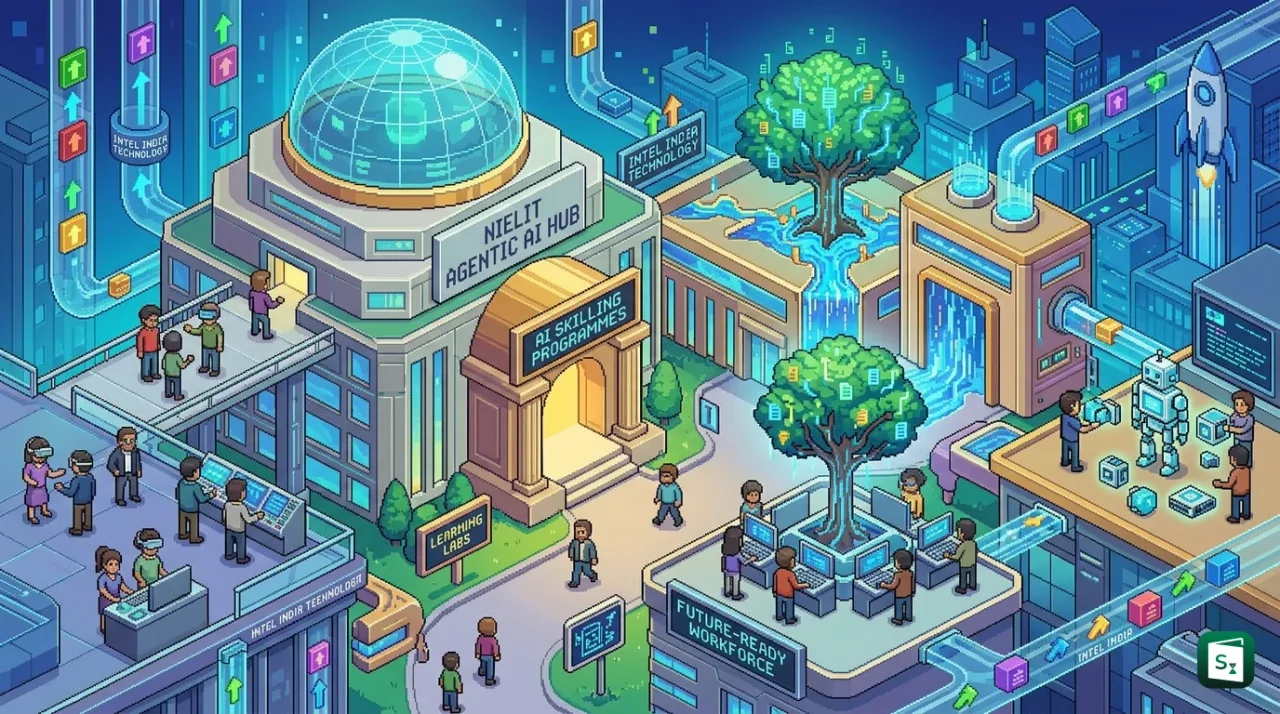
The National Institute of Electronics and Information Technology (NIELIT), under the Ministry of Electronics and Information Technology (MeitY), in collaboration with Intel India, launched the Agentic AI Skilling Programmes at the National Leadership Dialogue held at the India Habitat Centre in New Delhi on 3 September 2026. The initiative introduced two industry-aligned programmes designed to take practical Agentic AI learning to students, professionals and educators across the country. It aims to prepare India’s workforce to work effectively alongside next generation AI systems that can reason, plan and execute tasks with human oversight.
What Is Agentic AI and How Is It Different from Generative AI?
Agentic AI refers to artificial intelligence systems that can reason, plan and execute complex multi-step tasks with limited human direction and adapt based on feedback. Unlike a simple chatbot that answers one prompt at a time, an agentic system can set a goal, break it into steps, use tools and data sources, and keep working until the goal is complete, all under human oversight. It essentially acts as an autonomous coordinator that carries work from start to finish.
Generative AI, on the other hand, is a reactive tool that creates new content such as text, images, code or audio in response to a specific prompt. It draws on patterns in its training data to generate an output but does not on its own plan next steps or take actions in external systems. In many modern workflows, generative AI becomes a building block inside a larger agentic system, for example to draft an email that the agentic system then sends, tracks and follows up on.
The shift from predictive and generative systems toward agentic systems is why skilling needs are changing. Industries now need people who can design, govern and collaborate with AI agents, not just prompt them.
| Feature | Generative AI | Agentic AI |
|---|---|---|
| Core purpose | Creates new content from a prompt | Achieves a goal by planning and acting |
| Interaction | Responds to each prompt and waits for the next instruction | Takes a high level goal and decides the steps on its own |
| Autonomy | Low, needs constant human guidance | High, can work through multiple steps with minimal guidance |
| Tool use | Limited to generating output | Actively uses tools, APIs, databases and other agents |
| Memory and learning | Focuses on conversation history | Remembers outcomes, evaluates results and adjusts the plan |
| Typical example | Drafting a report or image from a prompt | Managing an entire workflow such as researching, drafting, scheduling and reporting |
In simple terms, if generative AI is the creative writer, agentic AI is the project manager who makes sure the work gets done.
What Is NIELIT?
What is NIELIT? The National Institute of Electronics and Information Technology (NIELIT) is an autonomous scientific society under the administrative control of MeitY, Government of India. It was originally formed as the DOEACC Society on 9 November 1994 under the Societies Registration Act, 1860, to accredit computer courses run by the private sector, and it was renamed NIELIT on 10 October 2011 to reflect its wider mandate in electronics and Information, Electronics and Communications Technology (IECT).
NIELIT is headquartered at NIELIT Bhawan, Dwarka, New Delhi, and is headed by the Director General, currently Dr. Madan Mohan Tripathi. The Management Board is chaired by the Secretary, MeitY, presently S. Krishnan. The institute has a pan India presence through more than 55 own centres across states and union territories, from Leh and Srinagar in the north to Thiruvananthapuram and Chennai in the south, and from Jammu and Imphal in the northeast to Aurangabad and Calicut in the west and south. In addition, it works through a network of over 900 accredited training institutions and more than 10,000 facilitation centres for digital literacy.
Its core work is capacity building and skill development in areas such as information technology, electronics, cyber security, cloud computing, data analytics, internet of things, blockchain, geographic information systems and e-governance. It offers both formal and non formal courses, including the well known O, A, B and C Level programmes, and is a national examination and certification body. It is also the nodal implementing agency for several government digital initiatives and conducts recruitment examinations for many organisations.
This nationwide reach is the reason MeitY has chosen NIELIT as the delivery partner for the Agentic AI initiative. Combined with Intel’s technology expertise, it can take practical, industry aligned AI training to institutions and learners even in tier 2 and tier 3 cities.
National Leadership Dialogue at India Habitat Centre: What Happened?
The National Leadership Dialogue on the theme “Preparing the Future Workforce for the Agentic AI Era” was organised by NIELIT and Intel India at the India Habitat Centre, New Delhi, on 3 September 2026. The India Habitat Centre, located on Lodhi Road in New Delhi, is a well known venue for national policy dialogues and conferences involving government, academia and industry.
The Dialogue brought together senior representatives from government, foreign embassies, academia, industry and the skilling ecosystem to discuss how artificial intelligence is reshaping education, employment and workforce development in India. The focus was on five areas, namely emerging skill requirements, industry aligned curricula, experiential learning, faculty readiness and AI enabled learning environments, along with stronger government academia industry collaboration.
Key participants included Shri Shashi Shekhar Vempati, Chairperson of the Central Board of Film Certification (CBFC), who attended as Chief Guest, Dr. Madan Mohan Tripathi, Director General of NIELIT, Shri Sudeep Shrivastava, Chief Operating Officer of the IndiaAI Mission and Joint Secretary at MeitY, and Ms. Shweta Khurana, Senior Director for Asia Pacific and Japan for International Government Affairs at Intel, along with Mr. Anshul Sonak, Head and Global Director for Intel Digital Readiness. The Press Information Bureau released details of the event on 3 September 2026.
Speakers highlighted that as AI moves from assistive tools to agentic systems and eventually physical intelligence, success will depend on human readiness, the ability of students, educators and professionals to collaborate with AI using adaptability, judgement and technical capability. Shri Vempati stressed the need for long term skilling pathways that combine foundational technology skills with real world exposure, industry case studies and practical datasets. Dr. Tripathi noted that the rapid evolution of AI is creating new requirements for the education system and that the partnership combines NIELIT’s nationwide reach with Intel’s technology perspective. Shri Shrivastava underlined the government’s vision of democratising sovereign AI and building a strong AI talent pipeline through industry led training, AI data labs and digital learning initiatives. Ms. Khurana underlined that investing in AI skills is essential to strengthen economic resilience, expand opportunity and reinforce technological sovereignty.
A landmark highlight noted by both organisations was that this is Intel’s first Agentic AI skilling initiative in the Asia Pacific and Japan region, launched in India.
Two Agentic AI Skilling Programmes Launched
The NIELIT-Intel India Agentic AI Skilling Initiative was launched as the key outcome of the Dialogue. Its stated aim is to expand access to practical, industry aligned and future ready Agentic AI learning, especially for learners and institutions across the country, and to contribute to a strong AI talent ecosystem that can drive India’s next phase of AI led growth. The programmes are designed for students, professionals and educators and will be rolled out through NIELIT centres nationwide.
1. Agentic AI for Everyone
This is an introductory programme for all learners, including those without extensive programming experience. It introduces concepts such as workflow automation, AI agents and multi-agent systems, with a focus on improving productivity, enabling business transformation and supporting intelligent decision making. Learners get hands on exposure to designing and governing AI powered workflows and agentic systems using no-code platforms, which allow building applications through visual interfaces without writing complex code. The emphasis is on how to use agentic AI to solve everyday productivity and business challenges.
2. Engineering Agentic AI Systems
This is an advanced, technically focused programme for learners who want to design, build and deploy AI powered agentic systems. It provides practical exposure to no-code, low-code and code based frameworks and covers the full lifecycle of an AI agent. Key topics include agent architecture, tool integration, orchestration, memory and deployment. Learners work on developing scalable and production ready solutions that can operate reliably in real world settings. The course is suited for those who wish to create customised AI agents using programming and system design skills.
Together, the two tracks create a clear pathway. A beginner can start with foundational workflow automation and then progress to advanced system engineering, ensuring that both non technical and technical learners can participate in the agentic AI economy.
Why This Initiative Matters for India’s Future Ready Workforce
The launch comes at a time when global demand for AI skilling is surging and India is positioning itself as a major AI talent hub. Building a future ready workforce means equipping people not only with technical know how but also with adaptability and judgement to work alongside increasingly autonomous systems.
At the policy level, the initiative directly supports the IndiaAI Mission, the national mission approved by the Union Cabinet in March 2024 with a budget outlay of ₹10,371.92 crore for five years. The Mission is implemented by the IndiaAI Independent Business Division under the Digital India Corporation and rests on seven pillars. These are IndiaAI Compute Capacity, IndiaAI Innovation Centre, IndiaAI Datasets Platform, IndiaAI Application Development Initiative, IndiaAI FutureSkills, IndiaAI Startup Financing and Safe and Trusted AI. The NIELIT Intel programmes strengthen the FutureSkills pillar, which aims to reduce barriers to entry in AI education, increase AI courses at undergraduate, masters and PhD levels, and set up Data and AI Labs in tier 2 and tier 3 cities.
The Ministry of Electronics and Information Technology (MeitY), formed as a full fledged ministry on 19 July 2016 after being the Department of Electronics and Information Technology, is the nodal ministry for electronics, IT, internet governance and emerging technologies. It is headed by Cabinet Minister Shri Ashwini Vaishnaw and Minister of State Shri Jitin Prasada, with Secretary S. Krishnan. MeitY also drives related efforts such as the Skill India Digital Hub and AI governance guidelines. By pairing with Intel India, whose expertise spans AI processors, AI PCs and software toolkits, the government seeks to combine public skilling infrastructure with industry standards.
For learners and faculty, the benefits are practical. The programmes promote experiential learning through hands on projects, use of real datasets and case studies, and focus on employability. For industry, they help build a pipeline of talent that can deploy agentic systems for customer service, supply chain management, finance, healthcare and other sectors where multi step automation is valuable. For the country, wider AI literacy supports economic resilience and technological sovereignty, goals repeatedly highlighted by both NIELIT and Intel at the Dialogue.
The initiative also emphasises faculty readiness and AI enabled learning environments, recognising that teachers need to be trained first before students can be trained at scale. Strengthening government academia industry collaboration is meant to keep curricula aligned with how quickly AI roles are evolving, from prompt based tasks to agent orchestration and governance.
The Way Forward
The next steps will determine how far the initiative scales. According to the official release, both programmes will be expanded through NIELIT’s network of centres to institutions and learners across states, with a focus on hands on exposure and industry relevance. Continuous updates to curricula, development of AI Data Labs, and stronger industry academia partnerships have been highlighted as priorities to provide practical access to emerging AI technologies.
Going forward, the success of the programme will be measured by how well it creates long term skilling pathways, supports faculty development and ensures that training translates into employment in an AI driven economy. If implemented at scale, the collaboration can help learners move from basic AI literacy to the ability to build, deploy and govern agentic systems, strengthening India’s position in the global AI talent ecosystem while supporting the broader objectives of Digital India and the IndiaAI Mission.
Key Takeaways
- The Agentic AI Skilling Programmes were launched on 3 September 2026 at the India Habitat Centre, New Delhi, during the National Leadership Dialogue on “Preparing the Future Workforce for the Agentic AI Era” by NIELIT under MeitY in collaboration with Intel India.
- The initiative introduced two programmes, Agentic AI for Everyone using no-code platforms for workflow automation and multi-agent systems, and Engineering Agentic AI Systems covering agent architecture, tool integration, orchestration, memory and deployment using no-code, low-code and code based frameworks.
- Agentic AI refers to systems capable of reasoning, planning and executing complex multi-step tasks under human oversight, while Generative AI only creates new content from a prompt without autonomous planning or tool use.
- NIELIT, formerly the DOEACC Society formed on 9 November 1994 and renamed on 10 October 2011, is headquartered at Dwarka, New Delhi, and is headed by Director General Dr. Madan Mohan Tripathi with its Management Board chaired by the Secretary, MeitY.
- The initiative supports the IndiaAI Mission approved in March 2024 with an outlay of ₹10,371.92 crore for five years, specifically its FutureSkills pillar which aims to expand AI education and establish Data and AI Labs in tier 2 and tier 3 cities.
- The launch is Intel’s first Agentic AI skilling initiative in the Asia Pacific and Japan region, and it was attended by Shashi Shekhar Vempati of CBFC, Sudeep Shrivastava, COO of IndiaAI Mission, and Shweta Khurana of Intel.