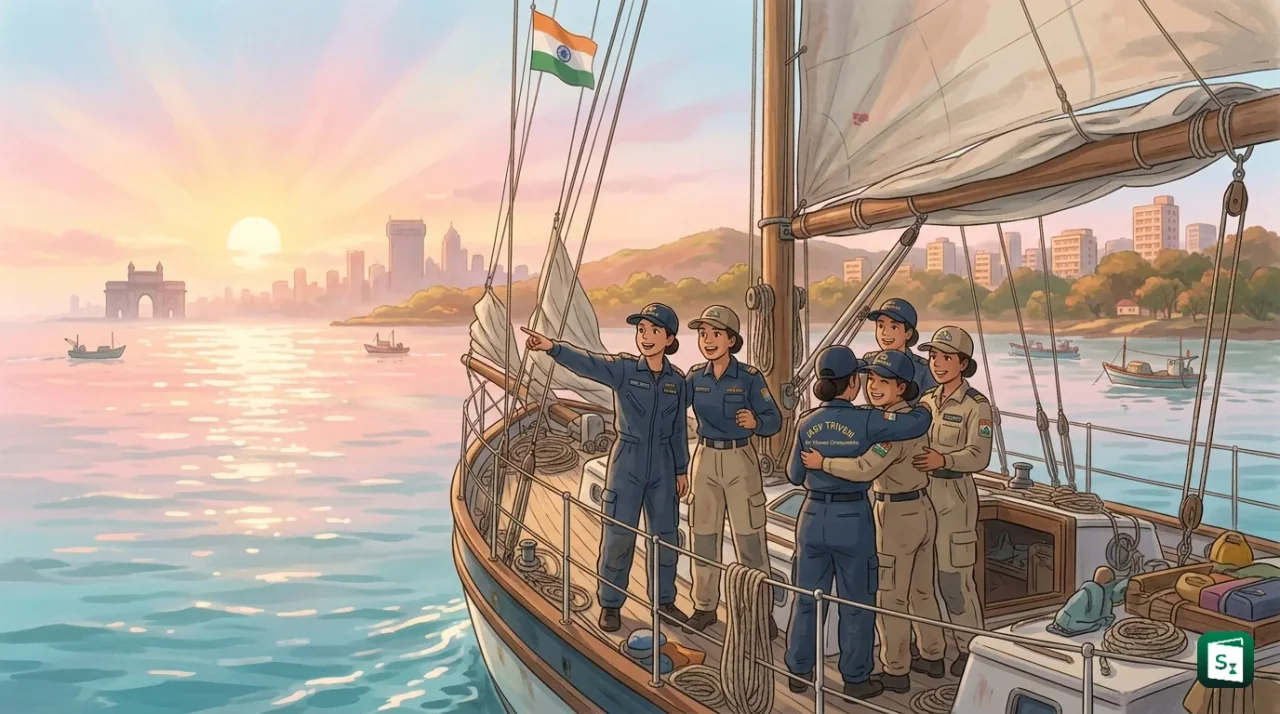
Defence Minister Rajnath Singh flagged in Samudra Pradakshina, India’s first Tri-Service all-women circumnavigation sailing expedition, on July 22, 2026, as nine women officers aboard the Indian Army Sailing Vessel (IASV) Triveni returned to Mumbai. The crew completed a gruelling 314-day voyage covering nearly 25,500 nautical miles across four oceans, fulfilling every internationally recognised condition for a true circumnavigation of the globe. The expedition stands as a landmark achievement in India’s maritime history, demonstrating the growing role of women in the armed forces, the effectiveness of Tri-Service jointness, and the nation’s indigenous shipbuilding capability under the Aatmanirbhar Bharat initiative.
What Is Samudra Pradakshina?
Samudra Pradakshina is the world’s first Tri-Service all-women circumnavigation sailing expedition. The term combines “Samudra” (ocean) and “Pradakshina” (circumambulation), reflecting the crew’s journey around the globe by sea. The expedition was virtually flagged off by Rajnath Singh from the Gateway of India in Mumbai on September 11, 2025, and the crew returned to the same location on July 22, 2026.
The expedition was planned and executed under the aegis of the Indian Army, which operates the sailing programme through the Heavy Bridging Training Camp (HBTC) at Marve, Mumbai. The crew underwent nearly two and a half years of rigorous training, including basic and intermediate blue-water sailing courses, navigation, communication, scuba diving, basic medical training, and a landmark international training expedition from Mumbai to Seychelles and back.
Rajnath Singh described the successful completion of the expedition as a testament to India’s Nari Shakti, a symbol of the nation’s resolve, proof of the effectiveness of Tri-Service synergy, and a celebration of “New India” that overcomes challenges to script history.
The Crew: Nine Officers from Three Services
The expedition originally set out with 10 women officers, but returned with nine aboard IASV Triveni. The crew composition reflected the joint character of the mission, with officers drawn from all three branches of the Indian Armed Forces.
| Service | Number of Officers | Key Members |
|---|---|---|
| Indian Army | 5 officers | Expedition Leader Lt Col Anuja Varudkar, Maj Karamjeet Kaur, Maj Omita Dalvi, Capt Prajakta P Nikam, Capt Dauli Butola |
| Indian Air Force | 4 officers | Deputy Expedition Leader Sqn Ldr Shraddha P Raju, Wg Cdr Vibha Singh, Sqn Ldr Aruvi Jayadev, Sqn Ldr Vaishali Bhandari |
| Indian Navy | 1 officer | Lt Cdr Priyanka Gusain |
The crew was led by Lieutenant Colonel Anuja Varudkar with Squadron Leader Shraddha P Raju serving as the deputy expedition leader. For more than ten months, these officers lived, trained, and sailed together as one cohesive unit, demonstrating that jointness is not merely an organisational concept but a force multiplier that enhances operational effectiveness.
The Voyage: Route, Distance, and Duration
The Samudra Pradakshina expedition sailed for 314 days and covered nearly 25,500 nautical miles, following an easterly route around the world. The crew set sail from the Gateway of India in Mumbai on September 11, 2025, and charted a course that took them across all major oceans of the planet.
To qualify as a true circumnavigation under the norms of the World Sailing Speed Record Council, the expedition had to meet strict criteria:
- Cross all meridians of longitude
- Cross the Equator twice
- Cross the International Date Line
- Round the Three Great Capes Cape Leeuwin (Australia), Cape Horn (Chile), and the Cape of Good Hope (South Africa)
- Complete the voyage under sail alone, without using canals or powered transit
The expedition made four international port calls during the voyage: Fremantle (Australia), Lyttelton (New Zealand), Port Stanley (Falkland Islands), and Cape Town (South Africa). During these stops, the crew engaged in diplomatic and cultural activities, showcasing India’s maritime traditions and military professionalism.
The Toughest Challenge: Drake Passage and Cape Horn
The most formidable leg of the expedition was the passage through the Drake Passage and the rounding of Cape Horn. The Drake Passage is the 800-kilometre-wide body of water between Cape Horn (the southern tip of South America) and the South Shetland Islands of Antarctica. It is notorious for its colossal waves, violent storms, gale-force winds, and freezing temperatures, making it one of the most dangerous maritime routes in the world.
The crew navigated this stretch during the Southern Hemisphere summer of December 2025 to February 2026. The successful passage through the Drake Passage and the rounding of Cape Horn earned the crew membership of the prestigious International Association of Cape Horners, an honour reserved for sailors who conquer one of the world’s most demanding maritime passages. This is a rare distinction that only a small number of sailors worldwide have earned.
Rajnath Singh remarked that the expedition proved “human courage is much greater than any storm,” adding that “ocean waves may rise high, but the spirit of India’s daughters soars higher.”
IASV Triveni: An Indigenous Marvel
The expedition was carried out aboard the Indian Army Sailing Vessel (IASV) Triveni, a 50-foot Class-A yacht built indigenously in Puducherry. The name “Triveni” symbolises the confluence of three rivers, reflecting the spirit of jointness among the three services. The vessel was acquired by the Indian Army in October 2024 and had already logged 10,000 nautical miles in training before the expedition.
Rajnath Singh termed IASV Triveni as an embodiment of Aatmanirbhar Bharat, stating that the vessel showcases India’s technical prowess, innovation, and self-confidence. He described it as “a testament to India’s engineering excellence, indigenous capability, and strategic confidence.”
| Feature | Specification |
|---|---|
| Length | 50 feet |
| Type | Class-A ocean-going yacht |
| Built at | Puducherry, India |
| Acquired by Indian Army | October 2024 |
| Training mileage before expedition | 10,000 nautical miles |
| Crew capacity | 9-10 persons |
| Equipment | Modern navigation and communication systems |
A Floating Ambassador: Military Diplomacy at Sea
Beyond its maritime achievement, Samudra Pradakshina served as a significant instrument of military diplomacy. During port calls across Australia, New Zealand, the Falkland Islands, and South Africa, the crew showcased India’s rich cultural heritage, maritime traditions, military professionalism, and enduring values.
Rajnath Singh described IASV Triveni as India’s “floating ambassador”, adding that the port calls across various nations strengthened the country’s soft power. The expedition fostered goodwill with friendly nations and projected India as a responsible maritime power with a rich seafaring tradition.
The flag-in ceremony at Kartavya Bhavan in New Delhi saw the participation of senior military leadership, including Chief of Defence Staff General NS Raja Subramani, Chief of the Naval Staff Admiral Krishna Swaminathan, Chief of the Army Staff General Dhiraj Seth, and Vice Chief of the Air Staff Air Marshal Ashutosh Dixit. Defence delegates from Australia, New Zealand, Argentina, and South Africa also attended the event. At the Gateway of India, the crew was received by senior officers from the Southern Command, South Western Air Command, and the Western Naval Command, along with veterans and families.
India’s Growing Legacy in Ocean Sailing
Samudra Pradakshina adds to India’s impressive and growing record in ocean sailing and circumnavigation. The country has built a distinguished tradition of maritime exploration through sailing expeditions led by armed forces personnel.
The first Indian to complete a solo circumnavigation was Captain Dilip Donde (Retd) of the Indian Navy in 2009-10. Commander Abhilash Tomy (Retd) became the first Indian to complete a solo, non-stop circumnavigation in 2012-13. The Indian Navy’s Navika Sagar Parikrama expeditions on INSV Tarini have been landmark all-women voyages: the first edition (2017-18) saw a six-member all-women crew circumnavigate the globe in 254 days. More recently, Navika Sagar Parikrama II (2024-25) was completed by Lieutenant Commander Dilna K and Lieutenant Commander Roopa A in double-handed mode on INSV Tarini, for which they were awarded the Shaurya Chakra, India’s peacetime gallantry award.
Samudra Pradakshina is distinctive because it is the first Tri-Service expedition of its kind, bringing together officers from the Army, Navy, and Air Force on a single mission. It also represents the Indian Army’s first circumnavigation, as all previous global sailing expeditions were led by the Indian Navy.
Key Takeaways
- Samudra Pradakshina is the world’s first Tri-Service all-women circumnavigation sailing expedition, flagged in by Defence Minister Rajnath Singh on July 22, 2026.
- The expedition lasted 314 days, covering nearly 25,500 nautical miles across four oceans, sailing aboard the indigenously built IASV Triveni.
- The crew comprised nine women officers from the Indian Army, Navy, and Air Force, led by Lieutenant Colonel Anuja Varudkar with Squadron Leader Shraddha P Raju as deputy.
- The expedition met all circumnavigation criteria, including crossing the Equator twice, rounding the Three Great Capes (Cape Leeuwin, Cape Horn, Cape of Good Hope), and crossing the Drake Passage, earning the crew membership of the International Association of Cape Horners.
- IASV Triveni is a 50-foot Class-A yacht built indigenously in Puducherry, acquired by the Indian Army in October 2024, symbolising Aatmanirbhar Bharat.
- The first Indian solo circumnavigation was by Captain Dilip Donde (Retd) in 2009-10, and the first solo non-stop circumnavigation was by Commander Abhilash Tomy (Retd) in 2012-13.