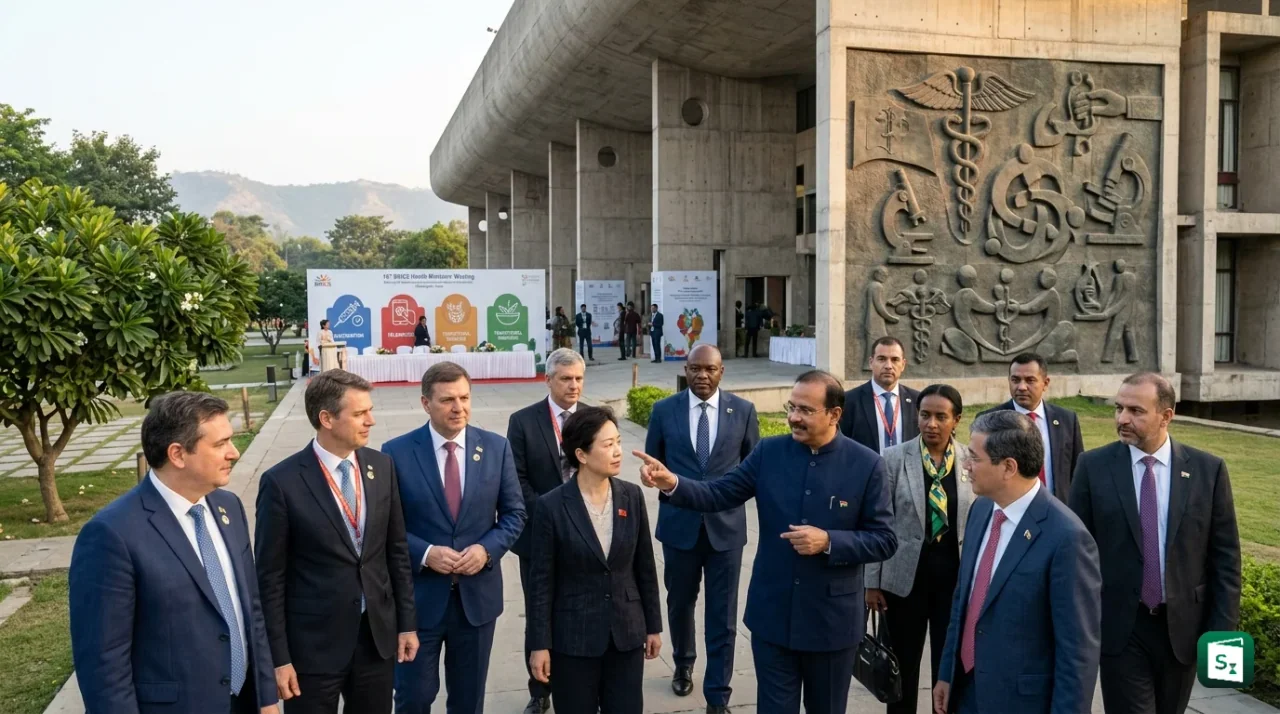
India hosted the 16th BRICS Health Ministers’ Meeting in Chandigarh from July 22 to 24, 2026, under its BRICS Chairship, bringing together health ministers and senior officials from all 11 member countries. The meeting unanimously adopted the 16th BRICS Health Ministerial Declaration, establishing a range of institutional mechanisms to deepen cooperation on public health, pandemic preparedness, digital health, and traditional medicine. Separately, the Ministry of Education convened the International Governing Board (IGB) meeting of the BRICS Network University (BRICS NU) virtually, furthering academic collaboration under India’s presidency.
BRICS: A Brief Background
BRICS is a grouping of major emerging economies that was formalised in 2006 when the foreign ministers of Brazil, Russia, India, and China met on the margins of the United Nations General Assembly in New York. The first summit of BRIC (before South Africa joined) was held in Yekaterinburg, Russia, in 2009. South Africa became a member in 2011, expanding the acronym to BRICS. In 2024, the grouping was further expanded to include Egypt, Ethiopia, Iran, Saudi Arabia, and the United Arab Emirates, followed by Indonesia joining in 2025. Today, BRICS has 11 member countries and 10 partner countries, including Belarus, Bolivia, Cuba, Kazakhstan, Malaysia, Nigeria, Thailand, Uganda, Uzbekistan, and Vietnam.
India is chairing BRICS for the fourth time in 2026, having previously held the chairship in 2012, 2016, and 2021. The theme for India’s chairship is “Building for Resilience, Innovation, Cooperation and Sustainability”, guided by a people-centric and humanity-first approach articulated by Prime Minister Narendra Modi. The chairship is structured around four key pillars: Resilience, Innovation, Cooperation, and Sustainability.
16th BRICS Health Ministers’ Meeting: Key Outcomes
The 16th BRICS Health Ministers’ Meeting, held in Chandigarh from July 22 to 24, 2026, was addressed virtually by Union Health Minister Jagat Prakash Nadda. He highlighted that India’s experience with people-centric healthcare reforms, expanded access through digital public infrastructure, and enhanced service delivery under the leadership of PM Modi has reinforced the belief that resilient public health systems are essential for sustainable development.
Nine Priority Areas and Institutional Mechanisms
The meeting identified nine priority areas for BRICS health cooperation. Among the most significant outcomes was the launch of the BRICS Mission for Healthy Lifestyle, aimed at addressing major risk factors such as unhealthy diets and physical inactivity. A BRICS Roadmap for Joint Initiative on Healthy Lifestyle Promotion (2026-2029) was also released to promote healthy diets, regular physical activity, preservation of traditional food cultures, and evidence-based behavioural change across member nations.
Nadda announced the establishment of the BRICS Network of Centres of Excellence on Mental Wellness, to be coordinated by the National Institute of Mental Health and Neuro Sciences (NIMHANS) in Bengaluru. NIMHANS, established in 1974 as an amalgamation of the All India Institute of Mental Health and the Government Mental Hospital, is India’s apex institute for mental health and neurosciences. This network will strengthen research, promote mental wellbeing, and narrow treatment gaps across member countries.
The meeting also adopted the Operational Framework to Fight Diseases Driven by Social Determinants of Health (DD-SDH) and the Operational Framework for the BRICS Network of National Public Health Institutes. These frameworks provide durable institutional structures for scientific collaboration, public health intelligence, and multi-sectoral action.
| Outcome | Purpose |
|---|---|
| Sub-Working Group on BRICS Integrated Early Warning System | Prevention and response to mass infectious diseases |
| BRICS GxP White Paper | Regulatory excellence and harmonisation of medical products |
| BRICS Compendium on Digital Health Architecture | Knowledge resource for continuum of care, including remote access |
| BRICS TB Research Network strengthening | Accelerating collaborative research for global TB elimination |
| BRICS Expert Working Group on TCIM | Promoting Traditional, Complementary and Integrative Medicine |
| BRICS Vaccine Research and Development Centre | Collaborative research and equitable access to vaccines |
| BRICS Nuclear Medicine cooperation | Continued support for nuclear medicine collaboration |
India’s Digital Health Showcase
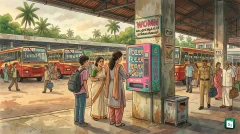
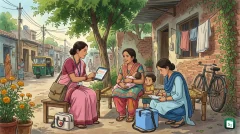
India highlighted its digital health achievements, including the Ayushman Bharat Digital Mission (ABDM), Ayushman Arogya Mandirs, and the e-Sanjeevani telemedicine platform. Delegates also visited exhibition pavilions set up by the Food Safety and Standards Authority of India (FSSAI), the National Health Authority (NHA), and the Ministry of AYUSH, including a live millet session under the Eat Right India initiative.
The 16th BRICS Health Ministerial Declaration was adopted unanimously, reaffirming commitments to Universal Health Coverage, pandemic prevention and response, digital health, regulatory cooperation, and equitable access to affordable medicines, vaccines, diagnostics, and medical technologies.
BRICS Network University: Advancing Academic Cooperation
Alongside the health ministers’ meeting, India convened the International Governing Board (IGB) meeting of the BRICS Network University (BRICS NU) in a virtual format as part of its BRICS presidency. This meeting followed a two-day conference on Traditional and Indigenous Knowledge Systems held from July 20, 2026, which brought together government representatives, university leaders, academics, and experts from BRICS member countries.
The BRICS Network University was established in 2015 during the II Meeting of BRICS Education Ministers in Moscow. It is a collaborative educational and research initiative that brings together higher education institutions from BRICS countries to promote joint research, academic mobility, and innovative educational programmes. The network was originally structured around six thematic areas: Computer Science and Information Security, BRICS Studies, Energy, Ecology and Climate Change, Water Resources and Pollution Control, and Economics. Following the expansion of BRICS membership in 2024 and 2025, five new areas were added: Health Sciences, Mathematics, Natural Sciences, Social Sciences and Humanities, and Sustainable Agriculture and Food Security.
The IGB meeting reviewed the BRICS Network University Action Plan (2025-2028), discussed measures to enhance institutional cooperation and academic mobility, and adopted the BRICS Network University International Governing Board Declaration. The conference on Traditional and Indigenous Knowledge Systems developed guiding principles on strengthening academic collaboration in mapping, documentation, preservation, and responsible digital dissemination of traditional knowledge, while emphasising ethical governance, community ownership, and the responsible use of emerging technologies including Artificial Intelligence.
Significance of India’s BRICS Chairship 2026
India’s chairship comes at a landmark moment: 2026 marks 20 years since BRICS was formalised. The grouping has evolved from a four-member economic dialogue into an 11-member bloc with 10 partner countries, representing a significant voice of the Global South. India’s approach mirrors the strategy it successfully used during its G20 Presidency in 2023, steering multilateral forums toward functional cooperation on health, education, climate, and technology rather than allowing geopolitical divisions to dominate.
The health outcomes carry particular weight. BRICS countries collectively account for nearly half of the global tuberculosis burden, making the strengthened TB Research Network vital for global health security. The establishment of the Integrated Early Warning System for infectious diseases addresses a critical gap exposed by the COVID-19 pandemic. The focus on traditional medicine aligns with India’s global advocacy for AYUSH systems and the International Day of Yoga.
On the education front, the BRICS Network University conference on Traditional and Indigenous Knowledge Systems positions India’s rich heritage as a global academic resource, while the Action Plan (2025-2028) ensures continuity in higher education cooperation beyond India’s chairship year.
Key Takeaways
- India hosted the 16th BRICS Health Ministers’ Meeting in Chandigarh from July 22 to 24, 2026, under its fourth BRICS Chairship.
- The meeting adopted the 16th BRICS Health Ministerial Declaration and launched the BRICS Mission for Healthy Lifestyle along with a Roadmap for 2026-2029.
- The BRICS Network of Centres of Excellence on Mental Wellness was announced, to be coordinated by NIMHANS in Bengaluru.
- The BRICS Network University (BRICS NU) was established in 2015 and its IGB meeting adopted an Action Plan (2025-2028) under India’s presidency.
- BRICS was formalised in 2006 and has expanded to 11 members and 10 partner countries.
- India’s chairship theme “Building for Resilience, Innovation, Cooperation and Sustainability” is built on four pillars: Resilience, Innovation, Cooperation, and Sustainability.