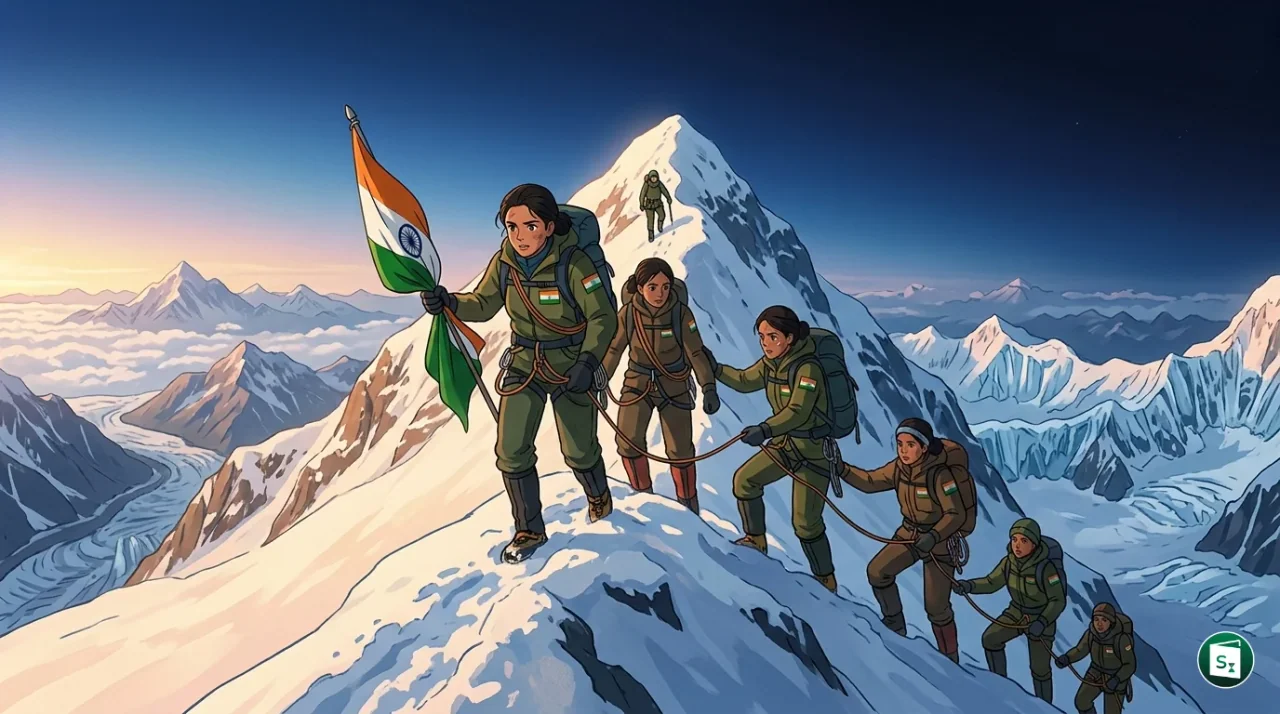
India achieved a historic double milestone in high-altitude mountaineering as all-women teams from the Indo-Tibetan Border Police (ITBP) and the Border Security Force (BSF) successfully scaled Mount Everest on May 21, 2026. The simultaneous triumphs, part of separate inaugural missions, underscore the growing leadership of women within India’s Central Armed Police Forces (CAPF). This feat also coincided with the BSF’s Diamond Jubilee celebrations, marking six decades of dedicated service to the nation.
ITBP’s Historic All-Women Summit
The Indo-Tibetan Border Police (ITBP) achieved a 100% success rate in its first-ever all-women international expedition to the world’s highest peak. A 14-member team, including 11 women climbers and 3 technical support members, reached the 8,848.86-metre summit via the South Col Route from Nepal. The expedition, led by Bhanita Timungpi, was flagged off in April 2026 as part of a multi-year initiative by the Ministry of Home Affairs (MHA) to enhance mountaineering expertise among female personnel.
Beyond the mountaineering feat, the ITBP team also spearheaded the “Clean Himalaya and Save Glacier” campaign. During their ascent and descent, the climbers collected non-biodegradable waste from various high-altitude camps, highlighting the force’s commitment to environmental conservation in the fragile Himalayan ecosystem. This mission marked the 232nd mountaineering expedition for the ITBP, an organization often referred to as the “Himveers” or Snow Warriors for their specialized skills in high-altitude warfare and rescue.
BSF’s ‘Mission Vande Mataram’
The Border Security Force (BSF) scripted its own chapter in history with ‘Mission Vande Mataram’, the force’s first successful all-women ascent of Mount Everest. The expedition was meticulously timed to coincide with the BSF’s Diamond Jubilee, celebrating 60 years since its establishment on December 1, 1965. Additionally, the mission commemorated the 150th anniversary of the national song, “Vande Mataram,” composed by Bankim Chandra Chatterjee.
Led by Deputy Commandant Loveraj Singh Dharamshaktu, a seven-time Everest summiteer and Padma Shri awardee, the team featured four courageous women constables: Kouser Fatima, Munmun Ghosh, Rabeka Singh, and Tsering Chorol. In a stirring display of patriotism, the members sang the national song in unison upon reaching the summit at 8:00 AM IST. The mission also integrated a “Clean Himalaya and Clean Glaciers” initiative, paralleling the ITBP’s efforts to maintain the purity of the world’s highest peaks. This achievement reflects the BSF’s motto, Jeevan Paryant Kartavya (Duty Unto Death), and its expanding role in specialized adventure missions.
Understanding India’s Central Armed Police Forces (CAPF)
The Central Armed Police Forces (CAPF) consist of seven distinct security agencies under the administrative control of the Ministry of Home Affairs (MHA). These include the Border Security Force (BSF), the Indo-Tibetan Border Police (ITBP), the Central Reserve Police Force (CRPF), the Central Industrial Security Force (CISF), the Sashastra Seema Bal (SSB), the National Security Guard (NSG), and the Assam Rifles (AR). Under Article 355 of the Indian Constitution, the Central Government is mandated to protect every state against external aggression and internal disturbance, which forms the legal basis for the deployment of these forces.
The roles and mandates of the BSF and ITBP are specifically tied to India’s territorial integrity. The BSF, often called the “First Line of Defence,” was raised in 1965 to guard India’s land borders with Pakistan and Bangladesh. In contrast, the ITBP was established on October 24, 1962, following the Sino-Indian War, with the primary task of guarding the 3,488 km Indo-China border. The recent Everest expeditions demonstrate the evolved capabilities of these forces, moving beyond traditional border guarding to elite high-altitude survival and specialized environmental leadership.
The South Col Route: The Path to the Top
Both the ITBP and BSF teams utilized the South Col Route from the Nepalese side of the mountain. This path is historically significant as the route taken by Sir Edmund Hillary and Tenzing Norgay during the first successful ascent in 1953. The journey involves navigating the treacherous Khumbu Icefall, a shifting glacier filled with deep crevasses, and ascending the Lhotse Face to reach Camp 4 at the South Col.
At an altitude of approximately 7,950 metres, the South Col marks the entry into the “Death Zone.” In this region, the atmospheric pressure is so low that the human body can no longer acclimatize, making supplemental oxygen and rapid movement essential for survival. By conquering this route, the women of the CAPFs have proven their physical endurance and technical proficiency in one of the most hostile environments on Earth.
Comparison of ITBP and BSF
| Feature | Indo-Tibetan Border Police (ITBP) | Border Security Force (BSF) |
|---|---|---|
| Establishment | October 24, 1962 | December 1, 1965 |
| Motto | Shaurya – Dridhata – Karm Nishtha | Jeevan Paryant Kartavya |
| Primary Border | Indo-China Border (3,488 km) | Pakistan and Bangladesh Borders |
| Nickname | Himveers (Snow Warriors) | First Line of Defence |
| Headquarters | New Delhi | New Delhi |
Key Takeaways
- All-women teams from the ITBP and BSF successfully scaled the 8,848.86-metre peak of Mount Everest on May 21, 2026.
- The BSF expedition, titled ‘Mission Vande Mataram’, was organized to celebrate the force’s Diamond Jubilee (60 years) and the 150th anniversary of India’s national song.
- The Indo-Tibetan Border Police (ITBP) was established on October 24, 1962, and is primarily responsible for guarding the 3,488 km border between India and China.
- The Border Security Force (BSF), established on December 1, 1965, is tasked with guarding India’s borders with Pakistan and Bangladesh.
- Both forces operate under the administrative control of the Ministry of Home Affairs (MHA) as part of India’s seven Central Armed Police Forces (CAPF).
- Both expeditions incorporated the “Clean Himalaya” initiative, focusing on collecting and removing non-biodegradable waste from the Everest region.