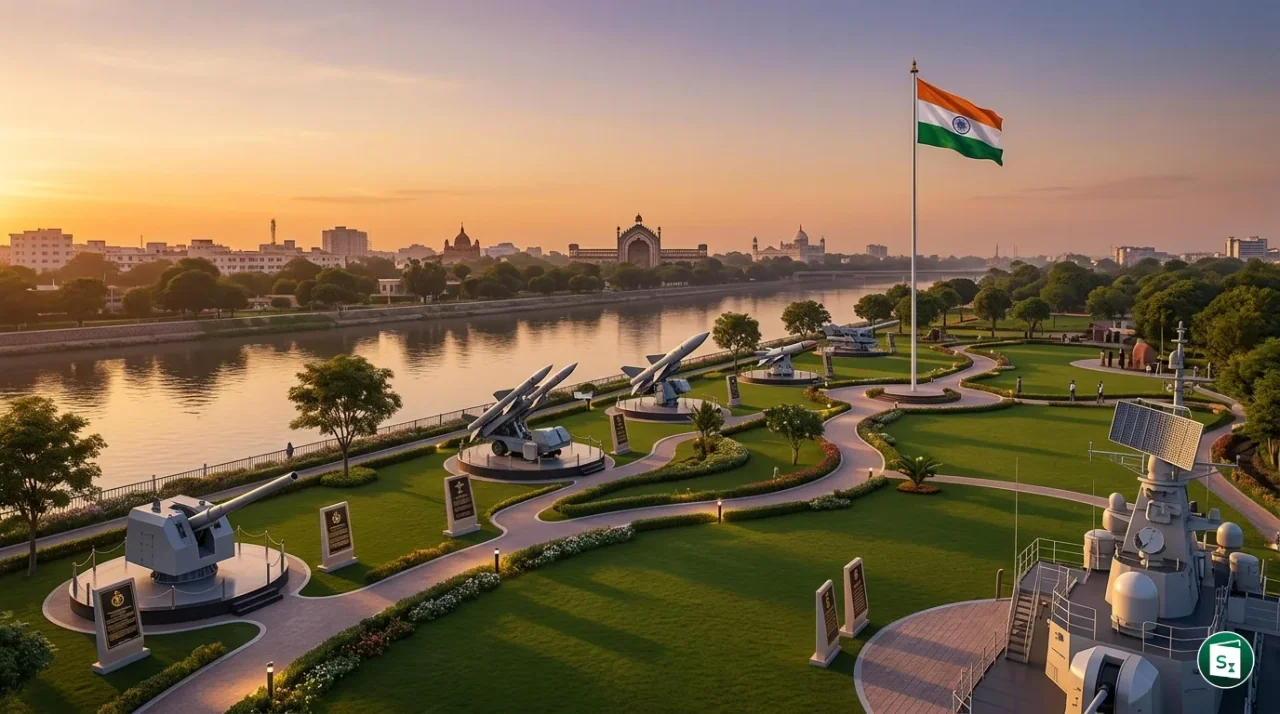
Union Defence Minister Rajnath Singh and Uttar Pradesh Chief Minister Yogi Adityanath inaugurated the Nausena Shaurya Vatika in Lucknow on May 30, 2026. This open-air naval museum, built at a cost of ₹19 crore, serves as a maritime heritage landmark in a landlocked state to honour the valour of the Indian Navy. The museum preserves the legacy of the decommissioned frigate INS Gomati, bringing the history of India’s maritime prowess to the heart of North India.
India’s First Major Naval Museum in a Landlocked State
The Nausena Shaurya Vatika is a joint initiative between the Indian Navy and the Uttar Pradesh Tourism Department. Located in the CG City area of Lucknow, the museum is spread across two acres on the banks of the Gomti River. While most naval museums are situated in coastal cities, this project is part of the Navy’s broader outreach to educate citizens in the hinterland about India’s maritime security and the growing Blue Economy.
The museum is designed to be a comprehensive interpretation centre. It forms the second phase of a larger naval heritage project that includes the upcoming INS Gomati Shaurya Sangrahalaya. Together, these facilities aim to transform Lucknow into a hub for military tourism, providing an immersive experience of life at sea for those living far from the coast.
The Legacy of INS Gomati: The Oldest Warrior of the Western Fleet
The centrepiece of the museum is the decommissioned INS Gomati (F21), a Godavari-class guided-missile frigate. Commissioned on April 16, 1988, the ship was built by Mazagon Dock Limited (MDL) in Mumbai and served the nation for 34 years. It was a technological pioneer, being the first Indian Navy vessel to incorporate digital electronics in its combat data system.
The ship’s connection to Lucknow is deeply symbolic. Named after the Gomti River, its crest featured the city’s historic Chhattar Manzil. Upon its decommissioning on May 28, 2022, the decision was made to transport its major components to Lucknow to create a lasting memorial.
Key Operations and Achievements
During its distinguished career, INS Gomati was twice awarded the prestigious Unit Citation for its contribution to national security. The vessel participated in several landmark military operations, including:
- Operation Cactus (1988): A swift military intervention that successfully thwarted a coup attempt in the Maldives.
- Operation Parakram (2001-2002): A major troop mobilization on the Indo-Pakistan border following the terrorist attack on the Indian Parliament.
- Operation Rainbow (2004): A large-scale humanitarian assistance and disaster relief mission conducted after the devastating Indian Ocean Tsunami.
Exhibits and Military Hardware at Shaurya Vatika
The museum provides a unique opportunity for visitors to see authentic naval weaponry and equipment up close. Many of these exhibits were physically transferred from INS Gomati after its decommissioning. The display includes heavy armament and advanced surveillance systems that were once the backbone of the ship’s combat capabilities.
| Category | Key Exhibits |
|---|---|
| Naval Weaponry | AK-726 medium-range naval gun, ZIF-101 surface-to-air missile launcher, and torpedo launchers |
| Ship Components | Main mast, anchors, propellers, and the ship’s original nameplate |
| Aviation Section | TU-142M long-range maritime patrol aircraft (walkthrough museum) and Sea King SK-42B helicopter |
| Technology | Radar systems, capstan drums, and warship simulators |
In addition to the physical hardware, the museum features digital storytelling galleries and a 7D theatre to provide an immersive experience of maritime warfare. The Defence Minister also announced plans to add a decommissioned submarine to the museum in the near future, which will allow visitors to explore the internal workings of an underwater vessel.
Strategic Significance: Inspiring the Youth of North India
The establishment of a naval museum in Uttar Pradesh carries significant strategic weight. Despite being a landlocked state, Uttar Pradesh contributes a substantial percentage of personnel to the Indian Navy. By bringing naval history to the state’s capital, the project aims to inspire the next generation to consider careers in the maritime forces and national service.
Chief Minister Yogi Adityanath emphasized that the Nausena Shaurya Vatika would become a “living symbol” of the Navy’s courage. It complements other military heritage sites in the city, such as the Rashtriya Prerna Sthal, creating a circuit of military tourism. This initiative is expected to boost local tourism while fostering a sense of national pride and awareness about the critical role the Indian Navy plays in safeguarding the nation’s vast coastline and maritime interests.
Key Takeaways
- Nausena Shaurya Vatika, an open-air naval museum, was inaugurated in Lucknow on May 30, 2026, by Union Defence Minister Rajnath Singh and UP CM Yogi Adityanath.
- The museum is dedicated to the legacy of INS Gomati (F21), a Godavari-class guided-missile frigate decommissioned in May 2022.
- INS Gomati was built by Mazagon Dock Limited (MDL) and was the first Indian Navy ship to feature digital electronics in its combat systems.
- The vessel participated in major national security operations, including Operation Cactus (1988), Operation Parakram (2001-2002), and Operation Rainbow (2004).
- Key exhibits at the museum include AK-726 naval guns, ZIF-101 missile launchers, and a walkthrough museum of the TU-142M maritime patrol aircraft.
- The project was developed at a cost of ₹19 crore by the Uttar Pradesh Tourism Department in collaboration with the Indian Navy.