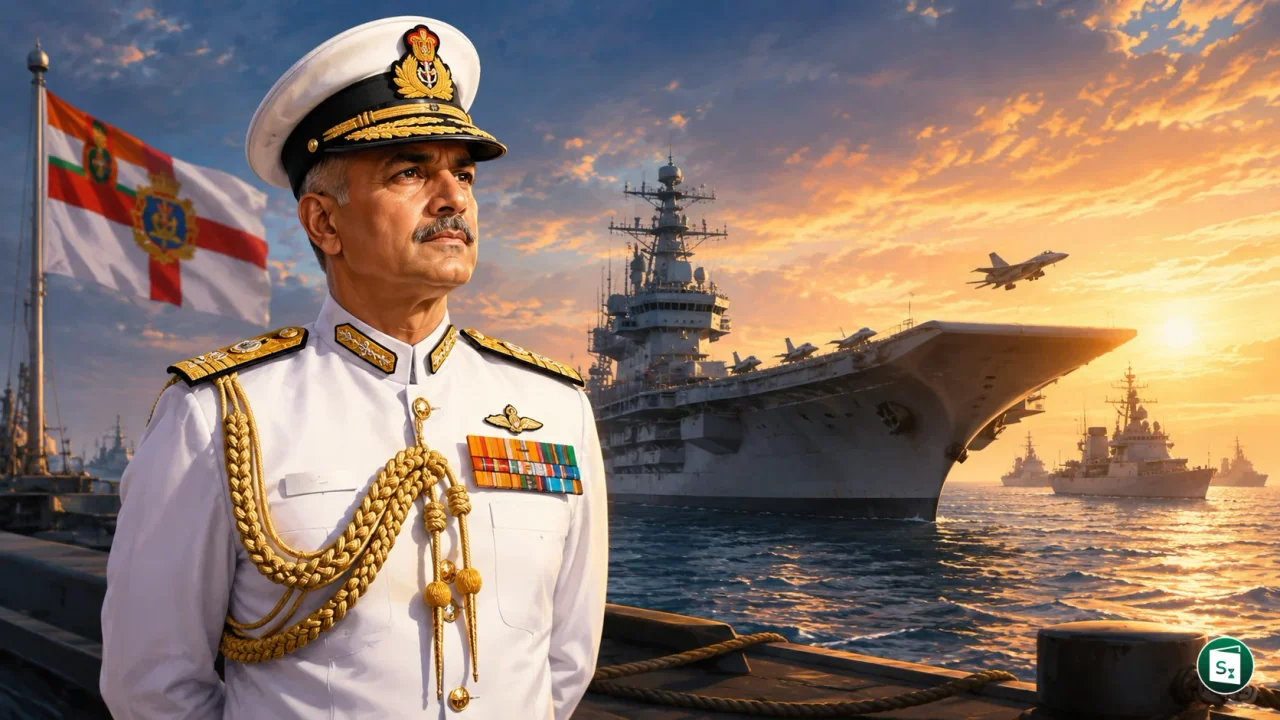
Vice Admiral Sanjay Vatsayan assumed the role of Flag Officer Commanding-in-Chief (FOC-in-C) of the Western Naval Command on June 1, 2026. He takes over the prestigious command from Vice Admiral Krishna Swaminathan, who has moved to New Delhi as the new Chief of the Naval Staff. This transition comes at a time when the Western Naval Command continues to play a pivotal role in securing India’s maritime interests in the Arabian Sea and beyond.
Distinguished Career of Vice Admiral Sanjay Vatsayan
Vice Admiral Sanjay Vatsayan is a highly decorated officer with a career spanning over three decades in the Indian Navy. An alumnus of the 71st Course of the National Defence Academy (NDA), he was commissioned into the Navy on January 1, 1988. He specialized in Gunnery and Missile Systems, a field that has been central to his numerous command and staff appointments.
Before taking over the Western Naval Command, he served as the Vice Chief of the Naval Staff (VCNS) at Naval Headquarters in New Delhi. His leadership experience is extensive, having commanded the Navy’s Eastern Fleet as the Flag Officer Commanding Eastern Fleet (FOCEF). He has also held other critical positions, including Deputy Chief of Integrated Defence Staff (Policy Planning and Force Development) and Chief of Staff of the Eastern Naval Command.
Throughout his service, he has been recognized with several prestigious awards for his exceptional devotion to duty and leadership. These include:
- Param Vishisht Seva Medal (PVSM) in 2026
- Ati Vishisht Seva Medal (AVSM) in 2021
- Nao Sena Medal (NM) in 2017
His operational experience is equally impressive, having served as the commissioning Commanding Officer of the indigenously built stealth frigate INS Sahyadri. He has also commanded the guided-missile corvette INS Kuthar and missile vessels INS Nashak and INS Vibhuti.
Understanding the Western Naval Command: The “Sword Arm”
Headquartered in Mumbai, the Western Naval Command (WNC) is the premier operational command of the Indian Navy. It is often referred to as the “Sword Arm” of the Navy because it is the primary formation responsible for naval operations in the Arabian Sea and the western parts of the Indian Ocean.
The jurisdiction of the WNC is vast, stretching from the border with Pakistan in Gujarat down to Karwar in Karnataka. It is responsible for the entire western seaboard of India, an area that includes some of the country’s most vital economic and strategic assets. The command is home to the Western Fleet, the Navy’s most powerful combat formation, which includes the aircraft carrier INS Vikramaditya, advanced destroyers, stealth frigates, and the majority of India’s submarine fleet.
One of the most significant assets under the WNC is INS Kadamba, located in Karwar, Karnataka. It is India’s first exclusive naval base and one of the largest in the Eastern Hemisphere. This base provides the Western Naval Command with the strategic depth and advanced infrastructure necessary for maintaining a high state of operational readiness.
Strategic Importance of the Western Seaboard
The Western Naval Command operates in an area of immense economic and geopolitical significance. Approximately 90% of India’s trade by volume and 70% by value moves through the waters under the WNC’s direct responsibility. Furthermore, the command protects vital Sea Lanes of Communication (SLOCs) through which 70% of the world’s crude oil transits.
The WNC is also responsible for the security of India’s critical offshore energy installations, such as the Bombay High oil fields. In addition to its military and economic roles, the command serves as a primary responder for Humanitarian Assistance and Disaster Relief (HADR) operations and anti-piracy missions in the Gulf of Aden and the Horn of Africa. Its ability to maintain stability in the Arabian Sea is crucial for regional security and the global energy supply chain.
Command Structure of the Indian Navy
The Indian Navy is organized into three operational commands, each headed by a Flag Officer Commanding-in-Chief of the rank of Vice Admiral. These commands are:
- Western Naval Command: Headquartered in Mumbai, Maharashtra.
- Eastern Naval Command: Headquartered in Visakhapatnam, Andhra Pradesh.
- Southern Naval Command: Headquartered in Kochi, Kerala. It primarily functions as a training command.
At the apex of the naval hierarchy is the Chief of the Naval Staff (CNS), a four-star Admiral based at Naval Headquarters in New Delhi. The CNS is responsible for the overall command, control, and administration of the Navy. Following the recent transition, Vice Admiral Krishna Swaminathan has taken over this top-most role, highlighting the continuous evolution and strengthening of India’s maritime leadership.
Key Takeaways
- Vice Admiral Sanjay Vatsayan assumed charge as the Flag Officer Commanding-in-Chief (FOC-in-C) of the Western Naval Command on June 1, 2026.
- He succeeded Vice Admiral Krishna Swaminathan, who has been elevated to the position of Chief of the Naval Staff (CNS).
- The Western Naval Command, headquartered in Mumbai, is recognized as the “Sword Arm” of the Indian Navy and is its premier operational command.
- Vice Admiral Vatsayan is a specialist in Gunnery and Missile Systems and was commissioned into the Navy on January 1, 1988.
- He was honored with the Param Vishisht Seva Medal (PVSM) in 2026 for his distinguished service of an exceptional order.
- The command is responsible for protecting critical national assets, including the Bombay High offshore oil fields and the major naval base INS Kadamba at Karwar.