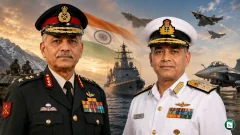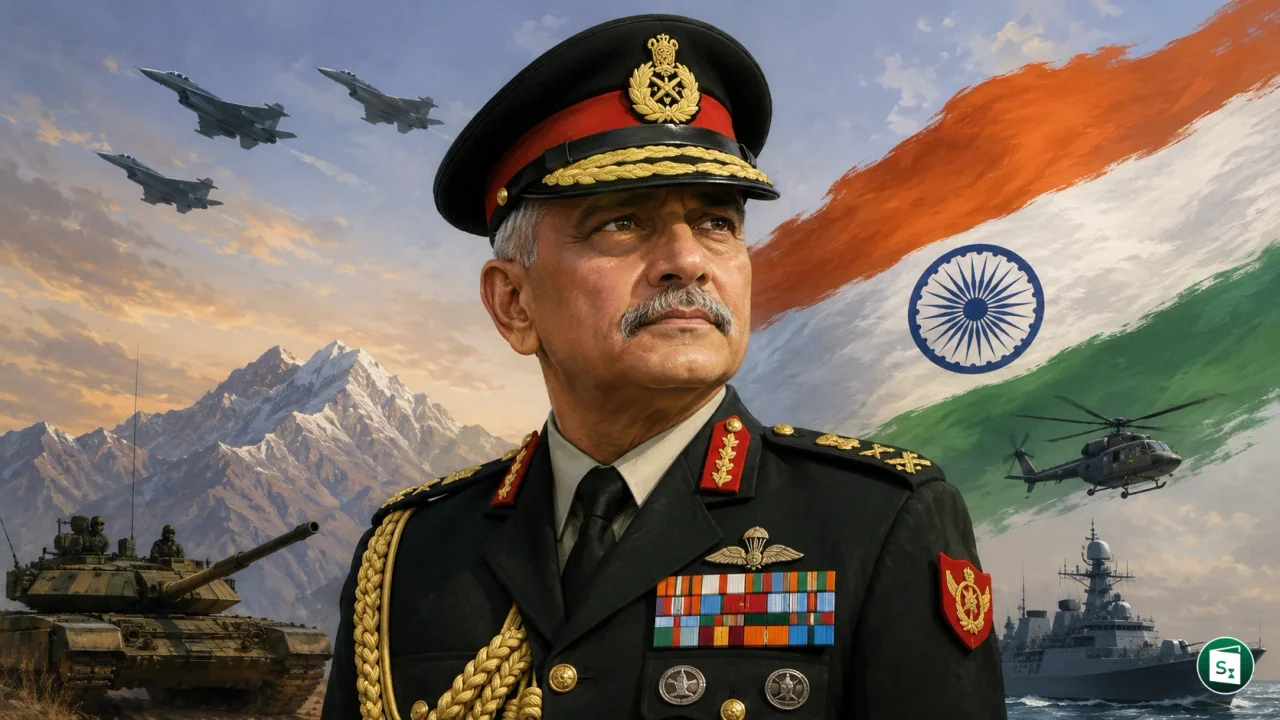
General NS Raja Subramani assumed charge as India’s third Chief of Defence Staff (CDS) on June 1, 2026, succeeding General Anil Chauhan. An alumnus of the National Defence Academy and the Indian Military Academy, he brings over four decades of distinguished service in the Indian Army. His appointment marks a pivotal step in India’s ongoing efforts to modernize its military structure and enhance tri-services synergy.
A Distinguished Career in Strategic Leadership
General Subramani was commissioned into the Garhwal Rifles in 1985. Over a career spanning more than four decades, he has held numerous critical command and staff appointments across various terrains and operational environments. Before being elevated to the position of CDS, he served as the Military Advisor at the National Security Council Secretariat (NSCS) from September 2025. The NSCS, which operates under the Prime Minister’s Office, is responsible for coordinating national security policies and advising the National Security Advisor (NSA).
His extensive leadership experience includes serving as the 47th Vice Chief of the Army Staff (VCOAS) from July 2024 to July 2025. In this role, he was instrumental in shaping the modernization initiatives and operational doctrines of the Indian Army. He also served as the General Officer Commanding-in-Chief (GOC-in-C) of the Central Command, headquartered in Lucknow, and commanded the premier strike formation of the Indian Army, the II Corps, popularly known as the Kharga Corps.
Deep Expertise in Northern and Western Border Operations
General Subramani is recognized for his deep understanding of India’s security challenges along both the Northern border with China and the Western border with Pakistan. He commanded the 17 Mountain Division, also known as the Black Cat Division, in Sikkim. This sector is highly sensitive due to its location along the Line of Actual Control (LAC). His tenure as the Chief of Staff of the Northern Command in Udhampur provided him with extensive experience in managing complex security operations in Jammu and Kashmir and Ladakh.
Beyond frontline command, his career includes significant roles in military intelligence and international diplomacy. He served as the Deputy Director General of Military Intelligence (DDGMI) at the Army Headquarters and represented India as the Defence Attaché to Kazakhstan. His operational expertise is supported by a strong academic foundation. He holds a Master of Arts from King’s College London and an MPhil in Defence Studies from Madras University. In recognition of his distinguished service, he has been awarded the Param Vishisht Seva Medal (PVSM), the Ati Vishisht Seva Medal (AVSM), and the Sena Medal (SM).
Institutional Significance of the Chief of Defence Staff
The position of the Chief of Defence Staff (CDS) was established in December 2019 following a historic announcement by the Prime Minister. The role was created to serve as the single point of military advice to the Government of India and to foster “jointness” or seamless coordination among the Army, Navy, and Air Force. The CDS functions as the Permanent Chairman of the Chiefs of Staff Committee (COSC) and leads the Department of Military Affairs (DMA) as its Secretary within the Ministry of Defence. While service chiefs retire at the age of 62, the CDS can serve until the age of 65 years.
The inaugural CDS, General Bipin Rawat, initiated major structural reforms and introduced the concept of integrated warfare before his tragic demise in a helicopter crash in 2021. He was succeeded by General Anil Chauhan, who oversaw the development of the final blueprints for military reorganization. General Subramani now takes over this responsibility, ensuring continuity in the mission to transform the Indian Armed Forces into a highly integrated and modern fighting force.
The Road Ahead: Theaterization and Military Jointness
A primary focus for General Subramani’s tenure will be the implementation of Military Theaterization. This landmark reform aims to integrate India’s 17 service-specific commands into a few unified Integrated Theatre Commands (ITCs). Currently, the Indian Army and Indian Air Force each operate seven independent commands, while the Indian Navy has three. Theaterization seeks to place these diverse assets under a single operational commander for specific geographical regions, ensuring a “Unity of Command” and more efficient use of resources.
The proposed structure includes a Northern Theatre Command to manage the border with China, a Western Theatre Command for the border with Pakistan, and a Maritime Theatre Command to secure the Indian Ocean Region. This reorganization is designed to prepare the country for modern multi-domain warfare, which increasingly involves the cyber and space domains alongside traditional land, air, and sea operations. As the third CDS, General Subramani will lead the complex task of harmonizing service-specific cultures into a cohesive and integrated military architecture.
Key Takeaways
- General NS Raja Subramani assumed charge as India’s third Chief of Defence Staff (CDS) on June 1, 2026.
- He succeeds General Anil Chauhan, who completed his tenure on May 30, 2026, following a service extension.
- General Subramani was commissioned into the Garhwal Rifles in 1985 and has previously served as the Vice Chief of the Army Staff and Military Advisor to the NSCS.
- The Chief of Defence Staff serves as the Permanent Chairman of the Chiefs of Staff Committee (COSC) and heads the Department of Military Affairs (DMA).
- A major mandate for the CDS is the implementation of Military Theaterization, involving the integration of 17 service-specific commands into unified theatre commands.
- The retirement age for the CDS is 65 years, which is higher than the retirement age of 62 for the three individual service chiefs.