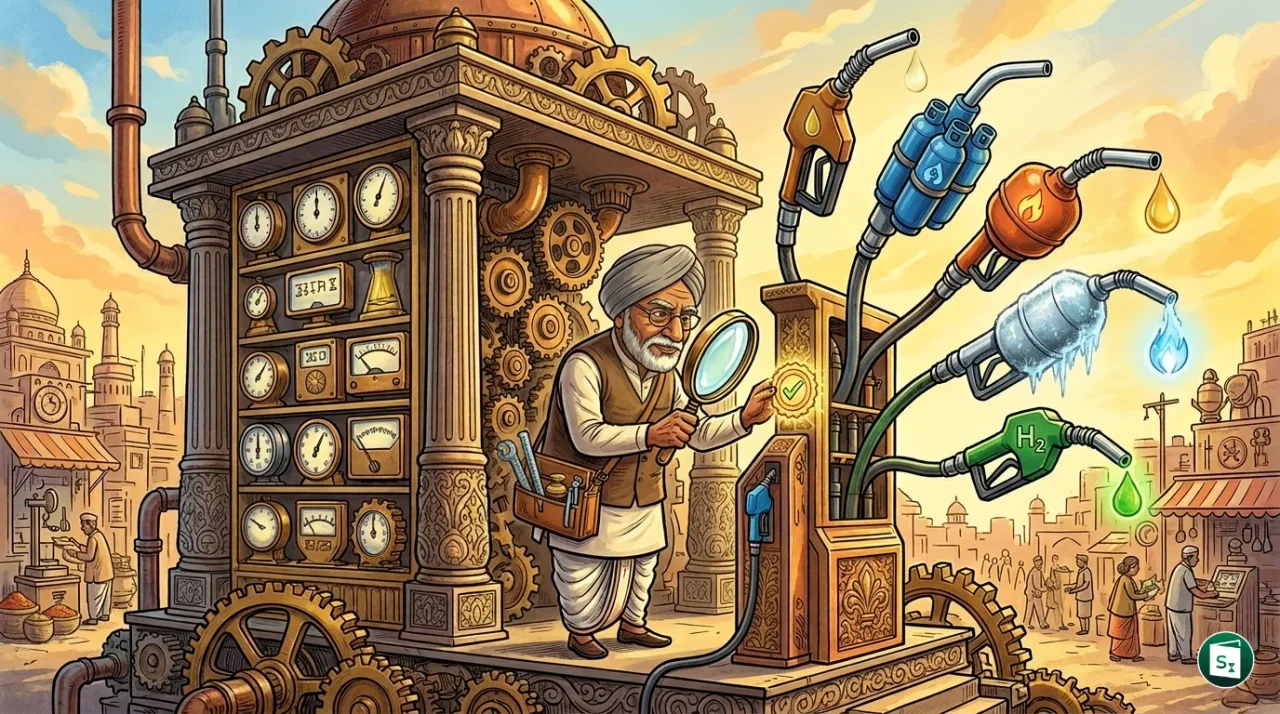
The Department of Consumer Affairs (DoCA) notified the Legal Metrology (Government Approved Test Centre) Amendment Rules, 2026, on June 1, 2026, significantly expanding the scope of weights and measures verification in India. By authorizing Government Approved Test Centres (GATCs) to verify fuel dispensing systems for petrol, diesel, and green fuels like Hydrogen, the government aims to strengthen infrastructure and ensure billing accuracy for consumers. This move increases the number of categories under the legal metrology framework from 18 to 23.
Modernizing India’s Metrology Framework
The Legal Metrology (Government Approved Test Centre) Rules, 2013, were originally designed to decentralize the verification process for common weighing and measuring instruments. Over the years, the Department of Consumer Affairs, functioning under the Ministry of Consumer Affairs, Food and Public Distribution, has gradually increased the number of categories that can be verified by these authorized centers. The 2026 amendment represents a major leap in this trajectory.
Previously, GATCs were permitted to verify 18 categories of instruments, ranging from water meters and clinical thermometers to weighing scales used in retail. The latest rules add five critical fuel dispensing categories, bringing the total to 23. This expansion is intended to reduce the workload of state-level metrology inspectors, allowing them to focus more on enforcement and market surveillance. By leveraging private sector efficiency through GATCs, the government ensures that high-volume dispensing systems are calibrated more frequently and with greater precision.
New Categories and Verification Fees
The 2026 amendment brings both traditional and emerging fuel dispensing systems under the GATC verification ambit. These systems are essential for the daily transport and industrial needs of the country. The inclusion of green fuels like Hydrogen and Liquefied Natural Gas (LNG) aligns the metrology framework with India’s broader energy transition goals, such as the National Green Hydrogen Mission.
To ensure transparency and standardization, the government has prescribed specific verification fees for these new categories. The charges vary depending on the complexity of the dispensing technology.
| Fuel Dispensing System | Verification Fee (per nozzle) |
|---|---|
| Petrol and Diesel | ₹5,000 |
| Compressed Natural Gas (CNG) | ₹10,000 |
| Liquefied Petroleum Gas (LPG) | ₹10,000 |
| Liquefied Natural Gas (LNG) | ₹10,000 |
| Hydrogen | ₹10,000 |
These fees are designed to cover the costs of high-precision testing equipment and the technical expertise required for calibration. For instance, Hydrogen dispensers operate at extremely high pressures, often between 350 to 700 bar, necessitating specialized master meters for accurate mass measurement. Similarly, LNG verification involves cryogenic conditions where the fuel is stored at temperatures as low as minus 162 degrees Celsius.
Administrative Reforms and State Empowerment
Beyond expanding the list of instruments, the Legal Metrology Amendment Rules, 2026, introduce significant administrative changes to streamline the approval of test centers. Previously, the power to approve a GATC was centralized with the Joint Secretary in the Department of Consumer Affairs. The new rules decentralize this authority, allowing any officer of the rank of Joint Secretary and above to grant approvals. This change is expected to reduce bureaucratic bottlenecks and speed up the recognition of new testing facilities across the country.
Furthermore, the amendment empowers State Governments to notify additional categories of weights and measures for GATC verification. This provision allows states to tailor their metrological infrastructure to meet local industrial requirements. For example, a state with a high concentration of textile mills or chemical plants can now authorize local GATCs to verify specialized meters used in those sectors. This flexibility is a critical component of the government’s Ease of Doing Business initiative, as it provides industries with more accessible and efficient verification options.
The Legal Metrology Act, 2009: Background and Importance
The Legal Metrology Act, 2009, is the primary legislation governing weights and measures in India. Enacted to establish and enforce standards based on the Metric System, the Act replaced two older laws: the Standards of Weights and Measures Act, 1976, and the Standards of Weights and Measures (Enforcement) Act, 1985. It came into force on April 1, 2011, with the goal of ensuring uniform measurement standards across the country.
The Act is a cornerstone of consumer protection, as it mandates that every instrument used in a commercial transaction must be verified and stamped periodically. This ensures that when a consumer pays for a specific quantity of a commodity, they receive exactly that amount. In the context of the fuel industry, even a minor calibration error can lead to cumulative financial losses for millions of consumers. By expanding the GATC framework to include modern fuel dispensers, the government is adapting the 2009 Act to the technological realities of the 2020s.
India’s commitment to international metrological standards was further highlighted in 2023 when it became an OIML (International Organization of Legal Metrology) Issuing Authority. This status allows India to issue internationally accepted certificates for weighing and measuring instruments, boosting the domestic manufacturing sector and facilitating global trade. The recent amendments to the GATC rules are another step toward aligning India’s internal verification infrastructure with these global benchmarks.
Key Takeaways
- The Department of Consumer Affairs (DoCA) notified the Legal Metrology (GATC) Amendment Rules, 2026, to include five new fuel dispensing categories.
- The amendment increases the number of instrument categories under the GATC verification framework from 18 to 23.
- Newly included fuel systems include Petrol/Diesel, CNG, LPG, LNG, and Hydrogen dispensers.
- Verification fees have been set at ₹5,000 per nozzle for petrol and diesel, and ₹10,000 per nozzle for CNG, LPG, LNG, and hydrogen.
- Approval authority for Government Approved Test Centres (GATCs) has been decentralized to include any officer of the rank of Joint Secretary and above.
- The Legal Metrology Act, 2009, which came into force on April 1, 2011, remains the primary legislation for measurement standards in India.