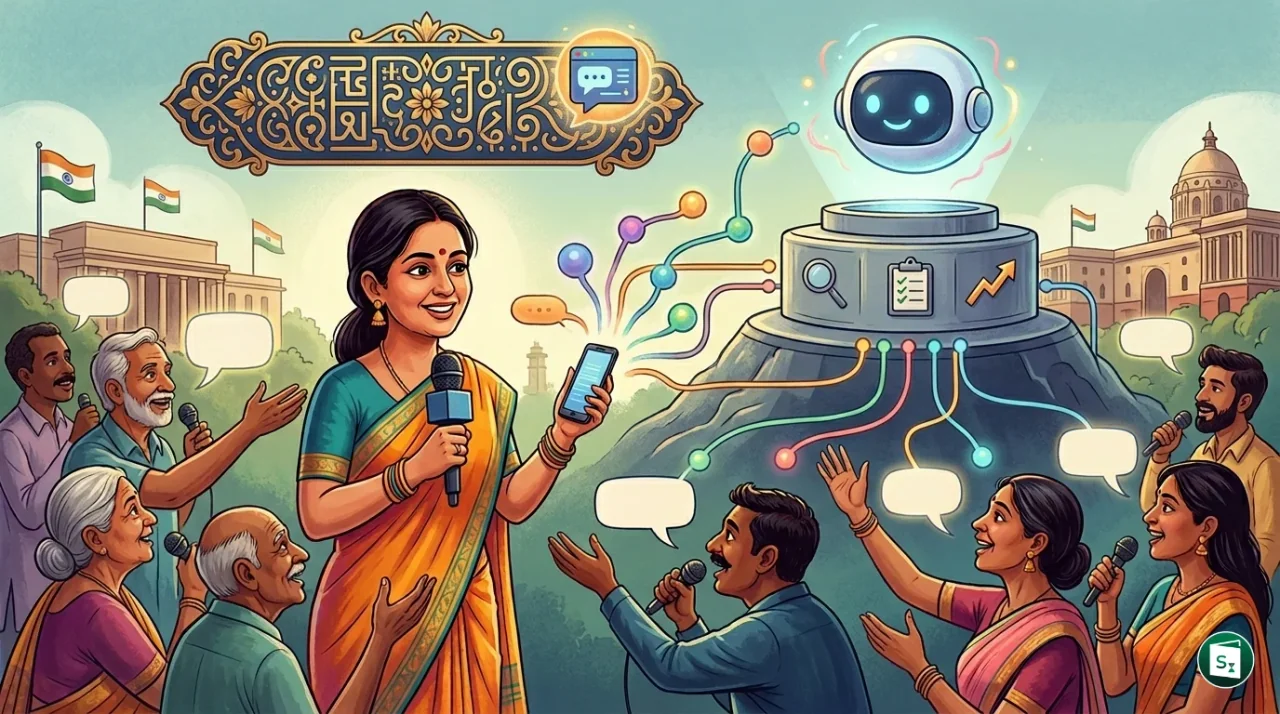
Union Minister Dr Jitendra Singh launched the AI-enabled voice chatbot Samadhan Didi on June 1, 2026, at Kartavya Bhawan in New Delhi to simplify the public grievance filing process. Developed by the Department of Administrative Reforms and Public Grievances (DARPG) in collaboration with Bhashini, the tool allows citizens to lodge complaints using their native language through voice commands. This initiative marks a significant leap in digital governance, making the Centralized Public Grievance Redress and Monitoring System (CPGRAMS) more inclusive and accessible to rural and non-tech-savvy populations.
The Evolution of Samadhan Didi: A Voice for Every Indian
The introduction of Samadhan Didi addresses a critical barrier in public administration: the complexity of digital forms. For years, citizens were required to navigate complex drop-down menus and select specific ministries to file a grievance, a task that often proved daunting for those with limited technical literacy. The new chatbot eliminates these hurdles by offering a conversational, voice-based interface. Users can simply speak their grievances, and the AI-driven system automatically categorizes and routes the complaint to the appropriate department. This ‘zero-navigation’ approach ensures that the focus remains on the citizen’s problem rather than the technicality of filing it.
Technical Architecture: The DARPG and Bhasini Collaboration
The technical backbone of this initiative is a unique collaboration between two key government arms. The Department of Administrative Reforms and Public Grievances (DARPG), which operates under the Ministry of Personnel, Public Grievances and Pensions, provided the administrative framework and domain expertise. The technological implementation was handled by Bhashini, India’s AI-led language translation platform under the Ministry of Electronics and Information Technology (MeitY). By leveraging Bhashini’s capabilities, the chatbot supports all 22 official languages mentioned in the Eighth Schedule of the Constitution. This integration allows the AI to not only understand diverse accents and dialects but also translate and process them into actionable data for government officials.
Transforming CPGRAMS: From 7.0 to NextGen AI
The launch of Samadhan Didi is part of the broader NextGen CPGRAMS reforms aimed at making the government more responsive. Since 2014, the volume of grievances handled by the portal has increased more than tenfold, rising from 2 lakh to over 25 lakh annually in 2026. To manage this massive influx while maintaining a disposal rate of over 95 percent, the government has implemented several layers of reforms. These include the 10-Step CPGRAMS Reforms, which introduced features like auto-routing of grievances to last-mile officers and the use of IIT Kanpur developed AI for intelligent categorization. The voice chatbot represents the final layer of this digital transformation, ensuring that even the most remote citizen can access the system effortlessly.
Strategic Impact: Bridging the Digital and Linguistic Divide
The strategic intent behind Samadhan Didi is to bridge the digital and linguistic divide that exists in India. By enabling voice-based interaction in 22 languages, the government is ensuring that language is no longer a barrier to seeking justice or administrative help. This is particularly significant for the elderly and rural populations who may find typing or navigating complex websites difficult. Furthermore, the use of AI for sentiment analysis and automated routing reduces the burden on human intermediaries, leading to faster resolution times. This shift from reactive governance to a proactive, citizen-centric approach is a major step toward achieving the goals of Digital India and Minimum Government, Maximum Governance.
Key Takeaways
- Samadhan Didi is an AI-enabled voice chatbot launched on June 1, 2026, to facilitate the filing of public grievances.
- The chatbot is developed by the Department of Administrative Reforms and Public Grievances (DARPG) in partnership with the Bhashini AI platform.
- It provides multilingual support for all 22 official languages of India listed in the Eighth Schedule of the Constitution.
- CPGRAMS serves as the central platform for citizens to lodge complaints with government ministries and departments.
- The system has evolved from handling 2 lakh grievances in 2014 to more than 25 lakh annual grievances in 2026.
- The launch is a key component of the NextGen CPGRAMS reforms, focusing on zero-navigation filing and AI-driven automated routing of complaints.