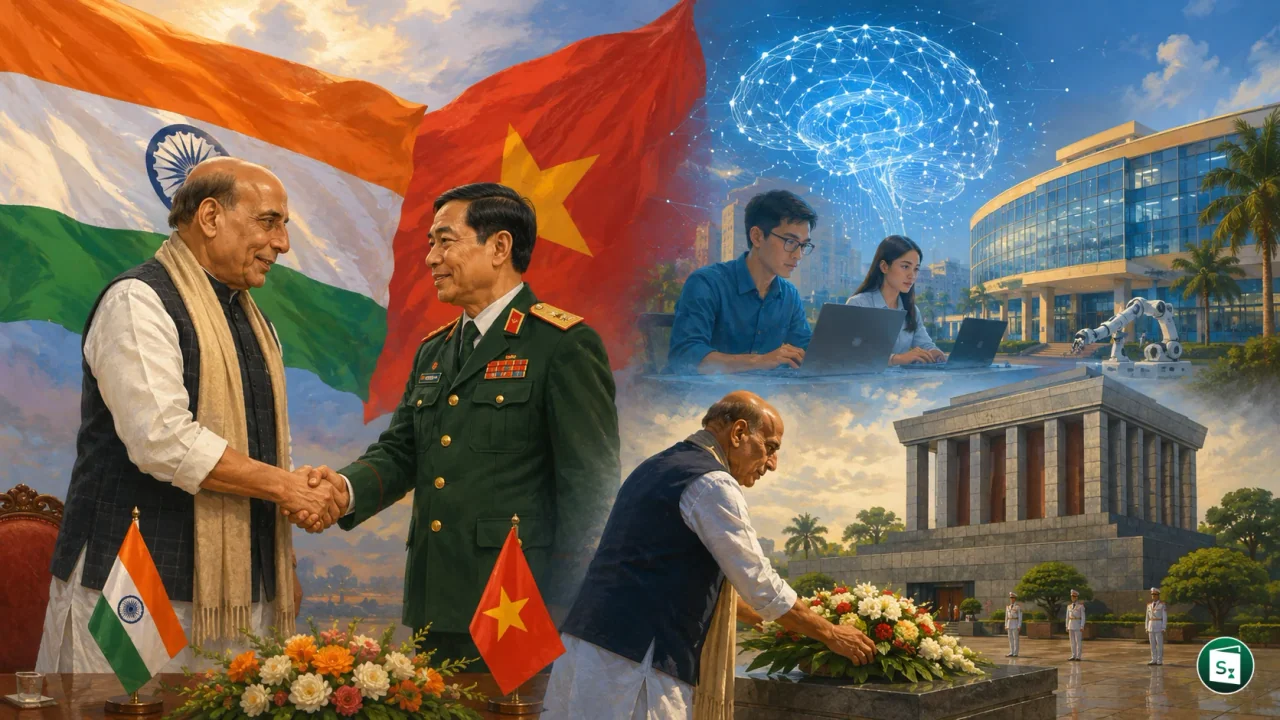
Union Minister Rajnath Singh arrived in Vietnam on June 1, 2026, to formally operationalise the newly elevated Enhanced Comprehensive Strategic Partnership between the two nations. The visit, which includes high-level discussions with Vietnamese President To Lam and Deputy Prime Minister General Phan Van Giang, signals a deepening of defense and technological cooperation. This strategic engagement reinforces India’s Act East Policy and its commitment to a stable and secure Indo-Pacific region.
Strengthening the Enhanced Comprehensive Strategic Partnership
The visit of the Indian Defence Minister follows the formal elevation of bilateral relations to an Enhanced Comprehensive Strategic Partnership (ECSP) in May 2026. This is the highest tier of diplomatic engagement for Vietnam, placing India among a select group of its most trusted global partners. The partnership is built on the foundation of the Comprehensive Strategic Partnership established in 2016 during Prime Minister Narendra Modi’s visit to Hanoi.
The operationalisation of the ECSP focuses on translating strategic goodwill into concrete outcomes across defense, technology, and trade. Both nations have adopted a Five More motto to guide this new phase: more political trust, more defense and security cooperation, more trade and investment, more technological collaboration, and more cultural exchange. During his meetings with President To Lam and General Phan Van Giang, Minister Rajnath Singh emphasised that a strong India-Vietnam bond is essential for maintaining the regional balance of power and a rules-based order in the Indo-Pacific.
High-Tech Cooperation: The AI Laboratory in Nha Trang
A significant highlight of the visit was the announcement of an Artificial Intelligence (AI) Laboratory to be established at the Telecommunications University (TCU) in Nha Trang, Vietnam. This laboratory is being set up with Indian technical and financial assistance. It will serve as a hub for joint research and training in emerging fields such as AI, Quantum Technology, and Data Science. The project is governed by a Memorandum of Understanding (MoU) signed between India’s Military College of Telecommunications Engineering (MCTE), located in Mhow, and Vietnam’s TCU.
The establishment of the AI Lab is part of a broader history of Indian support for the Telecommunications University, which is also known as the Army Telecommunications University. India has previously funded the creation of the Army Software Park at the university with a $5 million grant. Furthermore, the two nations virtually inaugurated a new Language Laboratory at the Air Force Officers’ College during this visit. These initiatives are designed to build a “high-tech industry-ready workforce” within the Vietnamese military and enhance its digital battlefield capabilities.
Strategic Convergence in the Indo-Pacific
The India-Vietnam partnership has emerged as a “strategic anchor” in Southeast Asia, particularly concerning maritime security in the South China Sea. During the ministerial-level talks, both countries reaffirmed their commitment to a “free, open, and rules-based Indo-Pacific.” They emphasized the importance of settling maritime disputes peacefully in accordance with international law, specifically the United Nations Convention on the Law of the Sea (UNCLOS) 1982.
India’s role as a primary security provider in the region has been marked by significant milestones, such as gifting the indigenously built missile corvette INS Kirpan to the Vietnam People’s Navy in 2023. The current discussions aimed to expand this cooperation into joint defense production and technology transfer. By strengthening Vietnam’s maritime domain awareness and coastal defense capabilities, India is playing a pivotal role in the Act East Policy, which views Vietnam as a key pillar for regional stability and economic integration.
Honoring a Shared Legacy: Visit to Ho Chi Minh Mausoleum
A deeply symbolic part of the visit was Minister Rajnath Singh’s tribute at the Ho Chi Minh Mausoleum in Hanoi. The visit coincided with the 136th birth anniversary of Ho Chi Minh, the founding father of modern Vietnam. The relationship between the two nations is rooted in the personal friendship between India’s first Prime Minister, Jawaharlal Nehru, and President Ho Chi Minh, who first met in 1927.
This historical connection has evolved from a shared struggle against colonialism into a multifaceted partnership. India and Vietnam established full diplomatic relations on January 7, 1972. Over the decades, India has consistently supported Vietnam’s economic and military development. By paying respects at the mausoleum, the Defence Minister reinforced the cultural and civilizational links that underpin the modern strategic alliance, ensuring that the legacy of the founding leaders continues to inspire bilateral cooperation.
Key Takeaways
- Union Minister Rajnath Singh visited Vietnam in June 2026 to operationalise the Enhanced Comprehensive Strategic Partnership (ECSP).
- India announced the establishment of an Artificial Intelligence (AI) Laboratory at the Telecommunications University in Nha Trang.
- An MoU for cooperation in AI and Quantum Technology was signed between India’s Military College of Telecommunications Engineering (MCTE) and Vietnam’s TCU.
- The visit coincided with the 136th birth anniversary of Ho Chi Minh, the founding leader of modern Vietnam.
- Both nations reaffirmed their commitment to a “rules-based order” and the UNCLOS 1982 to ensure maritime security in the Indo-Pacific.
- India and Vietnam established full diplomatic relations on January 7, 1972, following decades of historical and personal ties between their leaders.