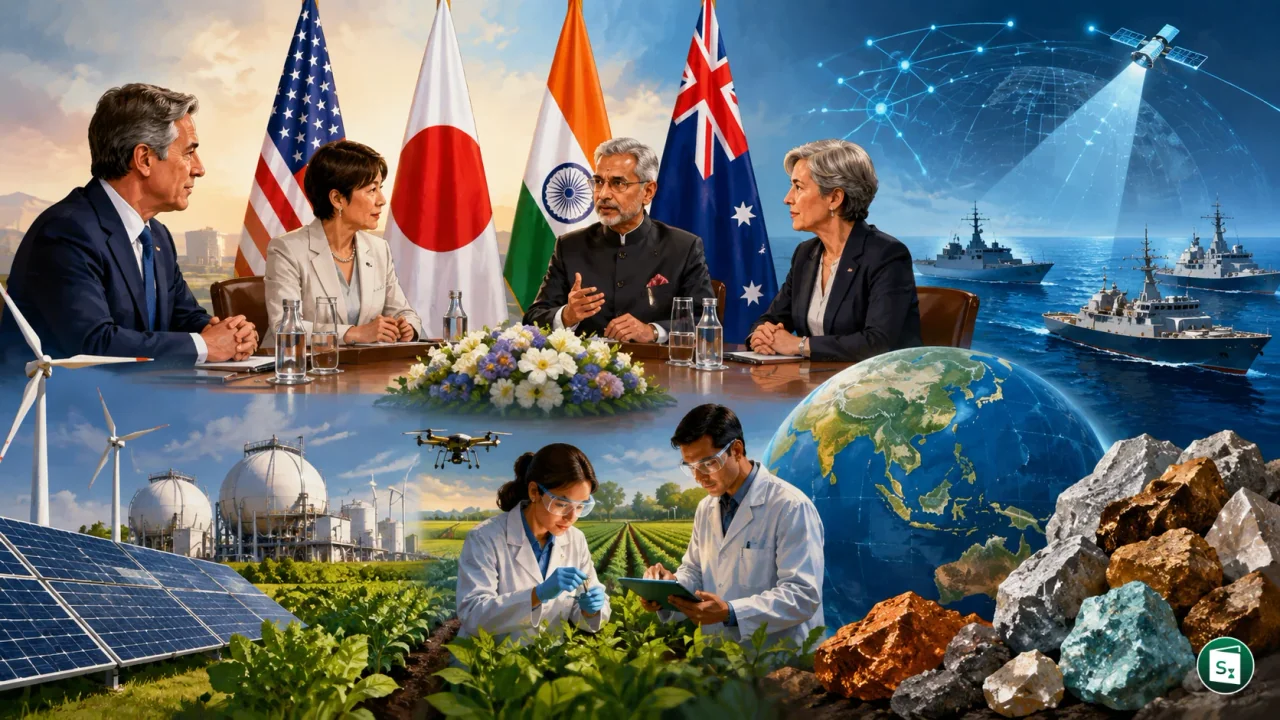
India hosted the 11th Quad Foreign Ministers’ Meeting (QFMM) in New Delhi on June 1, 2026, marking a significant step in deepening strategic cooperation across the Indo-Pacific. Chaired by External Affairs Minister S. Jaishankar, the meeting saw the launch of transformative initiatives in maritime surveillance, critical minerals, and agricultural innovation. These developments underscore the group’s commitment to maintaining a free and open regional order while building resilient supply chains.
Overview of the 11th Quad Foreign Ministers’ Meeting
The Quadrilateral Security Dialogue (Quad) consists of four major democracies: India, the United States, Japan, and Australia. The 11th meeting in New Delhi brought together the top diplomats of these nations to discuss regional stability and economic integration. The discussions emphasized “functional stitching”—a strategy aimed at integrating economic security with maritime domain awareness and technological sovereignty to counter emerging regional challenges.
| Participant | Country | Designation |
|---|---|---|
| S. Jaishankar | India | Minister of External Affairs |
| Marco Rubio | United States | Secretary of State |
| Penny Wong | Australia | Minister for Foreign Affairs |
| Toshimitsu Motegi | Japan | Minister for Foreign Affairs |
This meeting was particularly significant as it introduced several practical frameworks designed to move the Quad from a consultative body to an implementation-oriented partnership. The ministers reaffirmed their adherence to the United Nations Convention on the Law of the Sea (UNCLOS), highlighting the importance of freedom of navigation in critical waterways.
Indo-Pacific Maritime Surveillance Collaboration (IPMSC)
A major highlight of the meeting was the launch of the Indo-Pacific Maritime Surveillance Collaboration (IPMSC). This initiative is designed to pool the maritime surveillance capabilities of the four nations to enhance real-time information sharing across the region. With its initial focus on the Indian Ocean Region (IOR), the IPMSC aims to tackle unlawful maritime activities, including illegal fishing, piracy, and suspicious ship-to-ship transfers.
Strengthening Maritime Domain Awareness
The IPMSC works alongside the existing Indo-Pacific Partnership for Maritime Domain Awareness (IPMDA). By integrating satellite and aerial surveillance data, the Quad partners are developing a Common Operating Picture (COP). This system provides near real-time visibility of maritime traffic, allowing for faster response times to security threats.
India’s central role in regional security was further recognized as it was announced to host the second edition of the Quad-at-Sea Ship Observer Mission. This mission involves embedding naval and coast guard officers on each other’s vessels to improve operational interoperability. The Information Fusion Centre – Indian Ocean Region (IFC-IOR), which is located in Gurugram, will continue to serve as a key hub for coordinating these maritime security efforts.
Securing Critical Mineral and Energy Supply Chains
To reduce reliance on single-source markets and build economic resilience, the ministers launched the Quad Critical Minerals Initiative Framework. This ambitious framework seeks to mobilize up to $20 billion in public and private sector investments across the entire lifecycle of critical minerals, including mining, processing, and recycling.
The Quad Critical Minerals Initiative Framework
The framework focuses on identifying and funding projects with a “Quad nexus”—meaning those located within member countries or operated by companies headquartered in Australia, India, Japan, or the United States. This “blended finance” model uses government guarantees and loans to de-risk projects, thereby attracting significant private capital. The goal is to create stable supply chains for minerals essential to semiconductors, electric vehicle batteries, and defense equipment.
Energy Security in the Indo-Pacific
Alongside mineral security, the Quad Initiative on Indo-Pacific Energy Security was established to address the vulnerability of regional energy systems. This initiative promotes transparent energy markets and the development of strategic petroleum reserves. It also facilitates technical cooperation in cleaner energy technologies, helping regional partners transition to sustainable energy while maintaining fuel stability. To further this goal, the United States will host the first Quad Fuel Security Forum later in 2026.
Advancing Agricultural Innovation: The AI-ENGAGE Initiative
The Quad nations are also collaborating to transform regional food security through the Advancing Innovations for Empowering NextGen Agriculture (AI-ENGAGE) initiative. This program leverages emerging technologies such as Artificial Intelligence (AI) and robotics to modernize farming practices and improve crop yields. During the New Delhi meeting, the ministers announced over $6 million in joint funding for the first cohort of six international research projects.
These projects involve collaboration between premier research agencies, including India’s Indian Council of Agricultural Research (ICAR), the National Science Foundation (NSF) of the United States, Australia’s Commonwealth Scientific and Industrial Research Organisation (CSIRO), and the Japan Science and Technology Agency (JST). The research focuses on high-impact areas such as:
- Autonomous Orchard Monitoring: Using aerial and ground robots for early disease detection in fruit orchards.
- AI-Based Pest Identification: Developing smartphone applications and chatbots to help farmers identify and manage pests in real time.
- Resilient Wheat Breeding: Applying AI-driven genomic selection models to create climate-resilient and high-yielding crop varieties.
By integrating AI into agriculture, the Quad aims to build more resilient food systems and prepare a workforce skilled in the intersection of technology and farming.
Strategic Significance and the Way Forward
Beyond these core initiatives, the 11th QFMM addressed broader regional infrastructure and connectivity goals. The Quad reaffirmed its commitment to connecting all Pacific Island Forum countries via secure undersea cable networks by the end of 2026. Additionally, the first joint Quad port project was announced in Fiji under the Ports of the Future Partnership, aimed at addressing capacity constraints and securing critical trade corridors.
The meeting also focused on transnational security, with Australia designated to host a Quad Counterterrorism Tabletop Exercise in June 2026. This exercise will address state-sponsored threats and the misuse of emerging technologies like Unmanned Aerial Vehicles (UAVs). By moving toward practical, “constabulary” (policing) cooperation, the Quad is positioning itself as a key provider of regional public goods, ensuring that the Indo-Pacific remains a zone of peace, prosperity, and innovation.
Key Takeaways
- The 11th Quad Foreign Ministers’ Meeting was held in New Delhi on June 1, 2026, chaired by External Affairs Minister S. Jaishankar.
- The Indo-Pacific Maritime Surveillance Collaboration (IPMSC) was launched to pool surveillance assets and enhance real-time information sharing, with an initial focus on the Indian Ocean Region.
- The Quad Critical Minerals Initiative Framework aims to mobilize up to $20 billion to build resilient and non-China supply chains for minerals essential to high-tech industries.
- Under the AI-ENGAGE initiative, over $6 million in funding was awarded to six research projects aimed at modernizing agriculture using AI and robotics.
- India was announced as the host for the second edition of the Quad-at-Sea Ship Observer Mission, which fosters coast guard cooperation across the Indo-Pacific.
- The Quad Initiative on Indo-Pacific Energy Security was launched to strengthen regional fuel stability and support the development of strategic petroleum reserves.