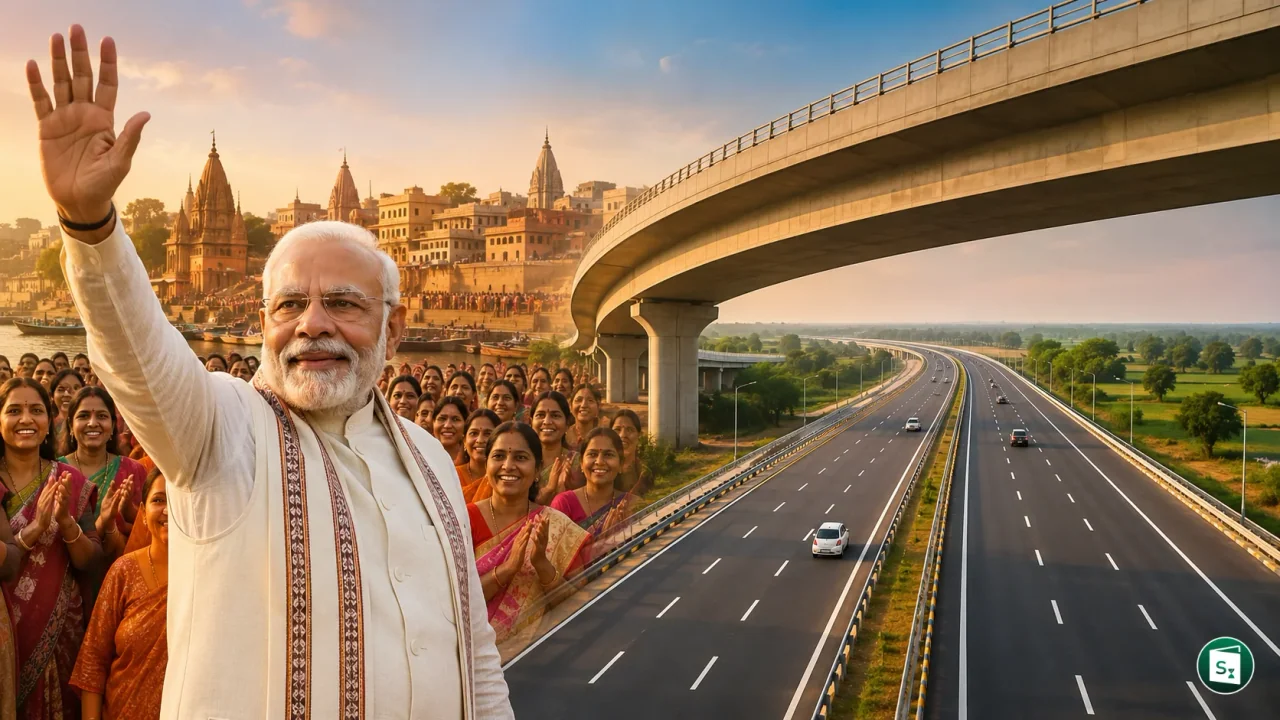
Prime Minister Narendra Modi inaugurated the 594 km long Ganga Expressway and multiple development projects worth ₹6,350 crore during his visit to Uttar Pradesh on May 9, 2026. The Prime Minister also addressed a massive ‘Mahila Sammelan’ in Varanasi, highlighting the government’s focus on gender-led development and infrastructure modernization. This double inauguration marks a significant leap in the state’s connectivity and social welfare framework, positioning Uttar Pradesh as a critical engine of India’s economic growth.
Inauguration of the Ganga Expressway
The Ganga Expressway, one of India’s largest greenfield infrastructure projects, was officially inaugurated in Hardoi, Uttar Pradesh. Constructed at an estimated cost of ₹36,230 crore, this 594 km long access-controlled corridor is designed to provide high-speed connectivity between western and eastern Uttar Pradesh. The expressway features a six-lane configuration, which is designed to be expandable to eight lanes to accommodate future traffic growth.
The project is implemented by the Uttar Pradesh Expressways Industrial Development Authority (UPEIDA). Established in 2007 and headquartered in Lucknow, UPEIDA has been the nodal agency for transforming Uttar Pradesh into the “Expressway State” of India. The Ganga Expressway is a significant milestone in this journey, traversing through 12 key districts of the state.
Strategic Connectivity and Technical Specifications
The expressway begins at Bijauli village in Meerut and terminates at Juhapur village in Prayagraj. By connecting districts including Hapur, Bulandshahr, Amroha, Sambhal, Budaun, Shahjahanpur, Hardoi, Unnao, Rae Bareli, and Pratapgarh, the corridor significantly reduces the travel time between the state’s eastern and western peripheries.
A notable feature of the Ganga Expressway is the inclusion of a 3.5 km long airstrip in the Shahjahanpur district. This infrastructure is specifically designed to facilitate emergency landings and take-offs for Indian Air Force (IAF) aircraft, enhancing the strategic and defensive capabilities of the region. The expressway is also expected to act as a catalyst for the development of industrial clusters and agricultural markets along its route.
Development Initiatives in Varanasi
In Varanasi, often referred to as the cultural capital of India or Kashi, the Prime Minister inaugurated a series of development projects valued at ₹6,350 crore. These initiatives span multiple sectors, including urban infrastructure, healthcare, and education, aimed at enhancing the quality of life in one of the world’s oldest continuously inhabited cities. The focus of these projects is to modernize Kashi while preserving its spiritual and cultural heritage.
The investments in Varanasi are part of a broader mission to transform the city into a global hub for tourism and trade. Recent years have seen the completion of major projects like the Kashi Vishwanath Corridor, which has significantly boosted the local economy and pilgrim footfall. The newly inaugurated projects are expected to further strengthen this economic momentum.
Empowerment through Mahila Sammelan
A central highlight of the Prime Minister’s visit was his participation in the ‘Mahila Sammelan’. The event underscored the government’s commitment to gender-led development and the socio-economic empowerment of women. During the convention, the Prime Minister interacted with women from various Self-Help Groups (SHGs) and highlighted the impact of schemes such as Lakhpati Didi and Namo Drone Didi in creating sustainable livelihoods.
The Mahila Sammelan serves as a platform to recognize the contribution of women in the “Viksit Bharat” (Developed India) vision. By integrating women into the formal economy through financial inclusion and skill development, the government aims to ensure that development is inclusive and equitable. The focus on women-led cooperatives and digital literacy is a cornerstone of this transformative strategy.
Uttar Pradesh: India’s Leading Expressway Hub
With the inauguration of the Ganga Expressway, Uttar Pradesh further solidifies its position as India’s premier “Expressway State.” The state now boasts the most extensive network of access-controlled highways in the country, facilitating seamless movement of goods and people. This infrastructure is a critical component of the UP Defence Industrial Corridor, which aims to attract global investments in the aerospace and defence sectors.
The systematic development of these corridors has transitioned Uttar Pradesh from a land-locked state into a logically connected economic powerhouse. Below is a summary of the major operational and upcoming expressways in the state:
| Expressway Name | Status | Key Connectivity |
|---|---|---|
| Ganga Expressway | Inaugurated | Meerut to Prayagraj |
| Purvanchal Expressway | Operational | Lucknow to Ghazipur |
| Bundelkhand Expressway | Operational | Chitrakoot to Etawah |
| Agra-Lucknow Expressway | Operational | Agra to Lucknow |
| Yamuna Expressway | Operational | Greater Noida to Agra |
| Gorakhpur Link Expressway | Operational | Gorakhpur to Purvanchal Expressway |
The expansion of the expressway network is expected to contribute significantly to India’s goal of becoming a $5 trillion economy. By reducing logistics costs and improving “last-mile” connectivity to agricultural hinterlands, these projects empower farmers and small-scale industries to access larger markets more efficiently.
Key Takeaways
- The Ganga Expressway is a 594 km long greenfield project connecting 12 districts of Uttar Pradesh.
- The project was constructed at an estimated cost of ₹36,230 crore and features a six-lane configuration.
- A 3.5 km long airstrip has been developed in the Shahjahanpur district for emergency use by the Indian Air Force (IAF).
- Development projects worth ₹6,350 crore were inaugurated in Varanasi, focusing on urban infrastructure and social welfare.
- The Uttar Pradesh Expressways Industrial Development Authority (UPEIDA), established in 2007, is the nodal agency for the project.
- The ‘Mahila Sammelan’ in Varanasi highlighted the impact of gender-led schemes like Lakhpati Didi and Namo Drone Didi.