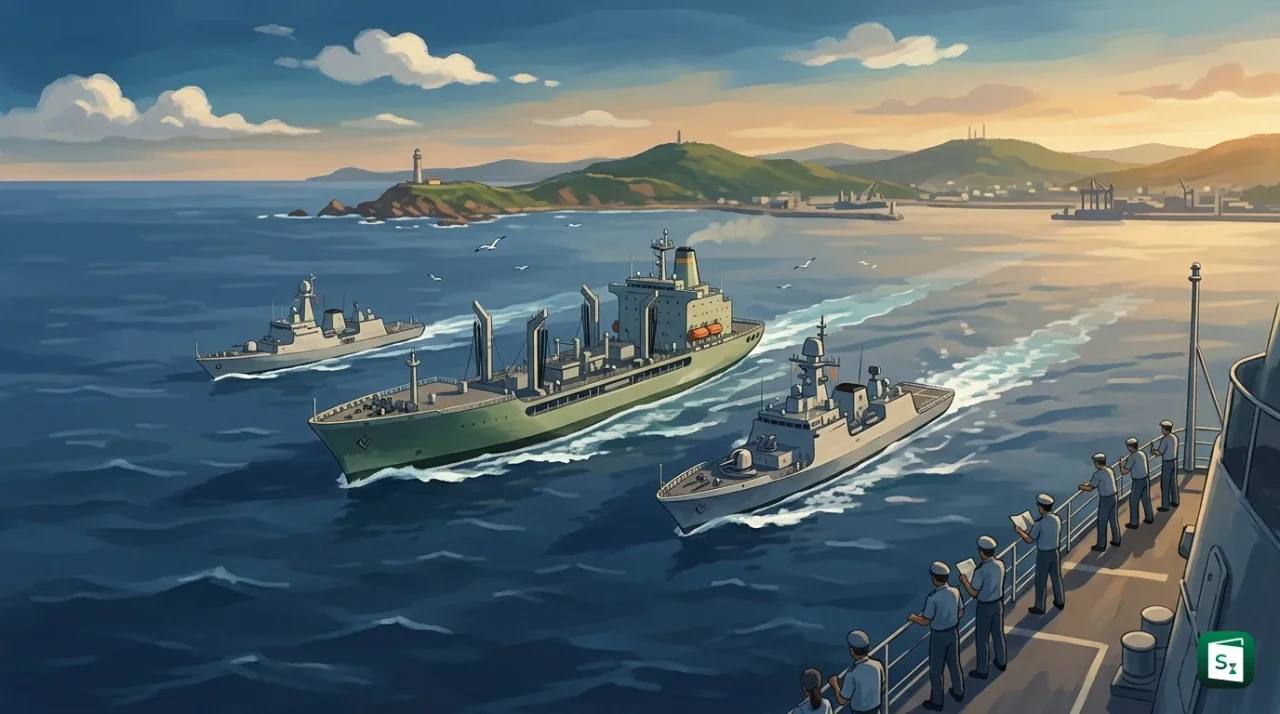
The 13th edition of the bilateral maritime exercise SLINEX-26 was held in Visakhapatnam, Andhra Pradesh from 17 to 21 September 2026 under the aegis of the Eastern Naval Command. The Indian Navy deployed INS Kavaratti and INS Jyoti while the Sri Lanka Navy deployed SLNS Sindurala for the five day engagement. The exercise focused on enhancing interoperability and maritime cooperation to strengthen stability in the Indian Ocean Region.
What Is SLINEX Exercise?
SLINEX is the Sri Lanka India Naval Exercise, a bilateral maritime exercise between the Indian Navy and the Sri Lanka Navy. SLINEX stands for Sri Lanka India Exercise. The exercise enhances interoperability and maritime cooperation through harbour and sea phase joint operations aimed at a secure Indian Ocean Region.
The SLINEX Exercise is a bilateral naval exercise conducted annually between India and Sri Lanka. The name combines Sri Lanka and India with EX, denoting exercise. In Hindi, it is often referred to as SLINEX Abhyas. The exercise was conceptualised in 2005 to build mutual understanding, share professional best practices and improve joint operational capability at sea.
SLINEX Exercise Between Which Country?
SLINEX exercise is conducted between India and Sri Lanka, the two maritime neighbours in the Indian Ocean Region. The Indian Navy and the Sri Lanka Navy are the sole participants. The bilateral format focuses on India Sri Lanka naval interoperability, unlike multilateral exercises such as MILAN which involve many navies.
The objective of SLINEX is to rehearse multi-faceted maritime operations in a realistic setting. Core aims include improving interoperability, which means the ability of two navies to operate together using common procedures and communication, strengthening maritime cooperation, and exchanging experiences in areas such as search and rescue, humanitarian assistance, communication drills and anti-submarine operations. Over time, the exercise has expanded from basic manoeuvres to complex drills involving helicopters, special forces and advanced sensors.
SLINEX Full Form
SLINEX stands for Sri Lanka India Naval Exercise. It is also expanded as Sri Lanka India Exercise. Both forms are used in official releases, though the Indian Navy generally uses the first expansion. The hyphenated version SLINEX-26 denotes the 2026 edition, while the 13th edition tag reflects the count since 2005.
SLINEX Started in Which Year and How Has It Evolved?
SLINEX started in 2005 as a modest bilateral naval engagement between India and Sri Lanka. The first edition was held in 2005. Since then the exercise has grown into an annual harbour and sea phase drill that enhances interoperability, operational synergy and mutual understanding between the two navies.
The exercise was conceptualised in 2005 when maritime security challenges in the Indian Ocean Region pushed both neighbours to formalise naval cooperation. Early editions were modest in scale, focusing on search and rescue, humanitarian assistance and basic manoeuvres with limited ships. As regional threats grew more complex, SLINEX steadily expanded in ambition and operational complexity.
The first SLINEX in 2005 involved a small number of vessels in the Bay of Bengal. By 2013, the exercise off Goa included INS Talwar and SLNS Sagara with distinct harbour and sea phases. The 2015 edition off Trincomalee saw INS Kora, INS Kirpan and INS Savitri alongside SLNS Sayura, SLNS Samudura and SLNS Sagara. In 2018, also off Trincomalee, the drill included INS Sumitra, INS Kirch and INS Cora with SLNS Sayurala, SLNS Samudura and SLNS Suranimala, plus Dornier aircraft and a helicopter, marking a shift to multi-domain operations. SLINEX 2020 off Trincomalee deployed advanced anti-submarine corvettes INS Kamorta and INS Kiltan with SLNS Sayura and SLNS Gajabahu.
Recent editions reflect the current two phase structure. The 11th edition, SLINEX 2024, was held from 17 to 20 December 2024 in Visakhapatnam with INS Sumitra and SLNS Sayura, each embarked with special forces teams, conducting gun firing and communication drills. The 12th edition, SLINEX 2025, was hosted by Sri Lanka in Colombo from 14 to 18 August 2025, with the harbour phase from 14 to 16 August and sea phase on 17 and 18 August. The Indian Navy deployed INS Rana and INS Jyoti, while the Sri Lanka Navy deployed SLNS Vijayabahu, SLNS Gajabahu and SLNS Sayura. The ships also marked India’s 79th Independence Day on 15 August in Colombo. SLINEX-26 in September 2026 therefore becomes the 13th edition, continuing the annual cycle and the practice of alternating venues between Indian and Sri Lankan waters.
| Edition | Year | Venue | Notable Participants |
|---|---|---|---|
| 1st | 2005 | Bay of Bengal | INS Sukanya, INS Kirpan |
| 3rd | 2013 (4 to 7 Nov) | Off Goa | INS Talwar, SLNS Sagara |
| 4th | 2015 (27 Oct to 15 Nov) | Trincomalee, Sri Lanka | INS Kora, INS Kirpan, INS Savitri and SLNS Sayura, SLNS Samudura, SLNS Sagara |
| 6th | 2018 (7 to 13 Sep) | Trincomalee | INS Sumitra, INS Kirch, INS Cora with Dornier aircraft and SLNS Sayurala, SLNS Samudura, SLNS Suranimala |
| 8th | 2020 (19 to 21 Oct) | Trincomalee | INS Kamorta, INS Kiltan and SLNS Sayura, SLNS Gajabahu |
| 11th | 2024 (17 to 20 Dec) | Visakhapatnam | INS Sumitra, SLNS Sayura with Special Forces teams |
| 12th | 2025 (14 to 18 Aug) | Colombo, Sri Lanka | INS Rana, INS Jyoti and SLNS Gajabahu, Vijayabahu, Sayura |
| 13th | 2026 (17 to 21 Sep) | Visakhapatnam | INS Kavaratti, INS Jyoti and SLNS Sindurala |
SLINEX-26 in Visakhapatnam: What Happened in the 13th Edition?
The 13th edition of SLINEX, SLINEX-26, was conducted in Visakhapatnam, Andhra Pradesh, from 17 to 21 September 2026 under the aegis of the Eastern Naval Command. The Eastern Naval Command, headquartered in Visakhapatnam and established on 1 March 1968, is one of three command level formations of the Indian Navy responsible for the Bay of Bengal and eastern Indian Ocean.
The schedule followed the now standard two phase format. The Harbour Phase began on 17 September with an opening ceremony and a reception onboard INS Kavaratti for the crew of SLNS Sindurala. SLNS Sindurala had arrived in Visakhapatnam on 17 September after departing Colombo on 11 September, and was formally welcomed per naval traditions. On 18 September, Captain Sunanda Appuhamy, Commanding Officer of SLNS Sindurala, held official discussions with Commander Suraj Aiyappa, Commanding Officer of INS Kavaratti, onboard both vessels.
Harbour Phase activities included professional interactions, cross deck visits, exchange of best practices, Yoga, sports and cultural events. These interactions allow crews to understand each other’s procedures, equipment and operational philosophy before going to sea. The Sea Phase on 20 and 21 September in the seas off the east coast of India focused on coordinated activities to strengthen operational synergy and interoperability. Drills typically include communication procedures, tactical manoeuvres, replenishment approaches and joint operational planning, enabling both navies to work as a cohesive unit.
| Phase | Dates in 2026 | Venue | Key Activities |
|---|---|---|---|
| Harbour Phase | 17 to 19 September | Visakhapatnam harbour | Opening ceremony, reception on INS Kavaratti, professional discussions, cross deck visits, best practice exchanges, Yoga and sports |
| Sea Phase | 20 to 21 September | Off Visakhapatnam, Bay of Bengal | Coordinated tactical exercises, communication drills, joint manoeuvres to enhance interoperability |
Visakhapatnam is significant as the hub for major eastern seaboard exercises. The city also hosted SLINEX 2024, MILAN 2026 and the International Fleet Review 2026 in February 2026, underlining its role as the gateway for India’s eastern maritime diplomacy.
Participating Forces and Assets: INS Kavaratti, INS Jyoti and SLNS Sindurala
Three ships formed the core of the exercise, two from the Indian Navy and one from the Sri Lanka Navy. The composition reflected a balanced mix of combat, support and patrol capabilities.
Indian Navy Assets: INS Kavaratti and INS Jyoti
INS Kavaratti (P31) is an Anti-Submarine Warfare Corvette of the Kamorta class, built under Project 28. The ship was designed by the Directorate of Naval Design of the Indian Navy and built by Garden Reach Shipbuilders and Engineers (GRSE), Kolkata. The keel was laid on 20 January 2012, the ship was launched on 19 May 2015, delivered on 18 February 2020 and commissioned on 22 October 2020 at Visakhapatnam by then Chief of Army Staff General Manoj Mukund Naravane. It is the fourth and last ship of the Kamorta class, preceded by INS Kamorta, INS Kadmatt and INS Kiltan.
The corvette is named after Kavaratti, the capital of the Union Territory of Lakshadweep. It succeeds an earlier Arnala class vessel of the same name that took part in Operation Trident in 1971 and was decommissioned in 1986. With a displacement of 3,300 tonnes, length of 109 metres and beam of 12.8 metres, the ship can reach 25 knots and has a range of about 3,450 nautical miles at 18 knots. It uses four Pielstick 12 PA6 STC diesel engines with a CODAD propulsion system and is built with DMR 249A warship grade steel and a carbon fibre composite superstructure, which lowers top weight, improves stealth by reducing radar cross section and lowers maintenance costs. Around 90 percent of its content is indigenous.
Key sensors include Revathi Central Acquisition Radar, EL/M-2221 STGR fire control radar, BEL Shikari, BEL RAWL02, HUMSA hull mounted sonar array and the Sanket electronic warfare system. Weapons include a 76 mm Oto Melara Super Rapid Gun Mount, two AK-630M close in weapon systems, two RBU-6000 anti-submarine rocket launchers and quad torpedo tubes, with provision for VL-SRSAM. The ship can operate a Sea King Mk 42B or HAL Dhruv helicopter, has a rail-less helo traversing system and foldable hangar door, and can fight in nuclear, biological and chemical environments. Complement is 123 personnel including 17 officers.
INS Jyoti (A58) is a Komandarm Fedko class replenishment oiler, meaning a fleet tanker that refuels warships at sea. Built by the Admiralty Shipyard, St Petersburg, Russia, the ship was laid down in September 1993, launched on 8 December 1995 and commissioned into the Indian Navy on 20 July 1996. The vessel is operated by the Eastern Naval Command and displaces 35,900 tonnes at full load, making it among the largest ships in the fleet after aircraft carriers INS Vikramaditya and INS Vikrant. It measures 178 metres in length and 25.3 metres in beam, with a speed of 15 knots and a range of 12,000 nautical miles.
The tanker can carry 28,000 tonnes of cargo, including diesel, aviation fuel, oil and fresh water, and has two replenishment positions on each side plus stern refuelling, allowing it to refuel three ships simultaneously at 300 tonnes per hour. It features a double hull to prevent pollution, eco friendly equipment, a helicopter deck for an Alouette III helicopter and close in weapon systems for self defence. Complement is about 208 personnel including 23 officers. Its role in SLINEX is to demonstrate fleet sustainment and blue water logistics, critical for prolonged joint operations.
| Ship | Type and Class | Built By | Commissioned | Key Role in SLINEX-26 |
|---|---|---|---|---|
| INS Kavaratti (P31) | Anti-Submarine Warfare Corvette, Kamorta class, Project 28 | GRSE, Kolkata | 22 October 2020 | Anti-submarine warfare, stealth operations, helicopter operations |
| INS Jyoti (A58) | Fleet Tanker, Komandarm Fedko class | Admiralty Shipyard, St Petersburg | 20 July 1996 | Fleet replenishment, sustaining joint operations at sea |
Sri Lanka Navy and SLNS Sindurala
The Sri Lanka Navy, headquartered in Colombo with operational area in the waters around the island nation, deployed SLNS Sindurala (P624) for SLINEX-26. SLNS Sindurala is an Advanced Offshore Patrol Vessel (AOPV) of the Saryu class, built by Goa Shipyard Limited, India. The contract for two AOPVs was signed in February 2014. The ship was laid down on 10 September 2014, launched on 11 June 2016, acquired on 22 March 2018 and commissioned on 19 April 2018 by then Prime Minister Ranil Wickremesinghe at the Port of Colombo. Cost was about $74 million and yard number is Y 1218. Meaning of the name Sindurala is Soft Waves in English.
With a displacement of 2,350 tonnes, length of 105.7 metres and beam of 13.6 metres, the vessel is powered by two MTU 20V 8000 M71 diesel engines, achieving 24 to 25 knots and a range of 7,000 nautical miles at 15 knots. Endurance is about 15 days at sea with 90 days of dry rations, and it can produce 31,000 litres of fresh water per day through reverse osmosis. It carries 127 personnel including 19 officers and has a landing deck and hangar for an Advanced Light Helicopter. Armament includes a Type 76 twin 37 mm naval gun as main gun, two Typhoon Mk 30c remote weapon stations with 30 mm Mk44 Bushmaster II guns, plus machine guns and decoy launchers. The ship has an integrated bridge system, navigation radar with ARPA, electro-optical sensors and about 150 km of wiring, and undertakes Exclusive Economic Zone patrol, search and rescue and anti-smuggling tasks.
SLNS Sindurala is the sister ship of SLNS Sayurala and earlier participated in Exercise Kakadu in Australia in 2018 and in SLINEX 2019 off Visakhapatnam. In 2019 it was adjudged Best Ship in the Sri Lanka Navy, reflecting high operational standards. The deployment to Visakhapatnam highlights the close shipbuilding and operational link between the two navies, as the vessel itself was built in India.
Significance for India Sri Lanka Maritime Cooperation and Indian Ocean Security
The SLINEX-26 exercise strengthens interoperability, the practical ability of two navies to communicate, manoeuvre and operate together using aligned procedures and tactics. By rehearsing joint drills in both harbour and at sea, the Indian Navy and the Sri Lanka Navy improve maritime domain awareness, coordination in search and rescue and readiness for humanitarian assistance and disaster relief. The exercise also allows exchange of operational experiences, which builds mutual trust and reduces response time during real contingencies in the Bay of Bengal and wider Indian Ocean Region.
For Sri Lanka, an island nation dependent on sea lines for trade and security, SLINEX provides exposure to advanced anti-submarine and logistics operations and enhances its capacity to patrol its Exclusive Economic Zone. For India, the engagement reinforces its role as a preferred security partner and net security provider in the region, while honing eastern fleet readiness. The Eastern Naval Command gains practical experience in hosting and coordinating bilateral operations, which feeds into larger multilateral events such as MILAN.
The exercise is aligned with India’s MAHASAGAR vision, which stands for Mutual and Holistic Advancement for Security and Growth Across Regions. The MAHASAGAR vision was unveiled by Prime Minister Narendra Modi on 12 March 2025 in Mauritius. It builds on the earlier SAGAR doctrine, which stands for Security and Growth for All in the Region and was announced in 2015. While SAGAR focused on the Indian Ocean, MAHASAGAR expands the scope to wider regions, integrating economic, connectivity, technology and sustainability dimensions with security cooperation. SLINEX-26 embodies this vision by contributing to a secure, stable and inclusive maritime environment, as stated by the Ministry of Defence.
Strategically, the Bay of Bengal links the Indian Ocean to the Pacific via the Strait of Malacca, a vital artery for energy and trade. Regular naval engagement between India and Sri Lanka helps secure these sea lanes, counters non traditional threats such as smuggling and improves joint readiness for natural disasters. The continuity of 13 editions since 2005 signals a durable bilateral commitment that complements India’s Neighbourhood First and Act East policies.
India Sri Lanka Defence Framework and Other Joint Exercises
SLINEX is the dedicated bilateral naval exercise between India and Sri Lanka, but it operates within a broader web of defence cooperation between the two countries. The Indian Navy exercises list includes both bilateral and multilateral drills that enhance collective security, and Sri Lanka participates in several of them.
The parallel army exercise is Mitra Shakti, meaning Power of Friendship. Mitra Shakti is a bilateral joint military exercise between the Indian Army and the Sri Lanka Army, started in 2012 and later upgraded to include air force elements. The 11th edition, Mitra Shakti 2025, was held from 10 to 23 November 2025 at the Foreign Training Node, Belagavi, Karnataka, with 170 Indian troops from the Rajput Regiment and 135 Sri Lankan troops from the Gajaba Regiment, focusing on counter terrorism, sub conventional operations under United Nations Chapter VII, heliborne missions and drone and counter drone employment. The 10th edition in 2024 was held at Maduru Oya, Sri Lanka. While Mitra Shakti focuses on land operations, SLINEX addresses the maritime domain, together covering the full spectrum of cooperation.
At the multilateral level, MILAN is India’s flagship multilateral naval exercise, launched in 1995 at Port Blair with four navies and now hosted at Visakhapatnam. MILAN 2026 in Visakhapatnam from 18 to 25 February 2026 saw participation from 74 friendly foreign countries, 42 ships and submarines and 29 aircraft, demonstrating India’s convening power.
| Exercise | Service | Partners | Focus Area |
|---|---|---|---|
| SLINEX | Navy | India and Sri Lanka | Bilateral maritime interoperability, anti-submarine and patrol operations |
| Mitra Shakti | Army (bi-service now) | India and Sri Lanka | Counter terrorism, counter insurgency and United Nations peacekeeping in semi urban terrain |
| MILAN | Navy | Multilateral, hosted by India | Large scale interoperability, maritime cooperation and strategic dialogue |
| Kakadu | Navy | Multilateral, hosted by Australia | Multinational maritime exercise, SLNS Sindurala participated in 2018 |
This layered architecture ensures that India and Sri Lanka can operate together across scenarios, from bilateral patrol and rescue at sea to multinational humanitarian missions, reinforcing trust and professional bonds.
The Way Forward
The SLINEX series is expected to grow in complexity as both navies modernise. Future editions are likely to include more advanced anti-submarine warfare drills, helicopter cross deck operations, special forces integration and maritime patrol aircraft participation, as seen in the progression from basic manoeuvres in 2005 to multi-domain drills by 2018 and special forces embarkation in 2024 and 2025.
The alternating venue model between Visakhapatnam and ports such as Trincomalee and Colombo will continue to expose crews to diverse operating environments. Deeper integration of logistics, communication and standard operating procedures will further shorten joint response times for humanitarian assistance, disaster relief and security operations in the Indian Ocean. Sustained engagement under the MAHASAGAR framework will keep SLINEX as a cornerstone of India Sri Lanka maritime partnership and regional stability.
Key Takeaways
- The 13th edition of SLINEX, SLINEX-26, was held in Visakhapatnam, Andhra Pradesh from 17 to 21 September 2026 under the Eastern Naval Command.
- SLINEX stands for Sri Lanka India Naval Exercise, a bilateral maritime exercise between the Indian Navy and the Sri Lanka Navy conceptualised in 2005.
- The Indian Navy deployed INS Kavaratti (P31), a Kamorta class Anti-Submarine Warfare Corvette commissioned on 22 October 2020, and INS Jyoti (A58), a Komandarm Fedko class fleet tanker commissioned on 20 July 1996.
- The Sri Lanka Navy deployed SLNS Sindurala (P624), an Advanced Offshore Patrol Vessel built by Goa Shipyard Limited and commissioned on 19 April 2018.
- The exercise followed a Harbour Phase (17 to 19 September) and Sea Phase (20 to 21 September) focused on interoperability and maritime cooperation aligned with the MAHASAGAR vision unveiled on 12 March 2025.
- The Eastern Naval Command, headquartered in Visakhapatnam and established on 1 March 1968, is responsible for the Bay of Bengal and eastern Indian Ocean.