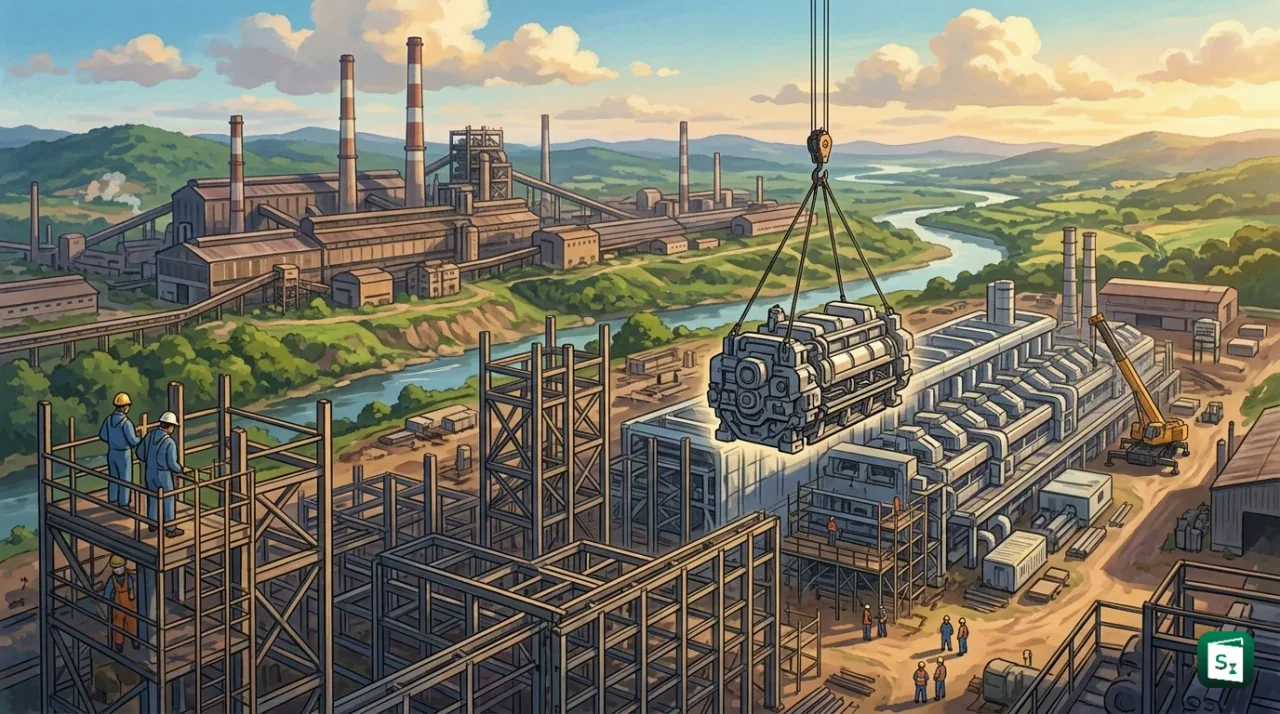
The National Aluminium Company Limited (NALCO) signed a technology licensing agreement with the UAE based Emirates Global Aluminium (EGA) in Dubai on 7 September 2026 for the expansion of its aluminium smelter at Angul in Odisha. Under the deal, NALCO will use EGA’s DX+ Ultra smelting technology for a 0.5 million tonnes per annum (MTPA) brownfield addition that will take its total smelter capacity to about 1 million tonnes per annum. The tie up gives India’s public sector aluminium maker access to one of the most energy efficient smelting technologies in the world.
What Does the Agreement Cover?
A technology licensing agreement is a contract where the owner of a technology gives another company the legal right to use it for a fee. In this case, EGA will give NALCO a licence to use its UAE developed aluminium smelting technology for the new potline at Angul. A potline is a long row of large vessels called reduction cells where alumina powder is converted into molten aluminium using a strong electric current.
Under the agreement, EGA will share the complete technical know how, engineering designs and other information needed to build the reduction cells with DX+ Ultra technology. EGA experts will also give technical support during different stages of the project, from construction to start up of production. NALCO employees will receive training to operate the new cells safely and efficiently. NALCO selected DX+ Ultra through a competitive bidding process.
Inside the Angul Smelter Expansion
The project at Anugul (commonly written as Angul) in Odisha is a brownfield expansion. Brownfield means the new capacity will be built inside or next to an existing plant, and not on fresh empty land. This helps save land cost and allows the use of existing roads, power links and township facilities.
The expansion will add about 0.5 MTPA of new aluminium capacity. NALCO’s existing smelter at Angul has a capacity of 0.46 MTPA (4.6 lakh tonnes per annum) with a 1,200 MW captive power plant. After the addition, the company’s total aluminium capacity will reach about 1 million tonnes per annum, or nearly double the present level.
Smelters need huge and steady power supply. To meet this need, NALCO signed a separate joint venture agreement with NLC India Limited on 8 July 2026 to build a 1,080 MW (4x270 MW) thermal captive power plant inside NALCO’s existing power plant premises at Angul. The two companies will hold 50 percent equity each in the new venture, which will supply power to NALCO for 25 years. The plant will also add 200 to 250 MW of firm renewable energy to meet clean energy rules. Company officials have said the smelter and power project together may cost about ₹25,000 crore to ₹30,000 crore, with the Detailed Project Report expected by late 2026 and board approval by November 2026. Construction is planned to start in 2027 and finish by December 2030.
What Is DX+ Ultra Technology and Why Was It Chosen?
Aluminium smelting uses a process called electrolytic reduction, in which electricity is passed through alumina dissolved in a hot chemical bath to separate pure aluminium metal. This process uses a very large amount of electricity, so even a small saving in power per tonne can cut costs sharply.
DX+ Ultra is EGA’s latest fully tested smelting technology. It is a high amperage technology, which means its cells can carry a very strong electric current of around 465 to 500 kiloamperes (kA). Higher amperage allows each cell to produce more metal every day without building a larger factory shed. The design also lowers the distance between cells, improves the busbar that carries current, and uses copper inserts in the cathode and longer anodes. These changes reduce energy loss and lower the cost of building the plant.
The result is among the lowest power use levels in the global industry, at about 12.8 to 13.0 kilowatt hours per kilogram of aluminium, along with higher current efficiency of over 95 percent and lower carbon use per tonne. DX+ Ultra was first tested in five demonstration cells at EGA’s Jebel Ali smelter in 2014 and was later used for 424 cells in Potline 6 of Aluminium Bahrain, which started production in December 2018. That project made EGA the first UAE industrial company to license its core process technology abroad, in 2016. EGA has since developed its next generation EX technology, which promises up to 22 percent higher output and 5 to 12 percent lower emissions, and is planned for full use by 2028.
Meet the Two Partners: NALCO and EGA
National Aluminium Company Limited (NALCO) is a Navratna Central Public Sector Enterprise under the Ministry of Mines. Navratna is a status given by the Government of India to select public companies that have strong profits and freedom to take large investment decisions. NALCO was founded on 7 January 1981 and has its registered office in Bhubaneswar, Odisha. The Government of India holds 51.28 percent of its shares.
NALCO is one of Asia’s largest integrated aluminium producers, which means it controls the full chain from mining to metal. Its main units are all in Odisha and are shown in the table below.
| Unit | Location | Capacity |
|---|---|---|
| Panchpatmali Bauxite Mine | Koraput district | 68.25 lakh tonnes per annum |
| Damanjodi Alumina Refinery | Koraput district | 21 lakh tonnes per annum |
| Angul Aluminium Smelter | Angul district | 4.6 lakh tonnes per annum |
| Angul Captive Power Plant | Angul district | 1,200 MW |
NALCO also operates captive coal mines, a fifth stream alumina refinery expansion to 3.1 million tonnes, wind and solar plants, and port facilities at Visakhapatnam and Paradip for exports.
Emirates Global Aluminium (EGA) is the world’s largest producer of premium aluminium and the largest industrial company in the UAE outside oil and gas. It was formed in 2014 by the merger of Dubai Aluminium (DUBAL), which started in 1979, and Emirates Aluminium (EMAL). It is jointly owned by the Mubadala Investment Company of Abu Dhabi and the Investment Corporation of Dubai and is headquartered at Al Taweelah in Abu Dhabi.
EGA produces about 2.84 million tonnes of aluminium every year, which is nearly 4 percent of world output or one in every 25 tonnes made globally. It operates smelters at Jebel Ali in Dubai and Al Taweelah in Abu Dhabi, an alumina refinery at Al Taweelah, a recycling plant in Abu Dhabi, a specialty foundry in Germany and a recycling plant in the United States. All its 2,843 reduction cells use its own home grown technology, developed over more than 30 years across ten generations.
Why This Expansion Matters for India
India is the second largest producer of aluminium in the world, after China. The country produced about 4.2 million tonnes in 2024, or nearly 6 percent of global output. The other large domestic producers are Vedanta, Hindalco and Bharat Aluminium Company (BALCO). Total Indian primary capacity is about 4.1 million tonnes per annum, with NALCO’s Angul unit accounting for 0.46 million tonnes.
Demand for aluminium is rising fast because the metal is light, strong, rust proof and fully recyclable. It is widely used in power lines, railways, electric vehicles, solar panels, packaging, construction and defence equipment. India’s per head use is still only about 2.2 kg, compared to a world average of about 8 kg, so growth potential is very large. Government programmes for rural electrification, smart cities, national infrastructure, renewable energy and electric vehicles are expected to push demand further. Demand is projected to grow from about 4 million tonnes today to over 37 million tonnes by 2070.
For NALCO, the use of DX+ Ultra will lower both building cost and running cost per tonne. Higher output per square metre of factory shed reduces capital cost, while lower power use cuts the biggest operating cost in smelting. This will help the public sector company compete better with private players like Vedanta and Hindalco, earn more foreign exchange from exports, and support its goal of reaching Maharatna status by 2030 with turnover above ₹25,000 crore. The deal also shows growing technology cooperation between India and the UAE, a key partner in West Asia.
The Way Forward
The technology licence is only the first step in a long project cycle. NALCO will now complete land purchase through the Odisha Industrial Infrastructure Development Corporation, obtain environmental clearance and finalise the Detailed Project Report. The company must also secure bauxite from new mines like Pottangi in Koraput, coal from Talcher region mines including Machhakata, and steady power from the planned joint venture plant.
Construction of the smelter and power plant will take about three years once ground work begins. If timelines hold, the new potline will start production by December 2030. Success will depend on controlling costs, managing power tariffs, meeting renewable energy rules and keeping emissions low. If completed on time, Angul will become one of the most efficient aluminium smelters in India and strengthen Odisha’s place as the centre of India’s aluminium industry.
Key Takeaways
- NALCO signed a technology licensing agreement with EGA of the UAE in Dubai on 7 September 2026 for its Angul smelter expansion.
- The expansion will use DX+ Ultra high amperage smelting technology to add 0.5 MTPA brownfield capacity at Angul, Odisha.
- NALCO’s total aluminium capacity will rise from 0.46 MTPA to about 1 MTPA after the project is completed by December 2030.
- NALCO, founded on 7 January 1981 and headquartered in Bhubaneswar, is a Navratna company under the Ministry of Mines.
- EGA, formed in 2014 and headquartered at Al Taweelah, produces about 4 percent of world aluminium and first licensed DX+ Ultra abroad to Bahrain in 2016.
- India is the second largest aluminium producer in the world with output of about 4.2 million tonnes in 2024.