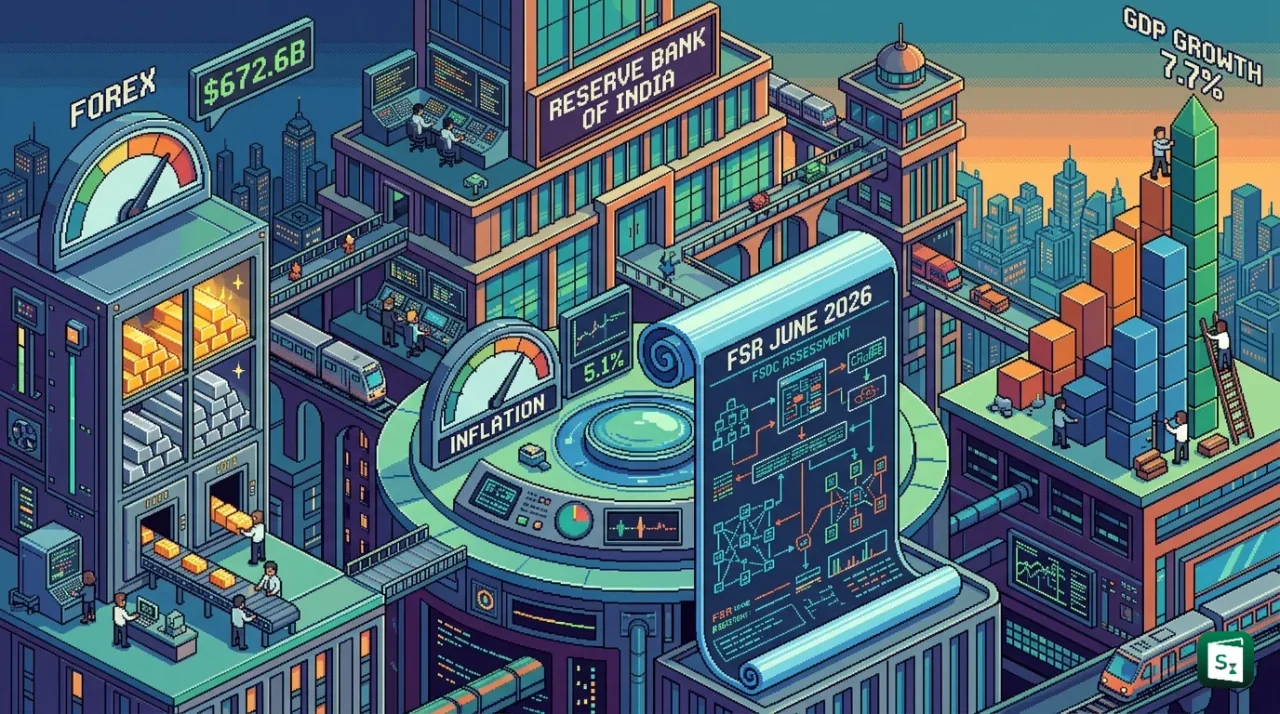
The Reserve Bank of India released the June 2026 edition of the Financial Stability Report (FSR) on 30 June 2026. The report presents the collective assessment of the Sub-Committee of the Financial Stability and Development Council (FSDC) on risks facing India’s financial system. It finds India’s economy grew at 7.7% in FY26 and its banks and non-bank lenders remain resilient, even as global stability risks stay elevated.
What Is the Financial Stability Report?
The Financial Stability Report (FSR) is a half yearly publication of the Reserve Bank of India (RBI). RBI, which was established on 1 April 1935 and is headquartered in Mumbai, brings out the report in June and December every year. The report checks the health of the entire financial system. It covers banks, non-banking financial companies, insurance firms, financial markets and the links between them.
The June 2026 edition reflects the collective view of the Sub-Committee of the Financial Stability and Development Council (FSDC). The Financial Stability and Development Council (FSDC) was set up by the government in December 2010 as the apex forum for financial stability, inter regulatory coordination and financial sector development. It is chaired by the Union Finance Minister. Its Sub-Committee meets more often and is chaired by the RBI Governor, a post currently held by Sanjay Malhotra. Its members include the heads of the Securities and Exchange Board of India (SEBI), the Insurance Regulatory and Development Authority of India (IRDAI), the Pension Fund Regulatory and Development Authority (PFRDA), the International Financial Services Centres Authority (IFSCA) and the Insolvency and Bankruptcy Board of India (IBBI), along with the Secretaries of the Departments of Economic Affairs, Financial Services, Revenue, Corporate Affairs and Electronics and Information Technology, and the Chief Economic Adviser. The Financial Stability Department of RBI acts as its secretariat and conducts system level stress tests.
The report has three broad parts. The first part reviews macro financial risks in India and the world. The second part tests the soundness of financial institutions. The third part lists regulatory steps taken by financial sector regulators.
India’s Growth and Inflation Picture in June 2026
The report says the Indian economy recorded strong growth of 7.7% in FY26. This is higher than the 7.1% growth in FY25. Average growth over the last three years stands at 7.3%. Strong private consumption and fixed investment supported this performance. Growth in the January to March quarter of FY26 was 7.8%. Most high frequency indicators for April and May 2026 showed that activity remained firm in the first quarter of 2026-27, despite headwinds from the conflict in West Asia.
The outlook for 2026-27 is weaker because of external pressures. The RBI has projected GDP growth of 6.6% for FY27, lower than the 6.9% estimated earlier in April 2026. Elevated prices of crude oil and other commodities, supply chain disruptions and slower global growth are expected to weigh on domestic activity. The quarterly path shows the sharpest slowdown in the middle of the year, with a revival at the end.
| Period in FY27 | Projected GDP Growth |
|---|---|
| Q1 (April to June 2026) | 6.6% |
| Q2 (July to September 2026) | 6.3% |
| Q3 (October to December 2026) | 6.5% |
| Q4 (January to March 2027) | 6.8% |
| Full year FY27 | 6.6% |
On prices, the Monetary Policy Committee (MPC) has revised the inflation forecast upward. The MPC is the six member rate setting panel of RBI, with three members from RBI and three external members. It targets Consumer Price Index (CPI) inflation of 4% within a band of 2% to 6%. CPI inflation measures the change in retail prices of goods and services bought by households. For 2026-27, CPI inflation is now projected at 5.1%, up from 4.6% projected in April. This is a sharp rise from the very low 2.1% recorded in 2025-26. Core inflation, which excludes food and fuel, is projected at 4.7% for 2026-27, which suggests that demand pressures remain contained if precious metals are excluded.
| Period in FY27 | Projected CPI Inflation |
|---|---|
| Q1 | 4.2% |
| Q2 | 5.1% |
| Q3 | 5.9% |
| Q4 | 5.4% |
| Full year FY27 | 5.1% |
The report links the higher inflation forecast to two main factors. The first is the assumption of higher average oil prices in 2026-27, at around $95 per barrel, after the sharp rise in crude prices due to the West Asia conflict. India imports more than 85% of its crude oil needs, so a sustained rise quickly raises transport and factory costs. Wholesale inflation had already risen to 8.3% in April 2026 from 3.9% in March, while retail inflation was still low at 3.5% in April. The second factor is the forecast of a below normal southwest monsoon by the India Meteorological Department, with risks from developing El Nino conditions. Adequate foodgrain stocks and satisfactory reservoir levels provide some comfort, but the report warns that higher energy prices could widen the current account deficit (CAD), which is the gap between what India earns from abroad and what it spends abroad, and put pressure on the fiscal deficit and bond yields.
External Strength: Forex Reserves at $672.6 Billion
India’s foreign exchange reserves were recorded at $672.6 billion as of 19 June 2026. Foreign exchange reserves are foreign currency assets, gold, and international drawing rights held by RBI. They act as a buffer against external shocks and help RBI manage sharp moves in the rupee. The reserves rose by $963 million during the week ended 19 June, after a sharp fall of $9.985 billion in the previous week to $671.625 billion.
The weekly rise was driven mainly by gold. Foreign Currency Assets (FCAs), the largest part of reserves, fell by $3.07 billion to $541.217 billion. This fall was more than offset by a $4.1 billion rise in gold reserves to $107.93 billion. Special Drawing Rights (SDRs), which are international reserve assets created by the International Monetary Fund (IMF), stood at $18.647 billion. India’s reserve position in the IMF stood at $4.793 billion.
| Component as on 19 June 2026 | Value |
|---|---|
| Foreign Currency Assets | $541.217 billion |
| Gold | $107.93 billion |
| Special Drawing Rights | $18.647 billion |
| Reserve Position in IMF | $4.793 billion |
| Total Reserves | $672.587 billion |
The report notes that India’s sound macroeconomic fundamentals place it in a stronger position than many peers. Large reserves, along with policy steps by the government and RBI to support capital inflows, have improved the balance of risks after the interim peace deal in West Asia. Strong reserves give RBI room to keep markets orderly when oil prices rise or global investors pull out funds.
How Safe Are Banks and NBFCs?
The report says India’s domestic financial system remains resilient because of strong balance sheets of banks and non-bank lenders. Scheduled Commercial Banks (SCBs) are all banks included in the Second Schedule of the RBI Act, 1934. They include public sector banks, private banks, foreign banks, small finance banks and regional rural banks. The report describes SCBs as safe and sound, with strong capital and liquidity buffers, better asset quality and stable profits.
Asset quality is at its best in many decades. The Gross Non-Performing Asset (GNPA) ratio, which is the share of loans that have stopped earning interest for more than 90 days out of total loans, fell to 1.8% in March 2026 from 2.3% a year earlier. The slippage ratio, which measures fresh bad loans added during the year, eased to 1.2% in FY26, the fourth straight year of improvement. The Capital to Risk-Weighted Assets Ratio (CRAR), which shows a bank’s capital as a share of its risk-weighted loans, stood at 17.7%. Bank credit grew by 14.5% year on year in FY26, after slowing in the first half and picking up in the second half.
Non-Banking Financial Companies (NBFCs) also remain financially sound. NBFCs give loans like banks but cannot accept demand deposits. Their aggregate credit growth was 16.6% in March 2026. Their GNPA ratio was 2.4% and net NPA ratio was 0.8%. Their CRAR was high at around 22.3% for the stress test sample, with profitability healthy and return on assets at 2.3%. Within retail loans, gold loans grew sharply and now form 17.4% of NBFC retail portfolios. The insurance sector also shows balance sheet strength, with the solvency ratio of life insurers staying above the minimum level. The solvency ratio checks whether an insurer has enough capital to pay all claims.
Stress Tests Show Buffers Hold Even in Adverse Cases
RBI tested what would happen if the economy faces severe shocks such as prolonged geopolitical conflict, high energy prices, currency pressure, high inflation and slow growth till FY28. For 46 selected banks, the GNPA ratio may edge up from 1.8% in March 2026 to 1.9% by March 2028 in the normal case. It could rise to 3.8% in the first adverse case and 4.1% in the second and more severe case. Even then, capital stays above the required floor. The Common Equity Tier 1 (CET1) ratio, which is the highest quality capital of a bank, may ease from 15.2% in March 2026 to 13.9% by March 2028 in the normal case and to 11.6% and 11.4% in the two adverse cases. No bank breaches the minimum capital rule in the normal case, while one bank in the first adverse case and two banks in the severe case may fall below the total capital floor. All banks still meet the minimum CET1 rule.
For 174 NBFCs in the upper and middle layers, the system GNPA may rise from 2.4% in March 2026 to 2.8% by March 2027 in the normal case and to 4% and 5.2% under medium and severe stress. Aggregate CRAR may dip from 22.3% to 20.8% in the normal case and to around 20% under severe stress, still above the 15% minimum. The risk is uneven across firms. About 7 NBFCs may breach the 15% floor even in the normal case, and 15 NBFCs may breach it under stress. Tests also show that if the three largest borrowers of an NBFC fail, system CRAR can fall by more than 200 basis points. Bank borrowings now form 43.5% of NBFC funding, so stress can travel quickly between banks and NBFCs.
Global Risks and the Way Forward
On the global front, the report says the financial system has shown notable resilience despite repeated shocks. Markets stayed orderly after an initial bout of volatility when the West Asia conflict broke out. The interim peace deal and policy steps to support capital inflows have turned the balance of risks favourable for India. RBI Governor Sanjay Malhotra noted that India’s economy and financial system have shown remarkable resilience despite external shocks of large size.
Risks remain high, however. Persistent supply chain uncertainty could tighten financial conditions and push inflation up again. High public debt, stress in bond markets, stretched prices of assets and high leverage among non-bank financial firms outside India remain weak spots that can make future shocks worse. The report also flags geopolitical fragmentation as a key source of external shocks. For India, high oil and commodity prices and weak global growth could hurt growth, widen the current account gap and raise bond yields if the fiscal math slips.
Technology risk is now a financial stability issue. The report finds that AI enabled cyberattacks are the most important near term cyber challenge. In a survey of 33 banks and 10 upper layer NBFCs, 95% ranked AI enabled threats among the top three risks for the next 12 months. About 93% depend partly or fully on outside vendors for core cyber tasks, and 81% spent less than 5% of revenue on information technology in FY26. Most firms rated themselves at developing or intermediate stage in readiness against AI specific threats.
The way forward, as per the report, is to keep strengthening buffers and safeguards while staying alert. The crisis has underlined the need to speed up the shift to clean energy, using solar, wind, geothermal, biofuels and nuclear power, to cut exposure to oil price swings. Continued repair of balance sheets, careful monitoring of bank and NBFC links, higher cyber spending and inter regulatory coordination through the FSDC will remain central to protecting stability while supporting growth.
Key Takeaways
- The June 2026 Financial Stability Report was released on 30 June 2026 as the collective assessment of the FSDC Sub-Committee chaired by the RBI Governor.
- India’s real GDP grew by 7.7% in FY26, while RBI projected growth of 6.6% for FY27 amid West Asia and oil price risks.
- The MPC revised CPI inflation for 2026-27 to 5.1%, with quarterly projections of 4.2%, 5.1%, 5.9% and 5.4% and core inflation at 4.7%.
- India’s foreign exchange reserves stood at $672.587 billion as on 19 June 2026, with gold reserves at $107.93 billion and foreign currency assets at $541.217 billion.
- Scheduled Commercial Banks reported a multi-decadal low GNPA of 1.8% in March 2026 and CRAR of 17.7%, with stress tests showing capital stays above minimums even if GNPA rises to 4.1% by March 2028.
- The FSDC was set up in December 2010 and is chaired by the Union Finance Minister, while its Sub-Committee is chaired by the RBI Governor and includes heads of SEBI, IRDAI, PFRDA, IFSCA and IBBI.