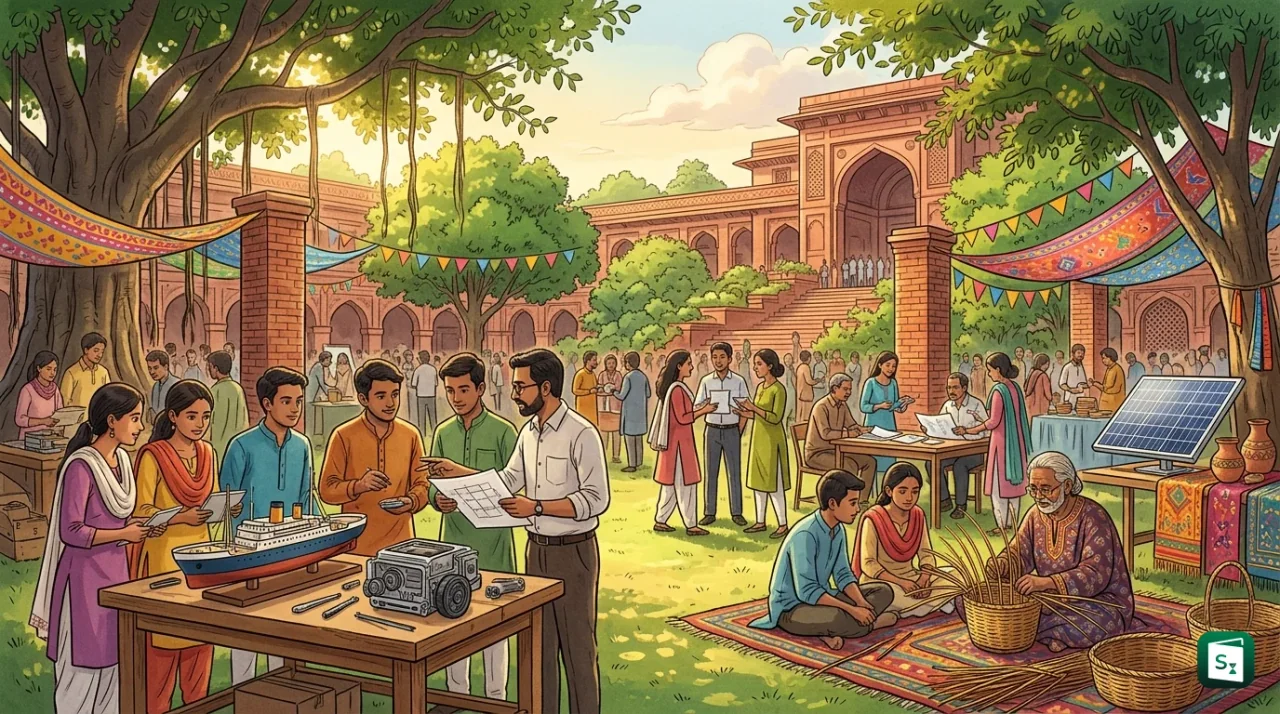
The Ministry of Minority Affairs organised the Samavesh Se VIKAS Implementation Review and Stakeholder Dialogue on 4 November 2026 at Samrasta Hall in Dr Ambedkar International Centre, New Delhi. The meeting reviewed the progress of the Pradhan Mantri Virasat Ka Samvardhan (PM VIKAS) scheme with more than 80 Project Implementing Agencies and other stakeholders. Four new training partnerships announced at the event will skill 9,720 youth from minority communities for jobs in auto, maritime, solar energy and traditional willow craft.
What Is PM VIKAS and What Does Virasat Ka Samvardhan Mean?
The Pradhan Mantri Virasat Ka Samvardhan (PM VIKAS) scheme is a Central Sector Scheme of the Ministry of Minority Affairs for the social and economic empowerment of notified minority communities. Virasat Ka Samvardhan means nurturing of heritage. The scheme links heritage crafts with modern skills, education and entrepreneurship support.
The PM VIKAS guidelines were approved in January 2025, and implementation started after that. The scheme brings together five earlier schemes of the Ministry into one integrated framework. This convergence was done to reduce overlap and to provide skilling, education and enterprise support through a single window.
| Earlier Scheme | What It Focused On | Now Part Of PM VIKAS As |
|---|---|---|
| Seekho aur Kamao | Skill training for minority youth | Non-traditional skilling |
| USTTAD | Upgrading skills of artisans | Traditional skilling |
| Hamari Dharohar | Preservation of heritage | Traditional skilling and heritage preservation |
| Nai Roshni | Leadership training for minority women | Women leadership and entrepreneurship |
| Nai Manzil | Education bridge for school dropouts | Education through open schooling |
PM VIKAS serves the six communities notified under the National Commission for Minorities Act, 1992. These are Muslims, Christians, Sikhs, Buddhists, Jains and Parsis. The Ministry of Minority Affairs, which was carved out of the Ministry of Social Justice and Empowerment on 29 January 2006, is the nodal Ministry for their development.
PM VIKAS is different from the Pradhan Mantri Kaushal Vikas Yojana (PMKVY). PMKVY is run by the Ministry of Skill Development and Entrepreneurship for all youth across India. PM VIKAS is run only by the Ministry of Minority Affairs and focuses on minority communities, with special attention to traditional artisans, women entrepreneurs and school dropouts.
What Happened at the Samavesh Se VIKAS Dialogue?
The Ministry of Minority Affairs held the Samavesh Se VIKAS dialogue on 4 November 2026 at Samrasta Hall, Dr Ambedkar International Centre, New Delhi. Samavesh means inclusion in Hindi. The title signals the goal of inclusive growth through the PM VIKAS scheme.
More than 80 participants attended the meeting. It was attended by Shyama Prasad Roy, Joint Secretary in the Ministry, and Neha Giri, Director in the Ministry. Representatives of Project Implementing Agencies (PIAs), industry partners and other stakeholders took part.
Neha Giri presented an overview of PM VIKAS implementation. She highlighted training progress, gaps in employment outcomes and priorities for the period ahead. She asked all PIAs to give sharper attention to placement results, closer contact with employers and timely reporting of verified placement data.
A central session was the PIA-wise implementation review. Each agency reported its training delivery, assessment status and placement record. Officials discussed field problems such as weak industry links, delays in certification and poor tracking of trainees after training. The review also explored steps to improve coordination, training quality and monitoring.
The dialogue also featured technical presentations. The Quality Council of India (QCI) and the Indian Institute of Management Bangalore (IIM Bangalore) spoke on independent quality checks. The EkStep Foundation presented BlueDot, a technology tool to improve placement tracking, and Voice AI for collecting candidate feedback. The role of the National Skill Development Corporation (NSDC) in strengthening employer links was also discussed. ITIHAAS, the Indian Traditions and Heritage Society, presented ideas on skilling youth for heritage and tourism jobs.
Four New Training Partnerships Signed Under PM VIKAS
The Ministry signed Memoranda of Understanding for training of 9,720 candidates in total. Three MoUs were signed at the 4 November event. A fourth MoU with the Central University of Kashmir was signed on 3 November 2026.
| Partner Institution | Candidates and Location | Job Roles and Course |
|---|---|---|
| Pithampur Auto Cluster (PAC), Madhya Pradesh | 2,400 candidates in Madhya Pradesh | Electric Vehicle Service Technician, CNC Milling Programmer, Warehouse Associate and Supply Chain Executive |
| Centre of Excellence in Maritime and Shipbuilding (CEMS) | 6,300 candidates across Karnataka, Puducherry, Maharashtra, Telangana, West Bengal, Odisha and Gujarat | Business Analyst, Warehouse Supervisor, AI Technocrat and Guest Service Executive |
| Institute of Entrepreneurship Development (IED), Uttar Pradesh | 900 candidates in Uttar Pradesh | Solar PV Installer (Suryamitra) for renewable energy jobs |
| Central University of Kashmir | 120 candidates in Ganderbal district, Jammu and Kashmir | Willow Craft Artisan through a 390 hour programme |
The partnership with PAC will train youth in Pithampur, a major auto and industrial hub near Indore. The courses match emerging factory needs such as electric vehicle service and computer controlled milling. This links minority youth directly to industrial jobs in central India.
CEMS will provide industry oriented training in seven states and Union Territories. CEMS is a skill initiative set up by the Ministry of Ports, Shipping and Waterways with Siemens and the Indian Register of Shipping. It runs modern labs at Mumbai and Visakhapatnam, operational since February 2019, and trains youth in manufacturing, logistics and digital tools. The PM VIKAS tie up extends its network to minority candidates.
The tie up with IED will train 900 youth in Uttar Pradesh as solar installers. The Suryamitra role supports rooftop solar and ground mounted solar projects. This creates work in installation and maintenance as India expands green energy capacity.
The Kashmir partnership focuses on traditional skills. The Central University of Kashmir, through its Design Innovation Centre at Green Campus in Ganderbal, will train 120 candidates as willow craft artisans. Ganderbal villages such as Kachan and Shallabugh are historic centres of willow wicker work, locally called Kaenikaem or Shaksazi. Baskets, chairs, trays and Kangri baskets from this craft face competition from cheap machine made products. The 390 hour course aims to improve design, quality and market links while preserving the craft. The university notification reserves 50 percent of the 120 seats for women and provides a stipend of ₹9,000 for the full course.
How Is PM VIKAS Structured and Who Can Apply?
The Ministry of Minority Affairs implements PM VIKAS through four components. Funds for the first three components are fully provided by the central government. Infrastructure support is dovetailed with the Pradhan Mantri Jan Vikas Karyakram (PMJVK), which builds schools, skill centres and community assets in minority concentration areas.
Component 1 covers skilling and training. Traditional training supports artisans in crafts such as embroidery, carpentry and wicker work. It includes need based courses, workshops on design, packaging, e-commerce onboarding and export management, and work to document languishing art forms. Non-traditional skilling provides placement linked training in National Skills Qualifications Framework (NSQF) approved job roles in manufacturing, services, logistics and green energy. NSQF is the national quality framework that fixes levels, learning hours and assessment standards for each job role.
Component 2 supports women leadership and entrepreneurship. It was earlier run as Nai Roshni. Women receive basic leadership and entrepreneurship training. Selected trainees are further mentored to become Biz Sakhis or Udyami Mitras, who guide other women to start group or individual enterprises. Credit links are arranged through the National Minorities Development and Finance Corporation (NMDFC), which was set up in 1994 to provide concessional loans for self employment.
Component 3 supports education. It was earlier run as Nai Manzil. School dropouts receive bridge courses and can appear for Class 8, 10 and 12 certification through the National Institute of Open Schooling (NIOS). NIOS was established in 1989 and functions under the Ministry of Education as the national open school.
Component 4 supports infrastructure. New buildings or upgrades are taken up only where existing Skill India centres or other public facilities are not available. Proposals under this part follow PMJVK funding norms with cost sharing between the Centre and states.
Eligibility is fixed by the scheme guidelines. Any Indian citizen belonging to the six notified minority communities can take part. Beneficiaries need an Aadhaar number and an Aadhaar linked bank account for stipend payment. The target age is 14 to 45 years for skilling and education, and 18 to 45 years for the women leadership track. At least 33 percent of skilling seats are reserved for women, at least 50 percent of education seats are reserved for women, and 3 percent are reserved for persons with disabilities. To promote social harmony, up to 25 percent seats in traditional training and up to 15 percent in other components can go to candidates from other communities in the economically weaker sections.
Parliament data shows the scale of rollout. Targets have been allotted through 59 Project Implementing Agencies. Enrolment had crossed 80,000 candidates by early 2026, with Uttar Pradesh, Assam, Punjab and Jammu and Kashmir among the larger enrolment states. Budget documents record a Budget Estimate of ₹267.29 crore for 2025-26, with actual spending picking up after guidelines were approved.
Why Placement Outcomes and Quality Checks Took Centre Stage
The 4 November review marked a clear shift from counting certificates to counting jobs. Ministry officials told PIAs that training alone is not success. Success will be measured by verified wage employment, apprenticeship or self employment after training.
Under the non-traditional skilling norms, PIAs are expected to place at least 75 percent of trained candidates, with at least half of them in the organised sector. Placements in farm and construction trades can include self employment because such work is largely informal. To enforce this, the Ministry has asked for employer engagement during course design, on the job training and apprenticeship links, and timely upload of verified placement proof on the scheme portal.
Quality assurance was another focus. All training centres must be affiliated with the Skill India Digital Hub and follow Common Cost Norms fixed by the Ministry of Skill Development and Entrepreneurship. The Ministry has brought in QCI and IIM Bangalore for independent monitoring of training delivery. EkStep Foundation demonstrated digital tools to track trainees after placement and to collect honest feedback through voice calls. NSDC will help connect PIAs with employers and Sector Skill Councils for assessment and certification.
The Ministry is also linking traditional crafts to markets. Five Lok Samvardhan Parvs have been held in Delhi, Jammu and Kashmir and Kerala to let artisans display products, meet buyers and join e-commerce platforms. The new willow craft course in Ganderbal and the solar and auto courses follow the same logic. Heritage skills get design and market support, while modern courses lead to factory, logistics and energy jobs.
Key Takeaways
- The Samavesh Se VIKAS dialogue was held on 4 November 2026 at Samrasta Hall, Dr Ambedkar International Centre, New Delhi.
- PM VIKAS stands for Pradhan Mantri Virasat Ka Samvardhan and is a Central Sector Scheme of the Ministry of Minority Affairs.
- PM VIKAS guidelines were approved in January 2025 by merging five schemes including Seekho aur Kamao, USTTAD and Nai Manzil.
- Four new MoUs will train 9,720 candidates, including 2,400 with PAC, 6,300 with CEMS, 900 with IED and 120 willow artisans with Central University of Kashmir.
- The Central University of Kashmir will run a 390 hour Willow Craft Artisan course in Ganderbal with 50 percent seats for women.