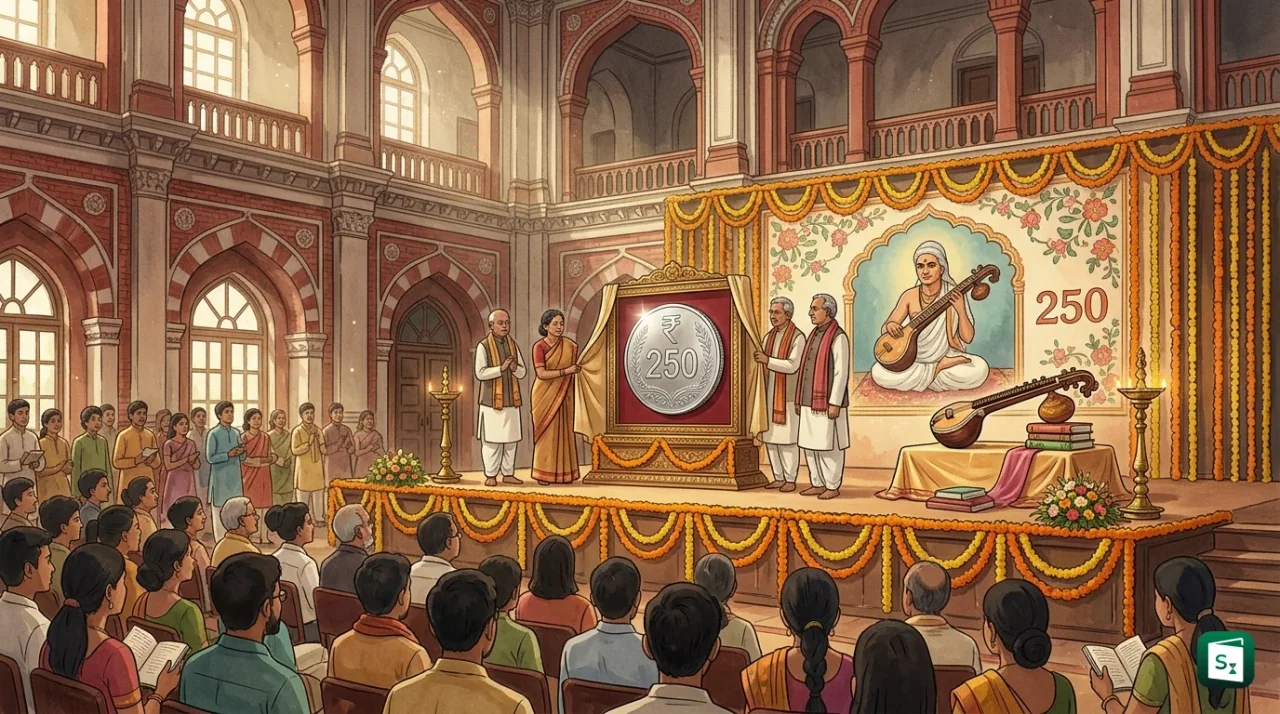
Union Finance Minister Nirmala Sitharaman released a ₹250 commemorative coin on 3 November 2026 at Swatantrata Bhavan in Banaras Hindu University (BHU), Varanasi. The coin marks the 250th birth anniversary of Muthuswami Dikshitar, one of the Trinity of Carnatic Music. The event also saw the release of a book on his life and the logo and website of the Centre of Excellence in Indian Knowledge Systems at IIT BHU.
What Is a Commemorative Coin?
A commemorative coin is a special coin issued by the government to honour a person, event, institution or milestone. The Government of India designs and mints these coins under the Coinage Act, 2011, and they carry a face value in rupees. Unlike regular circulation coins used for daily buying and selling, commemorative coins are made in limited numbers for collectors and for remembrance.
Regular circulation coins in India are issued in denominations of 50 paise, ₹1, ₹2, ₹5, ₹10 and ₹20 for everyday use. Commemorative coins can carry much higher face values, up to ₹1,000 under the law, but they are not released for general circulation. They are usually struck in precious metal mixes and sold at prices far above the face value because of metal cost, minting and collector packaging.
The role of institutions is clearly divided. The central government decides the design, size and metal mix. The coins are minted at the four India Government Mints at Mumbai, Hyderabad, Kolkata and Noida, which are owned by the Security Printing and Minting Corporation of India Limited (SPMCIL). SPMCIL was formed in 2006 and is headquartered in New Delhi. The Reserve Bank of India (RBI), established in 1935 and headquartered in Mumbai, only issues the coins supplied by the government for circulation.
India issued its first modern commemorative coin in 1964 to mark the birth anniversary of Jawaharlal Nehru. Since then, more than 150 such themes have been released, including coins for Mahatma Gandhi, B R Ambedkar, the Parliament of India and the International Day of Yoga.
Coin Released for Muthuswami Dikshitar in Varanasi
The Finance Ministry released the ₹250 commemorative coin for the 250th Janmotsava of Sri Muthuswami Dikshita at an event titled Amara Guruguha. The programme was organised by the Centre of Excellence in Indian Knowledge Systems at IIT BHU at Swatantrata Bhavan. BHU Vice Chancellor Ajit Kumar Chaturvedi and IIT BHU Director Amit Patra attended the ceremony along with faculty, students and schoolchildren.
The Minister also released the book Amara Guruguham Potruvam, which documents the life, philosophy and musical journey of Dikshitar. She spoke about the richness of Carnatic music, the special features of the veena linked to Dikshitar, and his stay in Kashi. She urged young listeners to learn about Indian temples, geography and spiritual traditions through his songs.
The programme featured a Carnatic vocal recital by Sumithra Vasudev and a veena recital by Ramana Balachandran, with support on the mridangam and violin. Before the event, the Minister paid floral tribute to the statue of Madan Mohan Malaviya, the founder of BHU in 1916 in Varanasi.
| Detail of the Dikshitar Coin | Fact |
|---|---|
| Face value | ₹250 |
| Weight | 35 grams |
| Metal mix | Silver 50 percent, copper 40 percent, nickel 5 percent, zinc 5 percent |
| Mint | India Government Mint, Mumbai |
| For circulation | No, collector item only |
| Sale price on mint website | ₹6,985 for booklet packing |
Collectors can order the coin from the official website of the India Government Mint, subject to stock. Such coins are sold as proof or uncirculated collector pieces in special packing, so the sale price is much higher than the face value.
Who Was Muthuswami Dikshitar?
Muthuswami Dikshitar was a poet, singer, veena player and composer of Indian classical music. He was born on 24 March 1775 in Tiruvarur in present day Tamil Nadu to Ramaswami Dikshitar and Subbamma. His family named him after Muthukumaraswamy, the deity of the Vaitheeswaran Koil. He died on 21 October 1835 at Ettayapuram, where his samadhi still attracts musicians.
Dikshitar learned Sanskrit, the Vedas and music from his father. His father Ramaswami Dikshitar was himself a musician and is credited with discovering the raga Hamsadhwani. Dikshitar had two brothers, Chinnaswami and Balaswami, and a sister Balamba. Balaswami later helped spread the use of the violin in Carnatic music. His grand nephew Subbarama Dikshitar later recorded 229 of his kritis in the famous music text Sangeeta Sampradaya Pradarshini.
Dikshitar used the signature Guruguha in every composition. Guruguha is one of the names of Lord Muruga. In his kriti Balagopala, he calls himself a vainika gayaka, which means a veena player who sings. The vainika style gives importance to gamakas, which are graceful slides and shakes between notes. Most of his pieces are in a slow tempo called chowka kala.
Unlike his contemporaries who wrote mainly in Telugu, Dikshitar wrote mostly in Sanskrit. He also wrote a few pieces in Manipravalam, a literary style that mixes Sanskrit and Tamil. His Sanskrit lyrics are known for correct grammar, including the use of all eight Sanskrit declensions, and for references to temples, deities, astrology and Advaita Vedanta philosophy.
Kashi Years and Musical Training
As a teenager, Dikshitar travelled with the ascetic Chidambaranatha Yogi to North India and stayed for about five years in Kashi, the older name for Varanasi. In Kashi he studied music, philosophy, yoga and tantra. The samadhi of his guru can still be seen near Hanuman Ghat in Varanasi. This long stay explains why Varanasi was chosen for the 250th anniversary honour.
The Kashi years shaped his music in two clear ways. He absorbed Dhrupad, the serious and slow form of Hindustani music, which added grandeur to his slow kritis. He also visited many temples and later composed on deities at Varanasi, Tirupati, Srirangam, Chidambaram, Kanchipuram, Palani and other centres.
Earlier, at Fort St George in Madras, now Chennai, Dikshitar had heard Western military bands with the support of the local administrator Venkatakrishna Mudaliar. He later adapted about 40 Western folk tunes into simple Sanskrit pieces. This collection is called Nottusvara Sahitya, where nottu comes from the English word notes. A well known example draws on a Celtic tune similar to a French folk song.
Famous Compositions and Groups of Kritis
Dikshitar is credited with around 450 to 500 compositions, almost all in the kriti form. A kriti is a structured Carnatic composition with pallavi, anupallavi and charanam sections. He also used the Samashti Charanam form, which has only one section after the pallavi. His first composition was Srinathadi Guruguho Jayati in the raga Mayamalavagowla.
His best known single piece is Vatapi Ganapatim in Hamsadhwani, sung at the start of many concerts. His large group compositions include:
- Kamalamba Navavarana Kritis: nine songs plus a dhyana piece on Goddess Kamalamba at Tiruvarur, linked to Sri Chakra worship
- Navagraha Kritis: nine songs on the Sun, Moon, Mars, Mercury, Jupiter, Venus, Saturn, Rahu and Ketu, showing his knowledge of mantra and Jyotisha
- Nilotpalamba Kritis: songs on the consort of Shiva at Tiruvarur, which revived rare ragas such as Narayanagowla and Chayagaula
- Guruguha Vibhakti Kritis: eight songs on Lord Muruga at Tiruttani in all eight Sanskrit declensions
- Abhayamba Vibhakti Kritis: songs on the goddess at Mayavaram
- Shodasha Ganapati Kritis: sixteen songs on sixteen forms of Ganapati
- Panchabhuta Kshetra Kritis: songs on Shiva temples linked to the five elements
He composed in all 72 Melakarta ragas under the older Asampurna Mela system and in all seven basic Carnatic talas. This wide range helped preserve many rare ragas for later generations.
Who Are the Trinity of Carnatic Music?
The Trinity of Carnatic Music, also called the Tiruvarur Trinity, refers to three great composers of the late 18th and early 19th centuries. The Trinity lived in the 18th and 19th centuries and all three were born in Tiruvarur in the old Thanjavur region of Tamil Nadu. Together they created a new age for Carnatic music with original ragas, talas and composition styles.
| Composer | Years | Main Language | Signature | Known For |
|---|---|---|---|---|
| Syama Sastri | 1762 to 1827 | Telugu and Sanskrit | Syama Krishna | Swarajatis, complex talas |
| Tyagaraja | 1767 to 1847 | Telugu | Tyagaraja | Pancharatna Kritis |
| Muthuswami Dikshitar | 1775 to 1835 | Sanskrit | Guruguha | Navagraha Kritis, Nottusvara |
Syama Sastri, the eldest, is remembered for rhythmic skill and for three famous swarajatis called the Ratnatrayam. Tyagaraja, the most widely sung, composed around 700 available kritis including the five Pancharatna Kritis sung every year at Tiruvaiyaru. Dikshitar, the youngest, added Sanskrit depth, temple detail and Hindustani touch. Women musicians M S Subbulakshmi, D K Pattammal and M L Vasanthakumari are often called the female Trinity of the 20th century.
Latest Commemorative Coins of India
The Dikshitar coin is part of a long series of recent collector coins. The year 2025 alone saw a record 35 themes, the highest in one year, with unusual face values such as ₹300, ₹350, ₹550 and ₹1,000. Many were struck in a four metal mix of silver, copper, nickel and zinc, while 15 were in pure silver.
Recent and widely noted issues include the ₹1,000 coin for 1,000 years of the naval expedition of Rajendra Chola I, released by the Prime Minister at Gangaikonda Cholapuram in July 2025, and the ₹300 coin for the 300th birth anniversary of Ahilyabai Holkar. Other 2025 and 2026 issues cover the birth centenary of Sathya Sai Baba, 100 years of the Rashtriya Swayamsevak Sangh, 150 years of Vande Mataram, 50 years of Project Tiger and the 200th anniversary of Rani Channamma.
The common pattern holds for all of them. The face value marks the anniversary number, the coin weighs around 35 to 40 grams, and the sale price on the mint portal stays between ₹7,000 and ₹17,500 depending on metal and packing. The coins remain legal tender in theory but do not enter daily use.
Key Takeaways
- The ₹250 commemorative coin for Muthuswami Dikshitar was released on 3 November 2026 at BHU, Varanasi by Nirmala Sitharaman.
- The coin weighs 35 grams and uses 50 percent silver, 40 percent copper, 5 percent nickel and 5 percent zinc, minted at the India Government Mint, Mumbai.
- Muthuswami Dikshitar was born on 24 March 1775 in Tiruvarur, Tamil Nadu and is the youngest of the Trinity of Carnatic Music with Tyagaraja and Syama Sastri.
- Dikshitar used the signature Guruguha, wrote mostly in Sanskrit, and is credited with 450 to 500 kritis including Vatapi Ganapatim and the Navagraha Kritis.
- Coins are designed by the central government under the Coinage Act, 2011, minted by SPMCIL mints and issued through the RBI, with collector sale through the mint website.