Alan Stanley Jones, the former Australian Formula 1 driver and 1980 world champion, passed away on 5 November 2026 in Sydney at the age of 80 after a short illness. Alan Jones won the 1980 Formula One World Championship with Williams Racing and remains the last Australian driver to win the Formula 1 world title. His family, through Motorsport Australia, confirmed his death three days after his 80th birthday.
What Is Alan Jones Famous For
Alan Jones is famous as the 1980 Formula One world champion and the first driver to win the drivers title for Williams Racing. The Australian driver won 12 Grands Prix in a Formula 1 career that ran from 1975 to 1986 and helped turn Williams into a championship winning team.
Jones remains the second and last Australian to win the Formula 1 world title. The first was Sir Jack Brabham, a three time champion. Jones also gave Williams its first drivers championship and played a central role in its first constructors championship in the same season.
His career numbers place him firmly in the history of the sport. He entered 117 Grands Prix, started 116 races, and recorded 12 wins, 24 podiums, 6 pole positions and 13 fastest laps. Eleven of his 12 wins came with Williams. His first win came with Shadow at the 1977 Austrian Grand Prix, and his last win came with Williams at the 1981 Caesars Palace Grand Prix in Las Vegas.
From Melbourne to Formula 1
Alan Stanley Jones was born on 2 November 1946 in Melbourne, Victoria, in Australia. His father was Stan Jones, a leading Australian racer who won the 1959 Australian Grand Prix. Alan started with kart racing and small saloon cars in Australia and moved to Britain in the late 1960s to build a racing career in Europe.
Alan Jones made his Formula 1 debut at the 1975 Spanish Grand Prix in a privately entered Hesketh. He later drove four races for the Graham Hill team that season and scored a strong fifth place at the German Grand Prix at the Nurburgring. In 1976 he got his first full season drive with Surtees, where his best result was fourth at the Japanese Grand Prix.
His break came with Shadow in 1977. Alan Jones joined the team after driver Tom Pryce died in a crash at the South African Grand Prix. Later that year he won the 1977 Austrian Grand Prix for Shadow in mixed wet and dry conditions, beating Ferrari driver Niki Lauda. It was the only win ever recorded by the Shadow team.
Alongside Formula 1, Alan Jones raced in North America. He drove a Lola for the Haas-Hall team and won the 1978 Can-Am Championship, with five wins in nine starts. The result proved his speed and stamina and raised his profile just as Williams was looking for a lead driver.
How Alan Jones Won the 1980 F1 World Championship With Williams
Alan Jones joined Williams Grand Prix Engineering in 1978, when the team was still small and new. The team had been founded in 1977 by Frank Williams and engineer Patrick Head. Jones drove the Williams FW06 in his first year and took the team’s first podium with second place at Watkins Glen in the United States.
The turning point came in 1979 with the Williams FW07, a car that used ground effect to create extra grip from airflow under the car. After early reliability problems, Alan Jones won four of the last six races in Germany, Austria, the Netherlands and Canada. He finished third in the drivers standings that year, while teammate Clay Regazzoni took the team’s first ever win at the British Grand Prix.
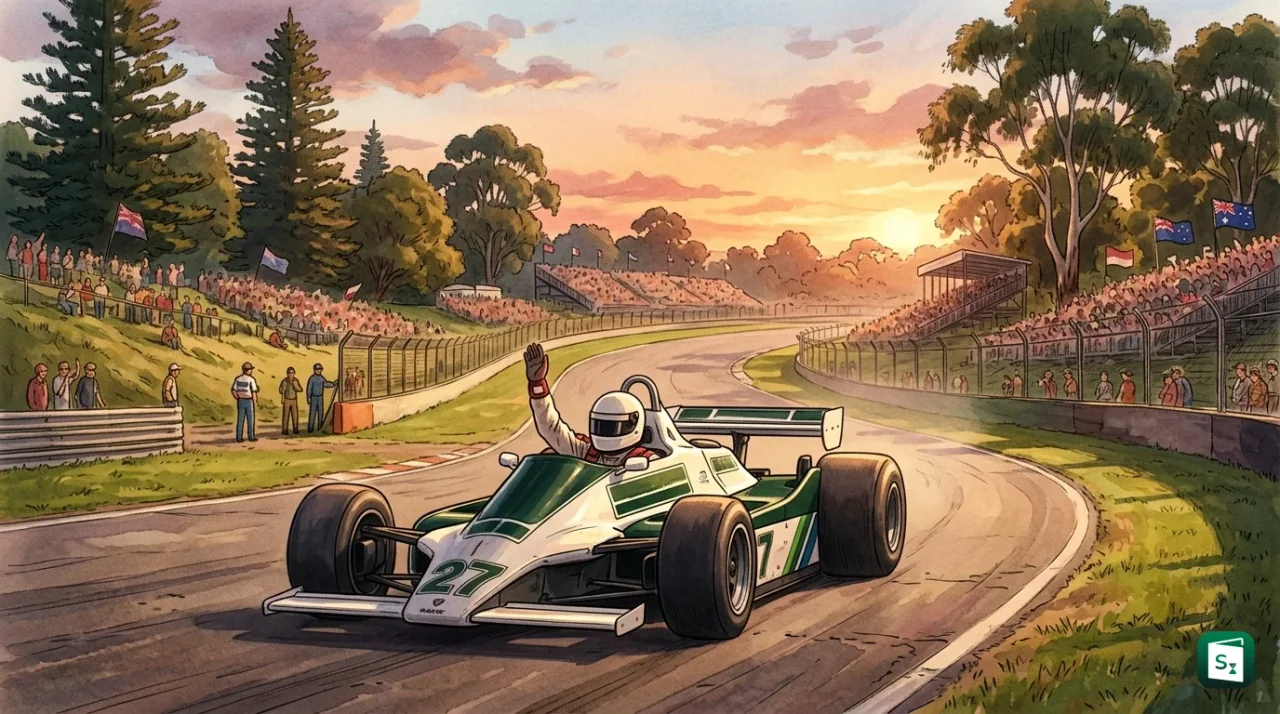
In 1980 Alan Jones drove the improved Williams FW07B and started the season as a title favourite. He won five championship races in Argentina, France, Britain, Canada and the United States over a 14 race season. He stood on the podium ten times and scored 67 points to beat Nelson Piquet of Brabham by 13 points. Williams also won its first constructors championship with 120 points, with Jones joined by teammate Carlos Reutemann.
| 1980 F1 Season Fact | Detail |
|---|---|
| Champion driver | Alan Jones, Williams, 67 points |
| Champion team | Williams Racing, 120 points |
| Jones wins counted for title | Argentina, France, Britain, Canada, United States |
| Main rival | Nelson Piquet, Brabham |
| Title decided | With one race to spare |
Alan Jones could have repeated the title in 1981. He won the opening race and the final race in Las Vegas but finished third overall after retirements and a difficult rivalry with teammate Reutemann. He retired from full time Formula 1 at the end of 1981 at the age of 34.
Williams Racing and the FW07: The Car Behind the Title
Williams Racing, formally known as Williams Grand Prix Engineering, is a British Formula 1 team based in Oxfordshire. Frank Williams handled team management and fund raising, while Patrick Head led car design. The team entered Formula 1 in 1977 with a customer March chassis before building its own car, the FW06, for 1978.
The FW07 series made the team a front runner. The original Williams FW07 appeared in the middle of 1979. The Williams FW07B followed in 1980 and the Williams FW07C in 1981. All three versions used a Ford Cosworth DFV V8 engine and ground effect sidepods for high cornering grip.
The success with Alan Jones set Williams on a long run at the top. The team has since won nine constructors championships and seven drivers championships, with more than 110 Grand Prix wins. Jones was the first of its seven world champion drivers, a list that later included Keke Rosberg, Nelson Piquet, Nigel Mansell, Alain Prost, Damon Hill and Jacques Villeneuve.
Australia’s F1 Champions: From Sir Jack Brabham to Alan Jones
Before Alan Jones, only one Australian had won the Formula 1 world title. That was Sir Jack Brabham, who won three drivers championships in 1959, 1960 and 1966. Brabham won his first two titles with Cooper and his third title in a car built by his own team, Brabham Racing Organisation, with an Australian Repco engine. He remains the only driver to win the world title in a car carrying his own name.
Alan Jones became the second Australian champion when he won in 1980. No Australian has won the title since. That long gap explains why Alan Jones held a special place in Australian sport for more than four decades.
Jones also kept a unique national record. He won the 1980 Australian Grand Prix at Calder Park Raceway in Melbourne. At that time the race was not part of the world championship. He lapped the entire field and remains the last Australian driver to win his home Grand Prix in any format.
Later Career, Touring Cars and Life Beyond Formula 1
Alan Jones left Formula 1 at the end of 1981 but returned twice. He drove one race for Arrows at the 1983 United States Grand Prix West at Long Beach. He then made a full comeback with the new American backed Haas team, driving the Lola THL1 and THL2 in late 1985 and through 1986. The project struggled with weak engines and poor reliability, and he scored only four points before leaving the sport for good after the 1986 Australian Grand Prix.
Back in Australia, Jones built a second career in touring and sports cars. He won the 1982 Australian GT Championship in a Porsche 935 and later won races in the Australian Touring Car Championship with Ford Falcons. He finished runner up in the championship in 1993. He also raced at Le Mans and won the Bathurst 12 Hour production car race in 1993. His final major race was the 2002 Bathurst 1000.
Off the track, Alan Jones became a well known television commentator in Australia and later served as a driver steward for the FIA, the governing body of world motorsport, at selected Grands Prix from 2010. He was appointed a Member of the Order of the British Empire (MBE) in 1980 for service to motorsport. He is survived by his wife Amanda Butler-Davis and his children, including racing driver Christian Jones.
Key Takeaways
- Alan Stanley Jones passed away on 5 November 2026 in Sydney at the age of 80 after a short illness.
- Alan Jones won the 1980 Formula One World Championship with Williams Racing, scoring 67 points in the Williams FW07B.
- He was the first Williams driver to win the drivers title and the second Australian champion after Sir Jack Brabham.
- Across his career from 1975 to 1986, Alan Jones recorded 12 wins, 24 podiums and 6 pole positions from 117 entries.
- Sir Jack Brabham won three titles in 1959, 1960 and 1966 and remains the only driver to win in a car of his own make.