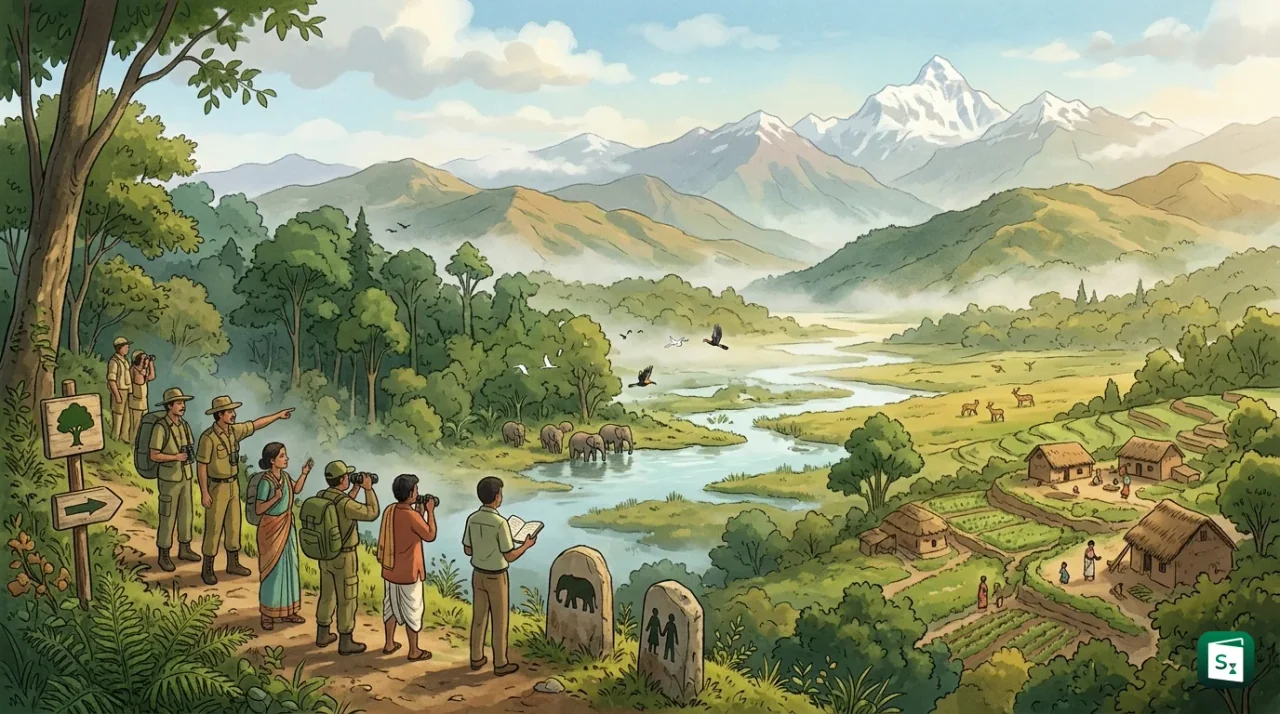
The International Day for Biosphere Reserves is observed every year on 3 November. UNESCO proclaimed the day in 2021 and the world marked it for the first time in 2022. It draws attention to 797 biosphere reserves in 145 countries, including 18 biosphere reserves in India, where conservation of nature and local livelihoods are managed together.
What Is a Biosphere Reserve?
A biosphere reserve is a large area on land, coast or sea that UNESCO recognises for testing how people and nature can grow together. It protects plants, animals and landscapes. At the same time, it supports research, education and sustainable income for local communities living inside and around it.
The word biosphere means the thin zone of life on Earth where land, water and air interact to support living things. Austrian geologist Eduard Suess first used the term in the nineteenth century. A biosphere reserve is a practical model for protecting this living zone in a specific place.
Unlike a fenced park that keeps people out, a biosphere reserve keeps people inside the plan. Villages, farms, forests and protected habitats can all lie within the same reserve. Human activity is not banned everywhere. It is guided by science so that use of resources does not destroy the natural base.
Biosphere reserves perform in situ conservation. This means they protect species in their natural homes, not in zoos or seed banks. They save not only wild plants and animals but also crop varieties, local livestock breeds, cultural practices and traditional knowledge.
How the Man and Biosphere Programme Created a World Network
The Man and Biosphere Programme, usually called the MAB Programme, is UNESCO’s oldest intergovernmental scientific programme for nature and people. UNESCO launched the MAB Programme in 1971 after the 1968 Biosphere Conference in Paris called for science to guide the use and care of natural resources. The programme combines natural and social sciences, economics, education and training to improve livelihoods while protecting ecosystems.
The World Network of Biosphere Reserves began in 1976 with 57 sites. It has grown steadily since then. The First International Congress on Biosphere Reserves in Minsk in 1983 produced an early Action Plan. The Seville Conference in Spain in 1995 gave the network its modern shape through the Seville Strategy and the Statutory Framework of the World Network. These documents fixed the goals, zonation rules and review process for reserves. Later roadmaps, the Madrid Action Plan for 2008 to 2013 and the MAB Strategy for 2015 to 2025, linked the network to the Sustainable Development Goals and climate action.
Today the World Network includes 797 biosphere reserves in 145 countries, including 22 transboundary sites shared by two or more countries. About 300 million people live inside these sites. The sites cover about 5 percent of the Earth’s land surface yet sustain more than 60 percent of the world’s terrestrial vertebrate species richness, which shows their high conservation value. New sites are added by the MAB International Co-ordinating Council. In June 2026 UNESCO added 14 new reserves, including Quebec City in Canada, the first whole city in the network.
Why Biosphere Reserves Are Established
Biosphere reserves are established to prove that protection of nature and progress of people can happen in the same landscape. UNESCO expects every reserve to perform three connected functions at the same time.
First is conservation of biological and cultural diversity. Reserves protect ecosystems, species, genetic variety and traditional ways of life. Second is sustainable development. Reserves help local people earn through farming, fisheries, forestry, handicrafts and ecotourism in ways that do not exhaust soil, water and forests. Third is logistic support. Reserves support research, monitoring, training and environmental education, and they share results with the global network.
This threefold role explains their importance for living organisms and for people. Reserves guard clean air, water, pollinators and soils. They store carbon and help villages adapt to floods, droughts and other extreme events. The UNESCO map for 2025 to 2026 warns that about 40 percent of reserves may face more extreme climate events by 2050, so their work on nature based solutions and climate monitoring has become more urgent.
How Biosphere Reserves Are Zoned Into Core, Buffer and Transition Areas
Every biosphere reserve uses the same three zone design. The zones form rings of reducing strictness from the centre outward. No zone can be skipped.
| Zone | Purpose | What Is Allowed |
|---|---|---|
| Core area | Strict long term protection of biodiversity | Non destructive research, monitoring and low impact education; usually a national park or sanctuary with no settlements |
| Buffer zone | Shield around the core and space for learning | Research, training, environmental education, ecotourism and limited sustainable use that does not harm the core |
| Transition area | Outer zone where people live and work | Villages, farms, fisheries, forests, tourism and small industry, managed to become more sustainable over time |
The core holds the most undisturbed habitats. It serves as a reference for scientists to study how ecosystems work without heavy human pressure. The buffer reduces pressure on the core. It is also used to test better farming, grazing and restoration methods. The transition area is the public face of the reserve. Local bodies, farmer groups, businesses and researchers work there together.
Globally a biosphere reserve averages about 18 percent core, 30 percent buffer and 52 percent transition area. The exact share varies with local geography and law. In India the core is normally an existing protected area under the Wild Life (Protection) Act, 1972, while the outer zones work through state schemes and community agreements.
International Day for Biosphere Reserves on November 3
The International Day for Biosphere Reserves is observed on 3 November every year. UNESCO’s General Conference proclaimed the day at its 41st session in 2021 through Resolution 37, on a proposal moved by Spain and Uruguay. The first global celebration took place on 3 November 2022, coinciding with the 50th anniversary of the MAB Programme.
The day reminds governments and citizens that sustainable living models already exist inside biosphere reserves. UNESCO asks national committees, schools, local bodies and reserve managers to hold cleanups, exhibitions, nature walks, science talks and cultural events. The focus is on youth, rural communities and sustainable production and consumption.
The observance also links biosphere reserves to larger goals such as the Sustainable Development Goals, the Kunming Montreal Global Biodiversity Framework and the aim of protecting 30 percent of land and sea by 2030. Core areas of reserves count as protected areas, while buffer and transition areas can support other effective conservation measures.
How Many Biosphere Reserves Are There in India?
India has 18 notified biosphere reserves covering about 91,425 square km. The network is managed by the Ministry of Environment, Forest and Climate Change. Financial help flows to states through a centrally sponsored scheme on a 60 to 40 sharing pattern, and 90 to 10 for Himalayan and North Eastern states. Of the 18 reserves, 13 are part of UNESCO’s World Network of Biosphere Reserves. This is the highest number for any country in South Asia.
The Nilgiri Biosphere Reserve, notified in 1986 across Tamil Nadu, Kerala and Karnataka, was India’s first biosphere reserve. It entered the UNESCO network in 2000. The Cold Desert Biosphere Reserve in Himachal Pradesh, notified nationally in 2009, became India’s newest UNESCO site in September 2025. It covers 7,770 square km in Lahaul and Spiti and includes Pin Valley National Park, Kibber Wildlife Sanctuary, Chandratal wetland and Sarchu.
The Great Rann of Kutch in Gujarat, spread over 12,454 square km, is the largest biosphere reserve in India. The Dibru Saikhowa Biosphere Reserve in Assam, spread over 765 square km, is the smallest. Among UNESCO sites, the Gulf of Mannar at 10,500 square km is the largest and Nokrek in Meghalaya at 820 square km is the smallest.
| Biosphere Reserve | State or Union Territory | Notified in India | In UNESCO Network Since |
|---|---|---|---|
| Nilgiri | Tamil Nadu, Kerala, Karnataka | 1986 | 2000 |
| Nanda Devi | Uttarakhand | 1988 | 2004 |
| Nokrek | Meghalaya | 1988 | 2009 |
| Gulf of Mannar | Tamil Nadu | 1989 | 2001 |
| Sundarbans | West Bengal | 1989 | 2001 |
| Manas | Assam | 1989 | Not yet included |
| Great Nicobar | Andaman and Nicobar Islands | 1989 | 2013 |
| Similipal | Odisha | 1994 | 2009 |
| Dibru Saikhowa | Assam | 1997 | Not yet included |
| Dihang Dibang | Arunachal Pradesh | 1998 | Not yet included |
| Pachmarhi | Madhya Pradesh | 1999 | 2009 |
| Khangchendzonga | Sikkim | 2000 | 2018 |
| Agasthyamalai | Kerala, Tamil Nadu | 2001 | 2016 |
| Achanakmar Amarkantak | Madhya Pradesh, Chhattisgarh | 2005 | 2012 |
| Great Rann of Kutch | Gujarat | 2008 | Not yet included |
| Cold Desert | Himachal Pradesh | 2009 | 2025 |
| Seshachalam | Andhra Pradesh | 2010 | Not yet included |
| Panna | Madhya Pradesh | 2011 | 2020 |
Famous sites add depth to this list. The Nilgiri reserve protects the Nilgiri tahr, lion tailed macaque, tiger and elephant in the Western Ghats. Nanda Devi shelters the snow leopard and musk deer. The Gulf of Mannar, India’s first marine biosphere reserve, protects dugongs, corals and Olive Ridley turtles. Sundarbans protects the Royal Bengal tiger and the world’s largest mangrove delta. Similipal in Odisha, also a tiger reserve and national park since April 2025, protects gaur, tiger and elephant. Khangchendzonga in Sikkim is both a mixed World Heritage Site and a biosphere reserve.
How Biosphere Reserves Differ From National Parks and Sanctuaries
Many readers mix up biosphere reserves with national parks and wildlife sanctuaries. The three categories differ in law, size and the place given to people.
| Feature | National Park | Wildlife Sanctuary | Biosphere Reserve |
|---|---|---|---|
| Legal base | Section 35 of the Wild Life (Protection) Act, 1972 | Sections 18 and 26A of the same Act | UNESCO MAB designation plus notification by the central government |
| Main aim | Protect the whole ecosystem | Protect wildlife and habitat, often a species | Conserve biodiversity while supporting sustainable use and research |
| Size | Small to medium | Small to medium | Very large, often includes parks and sanctuaries inside the core |
| People inside | No private rights or grazing after settlement | Limited regulated use with permission of the Chief Wildlife Warden | People live in buffer and transition zones by design |
A biosphere reserve does not replace a park or sanctuary. It usually contains one or more of them as its core. For example, Pin Valley National Park forms part of the Cold Desert reserve, and the Sundarban Tiger Reserve lies within the Sundarbans reserve. Boundary changes to parks and sanctuaries need a resolution of the State Legislature and advice from the National Board for Wild Life, while biosphere reserves are managed through the MAB review system.
Key Takeaways
- The International Day for Biosphere Reserves is observed every year on 3 November and was first celebrated in 2022.
- UNESCO launched the Man and Biosphere Programme in 1971, and the World Network started in 1976 with 797 sites in 145 countries at present.
- Every biosphere reserve has three zones, the strictly protected core area, the research oriented buffer zone and the people centred transition area.
- India has 18 notified biosphere reserves, of which 13 are in the UNESCO World Network, the highest number in South Asia.
- The Nilgiri reserve of 1986 is India’s first biosphere reserve, the Great Rann of Kutch at 12,454 square km is the largest, Dibru Saikhowa at 765 square km is the smallest, and Cold Desert joined UNESCO in September 2025.