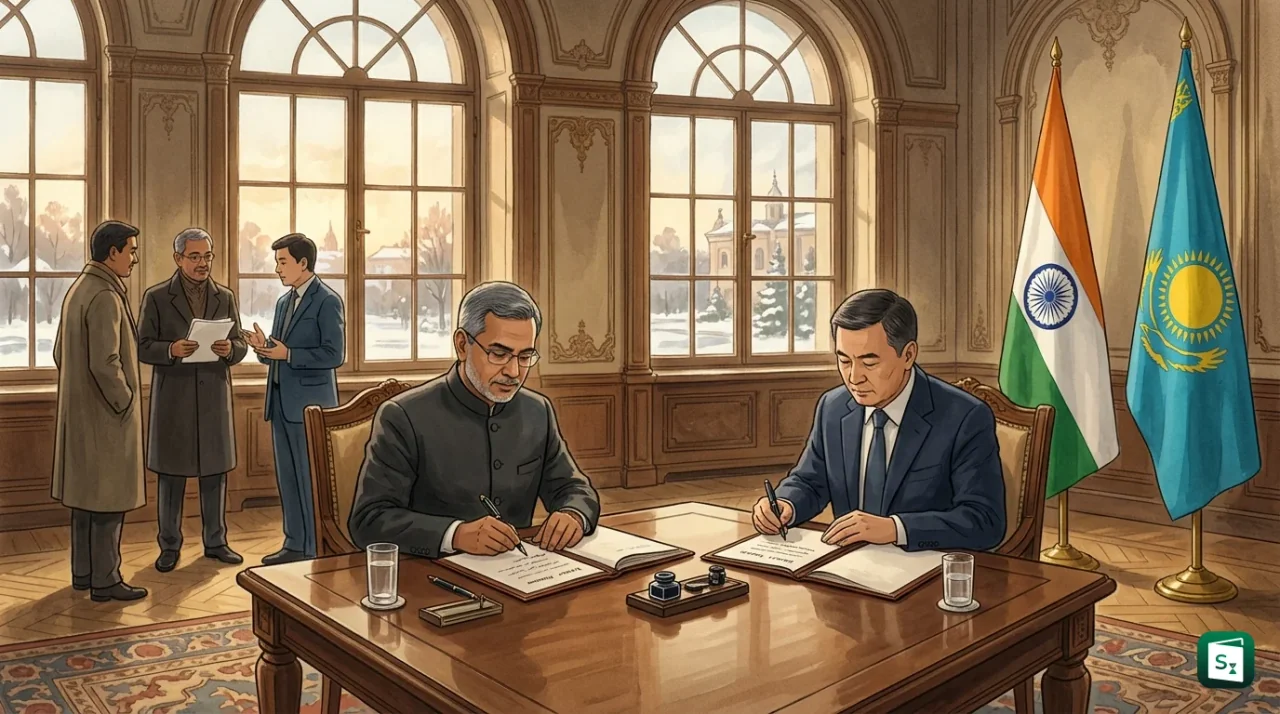
India and Kazakhstan signed a new extradition treaty on 3 November 2026 at the Prosecutor General’s Office in Astana. The pact was signed by Kazakhstan’s Prosecutor General Berik Assylov and India’s Ambassador Y. K. Sailas Thangal after Union Cabinet approval on 26 August 2026. It creates a clear legal path to hand over persons wanted for trial or for serving a sentence and completes the bilateral criminal justice framework.
What Is Extradition in International Law?
Extradition is the formal surrender of a person by the country where the person is found to another country where the person faces trial or has to serve a court sentence. The surrender happens only under a treaty or domestic law and follows a judicial and executive process in the requested country. There is no general duty to extradite under customary international law, so a bilateral treaty or a multilateral convention creates the legal basis for each request.
International practice follows a few settled principles. Dual criminality means the act must be treated as a crime in both countries, though it need not carry the same name in both laws. The specialty rule means the requesting country can prosecute or punish the surrendered person only for the offence for which surrender was granted, unless the other country agrees. Most treaties also bar surrender for offences of a political character and for purely military offences, and they bar surrender where there are strong grounds to believe the person will face persecution on grounds of race, religion, nationality or political opinion or will face torture.
What India and Kazakhstan Signed on 3 November 2026
The India Kazakhstan extradition treaty was signed on 3 November 2026 in Astana at the office of the Prosecutor General of Kazakhstan. Kazakhstan’s Prosecutor General Berik Assylov signed for Kazakhstan and India’s Ambassador to Kazakhstan Y. K. Sailas Thangal signed for India. The treaty lays down the legal framework for handing over persons wanted by the police and courts of either country for criminal prosecution or for serving a sentence already imposed by a court.
The Union Cabinet, chaired by Prime Minister Narendra Modi, had approved the signing and ratification of the treaty on 26 August 2026. The same Cabinet decision also approved extradition treaties with Kenya and the Kyrgyz Republic and gave ex post facto approval to the treaty signed with Seychelles in June 2026. Officials said the new pact updates the earlier extradition treaty signed on 24 January 2009 and ratified in February 2009, to reflect current legal needs. A signature alone does not lead to automatic handover. Each request will still need to meet the conditions in the treaty and the domestic law of the country where the person is found, and the treaty will operate after ratification and entry into force procedures are completed.
How Extradition Works Between Countries
Extradition works through a formal request from one country to another, followed by arrest, judicial scrutiny and an executive decision on surrender. The requesting country sends documents that establish identity, describe the facts, enclose the arrest warrant or court judgment and show that the conduct is punishable under the treaty. The requested country then checks treaty eligibility, dual criminality and bars to surrender before handing over the person.
A standard sequence has four stages. A provisional arrest can secure the person while the full file is prepared, usually within 45 to 60 days. A judge or inquiry magistrate then examines identity, evidence and legal conditions. The executive then takes the final decision on surrender and fixes the place and mode of handover. The specialty rule continues to protect the person after surrender.
| Stage | What Happens |
|---|---|
| Request | Requesting country sends warrant, facts and identity proof through diplomatic channels and the central authority |
| Provisional arrest | Requested country arrests the person pending the full request, often through Interpol channels |
| Judicial review | Court checks dual criminality, limitation, political offence bar and human rights safeguards |
| Surrender decision | Central government orders handover, escort officers take custody and the person is moved |
Extradition matters because it denies safe haven to fugitives and lets trials and sentences reach a conclusion. It supports cases linked to terrorism, terror financing, organised crime, drug trafficking, economic offences and cross border cybercrime. It also builds trust between police, prosecutors and courts of partner countries.
Extradition Law in India: The Extradition Act of 1962
In India, extradition is governed by the Extradition Act, 1962, which came into force after Parliament passed it on 15 September 1962. Parliament can make such laws under Article 253 of the Constitution, which gives it power to implement international treaties and agreements. The Ministry of External Affairs acts as the central authority for extradition, and its Consular, Passport and Visa (CPV) Division receives and examines requests sent through diplomatic channels.
A fugitive criminal means a person accused or convicted of an extradition offence in a foreign country. For a treaty partner, an extradition offence is an offence listed in the treaty. For a non treaty partner, it is generally an offence punishable with imprisonment of not less than one year in both countries, and it includes composite offences where conduct partly happens in one country but produces its effect in the other.
The Act provides two tracks. Requests from countries notified under Chapter II need proof that sets out a prima facie case, with evidence sufficient to commit the person for trial if the act had happened in India. Requests from countries with an extradition arrangement under Chapter III follow a faster process based on the endorsed arrest warrant and confirmation of identity and dual criminality, without a full prima facie test. India can seek surrender from abroad under Chapter IV, and a person surrendered to India can be tried only for the offence for which surrender was granted.
The law also provides safeguards. A request can be refused if the offence is of a political character, is a purely military offence, is barred by lapse of time, or if the person has already been tried or punished for the same offence. Surrender can also be refused where there are strong grounds to believe the request targets the person on grounds of race, religion, sex, nationality or political opinion. A provisional arrest can be made pending the full request, but the full request must generally reach within 60 days under Section 34B. If the person is not removed within two months of committal to prison, the High Court can order release under Section 24, though a fresh request can still be considered later.
How the Treaty Differs From Deportation and Mutual Legal Assistance
Extradition is often confused with deportation, but the two follow different laws and serve different goals. Extradition hands over a person to face trial or punishment under criminal law at the request of another country. Deportation or removal ends a person’s right to stay and sends the person out for reasons of immigration control, public order or national security. Rendition is an informal transfer outside a treaty process and lacks the judicial safeguards of extradition. Asylum is protection granted to a person who faces persecution, and it can bar return under refugee law and the principle of non refoulement.
| Mechanism | Purpose | Legal Basis |
|---|---|---|
| Extradition | Surrender to face prosecution or serve a sentence | Bilateral treaty and the Extradition Act, with judicial review |
| Deportation | Removal for unlawful stay or public order reasons | Immigration law, decided by immigration authorities |
| Mutual legal assistance | Help in investigation, such as evidence, bank records and witness statements | Mutual Legal Assistance Treaty (MLAT) in criminal matters |
| Transfer of sentenced persons | Move a convicted prisoner to the home country to serve the remaining sentence | Agreement on transfer of sentenced persons |
The Kazakhstan pact completes a three part system with the two earlier agreements. India and Kazakhstan already have a treaty on mutual legal assistance in criminal matters signed in New Delhi on 17 August 1999 and an agreement on transfer of sentenced persons signed in Astana on 8 July 2015, which took effect from 1 April 2016. The new extradition treaty adds the missing surrender channel, so evidence can be collected through legal assistance even when surrender is delayed, and sentenced persons can serve terms closer to home under the transfer pact.
Why the Treaty Matters for India Kazakhstan Relations
Kazakhstan is India’s largest trade and investment partner in Central Asia. Bilateral trade stood at about $900 million in 2024, guided by the India Kazakhstan Inter Governmental Commission set up in 1993. More than 600 Indian companies now work in Kazakhstan in pharmaceuticals, mining, medicine and food processing, and movement of people has grown fast. Nearly 10,000 Indian students studied in Kazakhstan in the 2025 to 2026 academic year, the highest among students from countries outside the Commonwealth of Independent States, while about 146,000 Indian tourists visited Kazakhstan and about 23,000 Kazakh tourists visited India in 2024.
Closer movement increases the need for joint action against crime. Both countries face shared risks from terrorism, extremism, drug trafficking and cybercrime, with Afghanistan and the northern and southern drug routes affecting the wider region. India and Kazakhstan hold a Joint Working Group on Counter Terrorism, whose fifth meeting took place in Astana on 8 April 2024, and they cooperate in the Shanghai Cooperation Organisation and the India Central Asia Dialogue. Defence ties run through the annual KAZIND army exercise held since 2016, including editions at Taraz in 2021, Umroi in Meghalaya in 2022, Otar in 2023 and Auli in Uttarakhand in 2024, and through Kazakh participation under the Indian battalion in the United Nations Interim Force in Lebanon (UNIFIL) since 2018. Astana, the capital of Kazakhstan, was briefly called Nur Sultan before the name Astana was restored in 2022.
India’s Extradition Network: Treaties, Arrangements and New Approvals
India maintained extradition treaties with 48 countries and extradition arrangements with 12 countries before the August 2026 decisions. The Cabinet approvals for Kenya, Kazakhstan, the Kyrgyz Republic and Seychelles will take the treaty network to 52 countries once all instruments enter into force. The Ministry of External Affairs publishes the full list, which includes long standing partners such as the United States (1997), the United Kingdom (1992), the United Arab Emirates (1999), Bangladesh (2013), Canada (1987), Russia (1998) and Australia (2008).
Arrangements, which are simpler than full treaties, cover countries such as Singapore, Sri Lanka, Italy, Sweden, Fiji, Tanzania and New Zealand. In the absence of a bilateral treaty or arrangement, India can also use a multilateral convention to which both India and the requesting country are parties as the legal basis for a request for offences covered by that convention.
The scale of work remains large. Reports note that India had sent 137 extradition requests abroad, with 125 pending before foreign governments, and that the Central Bureau of Investigation has set up a dedicated cell to improve the quality of requests from Indian agencies. The Kazakhstan file shows why lists change slowly. Kazakhstan did not appear on the Ministry list of treaties in force updated on 16 June 2026, because the 2009 text had lapsed in practical terms and the 2026 text still needs ratification and notification. Only the treaty text, the entry into force clause and the Chapter II or Chapter III notification under the Extradition Act will decide how fast future requests move.
Key Takeaways
- The India Kazakhstan extradition treaty was signed on 3 November 2026 in Astana by Berik Assylov and Y. K. Sailas Thangal.
- The Union Cabinet approved the treaty on 26 August 2026, along with treaties for Kenya, the Kyrgyz Republic and Seychelles.
- The pact covers surrender for criminal prosecution or for serving a court sentence and upholds the principle that punishment for crimes is inevitable.
- It completes a three part framework with the 1999 mutual legal assistance treaty and the 2015 transfer of sentenced persons agreement.
- In India, extradition is governed by the Extradition Act, 1962, with the CPV Division of the Ministry of External Affairs as the central authority.