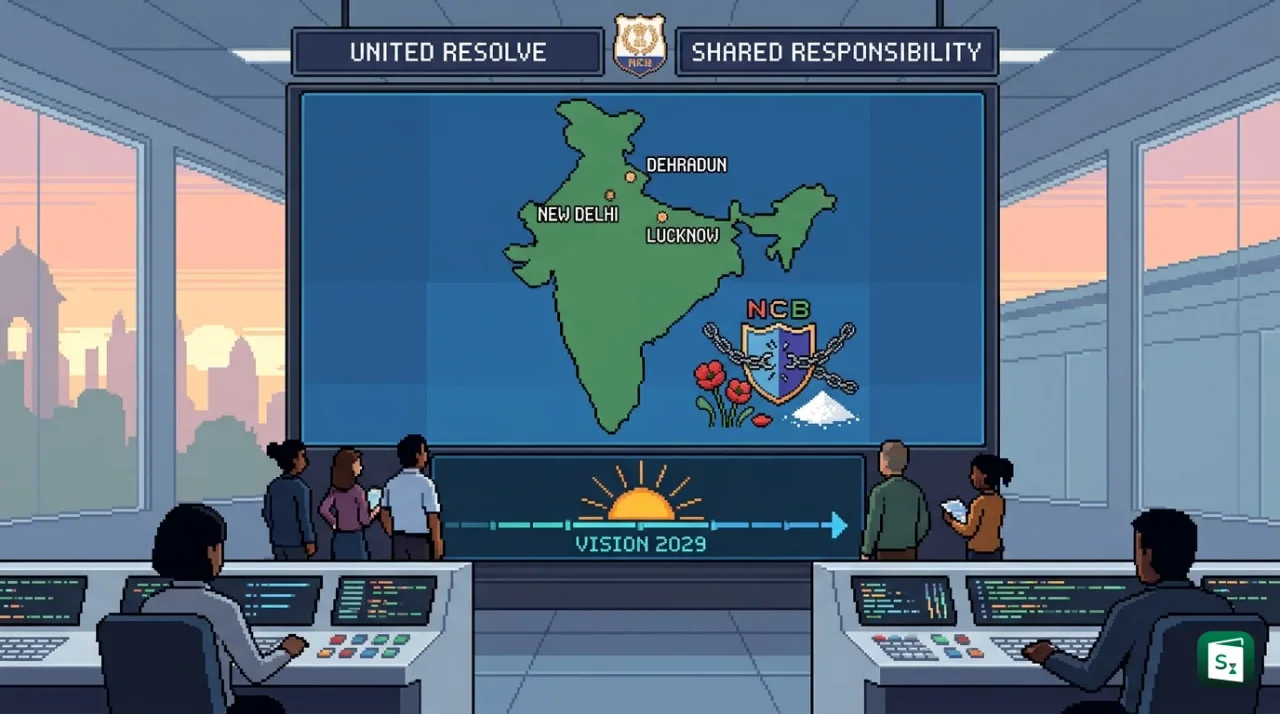
Union Home Minister Amit Shah inaugurated the 3rd National Conference of Anti-Narcotics Task Force (ANTF) Heads of States and Union Territories on 22 September 2026 in New Delhi. The two day meet, organised by the Narcotics Control Bureau (NCB) on 22 and 23 September, brought together ANTF heads from 36 States and Union Territories under the theme United Resolve, Shared Responsibility. The conference reviewed the Vision Document on Narcotics Control 2026 to 2029, which sets December 2029 as the deadline for a drug free India.
What Is ANTF and Why Did Its Heads Meet in New Delhi?
The Anti Narcotics Task Force (ANTF) is the dedicated anti drug unit set up in each State and Union Territory to handle narcotics cases. ANTF stands for Anti Narcotics Task Force, and in police terms it means the specialised state level force that tracks peddlers, gathers local intelligence and files cases under drug laws. The 3rd National Conference of ANTF Heads brought the chiefs of these forces from 36 States and Union Territories together in New Delhi on 22 and 23 September 2026 for a joint review.
The Narcotics Control Bureau (NCB) organised the two day meet. The NCB is the central agency that guides and coordinates all state drug enforcement units. The theme for the 2026 edition was United Resolve, Shared Responsibility. It signals that the Centre and the States will act as one team, with shared targets and shared accountability.
The timing matters. The meet followed the release of the Vision Document on Narcotics Control 2026 to 2029 in June 2026 and the call to prepare state level three year roadmaps. The first National ANTF Conference was held in April 2023, after the Centre asked all States and Union Territories in 2021 to create full time ANTF units. The third edition was meant to check how far States have moved on those targets and to fix the plan for the remaining period up to 2029.
Deliberations focused on three linked goals of drug policy. These are supply reduction (stopping production and trafficking), demand reduction (keeping people, especially youth, away from drugs) and harm reduction (treatment and care for affected persons). More than half a dozen technical sessions covered dismantling of trafficking networks and cartels, action against synthetic drugs and illegal labs, destruction of illegal cultivation, financial investigation, extradition of fugitives hiding abroad, and probe of darknet and cryptocurrency linked cases.
What Was Launched at the 3rd ANTF Conference?
The Home Minister used the conference platform for four concrete launches linked to awareness and infrastructure. He released 4 anti narcotics Television Commercials (TVCs) to spread awareness about the harm caused by drugs. He launched the revamped official website of the NCB to give citizens and agencies easier access to information and services. He also laid the foundation stones for two new NCB zonal complexes in Lucknow in Uttar Pradesh and Dehradun in Uttarakhand. These buildings will strengthen field presence in the northern region, which covers key transit routes and hill districts.
The event also honoured the best performing state force. The Elite Action Group for Drug Law Enforcement (EAGLE Force) of Telangana, which functions as the ANTF of Telangana, received the Best ANTF trophy from the Home Minister. EAGLE Force Director Sandeep Shandilya accepted the award on behalf of Telangana Police. The force scored more than 80 percent marks on the seven assessment parameters fixed by the Centre. These parameters were intelligence operations, control of precursors and synthetic drugs, prosecution, demand and harm reduction, coordination and capacity building, research and analysis, and administration and logistics.
A key message from the inaugural address was to take the fight to the district level. Under the new framework, districts will be grouped into three clusters based on their role in the drug chain. These are entry or manufacturing points, transport corridors, and high consumption areas. Enforcement will then run a three level attack to map local sellers, inter state supply lines and the larger cartel leadership. State police units were asked to make the conversion of raw information into usable intelligence a part of daily work, and to pair human intelligence with technical intelligence and community policing.
Vision Document on Narcotics Control 2026 to 2029 and Drug Free India by 2029
The Vision Document on Narcotics Control 2026 to 2029 is the national roadmap that guides the current phase of the anti drug campaign. The Home Minister released the document on 26 June 2026 at the 10th apex level meeting of the Narco Coordination Centre (NCORD) in New Delhi. The NCORD is the four tier coordination system that links the apex, executive, state and district levels for drug enforcement. The Vision Document fixes responsibilities, timelines and measurable targets for all stakeholders for the three years from 2026 to 2029.
The central goal is a drug free India by December 2029. The document states that drug networks must be dismantled so fully over the next three years that they cannot recover for decades. It follows a Whole of Government and Whole of Society approach. This means central ministries, state governments, enforcement agencies, schools, health services and citizens all have defined roles. States and districts were asked to prepare their own three year roadmaps in line with the national document, keeping local challenges in view.
The strategy rests on four pillars. It also uses the operational motto of Detect, Disrupt and Destroy, which means first locate networks through surveillance and intelligence, then break their finance and supply links, and finally ensure they are fully closed down.
| Pillar of Vision 2026 to 2029 | What It Covers |
|---|---|
| Enforcement, Intelligence and Operations | Intelligence led action against cartels, border and port surveillance, crime mapping, action under NDPS and money laundering laws |
| Precursor and Synthetic Drug Control | Control of precursor chemicals (chemicals used to make synthetic drugs), action against illegal labs and darknet supply |
| Demand Reduction and Rehabilitation | Awareness in schools, drug free zones and campuses, counselling, treatment and rehabilitation services |
| Capacity Building, Coordination and Monitoring | Training, forensic support, NCORD coordination, quarterly reviews and result based accountability |
The NCB Director General Anurag Garg, in his valedictory address on 23 September 2026, asked States to shift to a network centric approach. This means investigating the full chain from source to kingpin, not just seizing one consignment. The conference stressed financial investigation in every big case, including freezing of crime proceeds and mandatory coordination with the Enforcement Directorate in major cases. States were also asked to speed up Red Corner Notices and extradition requests through the Central Bureau of Investigation for smugglers hiding abroad, and to set up exclusive NDPS courts for faster convictions.
What Is the Narcotics Control Bureau?
The Narcotics Control Bureau (NCB) is the central agency for drug law enforcement and coordination in India. NCB stands for Narcotics Control Bureau. It was created on 17 March 1986 under Section 4(3) of the Narcotic Drugs and Psychotropic Substances Act, 1985. The NCB works under the Ministry of Home Affairs and has its headquarters at West Block No. 1, R.K. Puram, New Delhi.
The NCB does not work alone. It acts as the nodal point that joins central agencies, state police, ANTF units and foreign agencies. Its charter includes coordination of action under the NDPS Act and other laws, fulfilment of international treaty duties, and help to foreign agencies in cross border cases. Officers in the NCB come from the Indian Police Service, the Indian Revenue Service, paramilitary forces and direct recruitment. The Director General of the NCB is Anurag Garg (as of September 2026), an Indian Police Service officer who took charge in September 2024.
The field network has grown steadily from the first five zonal offices in Mumbai, Kolkata, Delhi, Chennai and Varanasi. The NCB now runs around 30 zonal offices with regional units across the country, including units in Lucknow, Dehradun, Jammu, Guwahati, Srinagar, Ahmedabad, Bengaluru, Indore, Chandigarh, Patna and Hyderabad. New zonal complexes, such as those planned in Lucknow and Dehradun and those opened in Jammu and Guwahati in June 2026, are part of this expansion to cover emerging trafficking routes.
Two related terms often cause confusion. The NCB is different from the Central Bureau of Narcotics (CBN), which mainly handles licensed opium cultivation. The NCB is also different from the use of NCB in insurance, where it means No Claim Bonus. In drug enforcement, NCB always means the Narcotics Control Bureau.
What Is the NDPS Act and How Does Punishment Work?
Narcotics are drugs that dull the senses and cause dependence, such as opium, heroin, cocaine and cannabis, along with many man made psychotropic substances that affect the mind. The Narcotic Drugs and Psychotropic Substances Act, commonly called the NDPS Act, is the main Indian law that bans the production, possession, sale, transport and use of these drugs except for medical or scientific purposes. NDPS stands for Narcotic Drugs and Psychotropic Substances. Parliament passed the Act in 1985, it received assent on 16 September 1985 and came into force on 14 November 1985. It was made to fulfil duties under global drug treaties, including the Single Convention on Narcotic Drugs of 1961 and the Convention on Psychotropic Substances of 1971.
The NDPS Act treats offences very strictly, and the jail term in most cases depends on the quantity involved. The Centre notifies a small quantity and a commercial quantity for each drug. For example, heroin has a small quantity of 5 grams and a commercial quantity of 250 grams, cocaine has 2 grams and 100 grams, ganja has 1 kilogram and 20 kilograms, and charas has 100 grams and 1 kilogram. Repeat offences draw one and a half times the normal term, and attempt, abetment and conspiracy draw the same term as the main offence.
| Type of Contravention | Punishment Under NDPS Act |
|---|---|
| Small quantity (for example, up to 5 grams of heroin) | Rigorous imprisonment up to 1 year, or fine up to ₹10,000, or both |
| More than small but less than commercial quantity | Rigorous imprisonment up to 10 years with fine up to ₹1 lakh |
| Commercial quantity (for example, 250 grams or more of heroin) | Rigorous imprisonment of 10 to 20 years with fine of ₹1 lakh to ₹2 lakh |
| Financing trafficking or harbouring offenders | Rigorous imprisonment of 10 to 20 years with fine of ₹1 lakh to ₹2 lakh |
| Consumption of cocaine, morphine or heroin | Rigorous imprisonment up to 1 year or fine up to ₹20,000 or both, with immunity if an addict seeks treatment voluntarily |
The Act also provides for seizure of property earned from drug trade and for preventive detention under the Prevention of Illicit Traffic in Narcotic Drugs and Psychotropic Substances Act, 1988. The 3rd ANTF Conference stressed stronger use of these financial tools, so that cartels lose both their stock and their money.
How Can Citizens Report Drugs and Join Demand Reduction?
The NCB runs a single national window for public help called MANAS. MANAS stands for Madak Padarth Nishedh Asuchna Kendra, which means the Narcotics Prohibition Intelligence Centre. The Home Minister launched the MANAS helpline 1933 on 18 July 2024. The platform was built by the NCB with the Digital India Corporation. It works round the clock and keeps the identity of the informer confidential.
Citizens can reach MANAS through the toll free number 1933, the portal www.ncbmanas.gov.in, email at info.ncbmanas@gov.in, and the UMANG app. People can report trafficking, sale, storage, manufacture or illegal cultivation. Those affected by addiction can seek counselling, and calls needing care are linked to the Ministry of Social Justice and Empowerment helpline 14446. The system creates a digital ticket for each tip and sends actionable inputs to the nearest NCB zonal unit or state ANTF. By mid 2026 the helpline had recorded lakhs of connection attempts and thousands of actionable tips that led to NDPS cases.
Demand reduction runs mainly through the Nasha Mukt Bharat Abhiyan. Nasha Mukt Bharat means drug free India. The Ministry of Social Justice and Empowerment, which is the nodal ministry for demand reduction, launched the Abhiyan on 15 August 2020. It first covered 272 vulnerable districts and later expanded across the country. The campaign works with schools, colleges, youth groups and local bodies to spread awareness, train teachers and counsellors, promote drug free campuses and link affected persons to treatment. Citizens can take the online pledge on the Abhiyan portal and download a certificate, a step that has driven large participation during August awareness peaks. In August 2026 the Prime Minister also launched the Nasha Mukt Yuva for Viksit Bharat drive to connect youth energy with the goal of a developed India by 2047.
Key Takeaways
- The 3rd National ANTF Conference was held on 22 and 23 September 2026 in New Delhi under the theme United Resolve, Shared Responsibility.
- ANTF stands for Anti Narcotics Task Force and NCB stands for Narcotics Control Bureau, which was created on 17 March 1986 under the Ministry of Home Affairs.
- The Home Minister released 4 TVCs, launched the revamped NCB website and laid foundation stones for NCB zonal complexes in Lucknow and Dehradun.
- Telangana’s EAGLE Force won the Best ANTF trophy after scoring more than 80 percent on seven national parameters.
- The Vision Document on Narcotics Control 2026 to 2029 targets a drug free India by December 2029 through four pillars and the motto of Detect, Disrupt and Destroy.
- The NDPS Act of 1985 punishes commercial quantity offences with 10 to 20 years of rigorous imprisonment, while the MANAS helpline 1933 provides round the clock confidential drug reporting.