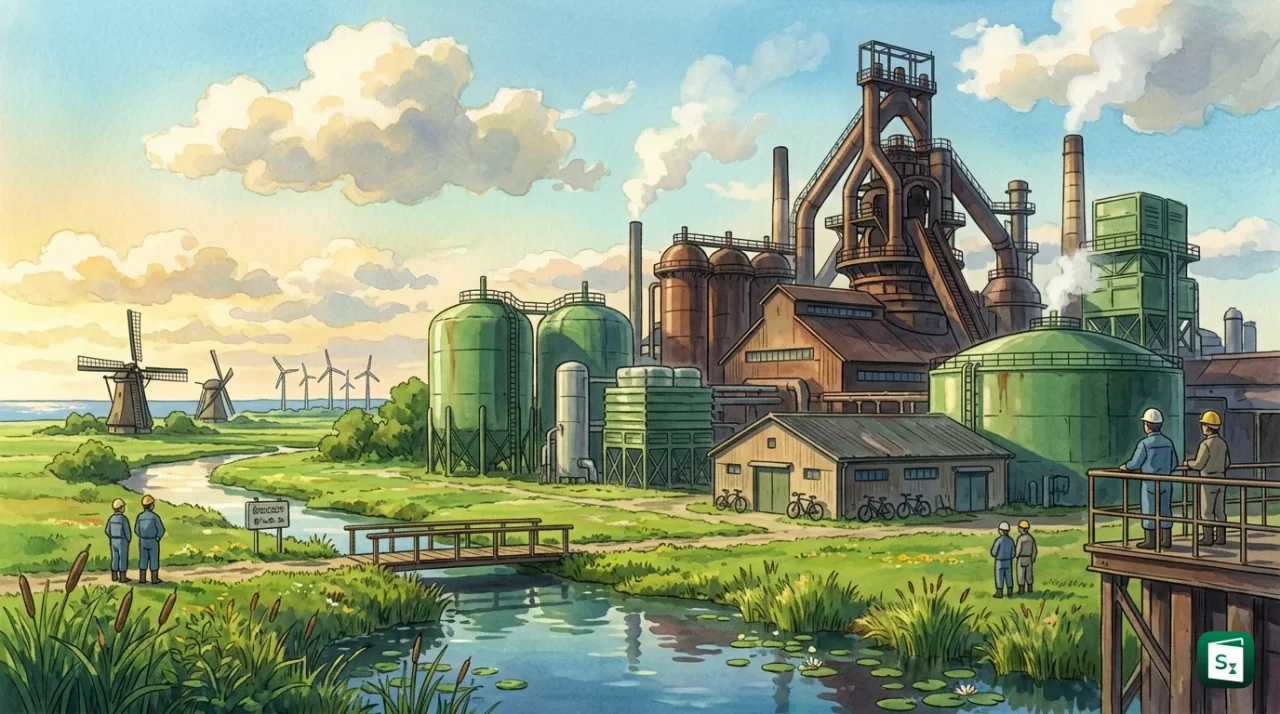
Tata Steel, the Dutch government and the Province of North Holland have extended their Joint Letter of Intent (JLoI) for the Green Steel Project at IJmuiden till 1 March 2027. The JLoI, first signed in September 2025, was due to end on 30 September 2026. The five month extension will give all sides more time to settle technical, financial and legal issues before a final tailor made agreement and investment decision.
What Did Tata Steel and the Netherlands Agree To Extend
Tata Steel Limited, Tata Steel Nederland, the Dutch Ministry of Economic Affairs and Climate, the Dutch Ministry of Infrastructure and Water Management and the Province of North Holland agreed on 25 September 2026 to extend the Joint Letter of Intent (JLoI) by five months till 1 March 2027. A Joint Letter of Intent is a written statement in which all sides record their shared goals and the next steps for negotiation. It is not a binding contract.
The original JLoI was signed in September 2025. It set 30 September 2026 as the target date for a final tailor made agreement. A tailor made agreement is the Dutch policy instrument under which the state supports the largest industrial polluters to cut carbon dioxide faster than the law alone would require, in return for strict targets on emissions, health and compliance. The extension keeps all the earlier principles unchanged and gives the negotiators time to complete basic engineering, cost optimisation, permit applications and the European Commission state aid approval process.
What Is Green Steel
Green steel is steel made with sharply lower carbon dioxide emissions than conventional coal based steel. The Tata Steel Netherlands plan defines green steel as steel produced by replacing coal and coke with cleaner inputs such as natural gas, biomethane, green hydrogen and higher use of scrap, along with carbon capture and storage.
Conventional steel made through the blast furnace route releases about 1.8 to 2.2 tonnes of carbon dioxide for every tonne of steel. Steel accounts for about 7 to 9 percent of global carbon dioxide emissions, so cutting these emissions is central to meeting the Paris Agreement and national net zero goals. The Netherlands, which has promised climate neutrality by 2050 and at least 55 percent emission cut by 2030 from 1990 levels, treats steel decarbonisation as a test case for industrial change.
India became the first country to legally define green steel when the Ministry of Steel notified the Taxonomy of Green Steel on 12 December 2024. Under this taxonomy, steel with emission intensity below 2.2 tonnes of carbon dioxide equivalent per tonne of finished steel qualifies as green steel, with star ratings for lower intensities. The National Institute of Secondary Steel Technology (NISST) acts as the nodal agency for measurement, reporting and verification and for issuing certificates.
How Is Green Steel Made
Green steel is made by removing oxygen from iron ore with natural gas or hydrogen instead of coke, and then melting the resulting iron with scrap in an electric furnace. This Direct Reduced Iron and Electric Arc Furnace (DRP-EAF) route releases far less carbon dioxide than burning coke in a blast furnace.
In a traditional blast furnace, coke made from coal does two jobs. It creates very high heat and it pulls oxygen out of iron ore. Both steps release large amounts of carbon dioxide. In a Direct Reduction Plant (DRP), a gas such as natural gas or hydrogen performs the same chemical job at a lower temperature without burning coke. The spongy iron from the DRP is then melted in an Electric Arc Furnace (EAF), which uses powerful electric currents instead of coal fire. The EAF can also melt a high share of recycled scrap, which further cuts the need for fresh ore and coal.
The cost question is important. Green steel is more expensive today than conventional steel. The extra cost comes from building new DRP and EAF plants, buying natural gas and later green hydrogen, paying for green electricity, and installing carbon capture. Prices are expected to fall as hydrogen supply grows, carbon prices rise on polluting steel, and new plants reach full scale.
| Feature | Conventional Steel (Blast Furnace Route) | Green Steel (DRP-EAF Route) |
|---|---|---|
| Main reducing agent | Coke from coal | Natural gas, biomethane or hydrogen |
| Melting unit | Basic Oxygen Furnace using hot metal | Electric Arc Furnace using direct reduced iron and scrap |
| Emission intensity | About 1.8 to 2.2 tonnes of carbon dioxide per tonne of steel | Below 2.2 tonnes in India, with best plants aiming below 1.6 tonnes |
| Scrap use | About 15 to 17 percent | Target of 30 percent and above |
The IJmuiden Plant and the Green Steel Plan
Tata Steel Nederland operates the only primary steel plant in the Netherlands at IJmuiden in the Province of North Holland. The site spreads over 750 hectares across Velsen, Beverwijk and Heemskerk, employs more than 9,200 people and produces about 7 million tonnes of high quality steel per year for cars, packaging, construction and machinery. The IJmuiden site is the largest single industrial emitter in the Netherlands, with maximum emissions of about 12.6 million tonnes of carbon dioxide per year, or about 7.6 percent of national greenhouse gas emissions. It is also the largest individual emitter of nitrogen oxides in the country.
Tata Steel Limited, the Indian parent company headquartered in Mumbai, acquired the plant as part of its 608 pence per share acquisition of Corus Group in April 2007. Corus itself was formed in 1999 by the merger of British Steel and Koninklijke Hoogovens of the Netherlands. The IJmuiden works traces its roots to 1918 and started its first blast furnace in 1924. T. V. Narendran is the Managing Director and Chief Executive Officer of Tata Steel Limited (as of September 2026).
The Green Steel Plan for IJmuiden has four parts. Roadmap Plus covers environmental fixes already paid for by Tata Steel without state support. Phase 1, which is the subject of the JLoI, will replace Coke and Gas Plant 2 and Blast Furnace 7 with a DRP-EAF unit that first runs on natural gas with higher scrap use. Carbon capture and storage (CCS) will then be added to the DRP, and natural gas will be replaced in stages by biomethane and hydrogen. A parallel package of health and environment measures covers dust covers, wind barriers, slag handling and noise control. Phase 2, planned after 2030, would replace the remaining Coke and Gas Plant 1 and Blast Furnace 6.
The targets agreed for Phase 1 show the scale of change. Carbon dioxide emissions are to fall by 5.4 million tonnes per year, or about 43 percent, on natural gas alone. The cut can rise to up to 57 percent once biomethane or hydrogen and CCS are in use. Nitrogen oxide emissions are to fall by 44 percent and sulphur dioxide by 38 percent, while dust levels in the nearby village of Wijk aan Zee are to fall by 35 percent from 2019 levels. Scrap intake is to rise from 17 percent in 2019 to 30 percent in 2030.
Why Was the JLoI Extended Till March 2027
The Tata Steel Netherlands statement said the extension will allow work towards a realistic approach to the integrated health and decarbonisation project. An agreement of this size needs careful work on spending, timelines and legal safeguards before Tata Steel can take a final investment decision.
Five groups of issues remain open. First, the future of the coke and gas plants. Tata Steel Nederland is discussing the safe and controlled closure of both plants with the Province and the environmental agency. The Province and the environmental service plan to withdraw permits for the coke plants after repeated breaches, and an earlier closure would change costs, timelines and health benefits.
Second, steel slag. Slag is the stony waste left after steelmaking. Dutch rules on its storage, transport and reuse have become stricter, which creates uncertainty over sales for road building and cement. Tata Steel says a workable long term solution is needed for regulatory clarity.
Third, money and market conditions. The total investment is estimated at €4 billion to €6.5 billion. The Dutch state intends to provide up to €2 billion in support, with Tata Steel also seeking about €0.3 billion from the European Union Innovation Fund. Talks cover grid tariffs, the rising price of carbon permits under the European Union Emissions Trading System (EU ETS) and the phase out of free carbon allowances from 2026 to 2034 alongside the Carbon Border Adjustment Mechanism (CBAM). The CBAM is the EU levy on the carbon content of imports of cement, iron and steel, aluminium, fertilisers, electricity and hydrogen. These changes directly affect whether coal based steel remains viable.
Fourth, legal and compliance concerns. In July 2026 the Dutch Public Prosecution Service decided to prosecute Tata Steel over alleged unlawful emissions that posed risks to nearby residents. The JLoI allows the state to end talks if a criminal case raises serious concerns. The cabinet has chosen not to use that clause for now but says it is watching the case closely. The government also insists on visible cultural change on rule compliance, a solid financial plan and strict monitoring of promises.
Fifth, permits and technical readiness. Tata Steel submitted a full Environmental Impact Assessment in June 2025 and has started permit steps for wind barriers, raw material coverages and the new DRP-EAF units. Basic engineering is near completion, but slag processing technology, hydrogen availability and carbon storage tenders between 2032 and 2037 still need detailed planning.
India’s Green Steel Framework: Taxonomy, Mission and Procurement
The Tata Steel Netherlands talks are part of a wider global shift in which India has taken an early policy lead. The Ministry of Steel released India’s Taxonomy of Green Steel on 12 December 2024 after work by a task force of industry, scholars, think tanks and ministries.
The taxonomy sets a clear cut off and rating system based on emission intensity measured up to the finished steel stage, including Scope 1, Scope 2 and limited Scope 3 emissions from sintering, pellet making, coke making and bought inputs. The limits are reviewed every three years.
| Star Rating | Emission Intensity (tonnes of carbon dioxide equivalent per tonne of finished steel) |
|---|---|
| Five star green rated steel | Less than 1.6 |
| Four star green rated steel | 1.6 to 2.0 |
| Three star green rated steel | 2.0 to 2.2 |
| Not eligible for green rating | More than 2.2 |
The framework is supported by two linked policies. The draft National Mission on Green Steel (NMGS) aims to build demand, fund pilot projects, support research and expand green hydrogen and scrap use to meet India’s net zero emission intensity target by 2070. The draft Green Steel Public Procurement Policy (GSPPP) proposes preference for green rated steel in government construction and infrastructure. Together, taxonomy, mission and procurement are meant to create a market where low emission steel earns a premium and attracts investment.
What Lies Ahead for the Project
The Dutch cabinet, the Province of North Holland and Tata Steel say they remain committed to a final agreement by 1 March 2027. The coming months will focus on final cost figures, the phasing of spending over several years, and the legal design of emission ceilings, monitoring and penalties.
If a binding tailor made agreement is signed, Tata Steel will move to a final investment decision on Phase 1. Construction of the DRP-EAF complex, closure of Coke and Gas Plant 2 and Blast Furnace 7, and rollout of dust, odour and noise controls would follow, with the new units targeted for full operation around 2030. Success would keep primary steelmaking in the Netherlands, protect about 9,000 direct jobs and many more supplier jobs, and cut a large share of Dutch industrial emissions.
Failure to agree would leave both sides with difficult choices. Tata Steel would face rising carbon costs without state support, while the Netherlands would need other tools to cut emissions from its largest industrial source and to address health concerns in the IJmond region. For India, the outcome will be watched as a test of how an Indian multinational manages deep decarbonisation under European climate law, carbon pricing and public health scrutiny.
Key Takeaways
- The Joint Letter of Intent for the Green Steel Project between Tata Steel and Dutch authorities was extended till 1 March 2027 after being first signed in September 2025.
- The IJmuiden plant produces about 7 million tonnes of steel per year and emits up to 12.6 million tonnes of carbon dioxide, the largest industrial source in the Netherlands.
- Phase 1 will replace Blast Furnace 7 and Coke and Gas Plant 2 with a DRP-EAF unit to cut carbon dioxide by 5.4 million tonnes or 43 percent.
- The Dutch state has offered up to €2 billion in support for a project estimated at €4 billion to €6.5 billion, subject to European Commission state aid approval.
- India notified its Green Steel Taxonomy on 12 December 2024, defining green steel as steel below 2.2 tonnes of carbon dioxide per tonne of finished steel with NISST as nodal agency.