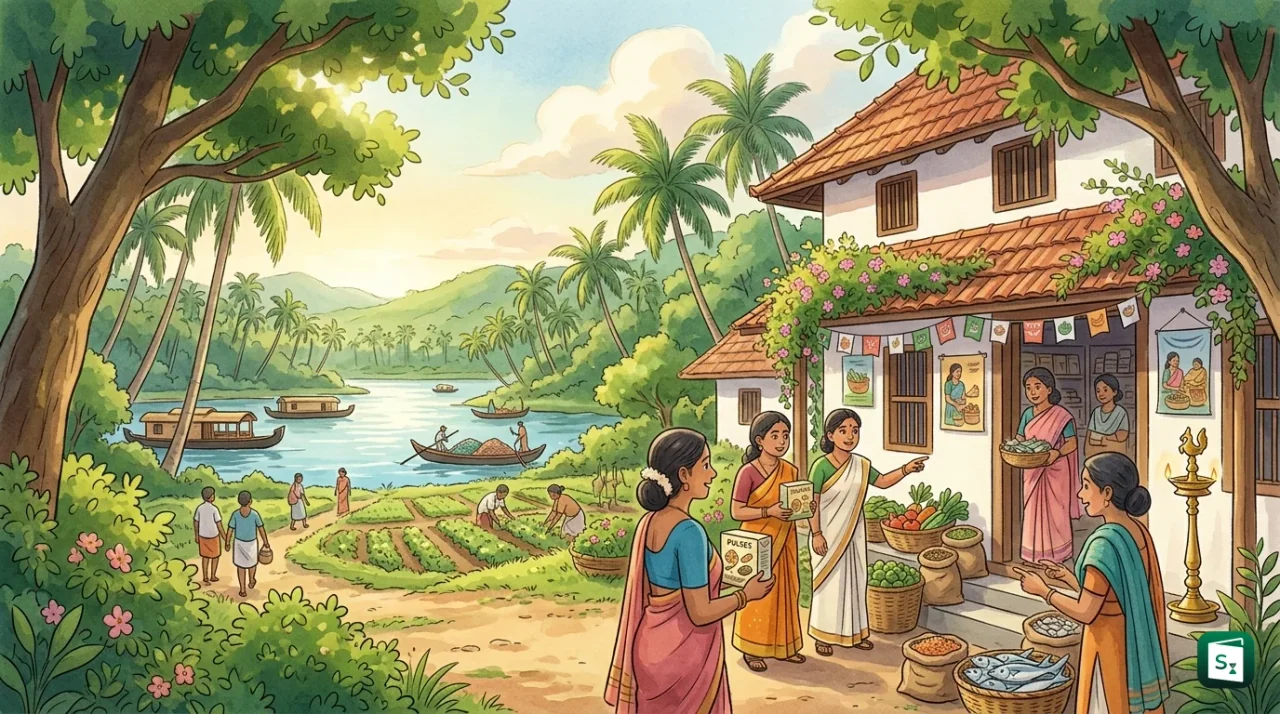
Union Home and Cooperation Minister Amit Shah launched the She Mart Mission rollout in Kollam, Kerala on 26 September 2026 through the National Cooperative Consumers Federation of India (NCCF). He inaugurated the Vanitham She Mart Store to connect women Self Help Groups and rural entrepreneurs directly with consumers. The Kollam programme also unveiled the Janah brand, a 300 store expansion plan, free pulses seed kits and scholarships for daughters of farmers.
She Mart Mission and the Kollam Launch
The She Mart Mission began as a Union Budget announcement. Finance Minister Nirmala Sitharaman proposed Self Help Entrepreneur (SHE) Marts in the Union Budget 2026-27 presented on 1 February 2026. SHE stands for Self Help Entrepreneur. The idea builds on the Lakhpati Didi Programme, which helped women in Self Help Groups reach an annual household income of at least ₹1 lakh. The next step is to move women from credit linked livelihoods to ownership of enterprises.
The National Cooperative Consumers Federation of India organised the Kollam event at Kundara near Kollam on 26 September 2026. The Minister inaugurated the logo of the Vanitham She Mart Store and launched sales under the new Janah brand. He also flagged off mobile vans of NCCF and the National Agricultural Cooperative Marketing Federation of India (NAFED) selling onions at a subsidised price of ₹35 per kg. He launched the sale of Bharat Atta and Bharat Rice through the Vanitham outlets for women customers.
The She Mart model is simple. A Self Help Group (SHG) is a small voluntary group of 10 to 20 people, mostly women, who save together and take small loans. A cluster level federation is a larger body formed by joining many such SHGs in an area. She Marts will work as community owned retail outlets inside these federations. Products made by women, such as food items, farm produce, handicrafts and household goods, will reach buyers without middlemen. Support will cover the full chain from procurement and processing to branding, packaging and retail marketing.
What Is NCCF?
The National Cooperative Consumers Federation of India (NCCF) is the apex national level consumer cooperative body with operations across India. It links farmers and producers with consumers by handling procurement, processing, storage and retail sale of essential goods. NCCF also acts as a central agency for price stabilisation sales such as onions, Bharat Atta and Bharat Rice.
NCCF was registered in October 1965, with 16 October 1965 recorded as its establishment date. It is registered under the Multi State Cooperative Societies Act, 2002. Its headquarters is at the NCUI Complex, Siri Institutional Area, New Delhi. It operates through a network of about 28 branch offices across the country. Nearly 6 lakh women farmers are associated with NCCF (as stated at the Kollam event). The federation plans to support more than 2,500 retail outlets along with the 300 She Mart stores.
NCCF Under Which Ministry?
NCCF functions under the administrative control of the Department of Consumer Affairs in the Ministry of Consumer Affairs, Food and Public Distribution. The Ministry of Cooperation, formed on 6 July 2021 with the motto of Sahkar Se Samriddhi (Prosperity through Cooperation), provides the overall policy direction for cooperative growth. NCCF therefore works in close coordination with the Ministry of Cooperation for programmes such as She Marts, pulses procurement and consumer outreach.
What Is NAFED and How Is It Different From NCCF?
The National Agricultural Cooperative Marketing Federation of India (NAFED) is the national federation for marketing of farm produce. It helps farmers get fair prices by procuring oilseeds, pulses and copra, by supporting processing and storage, and by selling goods wholesale and retail. NAFED is also a central agency for price support and price stabilisation operations of the central government.
NAFED was founded on 2 October 1958, the birth anniversary of Mahatma Gandhi, to promote trade of farm and forest produce. It is registered under the Multi State Cooperative Societies Act and is headquartered at Ashram Chowk, New Delhi. It has four regional offices at Delhi, Mumbai, Chennai and Kolkata, besides 28 zonal offices. About 8 lakh farmers are associated with NAFED. NAFED is the nodal agency for price stabilisation measures under Operation Greens and undertakes procurement under the Price Support Scheme (PSS) within the umbrella scheme Pradhan Mantri Annadata Aay Sanrakshan Abhiyan (PM-AASHA). PM-AASHA is a central scheme that ensures farmers receive the Minimum Support Price (MSP), which is the assured price fixed by the government.
The table below captures the basic difference between the two federations active at Kollam.
| Feature | NCCF | NAFED |
|---|---|---|
| Full form | National Cooperative Consumers Federation of India | National Agricultural Cooperative Marketing Federation of India |
| Set up | October 1965 | 2 October 1958 |
| Main focus | Consumer cooperatives, retail supply to consumers | Marketing of farm produce for farmers |
| Headquarters | New Delhi, Siri Institutional Area | New Delhi, Ashram Chowk |
| Key Kollam role | She Mart stores, Janah brand, Bharat Atta and Rice sales | Mobile vans, pulses procurement, Kalyan scholarships |
Cooperative Movement in India and the Ministry of Cooperation
A cooperative society is a voluntary group formed by people with a common need who pool resources, share ownership and share benefits. Members run it on the principle of one member one vote. In India, cooperatives work in credit, dairy, housing, fisheries, marketing, processing and consumer supply. A cooperative society is registered under the concerned State Cooperative Societies Act if it works in one state. If it works in more than one state, it is registered under the central Multi State Cooperative Societies Act, 2002.
Kerala has a strong base for this model. The state has more than 23,000 cooperative societies, with roots going back to the pre Independence period. The Minister noted this strength at Kollam and invited the state Cooperation Minister to New Delhi to prepare a joint plan to help Kerala gain more from central schemes in seeds and organic farming. An agreement for opening more than 300 She Mart shops across Kerala, Tamil Nadu and Karnataka was exchanged between NCCF and the Bharat Lajhna Sahakari Samiti. A separate agreement was exchanged between NCCF and The Central Financial Credit and Investment Cooperative (India) Limited to support the Vanitham She Mart shops.
At the national level, India has more than 8.5 lakh cooperative societies with over 32 crore members (as stated in 2026). Cooperatives fall in the State List under the Constitution, but the centre created a dedicated Ministry of Cooperation on 6 July 2021 to give legal and policy support. The Ministry is headed by the Union Home and Cooperation Minister. Its stated vision is Sahkar Se Samriddhi. The Ministry guides new national cooperatives for seeds, organics and exports and coordinates with bodies such as NCCF, NAFED, Kendriya Bhandar and Amul for expansion of women led enterprises.
Janah Brand, Bharat Brand and the Fisheries Integration
The Kollam launch introduced Janah as a new NCCF brand for the She Mart network. She Mart outlets will sell two types of goods under this umbrella. The first is locally sourced goods made by women Self Help Groups and rural entrepreneurs. The second is subsidised essential commodities supplied through cooperatives. The aim is to give small producers shelf space, a common brand name, standard packaging and direct access to retail buyers in Kerala, Tamil Nadu and Karnataka.
A separate agreement links fisheries to this retail chain. NCCF exchanged an understanding for supply chain integration of fisheries products of the Bharatiya Matsya Pravartak Sangham with the Janah brand. Kerala has a long coastline, backwaters, rivers and a rich maritime tradition. The fisheries sector offers work across fishing, processing, packaging, branding and exports. The plan is to bring coastal fish products into the organised cooperative supply chain so that fisher groups gain better prices and consumers gain assured quality.
She Marts will also sell the well known Bharat brand goods. The Bharat brand is a central label through which the government sells essential food at subsidised rates to control retail prices. The Food Corporation of India (FCI), the central agency that holds food grain stocks, supplies wheat and rice to NCCF, NAFED and Kendriya Bhandar for conversion and packing. Sales happen through cooperative stores, mobile vans and e commerce platforms in packs of 5 kg and 10 kg.
| Product | Price at Launch Phase | Current Phase II Price |
|---|---|---|
| Bharat Atta (wheat flour) | ₹27.50 per kg | ₹30 per kg |
| Bharat Rice | ₹29 per kg | ₹34 per kg |
| Onions via Kollam mobile vans | Priced for relief sale | ₹35 per kg |
At Kollam, Bharat Atta and Bharat Rice sales were started through the Vanitham She Mart shops. NCCF and NAFED mobile vans began onion sales at the subsidised rate. This combination allows a She Mart to function both as a market for women made local products and as a fair price outlet for daily essentials.
Mission for Aatmanirbharta in Pulses
The free seed kits distributed at Kollam belong to the Mission for Aatmanirbharta in Pulses. Aatmanirbharta means self reliance. India is the largest producer and consumer of pulses in the world, yet demand exceeds domestic supply and imports are needed. The Mission was announced in the Union Budget 2025-26. The Union Cabinet approved it on 1 October 2025 as a Centrally Sponsored Scheme for six years from 2025-26 to 2030-31 with a total outlay of ₹11,440 crore.
The special focus is on Tur (Arhar), Urad and Masoor (lentil). The Mission promotes climate resilient and high yielding seeds, expansion of area into rice fallows and intercropping systems, and better storage and processing. The Indian Council of Agricultural Research (ICAR) supervises breeder seed production, while foundation and certified seeds are tracked through the SATHI portal. SATHI stands for Seed Authentication, Traceability and Holistic Inventory. For post harvest strength, the Mission supports 1,000 pulse processing and packaging units with assistance of 33 percent of project cost or up to ₹25 lakh per unit, whichever is lower.
A central promise is assured purchase. NAFED and NCCF will undertake 100 percent procurement of Tur, Urad and Masoor for four years from registered farmers under the Price Support Scheme of PM-AASHA. The table below shows the scale fixed for 2030-31.
| Indicator | Base Level | Target by 2030-31 |
|---|---|---|
| Production | About 242 lakh tonnes | 350 lakh tonnes |
| Area | About 275 lakh hectares | 310 lakh hectares |
| Yield | About 881 to 926 kg per hectare | 1,130 kg per hectare |
| Seed support | Ongoing distribution | 88 lakh free seed kits and 126 lakh quintals of certified seeds |
| Processing | Limited rural units | 1,000 new units with subsidy |
| Coverage | Selected districts | 489 focus districts in clusters, about 2 crore farmers to benefit |
At Kollam, urad and gram (chana) seed kits were given free to women farmers. The distribution was linked to the International Year of the Woman Farmer to place women producers at the centre of pulses self sufficiency. During Rabi 2025-26 alone, more than 10.36 lakh seed kits were allocated to states as part of the phased plan.
International Year of the Woman Farmer 2026 and Support for Women Farmers
The year 2026 is observed as the International Year of the Woman Farmer. The United Nations General Assembly declared this observance in 2024 on a proposal moved by the United States of America and adopted by consensus. The Food and Agriculture Organization (FAO), headquartered in Rome, Italy, coordinates the year along with the International Fund for Agricultural Development (IFAD) and the World Food Programme (WFP). The formal global launch took place in Rome in May 2025. The aim is to highlight the role of women across agrifood systems from production to trade and to push reforms in land rights, finance, technology, extension services, markets and decision making.
Women farmers are central to food security and rural incomes, but they face gaps in land ownership, credit, training and market access. FAO has noted that closing gender gaps in agriculture could raise global GDP by one trillion dollars and reduce food insecurity for 45 million people. In India, women form a large share of the farm workforce, especially in sowing, weeding, harvesting and dairy, though ownership records often remain in male names. Programmes such as She Marts, free pulses kits for women farmers and targeted scholarships respond to this gap by giving women direct income, inputs and retail ownership.
The Kollam event linked this theme to education support. Under the NAFED Kalyan Scholarship Scheme, financial aid was given to daughters of registered farmers, covering nearly 2,000 families. NAFED launched the Kalyan scheme in June 2026 along with three digital tools, namely Nafex.in for farm e auctions, Drishti for inventory management and an Enterprise Resource Planning (ERP) system for internal working. NAFED has committed 1 percent of its annual profits for scholarships and career development of farmers children. Early cheques of ₹1.01 lakh each were given to selected students, and the scheme provides assistance of up to ₹1 lakh for higher studies. NAFED recorded a net profit of ₹423 crore in the reporting year discussed at its 69th annual meeting, which supports this welfare fund.
Key Takeaways
- The Vanitham She Mart Store was inaugurated at Kollam on 26 September 2026 to link women SHGs with consumers under the She Mart Mission.
- Over 300 She Mart stores will be opened across Kerala, Tamil Nadu and Karnataka with the new Janah brand for local and subsidised goods.
- The NCCF, set up in October 1965 and headquartered in New Delhi, works under the Department of Consumer Affairs, while NAFED was founded on 2 October 1958.
- The Mission for Aatmanirbharta in Pulses runs from 2025-26 to 2030-31 with an outlay of ₹11,440 crore and targets 350 lakh tonnes of production by 2030-31.
- The year 2026 is observed as the International Year of the Woman Farmer coordinated by the FAO in Rome, and Kollam marked it with free urad and gram seed kits for women farmers.
- The NAFED Kalyan Scholarship uses 1 percent of NAFED profits to support daughters of farmers and covered nearly 2,000 families at Kollam.