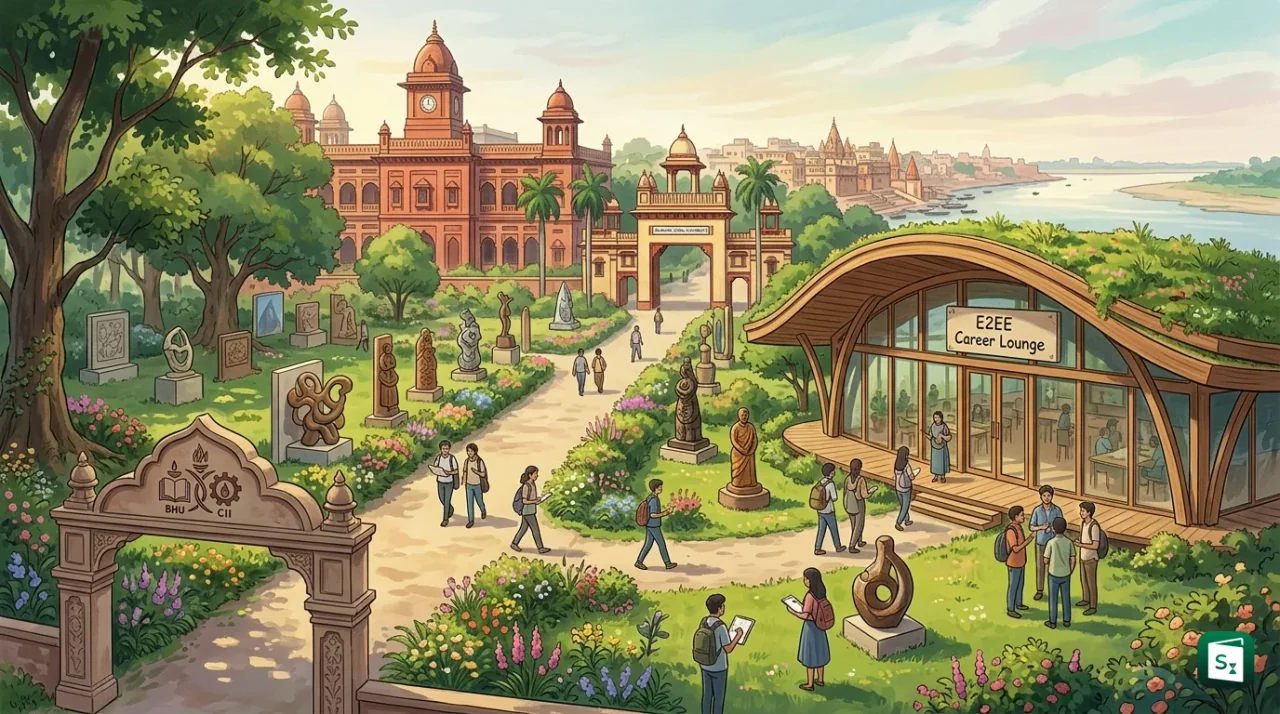
Banaras Hindu University (BHU) signed two Memoranda of Understanding (MoUs) with the Confederation of Indian Industry (CII) on 27 August 2026 to organise the inaugural Banaras Biennale 2026 and to set up a CII Education to Employment and Enterprise (E2EE) Career Lounge on its Varanasi campus. The Biennale will run from 27 November to 31 December 2026 under the theme “Kashi / Light, City as Sensorium”, turning the ancient temple city into a month-long open-air cultural platform. Through these twin pacts, India’s first central university and the country’s largest industry chamber are seeking to fuse heritage, academia and employability in a single partnership.
What the Two MoUs Cover
The agreements were signed at BHU’s Central Office by Registrar Rajan Srivastava on behalf of the university. The CII side was represented by Amita Sarkar, Deputy Director General of CII, and Prashant AN, Executive Director of CII. Madhav Singhania, JMD and CEO of JK Cement and President of CII’s National Steering Committee, led the CII delegation.
The two pacts are operationally separate but strategically linked.
| MoU | Anchor Institution on BHU Side | Lead Purpose |
|---|---|---|
| MoU 1: Banaras Biennale 2026 | Bharat Kala Bhawan, the university museum | Position Varanasi as a global hub for culture, creativity and heritage |
| MoU 2: E2EE Career Lounge | Placement and Internship Cell of the university | Provide technology-enabled career support to students |
Both agreements are part of a larger CII effort to strengthen university-industry linkages through structured skilling programmes. The Biennale MoU is institutional in scope, while the E2EE MoU is employment-oriented, creating a deliberate bridge between cultural capital and human capital.
Banaras Biennale 2026: A Month-Long Cultural Showcase
The inaugural CII Banaras Biennale 2026 will be a city-wide cultural event held across Varanasi from 27 November to 31 December 2026. Conceived as a permanent fixture on India’s cultural calendar, it is designed to blend visual arts, textiles and crafts, music, heritage walks, scholarly conversations, culinary experiences and a brand-new film showcase. The first edition will also host the inaugural Banaras Film Festival, adding a cinema dimension to the broader arts programming.
Theme, Venues and Programming
The Biennale’s theme, “Kashi / Light, City as Sensorium”, frames the ancient city of Kashi as a living, sensing organism, where light, sound, ritual and craft are treated as cultural material. The organisers want visitors to experience Varanasi not merely as a heritage site but as a contemporary creative ecosystem.
Three core venues will host the main programming:
| Venue | Role in the Biennale |
|---|---|
| Banaras Hindu University campus | Academic engagement, student participation, public lectures and masterclasses |
| Bharat Kala Bhawan | Institutional partner anchoring exhibitions and artefact-based programming |
| Jnana Pravaha | A centre for cultural studies, hosting curated dialogues and residencies |
Beyond these anchors, programming will spill into the city’s ghats, lanes and public spaces, making the entire city an exhibition floor. The Vice-Chancellor, Prof. Ajit Kumar Chaturvedi, also proposed a dedicated mobile application to map exhibits, venues and visitor itineraries, suggesting that Biennale planners view technology as central to audience experience from day one.
Curatorial Leadership and Partner Institutions
The curatorial team comprises three art professionals with strong credentials in modern Indian art history: Gayatri Sinha, a leading art critic and curator; Pramod Kumar KG, a museum and collections expert; and Dr. Anjan Chakraborty, a scholar of Indian aesthetics. The Steering Committee is chaired by Madhav Singhania, indicating a strong industry backer for the project. Bharat Kala Bhawan, whose holdings of over 1.04 lakh artefacts include paintings, textiles and Buddhist and Hindu sculptures, will be the principal institutional partner, lending both artefacts and curatorial muscle to the Biennale.
E2EE Career Lounge: Bridging Education and Employment
The second MoU establishes a CII Education to Employment and Enterprise (E2EE) Career Lounge on the BHU campus. E2EE is CII’s flagship employability initiative, designed to convert academic learning into workplace readiness through structured interventions at the university level. The BHU Lounge will be set up in partnership with the university’s Placement and Internship Cell, which will provide the institutional anchor and student outreach.
CII currently operates 32 E2EE Career Lounges across Indian universities and plans to scale the network to 100, with a combined annual reach of more than five lakh (500,000) students. The BHU Lounge, with Varanasi’s large student population, is expected to be one of the largest in this expanded network.
How the Lounge Will Function on Campus
The Lounge is conceived as a technology-enabled career hub rather than a traditional placement office. Its service portfolio covers the full employability cycle, from self-assessment to first job or enterprise.
| Service Category | What Students Will Receive |
|---|---|
| Career counselling | One-on-one guidance on career paths, stream choices and higher studies |
| Soft-skills training | Communication, presentation, group discussion and interview preparation |
| Internships and apprenticeships | Structured industry placements with corporate partners |
| Placement assistance | Job fairs, campus drives and recruiter connect |
| Job fairs | Periodic hiring events connecting students with employers |
| Entrepreneurship mentoring | Mentorship for students interested in starting their own ventures |
The placement cell on campus is led by Prof. Amit Gautam, while the Dean of the Faculty of Arts, Prof. Sushma Ghildyal, was present at the signing, signalling that the Lounge will serve arts and humanities students as much as engineering and management students. By integrating employability services with the existing Placement and Internship Cell, BHU aims to create a single window where students can move from learning to earning without leaving campus.
BHU: The Centenary Institution Behind the Partnership
Banaras Hindu University is a collegiate, central and research university located in Varanasi, Uttar Pradesh. It was founded on 4 February 1916 by the nationalist leader Pandit Madan Mohan Malaviya, with the support of the Maharaja of Darbhanga (Rameshwar Singh), the Maharaja of Benares (Prabhu Narayan Singh), the lawyer Sunder Lal and the theosophist Annie Besant. The university was created through the Banaras Hindu University Act, 1915, making it India’s first central university, established through a parliamentary Act rather than as a state institution.
BHU marked its centenary in 2015 to 2016 and has grown into one of the country’s most comprehensive universities. Its 1,300-acre main campus hosts over 65 hostels, more than 30,000 students from 48 countries, and a wide range of faculties covering arts, science, commerce, law, medicine, agriculture and performing arts. In June 2012, the university’s engineering institute was converted into the Indian Institute of Technology (BHU), bringing a premier technology institution under the same historic campus.
The university’s cultural and archival backbone for the Biennale is Bharat Kala Bhawan, a museum founded on 1 January 1920 by Rai Krishnadasa and Malaviya. Its first honorary chairman was Nobel laureate Rabindranath Tagore, with Abanindranath Tagore as vice-chairman. The museum holds over 1,04,376 artefacts across 14 galleries, ranging from 1st to 15th century sculptures, Mughal miniatures, Pahari and Rajasthani paintings, brocade textiles, numismatic collections and contemporary art. Jawaharlal Nehru laid the foundation of the current museum building in 1950 and inaugurated it in 1962, and Mahatma Gandhi visited the museum three times, famously noting that the collection was “very good.”
The BHU Vice-Chancellor, Prof. Ajit Kumar Chaturvedi, described the Biennale as an effort to reposition Kashi as a vibrant centre of contemporary creativity, while the E2EE Lounge, in his words, will ensure students are “equipped with the skills, exposure, and opportunities necessary to shape their own futures.”
CII: From EITA to a 130-Year-Old Industry Voice
The Confederation of Indian Industry (CII) is a non-government, not-for-profit, industry-led and industry-managed organisation, registered under the Societies Registration Act, 1860. It is headquartered at the Mantosh Sondhi Centre, 23 Institutional Area, Lodi Road, New Delhi. CII currently has around 9,000 direct members from the private and public sectors, including small and medium enterprises and multinational corporations, and an indirect membership of over 3,65,000 enterprises drawn from 294 national and regional sectoral industry bodies.
CII’s institutional journey spans more than a century. The organisation was first formed in 1895 as the Engineering and Iron Trades Association (EITA), when five engineering firms of the Bengal Chamber of Commerce, namely Martin & Company, Burn & Company, John King & Company, Jessop & Company and Turner Morrison & Company, came together to lobby the colonial government for Indian sourcing of engineering orders. It was renamed the Indian Engineering Association in 1912, became the Association of Indian Engineering Industry in 1974 and the Confederation of Engineering Industry in 1986, before finally being rechristened the Confederation of Indian Industry in 1992, in step with India’s post-1991 economic liberalisation.
The evolution of CII’s name mirrors the evolution of Indian industry itself.
| Year | Name | Defining Phase |
|---|---|---|
| 1895 | Engineering and Iron Trades Association (EITA) | Colonial-era engineering lobby |
| 1912 | Indian Engineering Association (IEA) | Indian-owned manufacturers take the lead |
| 1974 | Association of Indian Engineering Industry (AIEI) | Merger of IEA and EAI |
| 1986 | Confederation of Engineering Industry (CEI) | Apex body for manufacturing |
| 1992 | Confederation of Indian Industry (CII) | Cross-sectoral business chamber |
CII operates 70 offices, including 12 Centres of Excellence in India, and 8 overseas offices in Australia, Egypt, Germany, Indonesia, Singapore, the UAE, the UK and the USA. It maintains institutional partnerships with about 300 counterpart organisations in nearly 100 countries. In 2023, CII served as the B20 India Secretariat during India’s G20 Presidency, underscoring its role as the country’s most visible business diplomacy platform.
The Wider Push for Industry-Academia Linkages
The twin MoUs sit inside a larger CII architecture of programmes that connect universities, industry and government. Three are particularly relevant for the BHU partnership.
| Programme | Lead Vertical | Relevance to BHU Pact |
|---|---|---|
| CII India Skills Development Programme | Skilling and workforce readiness | Feeds trained candidates into E2EE Lounges |
| CII India Skills Report | Annual employability data and analytics | Provides benchmarking for placement outcomes |
| Model Career Centre | Career counselling infrastructure | Mirrors the E2EE Lounge service model |
CII has also been a key participant in the government’s Skill India mission and runs industry-academia engagement initiatives across sectors. For BHU, the E2EE Lounge effectively becomes a private-sector add-on to its existing Placement and Internship Cell, expanding the menu of services without creating parallel infrastructure. For CII, the BHU partnership adds a high-visibility anchor in Uttar Pradesh, where the chamber already operates through its Lucknow office in Gomti Nagar and its Northern Region headquarters in Chandigarh.
The Biennale MoU, on the other hand, advances a different but equally strategic objective for CII. Cultural diplomacy and the creative economy have been growing areas of CII’s work, and the Biennale is being positioned as more than a one-off event. By framing the Biennale as a long-term national cultural institution connecting heritage, tourism, education, employment, innovation and the creative economy, CII is signalling that it intends to anchor recurring cultural programming in India’s temple cities, much as it has anchored industrial policy dialogues in Delhi and Mumbai.
For BHU and the wider Varanasi region, the practical fallout is tangible: students gain access to career services and cultural exposure that earlier generations had to seek in Delhi or abroad, while artisans, musicians and craftspeople get a curated citywide platform to showcase their work to a global audience. The partnership model being tested here, where a central university and a national industry chamber co-own both cultural and employability projects, could well become a template for similar collaborations in other Indian heritage cities.
Key Takeaways
- Banaras Hindu University (BHU) and the Confederation of Indian Industry (CII) signed two MoUs on 27 August 2026 to organise the Banaras Biennale 2026 and launch an E2EE Career Lounge on the BHU campus in Varanasi, Uttar Pradesh.
- The Banaras Biennale 2026 will be held from 27 November to 31 December 2026 under the theme “Kashi / Light, City as Sensorium”, with Bharat Kala Bhawan as the institutional partner.
- The E2EE Career Lounge will operate through BHU’s Placement and Internship Cell, offering career counselling, soft-skills training, internships, placements and entrepreneurship mentoring; CII plans to scale its lounge network from 32 to 100, reaching over 5 lakh students annually.
- BHU, founded on 4 February 1916 by Pandit Madan Mohan Malaviya under the Banaras Hindu University Act, 1915, is India’s first central university and runs a 1,300-acre campus with over 30,000 students.
- Bharat Kala Bhawan, the BHU museum founded on 1 January 1920 with Rabindranath Tagore as its first honorary chairman, holds over 1,04,376 artefacts across 14 galleries.
- CII, headquartered in New Delhi, traces back to the Engineering and Iron Trades Association (EITA) of 1895 and was rechristened the Confederation of Indian Industry in 1992, aligning with India’s liberalisation reforms.