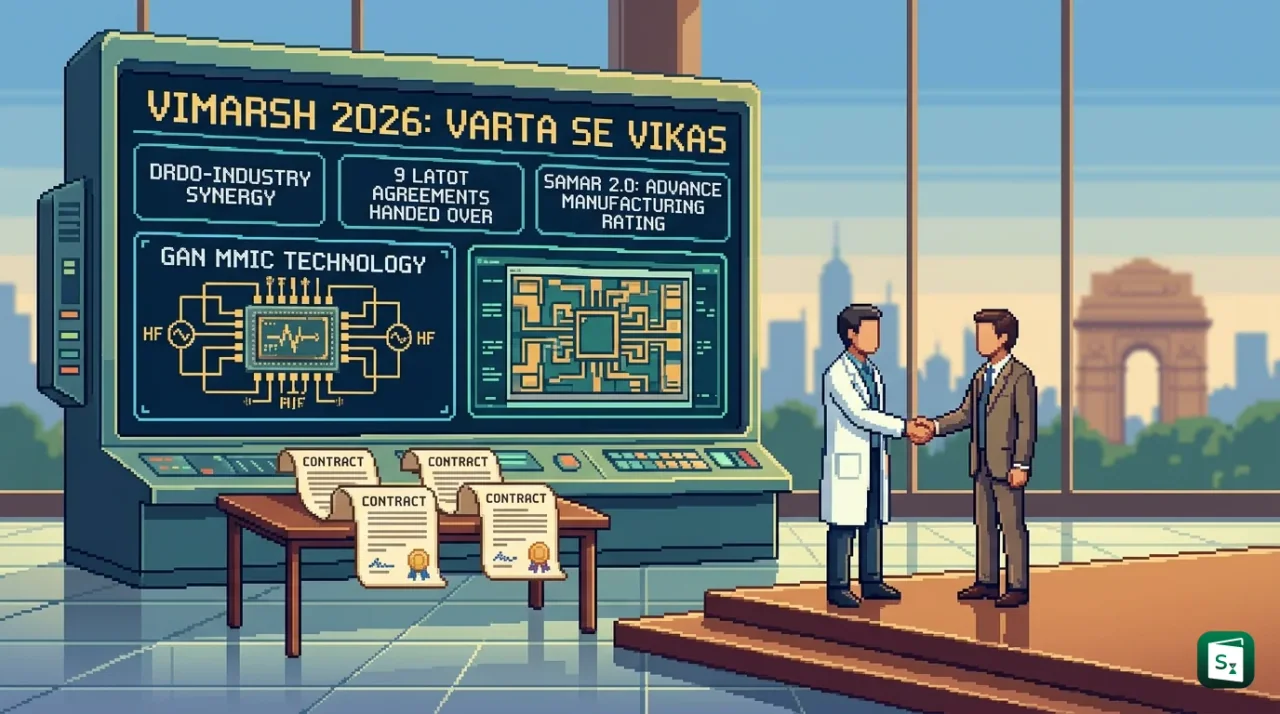
Defence Minister Rajnath Singh unveiled a new support package for MSMEs and defence startups in India at the VIMARSH 2026 DRDO Industry Synergy Meet held on 15 September 2026 at the Dr D.S. Kothari Auditorium in New Delhi. The meet, themed Varta se Vikas, handed over 9 Licensing Agreements for Transfer of Technology to 13 manufacturing partners and launched a framework to share software source codes with industry. The announcements link DRDO research directly with Make in India manufacturing and private innovation to speed up self reliance in defence.
What Is DRDO and Why Was VIMARSH 2026 Organised?
The Defence Research and Development Organisation (DRDO) is the research arm of the Ministry of Defence. It designs weapons, sensors and electronics for the Army, Navy and Air Force. DRDO is a government organisation under the Department of Defence Research and Development, not a public company.
DRDO was formed in 1958 by merging the Technical Development Establishment, the Directorate of Technical Development and Production and the Defence Science Organisation. DRDO started with 10 laboratories and has grown into a network of about 50 laboratories across India. DRDO headquarters is located at DRDO Bhawan on Rajaji Marg in New Delhi. The DRDO Chairman (as of September 2026) is Rajesh Kumar Singh, who also serves as Secretary of the Department of Defence Research and Development and as Defence Secretary in additional charge.
VIMARSH 2026 was organised as a DRDO Industry Synergy Meet to connect DRDO laboratories with industry, startups and universities. The theme Varta se Vikas means discussion leading to development. The aim was to move the relationship beyond a buyer and seller model to joint research, design, testing, certification and manufacturing. Senior officials, scientists and industry representatives attended the meet in New Delhi to align laboratory research with factory production and user needs.
| VIMARSH 2026 At A Glance | Detail |
|---|---|
| Full name | VIMARSH 2026 DRDO Industry Synergy Meet |
| Date | 15 September 2026 |
| Venue | Dr D.S. Kothari Auditorium, DRDO Bhawan, New Delhi |
| Theme | Varta se Vikas |
| Chaired by | Defence Minister Rajnath Singh |
| Organiser | DRDO under Ministry of Defence |
Nine Technology Transfers to Thirteen Industry Partners
DRDO handed over 9 Licensing Agreements for Transfer of Technology (LAToTs) to 13 manufacturing partners at VIMARSH 2026. A Licensing Agreement for Transfer of Technology is a legal permission that allows a company to produce a system designed by a DRDO laboratory. The agreements allow companies to start commercial production of advanced systems for the armed forces. The move helps create more than one production line for the same product, so supply becomes faster and more secure.
The scale of transfer is large. DRDO has completed more than 2,300 technology transfers to over 1,100 industries so far. DRDO has also made technologies linked to about 50 missiles available to industry. This wider sharing helps micro, small and medium enterprises join the defence supply chain as makers of parts, sub systems and complete systems.
VIMARSH 2026 also launched a standard and secure framework to share software source codes developed by DRDO with licensed companies. Source code is the basic set of instructions behind a software program. Access to source code helps companies repair, update and improve software based weapons and sensors without delay. The framework is expected to support software defined defence, where performance is improved through software upgrades, and to reduce problems caused by old or foreign software parts.
Two industry outreach pacts were exchanged at the meet. DRDO exchanged memorandums with the Society of Indian Defence Manufacturers (SIDM) and Laghu Udyog Bharati (LUB) to reach more companies at the grassroots level. DRDO also released a book titled Defence Systems for Resilient Bharat, Advancing Aatmanirbharta in Defence, which lists systems developed between 2014 and 2026, along with new guidelines for human resource outsourcing contracts in DRDO laboratories.
| Key Outcome At VIMARSH 2026 | What It Means |
|---|---|
| 9 LAToTs to 13 partners | Companies can manufacture DRDO designed systems |
| Software source code framework | Licensed firms can update and maintain defence software |
| MoUs with SIDM and LUB | Wider reach to large firms and small industries |
| SAMAR 2.0 contract with QCI | Quality rating for defence manufacturers |
| Book and HR guidelines | Record of 2014 to 2026 systems and simpler staffing rules |
SAMAR 2.0 and Quality Council of India Partnership
DRDO signed a contract with the Quality Council of India (QCI) for implementation of System for Advance Manufacturing Assessment and Rating (SAMAR) version 2.0. SAMAR is a rating system that checks how mature and reliable a defence factory is. The rating looks at process control, quality systems, traceability and capacity for continuous improvement. The goal is to make sure that a larger number of suppliers does not lead to lower quality in critical weapons and equipment.
SAMAR was developed jointly by DRDO and QCI. The framework applies to micro, small, medium and large enterprises that make parts, sub systems or complete systems for defence and aerospace. The model uses five maturity levels and gives a certificate valid for two years. Assessment is done through a digital and paperless process with geo tagging and time stamping. Fees are subsidised for micro and small units to encourage participation. DRDO has announced that SAMAR certification will become mandatory for industry partners dealing with DRDO with effect from 1 May 2027.
The Quality Council of India is the national body for accreditation and quality promotion in India. QCI was set up in 1996 through a Cabinet decision and registered in 1997 as an autonomous society. QCI was created jointly by the Government of India and three industry bodies, the Associated Chambers of Commerce and Industry of India (ASSOCHAM), the Confederation of Indian Industry (CII) and the Federation of Indian Chambers of Commerce and Industry (FICCI). Industrialist Ratan Tata served as the first Chairman of QCI. QCI works under the Department for Promotion of Industry and Internal Trade (DPIIT) of the Ministry of Commerce and Industry and is headquartered at the World Trade Centre in Nauroji Nagar, New Delhi.
SAMAR 2.0 matters because defence systems must work without failure in tough conditions. A common rating helps DRDO pick capable vendors for import substitution of mission critical parts. It also gives companies a clear roadmap to raise standards and qualify for larger orders and exports. In the long run, the system supports reliable vendor development and stronger trust in Indian made defence products.
What Is Gallium Nitride and Why Does It Matter for Defence?
Gallium Nitride (GaN) is a compound semiconductor material made from gallium and nitrogen. It handles high voltage, high power and high frequency with high efficiency. DRDO uses GaN to build compact radar, electronic warfare and communication parts that run faster and cooler than silicon parts.
The GaN breakthrough showcased at VIMARSH 2026 was developed by a team led by Dr Meena Mishra, Outstanding Scientist and Director of the Solid State Physics Laboratory (SSPL) in Delhi. SSPL works on semiconductor materials and devices for strategic use. Fabrication of the chips is done at the Gallium Arsenide Enabling Technology Centre (GAETEC) in Hyderabad. The team has demonstrated indigenous GaN Monolithic Microwave Integrated Circuit (MMIC) technology for use up to X band frequencies, which cover high frequency radar and communication bands.
The performance is striking. One indigenous GaN chip measuring only 3.5 mm by 3 mm can deliver up to 30 watts of power and operate at speeds 300 times faster than silicon. SSPL has also built processes for 4 inch silicon carbide (SiC) wafers and fabricated GaN High Electron Mobility Transistor (HEMT) devices up to 150 watts and MMICs up to 40 watts. Indigenously made S band GaN HEMT power bars, power amplifiers, low noise amplifiers and switch MMICs have been designed, fabricated and tested. More than 30 chips across frequencies have been designed for radars, electronic warfare, satellite communication and 5G.
What Is MMIC and How Does GaN MMIC Work?
A Monolithic Microwave Integrated Circuit (MMIC) is a tiny chip that packs amplifiers, switches and control circuits for microwave signals on one base. It generates, boosts and receives high frequency waves. DRDO packs GaN power parts into MMICs to shrink radar and jammer modules.
A High Electron Mobility Transistor (HEMT) is a special fast switch that controls large currents using a thin layer of electrons. In a GaN MMIC, many such transistors, along with passive parts, are built together on a silicon carbide base. GaN handles higher voltage than the older gallium arsenide (GaAs) technology because it has a higher breakdown field. It also gives higher impedance, so simpler matching circuits are needed. The result is smaller transmit and receive modules for Active Electronically Scanned Array (AESA) radars, lighter jammers and lower cooling needs.
The push for local GaN grew after foreign suppliers refused to share the process know how. India had sought GaN technology under the offset clause of the 2016 deal for 36 Rafale aircraft worth about ₹59,000 crore, but the request was declined due to the strategic nature of the technology. DRDO then started full local development, building on early compound semiconductor work encouraged by former President A P J Abdul Kalam. The effort took long fabrication cycles of about 80 days with hundreds of steps for each run before success was confirmed in tests.
| Feature | Silicon Based Part | GaN Based MMIC Part |
|---|---|---|
| Chip size in focus | Larger module for same power | 3.5 mm by 3 mm chip for up to 30 watts |
| Speed | Standard switching speed | Up to 300 times faster than silicon |
| Power and frequency | Limited at high frequency | High power at S, C, X and Ku bands |
| Heat and efficiency | More heat, larger cooling | Higher efficiency, lower cooling need |
| Use | General electronics | Radar transmitters, jammers, seekers, satcom |
GaN MMICs will feed next generation radars, electronic warfare systems, secure communications, intelligence, surveillance, reconnaissance and unmanned systems. The same base technology also supports space, aerospace and satellite communication uses. Under the Innovations for Defence Excellence (iDEX) network, DRDO is also working with firms such as Agnit Semiconductors to design GaN parts for wireless transmitters, since almost all such parts were earlier imported.
Defence Startup Ecosystem and Innovation Framework
Defence startups in India are small technology firms that build parts, software and systems for the armed forces. The VIMARSH 2026 package lowers entry barriers for these firms and for micro, small and medium enterprises through direct funding, incubation support and dedicated access to DRDO testing facilities. The aim is to bring startups into the supply chain for components, sub systems and advanced technologies alongside large manufacturers. This focus responds to a clear trend, with interest in Make in India defence and Indian defence startups showing strong growth.
The policy push builds on earlier reforms. These include Positive Indigenisation Lists that restrict imports of selected items, the Make in India programme for local manufacturing, and the decision to earmark 25 percent of the defence research and development budget for the private sector. Grants are given through the Technology Development Fund (TDF) of DRDO, and several startup developed technologies have already reached production. The larger goal presented at the meet links to Viksit Bharat by 2047, with targets for self reliance in critical technologies, higher indigenous content, growth in defence exports and a stronger place in global supply chains.
What Is the iDEX Scheme in Defence?
The Innovations for Defence Excellence (iDEX) scheme, launched in 2018, funds startups, MSMEs and innovators to build prototypes for the armed forces. It is run by the Defence Innovation Organisation. Winners get grants through Challenges such as DISC, Open Challenge and ADITI for development and trials.
iDEX is implemented by the Defence Innovation Organisation (DIO), a not for profit company set up under Section 8 of the Companies Act, 2013 by Hindustan Aeronautics Limited (HAL) and Bharat Electronics Limited (BEL). DIO works under the Department of Defence Production. The scheme budget of ₹498.78 crore for 2021-22 to 2025-26 supports about 300 startups and MSMEs and about 20 partner incubators. Support is given mainly as a grant, not as equity, through the SPARK framework, which stands for Support for Prototype and Research Kickstart.
The Defence India Startup Challenge (DISC) invites startups to solve problem statements given by the armed forces and public sector units. The Open Challenge allows innovators to propose their own solutions through the year. The ADITI challenge, which stands for Acing Development of Innovative Technologies, supports more advanced systems with larger grants. New areas highlighted at VIMARSH 2026 include artificial intelligence, quantum computing, hypersonics and directed energy.
| Challenge Under iDEX | Grant Support | How It Works |
|---|---|---|
| DISC | Up to ₹1.5 crore | Apply against set problem statements from users |
| Open Challenge | Up to ₹1.5 crore | Propose own solution any time in the year |
| ADITI | Up to ₹25 crore | Advanced technologies with higher funding need |
| iDEX Prime | Up to ₹10 crore | Higher support for select prime projects |
To start a defence startup in India, a founder must first register the firm as a startup with the Department for Promotion of Industry and Internal Trade or as an MSME under the MSME Act. The firm can then register on the iDEX portal and apply against a DISC problem or submit an Open Challenge proposal. Shortlisted teams face screening by the user service and a high powered committee. Winners sign a grant agreement, build a prototype with mentor and incubator support, and offer it for trials with the armed forces or public sector units.
The Way Forward
The next test for VIMARSH 2026 will be speed of execution on the factory floor. DRDO laboratories will need to keep technology transfer documents, testing slots and software code access simple and predictable for small firms. Industry partners will need to invest in design skills, not only in assembly, so that research, design, testing, certification and manufacturing grow together. The SAMAR 2.0 rollout before the May 2027 mandate will show whether quality rating improves delivery without blocking new entrants.
If these links hold, the defence industry can move from single product orders to steady production, maintenance and exports. Wider use of local GaN MMICs in radars and jammers can cut import dependence in high value electronics. Steady funding through TDF and iDEX, combined with university research and private manufacturing, can help India build depth in critical technologies and move closer to the goal of a global defence manufacturing hub.
Key Takeaways
- VIMARSH 2026 DRDO Industry Synergy Meet was held on 15 September 2026 in New Delhi under the theme Varta se Vikas.
- 9 Licensing Agreements for Transfer of Technology were handed over to 13 manufacturing partners to enable commercial production of DRDO systems.
- DRDO signed a pact with the Quality Council of India for SAMAR 2.0, a five level rating valid for two years and mandatory from 1 May 2027.
- Indigenous Gallium Nitride MMIC technology up to X band was developed by SSPL under Dr Meena Mishra, with a 3.5 mm by 3 mm chip delivering 30 watts.
- DRDO, formed in 1958 and headquartered at DRDO Bhawan in New Delhi, has completed over 2,300 transfers to more than 1,100 industries.
- The iDEX scheme, launched in 2018 and run by DIO, gives grants up to ₹1.5 crore under DISC and up to ₹25 crore under ADITI.