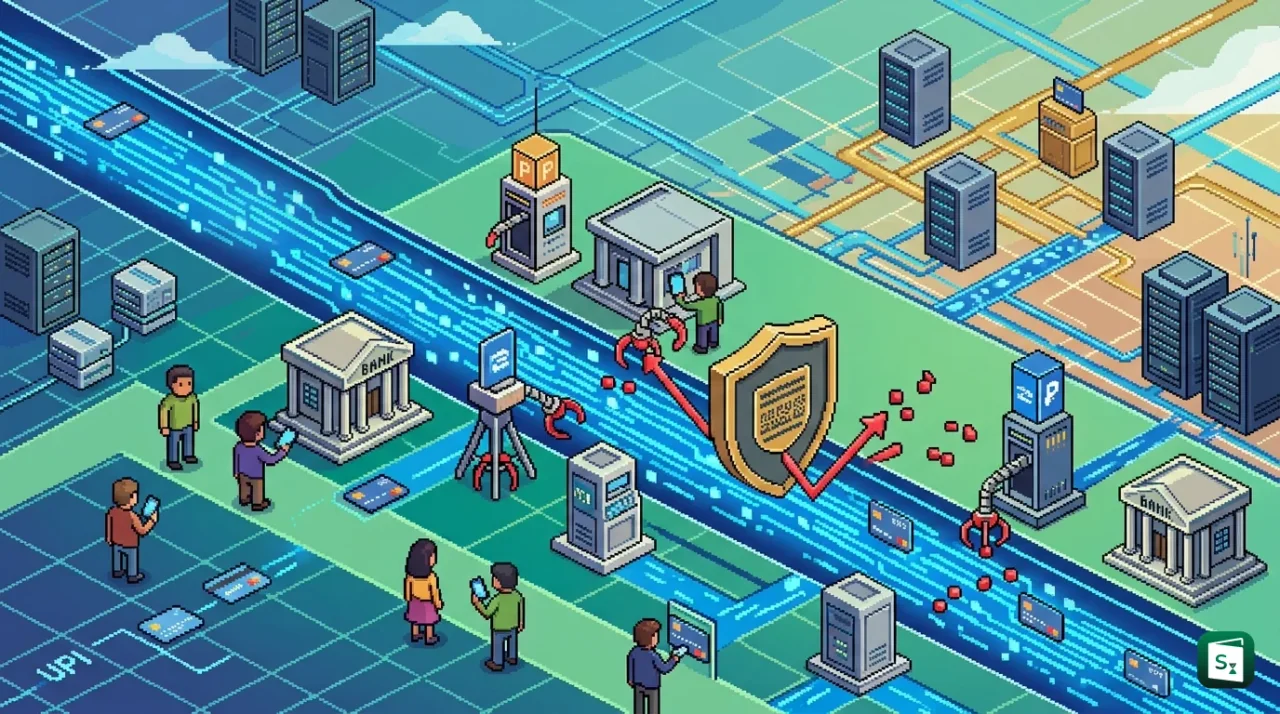
The Ministry of Finance has notified that banks and payment system providers cannot impose any direct or indirect charge on UPI transactions up to ₹2,000 or on payments made through RuPay-powered debit cards. The gazette notification, issued on 14 September 2026 under Section 10A of the Payment and Settlement Systems Act, 2007, gives statutory protection to small-value digital payments. It comes weeks after Parliament amended the same law, opening the door for a merchant-side fee on higher-value transactions while keeping ordinary users out of the charge net.
What Is the Merchant Discount Rate (MDR)?
The Merchant Discount Rate (MDR) is the fee that a merchant pays to banks and payment system providers for accepting a digital payment. It is calculated as a percentage of the transaction value and is deducted by the acquiring bank before the balance is credited to the merchant. MDR is a business-to-bank charge, not a consumer charge.
The Reserve Bank of India regulates MDR. On ordinary debit cards, it can go up to 0.90% of the transaction value. On credit cards, it typically ranges between 1.5% and 2.5%. Within the UPI system, NPCI had earlier allowed acquiring banks to charge up to 0.30% on person-to-merchant (P2M) transactions. Person-to-person (P2P) transfers, such as sending money to a friend or family member, never carried an MDR.
MDR is distinct from the transaction limits that banks set. A UPI daily limit of ₹1 lakh, for example, is a risk-control measure. MDR, by contrast, is a pricing mechanism that decides who pays for running the payment rails.
| Payment Mode | Typical MDR Before the 2026 Change | Who Paid It |
|---|---|---|
| Credit cards | 1.5% to 2.5% | Merchant |
| Debit cards (Visa, Mastercard) | Up to 0.90% | Merchant |
| UPI person-to-person | Nil | Nobody |
| UPI person-to-merchant | Nil since January 2020 | Nobody |
| RuPay debit cards | Nil since January 2020 | Nobody |
What Exactly Did the Finance Ministry Notify?
The Department of Financial Services, under the Ministry of Finance, issued a gazette notification on 14 September 2026. It used the powers granted by Section 10A of the Payment and Settlement Systems Act, 2007 to name two electronic payment modes that cannot attract any charge.
The two specified modes are:
- Debit cards powered by RuPay
- Unified Payments Interface (UPI) transactions up to ₹2,000
The notification states that no bank or system provider shall impose, whether directly or indirectly, any charge upon a person making or receiving a payment through these modes. The phrase “directly or indirectly” is important. It blocks banks from levying a fee under a different label, such as a processing charge, a platform fee or a convenience fee.
Crucially, the notification protects both sides of a transaction. A person receiving money through these modes is also shielded, not just the person sending it. For an ordinary user, a UPI payment of ₹500, ₹1,500 or ₹2,000 to a shopkeeper now carries a clear legal guarantee of no charge.
The Legal Chain: Section 10A, Section 269SU and the 2026 Amendment
To understand why this notification matters, one has to trace a legal chain that begins with the Income-tax Act, 1961. Section 269SU of that Act requires every business with an annual turnover above ₹50 crore to offer prescribed electronic payment modes to its customers. In December 2019, the Central Board of Direct Taxes (CBDT) notified UPI, UPI QR codes and RuPay debit cards as those prescribed modes.
Section 10A of the Payment and Settlement Systems Act, 2007 then barred banks and system providers from charging the payer or the payee on those same modes. Together, these two provisions created the zero-MDR regime that took effect in January 2020. It made UPI and RuPay debit card payments free for both customers and merchants, with the government stepping in to compensate the ecosystem through incentives.
This arrangement changed in August 2026, when Parliament passed the Taxation and Other Laws (Amendment) Bill, 2026. The amendment delinked Section 10A from Section 269SU. Instead of drawing the list of protected payment modes from the Income-tax Act, the central government would now specify those modes by notification. This shifted the power from a fixed statutory rule to executive discretion, allowing the government to change the list in the future without returning to Parliament.
The 14 September notification is the first use of that new power. Legal experts describe the amendment as an enabling provision: it does not itself impose any fee, but it creates the framework under which a fee can later be prescribed for certain transactions.
Analogy · The Library Membership Card Expand analogy
Think of Section 269SU as the rule that tells large shops they must accept a particular library membership card, and Section 10A as the rule that says the library cannot charge you for using that card. The 2026 amendment separates the two rules, so the library can now decide separately which cards stay free. The 14 September notification confirms that ordinary cards up to ₹2,000 are still free.
UPI Remains Free for Consumers and Person-to-Person Transfers
A frequent misreading of the notification is that UPI payments above ₹2,000 will now attract a fee from the user’s bank account. That is not what the notification says. It sets a protected threshold, not a billing threshold.
The Ministry of Finance and the National Payments Corporation of India (NPCI) have both clarified the position. All person-to-person (P2P) UPI transactions remain completely free, irrespective of the amount transferred. No transaction fee, platform fee or other charge can be levied on an individual for sending or receiving money through UPI. P2P transactions account for roughly 70% of the total value flowing through the platform.
For merchant payments, the protection is broad. Payments up to ₹2,000 and transactions covered under the zero-MDR framework for small merchants remain free. The government estimates that this covers approximately 96% of all person-to-merchant transactions. Individuals also continue to have unlimited free usage, with no monthly quotas, volume restrictions or tiered caps on free UPI transactions.
The daily transaction limits that banks and NPCI prescribe, usually between ₹1 lakh and ₹5 lakh depending on the category, are security and risk safeguards. They are not charging thresholds, and crossing them does not trigger a fee.
When Does MDR Apply, and How Much Is It?
Where a charge does apply, it falls on the merchant, not the customer. The UPI and Services Steering Committee, a 22-member body headed by NPCI and including representatives from the Indian Banks’ Association (IBA) and the Payments Council of India (PCI), finalised the framework.
Key features of the MDR framework:
- A nominal MDR of 0.4% applies only to person-to-merchant UPI transactions above ₹2,000.
- For transactions of ₹75,000 and above, the MDR is capped at ₹300 per transaction.
- Certain categories, including telecom, railways, fuel, insurance and select government services, attract a flat ₹5 per transaction instead of the percentage rate.
- Payments to small merchants with monthly UPI receipts under ₹1 lakh are exempt.
- Auto-debits and UPI mandates do not attract charges.
The framework took effect from 15 October 2026, giving acquiring banks, payment aggregators, fintech applications and accounting platforms time to update their billing systems. At 0.4%, a ₹2,000 payment would attract about ₹8, while a ₹10,000 payment would attract ₹40.
| Transaction Type | MDR Applicable | Who Bears the Cost |
|---|---|---|
| UPI person-to-person (any amount) | Nil | Nobody |
| UPI person-to-merchant up to ₹2,000 | Nil | Nobody |
| Small merchant with monthly receipts under ₹1 lakh | Nil | Nobody |
| P2M above ₹2,000 (general) | 0.4%, capped at ₹300 | Merchant |
| Fuel, telecom, insurance, railways | Flat ₹5 | Merchant |
Banks have been advised to ensure that merchants do not pass MDR on to customers, and UPI application providers are expressly barred from imposing platform fees or hidden charges. The merchant must charge the customer only the posted price of the goods or services.
Why Was the Zero-MDR Model Under Strain?
The zero-MDR regime, in place since January 2020, was a deliberate policy choice to accelerate digital payments. It worked. UPI grew from a niche product into the world’s largest real-time payment system. In July 2026 alone, India processed about 2,366 crore UPI transactions worth ₹29.9 lakh crore.
But the model had a cost problem. With no MDR, banks and payment providers earned nothing from UPI transactions. The government supported them through the Incentive Scheme for Promotion of RuPay Debit Cards and low-value BHIM-UPI transactions (P2M), first notified for FY 2021-22. Under this scheme, the government pays an incentive of 0.15% on UPI transactions up to ₹2,000 made to small merchants. The outlay was ₹1,500 crore for FY 2024-25.
Government payouts under the scheme were ₹1,389 crore in FY 2021-22, ₹2,210 crore in FY 2022-23 and ₹3,631 crore in FY 2023-24. NPCI has argued that the subsidy is a short-term measure and that maintaining UPI operations, server bandwidth and fraud prevention requires around ₹20,000 crore annually.
The Payments Council of India has long requested a nominal MDR on large-merchant transactions, arguing that zero MDR makes the ecosystem financially unsustainable. The 0.4% rate is far lower than card MDRs, and the government has positioned it as a way to fund the next phase of UPI growth without burdening individuals or small businesses.
How the MDR Revenue Is Shared
MDR is not a tax and is not collected by the government or by NPCI. It is a payment-ecosystem charge distributed among the participants who keep UPI running.
Of the 0.4% MDR, about 0.28% is an interchange fee paid by the acquiring bank to the issuer bank. The remaining portion is shared with the payment service provider, which in turn pays a share to the UPI application provider. NPCI has also announced a dedicated fund for small merchants, with 5% of MDR collections earmarked for it.
A useful comparison comes from other countries. Brazil’s instant payment system PIX carries a merchant charge of around 0.33%, while in China the corresponding charge is about 0.40%. India’s rate therefore sits close to global norms, even as the country keeps its threshold exemptions unusually generous.
RuPay Debit Cards and the Wider Card Ecosystem
The notification also keeps RuPay-powered debit card payments free of direct or indirect charges. This is significant because RuPay is India’s indigenous card network, launched by NPCI in 2012. RuPay cards are issued by public sector banks, regional rural banks and cooperative banks, and they carry a large share of accounts opened under the Pradhan Mantri Jan Dhan Yojana (PMJDY).
For these cardholders, mostly in rural and semi-urban areas, the guarantee that a debit card payment will not attract an extra charge matters for financial inclusion. Keeping RuPay debit payments free also keeps them competitive against cash and against other card networks.
The distinction between debit and credit matters here. The charge protection covers RuPay debit cards. RuPay credit cards linked to UPI fall under the merchant MDR framework, where the 0.4% rate applies to qualifying transactions above ₹2,000. This reflects the commercial reality that credit is a borrowing product with its own cost structure.
What This Means for Consumers and Merchants
For an ordinary user, the practical effect of the notification is simple. Small UPI payments up to ₹2,000 carry a legal guarantee of no charge from any bank or payment system provider.
Merchants face a more nuanced picture. Small merchants, and any merchant whose monthly UPI receipts stay under ₹1 lakh, remain outside the MDR net. Large merchants processing higher-value payments will bear a nominal 0.4% cost, which many may absorb for the same reason they accept cards today: handling cash also carries a cost. Several banks charge a deposit fee for cash, so a 0.4% digital charge can compare favourably.
The framework also preserves the cashless economy push. By keeping everyday small payments free and charging only a thin margin on large merchant payments, the policy tries to balance financial inclusion, ecosystem sustainability and consumer protection at once.
Challenges and the Road Ahead
The framework is not without open questions. The first is enforcement. Banks have been asked to ensure merchants do not pass MDR on to customers, but monitoring this at scale, across crores of merchants, will be difficult. A merchant could quietly raise prices to absorb the fee, and consumers may never know.
The second is the treatment of online platforms and aggregators. These entities process very high transaction values, and the MDR applies to them above ₹2,000. Whether they absorb the cost or restructure their pricing will become clear only in the months after 15 October 2026.
The third is ecosystem behaviour. A small charge can change incentives. Some providers may push users toward higher-value transactions to generate MDR, while others may invest the new revenue in fraud detection and infrastructure. The stated expectation is that MDR revenue will fund better security, deeper acceptance networks and wider UPI adoption.
For now, the legal position is clear. The 14 September notification locks in free UPI payments up to ₹2,000 and free RuPay debit card payments. The MDR on qualifying higher-value merchant transactions is a separate, notified framework, and it does not touch the individual consumer’s pocket.
Key Takeaways
- The Ministry of Finance notified on 14 September 2026 that banks and payment system providers cannot impose any direct or indirect charge on UPI transactions up to ₹2,000 and on RuPay-powered debit card payments.
- The notification was issued under Section 10A of the Payment and Settlement Systems Act, 2007, after the Taxation and Other Laws (Amendment) Bill, 2026 delinked that section from Section 269SU of the Income-tax Act, 1961.
- The zero-MDR regime for UPI and RuPay debit cards has been in place since January 2020, when the CBDT notified UPI, UPI QR codes and RuPay debit cards as prescribed electronic payment modes.
- A nominal MDR of 0.4% applies only to UPI person-to-merchant transactions above ₹2,000, capped at ₹300 for transactions of ₹75,000 and above, with a flat ₹5 for categories such as fuel, telecom, insurance and railways.
- All person-to-person UPI transactions remain free irrespective of amount, and about 96% of merchant transactions stay outside the MDR net.
- NPCI, established in 2008 and headquartered in Mumbai, operates UPI, which was launched on 25 August 2016; India processed about 2,366 crore UPI transactions worth ₹29.9 lakh crore in July 2026 alone.
- MDR is a merchant-side charge, not a tax or a consumer fee, and is shared among banks, payment service providers, app providers and NPCI.