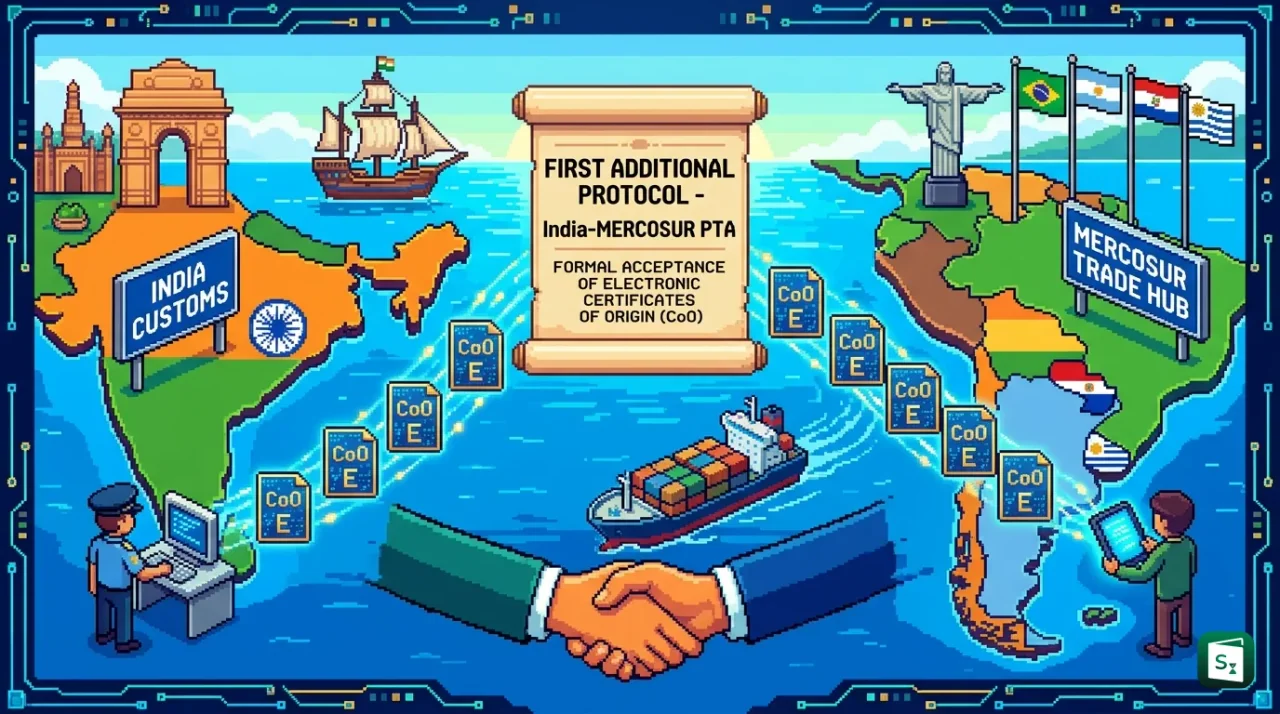
India and the MERCOSUR bloc signed the First Additional Protocol to their Preferential Trade Agreement (PTA) on 14 September 2026, formally accepting electronic Certificates of Origin. The protocol amends Article 16 of Annex III, the Rules of Origin chapter of the 2004 agreement, giving a digitally signed certificate the same legal force as a paper one. On the same day, the two sides also announced the launch of negotiations to expand the two-decade-old pact.
What Is the First Additional Protocol to the India-MERCOSUR PTA?
A Preferential Trade Agreement is a limited trade deal in which two trading partners lower import duties on a select list of products rather than on all goods. The India-MERCOSUR PTA, which came into operation in June 2009, is precisely this kind of arrangement. The First Additional Protocol is the first formal amendment to that original agreement since it was signed.
The protocol was signed in New Delhi by Commerce Secretary Rajesh Agrawal for India. The MERCOSUR side was represented by officials including Alberto Guani of Uruguay and Fleming Raul Duarte Ramos of Paraguay, with Uruguay’s Foreign Minister Mario Lubetkin present as the representative of the bloc’s temporary presidency. India’s Commerce and Industry Minister Piyush Goyal and Lubetkin also used the occasion to launch talks on expanding the PTA.
The Committee That Prepared the Groundwork
The change did not happen overnight. The proposal was discussed and endorsed within the Joint Administrative Committee, the body that oversees the day-to-day administration of the PTA. At its fourth meeting on 27 November 2025, both sides agreed to update the agreement for digital certificates. The text of the protocol was then adopted by mutual consent at the fifth meeting on 9 April 2026.
When Does the Protocol Take Effect?
The protocol does not come into force on the day of signing. It will take effect only after India and each MERCOSUR member state complete their own domestic legal procedures and formally notify the other side. Until that happens, exporters must continue using paper Certificates of Origin under the existing arrangement.
What Is a Certificate of Origin and Why Is It Important?
A Certificate of Origin is a document issued by an authorised agency that certifies where a consignment was produced. Customs authorities in the importing country use it to decide whether the goods qualify for a lower preferential tariff or must pay the standard, higher duty.
Without a valid certificate, a shipment is treated as an ordinary import and loses the benefit of the trade agreement even if the product is on the concession list. The certificate is therefore not a routine formality. It is the key that unlocks the duty benefit.
Who Issues a Certificate of Origin in India?
In India, Certificates of Origin are issued through the Common Digital Platform maintained by the Directorate General of Foreign Trade (DGFT), which works under the Ministry of Commerce and Industry. The DGFT is the nodal authority for the country’s foreign trade policy and export-import administration.
The platform serves as a single point of access for certificates under all Free Trade Agreements, Preferential Trade Agreements, and regional arrangements, and it is used by all designated issuing agencies such as chambers of commerce and export promotion bodies. The DGFT is headquartered in New Delhi.
Preferential and Non-Preferential Certificates
There are two broad categories. A preferential Certificate of Origin is issued under a specific trade agreement and allows the importer to claim a reduced tariff. A non-preferential Certificate of Origin is issued for general customs clearance, trade remedies, or statistical purposes, and does not offer any tariff benefit. The new protocol concerns only the preferential category under the India-MERCOSUR PTA.
What Are Rules of Origin Under Annex III?
Rules of Origin are the legal tests that decide whether a product truly originates in a partner country and therefore deserves the preferential duty. They prevent a third country from simply routing its goods through a partner nation to enjoy benefits it was never meant to receive.
The India-MERCOSUR PTA places these rules in Annex III, one of five annexes that operationalise the agreement. The others cover the tariff concession lists of both sides, safeguard measures, and a dispute settlement procedure. Article 12 of the main agreement states that only products meeting the Annex III origin rules can claim tariff preferences.
The Origin Tests in the Agreement
The agreement recognises goods in two ways. Wholly produced or obtained products, such as agricultural produce or minerals extracted in the partner country, qualify automatically. For other goods, the value of non-originating materials from outside the signatory parties must not exceed 40 per cent of the free-on-board (FOB) value of the final product, and the final manufacturing process must take place within the exporting country.
Annex III also lists certain operations that are considered insufficient to confer origin, such as simple packaging, labelling, or minor assembly. These safeguards ensure that genuine manufacturing, not cosmetic processing, earns the tariff concession.
Analogy · The Origin Passport Expand analogy
Think of a Certificate of Origin as a passport for a consignment. The Rules of Origin are the eligibility criteria for that passport, and Article 16 is the rulebook describing what the document must look like. The new protocol says a digital passport is as valid as a paper one, so long as it is issued by the right authority and carries a proper electronic signature.
How the Electronic Certificate of Origin Amendment Works
The amendment changes Article 16 of Annex III, which governs the form of the Certificate of Origin. It states that a certificate issued in electronic format will have the same legal validity and identical value as a certificate issued on paper. This gives a data record the same standing as a signed physical document.
The protocol adds an important condition. Electronic certificates must be issued and electronically signed in line with the domestic laws of each party, and only by duly authorised entities and officials. A digitally signed certificate from a recognised agency is therefore treated as authentic, while an unauthorised or improperly signed one is not.
What Changes for Exporters and Customs
For an exporter, the certificate is generated through the issuing agency’s digital portal and travels with the shipment as a verifiable electronic record. The importing country’s customs administration can validate it against the issuing authority’s database, often in real time, instead of relying on a physical paper copy.
This is expected to cut transaction costs and processing time, reduce the risk of lost or forged documents, and make it easier to claim the tariff preferences that already exist under the PTA. The key point is that the protocol does not create any new tariff concession. It only changes how the paperwork that supports an existing concession is issued and accepted.
Why Legal Equivalence Matters
Accepting a digital document is not merely a technical upgrade. It means the two sides have agreed to treat an electronic transaction as a legally complete substitute for a physical one. That legal recognition is what allows customs systems on both sides to verify origin through a data exchange rather than through couriered paper.
India already uses the electronic format for several other partners. Its eCoO 2.0 system, hosted on the Trade Connect e-platform, supports preferential certificates under a string of trade deals. The new protocol extends that same digital recognition to MERCOSUR.
Understanding MERCOSUR: Members and Structure
MERCOSUR, short for the Southern Common Market, is a regional trade bloc in South America established by the Treaty of Asunción in 1991. Its name comes from the Spanish initials for Mercado Común del Sur. The bloc was given its permanent institutional shape by the Protocol of Ouro Preto in 1994. Its headquarters is in Montevideo, Uruguay, and its recognised languages are Spanish, Portuguese, and Guarani.
The founding members were Argentina, Brazil, Paraguay, and Uruguay. Bolivia completed its accession and became a full member in 2024. Venezuela is a full member on paper but has been suspended since December 2016.
Full Members and Associate States
The distinction between members and associates matters for understanding who is bound by which rules.
| Category | Countries |
|---|---|
| Founding members | Argentina, Brazil, Paraguay, Uruguay |
| Full member (newest) | Bolivia (2024) |
| Suspended full member | Venezuela (suspended since 2016) |
| Associate states | Chile, Colombia, Ecuador, Guyana, Panama, Peru, Suriname |
Associate states are members of the Latin American Integration Association that have free trade agreements with MERCOSUR and are allowed to take part in meetings on matters of common interest. The current India-MERCOSUR PTA, however, binds only the full member states.
MERCOSUR as a Customs Union
MERCOSUR is more than a free trade area. It is a customs union, which means its members not only trade freely among themselves but also apply a Common External Tariff on goods coming from outside the bloc. This structure shapes how India must negotiate, because concessions granted to the bloc apply across its member markets.
The bloc was created after earlier efforts at Latin American integration, including the Latin American Free Trade Association of 1960 and its successor, the Latin American Integration Association of 1980. The Declaration of Iguaçu (1985) between Argentina and Brazil set the integration process in motion.
The India-MERCOSUR PTA: Two Decades of Preferential Trade
India and MERCOSUR signed a Framework Agreement in 2003 to begin trade negotiations, and followed it with the Preferential Trade Agreement on 25 January 2004. The agreement entered into force on 1 June 2009. Negotiations had concluded in March 2005, and the PTA was brought into operation in line with India’s commitments at the World Trade Organization.
The agreement rests on five annexes. Annex I lists the products on which MERCOSUR grants concessions to India, and Annex II lists the products on which India grants concessions to MERCOSUR. Annex III contains the Rules of Origin, Annex IV the safeguard measures, and Annex V the dispute settlement procedure.
Tariff Concessions on Both Sides
India offers preferential tariff concessions on 450 tariff lines, while the MERCOSUR countries offer concessions on 452 tariff lines. A tariff line is a specific product category in the customs classification. The duty discounts range from 10 per cent to 100 per cent, with most products receiving concessions of 10 to 20 per cent.
MERCOSUR grants discounts on 452 Indian export lines: 394 products get 10 per cent, 45 products get 20 per cent, and 13 products get 100 per cent. India’s offer covers 450 MERCOSUR export lines: 93 products get 10 per cent, 336 products get 20 per cent, and 21 products get 100 per cent.
Bilateral Trade in Numbers
Bilateral merchandise trade between India and the MERCOSUR countries has grown steadily. In 2024-25, total trade stood at $17.48 billion, made up of $8.12 billion in exports and $9.36 billion in imports. In the April to October period of 2025-26, total trade was $11.84 billion, with exports of $5.22 billion and imports of $6.62 billion.
Brazil and Argentina account for the largest share of this trade. India’s exports to the bloc are led by pharmaceuticals, engineering goods, chemicals, and textiles, while imports are dominated by crude oil, edible oils, and agricultural commodities. The trade balance has generally tilted against India, which is one reason the two sides now want a wider agreement.
India’s Broader Paperless Trade Push
The MERCOSUR protocol is one piece of a wider Indian effort to move trade documentation online. The legal foundation for much of this work is the WTO Trade Facilitation Agreement (TFA), the first multilateral trade agreement concluded since the WTO was created. India ratified the TFA in April 2016, and the agreement came into force on 22 February 2017.
The TFA asks member countries to simplify and harmonise customs procedures, clear goods faster at borders, and adopt electronic and paperless trade systems. In response, India set up the National Committee on Trade Facilitation (NCTF) and launched successive National Trade Facilitation Action Plans, with the current plan covering 2024 to 2027.
Key Digital Systems in Indian Trade
India has built several digital platforms that reduce physical paperwork at ports and customs points.
| System | Full Form and Purpose |
|---|---|
| ICEGATE | Indian Customs Electronic Gateway, for electronic filing and customs clearance |
| SWIFT | Single Window Interface for Facilitating Trade, integrating approvals from multiple regulatory agencies |
| e-SANCHIT | Paperless submission and processing of supporting documents |
| eCoO 2.0 | Revamped system for electronic issuance of Certificates of Origin, hosted on the Trade Connect e-platform |
The DGFT has also introduced an Open API facility through the Trade Connect e-platform, allowing exporters to link their own accounting or enterprise software directly with the Certificate of Origin system. This removes duplicate data entry and speeds up applications.
The Shift Toward Cross-Border Exchange
Domestic digitisation alone does not deliver the full benefit of paperless trade. The gains are largest when trade documents are recognised across borders. India has moved in this direction with the Electronic Origin Data Exchange System (EODES) with South Korea, operational since 2023, under which the two customs administrations exchange Certificate of Origin information electronically.
The India-MERCOSUR protocol follows the same logic. It does not yet create a live data exchange network, but it removes the legal barrier by recognising the electronic certificate itself. That makes a future system-to-system exchange technically and legally possible. Analysts note that cross-border electronic exchange of certificates of origin is still an area where India’s implementation remains partial, so this step closes a long-standing gap.
PTA Expansion Negotiations and the Road Ahead
Alongside the protocol, India and MERCOSUR announced the start of negotiations to expand the PTA. Commerce and Industry Minister Piyush Goyal and Uruguay’s Foreign Minister Mario Lubetkin made the announcement together. Both sides are finalising the Terms of Reference, the document that will define the scope and structure of the expanded agreement.
The plan is to move the current narrow PTA toward a comprehensive Free Trade Agreement (FTA) covering goods, services, and investments. Officials have spoken of expanding the product coverage from about 450 lines to a far larger list, potentially in the range of 1,500 to 3,000 items, and a target of concluding the expanded pact by around mid-2027.
Why Expansion Matters for India
India’s exports to Latin America were about $15.17 billion in 2025, which is less than 2 per cent of the region’s total imports. That gap shows how much room exists for growth. Indian exporters are especially keen on market access for engineering goods, automobiles, pharmaceuticals, and electronics, where import duties in Brazil and Argentina can run as high as 40 to 50 per cent.
For MERCOSUR, a wider deal offers access to one of the world’s fastest-growing major economies and a way to diversify export destinations. The expansion also fits India’s broader strategy of deepening ties across Latin America and building on its network of agreements with partners such as the UAE, Australia, the United Kingdom, and the European Free Trade Association.
What to Watch Next
Two processes will now run in parallel. The electronic Certificate of Origin protocol must clear domestic ratification in India and each MERCOSUR member state before it becomes effective. Until then, paper certificates remain the norm. Separately, the PTA expansion talks will move from finalising the Terms of Reference to substantive negotiation on tariff lines and services.
The protocol on its own does not add a single product to the concession list. Its value lies in making the existing preferences cheaper and faster to use, and in signalling that both sides are ready to modernise the framework as they prepare for a much larger deal.
Key Takeaways
- India and MERCOSUR signed the First Additional Protocol to their Preferential Trade Agreement on 14 September 2026 in New Delhi to accept electronic Certificates of Origin.
- The protocol amends Article 16 of Annex III (Rules of Origin), giving an electronically issued and signed Certificate of Origin the same legal validity as a paper certificate.
- The India-MERCOSUR PTA was signed on 25 January 2004 and entered into force on 1 June 2009; India offers concessions on 450 tariff lines and MERCOSUR on 452 tariff lines.
- The protocol enters into force only after domestic ratification by India and each MERCOSUR member state; until then, paper certificates continue.
- MERCOSUR is a South American customs union founded by the Treaty of Asunción (1991) with headquarters in Montevideo; its full members are Argentina, Brazil, Paraguay, Uruguay, and Bolivia.
- Certificates of Origin in India are issued through the DGFT’s Common Digital Platform, and the revamped eCoO 2.0 system runs on the Trade Connect e-platform.
- India ratified the WTO Trade Facilitation Agreement in 2016, and it came into force in 2017.
- On the same day, India and MERCOSUR launched negotiations to expand the PTA toward a comprehensive FTA covering goods, services, and investments, with a target of around mid-2027.