JSW Group and Skoda Auto Volkswagen India Pvt Ltd (SAVWIPL) have signed a non-binding Memorandum of Understanding (MoU) in September 2026 to explore a joint venture for passenger vehicles in India. The proposed venture will follow a 51:49 ownership structure with JSW holding the majority stake. Both sides have started exclusive talks on valuation and aim to sign a final binding agreement by December 2026.
What Is the Proposed JSW Volkswagen Joint Venture?
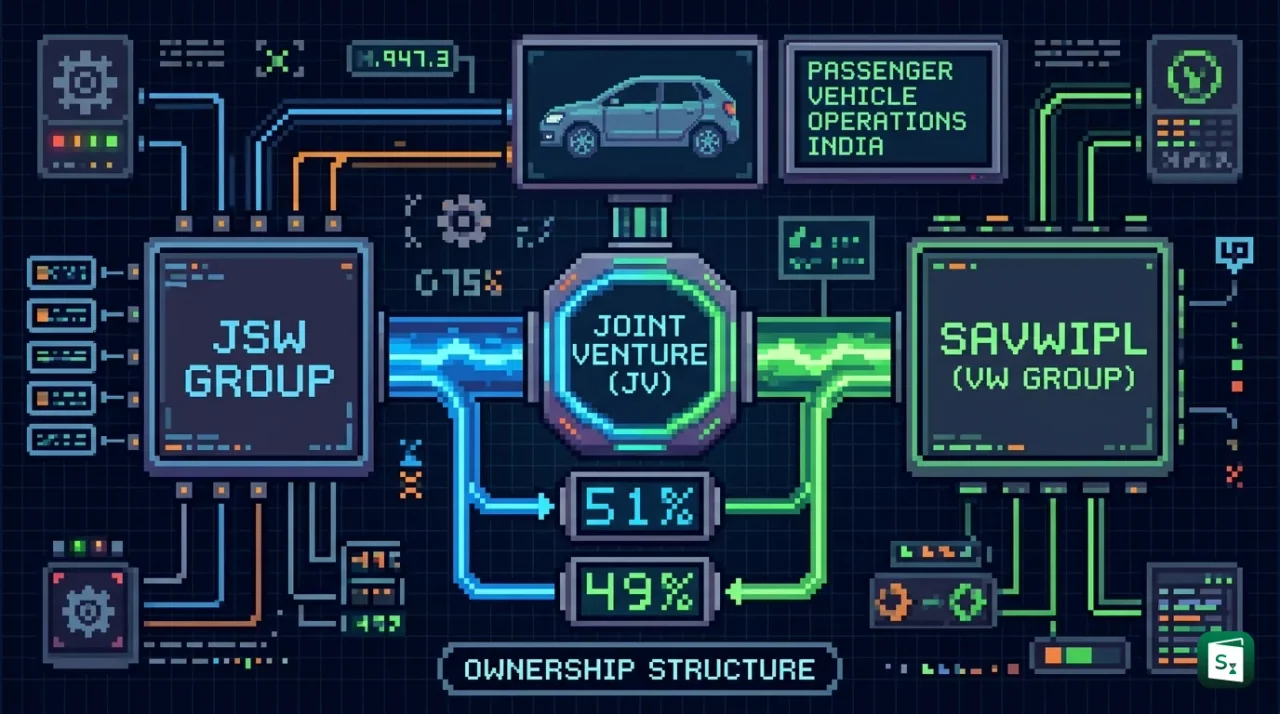
The proposed JSW Volkswagen joint venture is a 51:49 partnership between JSW Group and Skoda Auto Volkswagen India (SAVWIPL). JSW will hold 51 percent and Volkswagen 49 percent. The September 2026 non-binding MoU starts exclusive talks, with a binding agreement targeted by December 2026.
A Memorandum of Understanding (MoU) is a written document in which two parties record their intent to work together, but it does not create a legal obligation to complete the deal. The MoU signed in September 2026 is non-binding, which means it only starts exclusive talks and due diligence. Due diligence is a detailed financial and legal check of a business before an investment is finalised. The proposed partners are JSW Group, an Indian conglomerate led by Sajjan Jindal, and SAVWIPL, the Indian arm of Germany based Volkswagen Group.
The proposed venture will be set up through a new entity with a 51:49 ownership structure. JSW Group will hold 51 percent, which gives it the majority economic interest, while the Volkswagen Group will hold 49 percent through SAVWIPL. The stated design is joint control with clearly defined roles and faster decision making. Market estimates place the project investment and capital commitments at more than €1 billion, or about ₹10,000 crore, although the final transaction value will be fixed only after due diligence.
The venture will focus on the passenger vehicle operations of Volkswagen in India. Passenger vehicles are cars and utility vehicles meant for personal use, including hatchbacks, sedans and Sport Utility Vehicles (SUVs). The initial scope is expected to cover the eight Skoda and Volkswagen models sold in India, along with future launches, including electric vehicles.
The product focus will be mass market Internal Combustion Engine (ICE), hybrid and electric vehicles. ICE vehicles run on petrol or diesel, hybrids combine fuel engines with electric motors, and electric vehicles run fully on batteries. Luxury marques such as Audi, Porsche, Lamborghini and Bentley are expected to stay outside the venture at the start, though some reports suggest they could be included at a later stage.
What Is Skoda Auto Volkswagen India Pvt Ltd?
Skoda Auto Volkswagen India Pvt Ltd (SAVWIPL) is the Indian subsidiary of Germany based Volkswagen Group. The group, founded in 1937 and headquartered in Wolfsburg, owns Volkswagen, Skoda, Audi, Bentley, Lamborghini and Porsche. Skoda Auto leads group activities in India.
SAVWIPL is headquartered in Pune, Maharashtra, and is led by Managing Director Piyush Arora. It was formed on 7 October 2019 through the merger of three Indian units, which were Volkswagen India Pvt Ltd, Volkswagen Group Sales India Pvt Ltd and Skoda Auto India Pvt Ltd. The company manages the Indian operations of six brands, which are Skoda, Volkswagen, Audi, Bentley, Lamborghini and Porsche.
The company operates two plants in Maharashtra. The plant at Chakan near Pune has an annual capacity of more than 225,000 cars, while the plant at Shendra in Chhatrapati Sambhajinagar (formerly Aurangabad) has a capacity of about 60,000 cars. Combined reports place joint capacity at around 400,000 vehicles per year. In 2025, SAVWIPL crossed 2 million locally produced vehicles in its 25 years of operations in India. Its India 2.0 models, which are the Skoda Kushaq and Slavia and the Volkswagen Taigun and Virtus, are built on the MQB-A0-IN platform, a vehicle base designed specially for India. These models have received five star safety ratings for adult and child occupants from Global NCAP, a global vehicle safety testing body.
What Is JSW Group and What Is JSW Motors?
JSW Group stands for Jindal South West. It is an Indian conglomerate founded in 1982 in Mumbai, led by Sajjan Jindal, with about $23 billion in revenues across steel, energy, infrastructure, cement and paints. JSW Motors is its own auto brand for electric and hybrid cars.
JSW entered the automobile sector through JSW MG Motor India Pvt Ltd, a joint venture with SAIC Motor (Shanghai Automotive Industry Corporation) of China formed in November 2023. In that venture, JSW holds 35 percent along with Indian financial investors, dealers and employees, while SAIC retains 49 percent. The company operates a plant at Halol in Gujarat with a capacity of over 100,000 vehicles, which it plans to expand to 300,000 vehicles. Its best known model is the MG Windsor, among the best selling electric cars in India in 2025.
Separately, JSW Motors is the own auto brand of the group for electric and plug-in hybrid passenger cars. Its first product is expected to be a large SUV based on the Jetour T2 platform, with assembly planned at Chhatrapati Sambhajinagar. The venture with Volkswagen will sit in a new entity, separate from the SAIC partnership.
How Manufacturing, Localisation and Product Plans Will Work
The proposed venture is expected to use the existing SAVWIPL manufacturing base in Maharashtra. The Chakan plant near Pune handles full production from press shop to final assembly and also assembles 1.0 litre and 1.5 litre petrol engines. The Chhatrapati Sambhajinagar plant handles assembly of models, including premium models of Skoda, Volkswagen and Audi. Together, the two plants can produce about 400,000 vehicles per year, while current Skoda and Volkswagen sales in India are around 100,000 units. Higher use of this idle capacity can lower the cost of each car and improve profits.
The core strategy is deeper localisation. Localisation means sourcing more parts from Indian suppliers instead of importing them. Local parts reduce costs, protect against currency swings and help meet Indian safety and fuel rules. The partners plan to share common vehicle platforms, exchange models, combine supplier networks and strengthen research and development in India. SAVWIPL already runs a technology centre in India and exports parts and cars to more than 40 countries in Latin America, Africa, Southeast Asia and the Middle East. The new venture could also use India as a larger export base, including for electric vehicles.
Why the Deal Matters for the Indian Passenger Vehicle Market
India is the third largest passenger vehicle market in the world, after China and the United States. Domestic sales reached a record 4.64 million units in 2025-26, as reported by the Society of Indian Automobile Manufacturers (SIAM). SIAM, established in 1958 and headquartered in New Delhi, is the national industry body for automakers in India. Utility vehicles, which include SUVs and multi purpose vehicles, now form about 67 percent of all passenger vehicle sales, crossing 3 million units for the first time.
In this large but crowded market, Skoda and Volkswagen together hold only about 2.5 percent share. The top four makers control more than 85 percent of sales. Maruti Suzuki remains the leader with over 18 lakh units in 2025-26, followed by Mahindra and Mahindra and Tata Motors. Volkswagen has been searching for a local partner for more than three years to cut material costs, expand its dealer network and fund new models for India. JSW has told Skoda that it can help cut material costs sharply by using its scale in steel, manufacturing and local supply chains.
For Volkswagen, a well funded Indian partner brings fresh capital, local sourcing strength and policy understanding. For JSW, the venture brings a ready factory network, trained workforce, established brands and proven platforms. The partners have stated that expanded product offerings, deeper localisation and stronger manufacturing and research capabilities will improve competitiveness. They also plan joint work on employee transfers, sales and marketing, and after sales service.
| Fact | Detail |
|---|---|
| Proposed structure | 51 percent JSW, 49 percent Volkswagen through SAVWIPL |
| Current stage | Non-binding MoU signed in September 2026, exclusive talks on |
| Binding deal target | December 2026 |
| Estimated investment | More than €1 billion (about ₹10,000 crore) |
| Plants involved | Chakan, Pune and Chhatrapati Sambhajinagar, combined capacity about 400,000 vehicles |
| Initial brand scope | Skoda and Volkswagen mass market cars, including future EVs |
| Kept outside for now | Audi, Porsche, Lamborghini, Bentley |
Is Volkswagen Leaving India?
No, Volkswagen is not leaving India. The September 2026 MoU with JSW signals plans to stay and grow with a strong local partner. The company will expand products, use factories more fully and share investment risks in the third largest car market.
The venture will initially cover Skoda and Volkswagen cars sold in India, along with future launches including electric vehicles. Reports also point to continued work on E20 compatibility, which means making petrol engines run on fuel blended with 20 percent ethanol, as required under India biofuel policy. Staying with a local majority partner helps Volkswagen share investment risks while retaining access to technology income and future growth in the third largest car market in the world.
Are Volkswagen and Skoda the Same Company?
No, Volkswagen and Skoda are separate brands under the same parent. Both are owned by the Volkswagen Group of Germany with Skoda Auto founded in 1895 in Czechia. In India both operate through SAVWIPL, with Skoda selling the Kushaq, Slavia and Kylaq and Volkswagen selling the Taigun, Virtus and Tiguan.
Since 2018, Skoda has led the group strategy in India, including the development of the MQB-A0-IN platform.
In India, both brands operate through the single company SAVWIPL. Skoda sells models like the Kushaq, Slavia and Kylaq, while Volkswagen sells the Taigun, Virtus and Tiguan. The proposed joint venture will therefore cover cars of both brands together, even though each brand keeps its own identity, design and showrooms.
What Is the Customs Duty Challenge Facing the Deal?
A major issue in valuation talks is the pending customs duty dispute of SAVWIPL. In September 2024, customs authorities issued a show cause notice of about ₹11,526 crore (about $1.4 billion) for the period from March 2012 to July 2024. A show cause notice is an official letter asking a company to explain why a tax should not be charged.
The dispute is about Completely Knocked Down (CKD) kits. A CKD kit is a full car shipped in unassembled form for final assembly in India. CKD imports attract duty of 30 to 35 percent, while individual parts attract only 5 to 15 percent. Authorities allege that SAVWIPL imported almost full cars in separate consignments through different ports and declared them as individual parts, covering about 33,000 transactions at the Chhatrapati Sambhajinagar plant. The company denies wrongdoing and points to a 2011 clarification of the revenue department in support of its method.
The matter is before the Bombay High Court in Mumbai. In August 2026, the earlier bench released the case without giving a verdict, so it will be heard afresh by a new bench. Reports state that JSW will not take over liability from this case, and the possible exposure will be factored into the valuation. The final deal value and payment terms, including a possible initial equity payment with the rest paid later, will be fixed only after the financial due diligence is complete.
Key Takeaways
- JSW Group and Skoda Auto Volkswagen India (SAVWIPL) signed a non-binding MoU in September 2026 for a 51:49 joint venture for passenger vehicles.
- The binding agreement is targeted by December 2026, with estimated investment of over €1 billion (about ₹10,000 crore).
- SAVWIPL, formed on 7 October 2019 and headquartered in Pune, runs plants at Chakan and Chhatrapati Sambhajinagar with combined capacity of about 400,000 vehicles.
- Volkswagen Group, founded in 1937 and headquartered in Wolfsburg, Germany, owns Skoda, Volkswagen, Audi, Bentley, Lamborghini and Porsche.
- JSW Group, founded in 1982 and led by Sajjan Jindal, already runs JSW MG Motor India with SAIC Motor from November 2023 at Halol, Gujarat.
- India sold a record 4.64 million passenger vehicles in 2025-26 and is the third largest passenger vehicle market in the world.
- SAVWIPL faces a pending customs demand of about ₹11,526 crore over CKD versus parts classification for 2012 to 2024, now before the Bombay High Court.