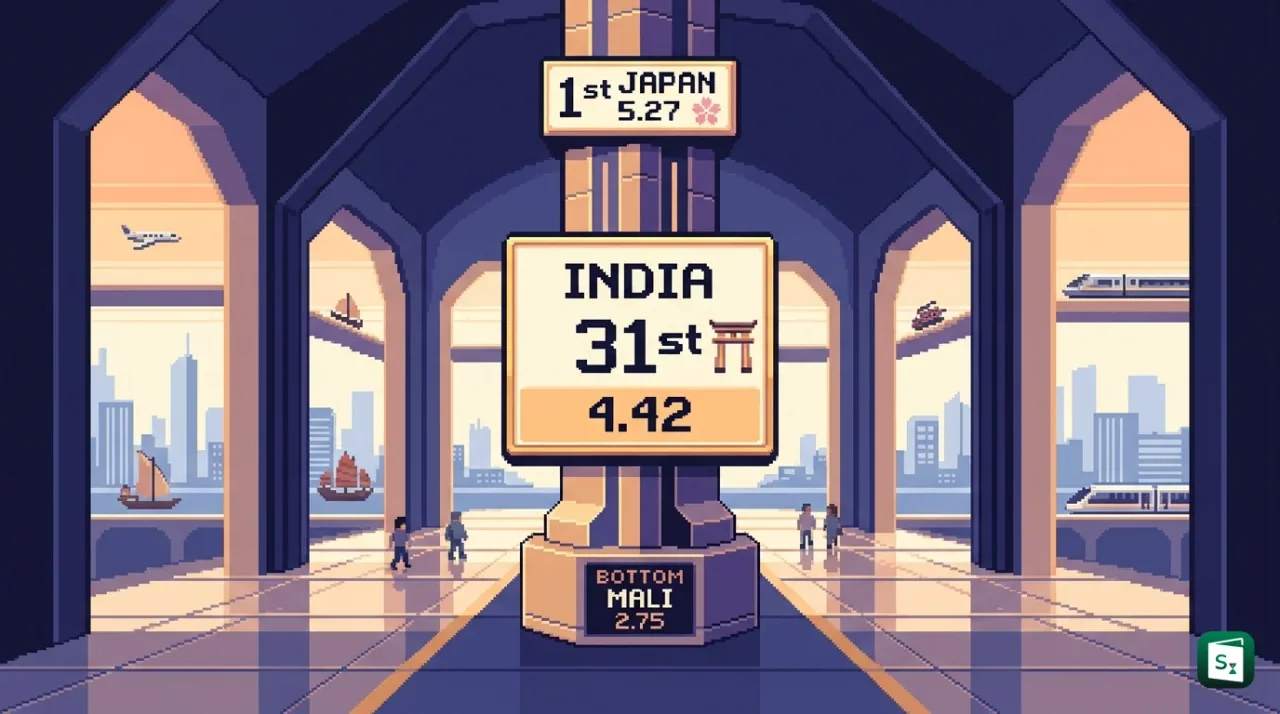
The World Economic Forum released the Travel and Tourism Development Index 2026 on 25 September 2026, ranking 110 economies on the conditions that support sustainable tourism. India climbed nine places to 31st place with an overall score of 4.42 on a 1 to 7 scale. Japan topped the index with a score of 5.27, followed by the United States, Spain, Australia and France, while Mali placed last with 2.75.
What Is the Travel and Tourism Development Index?
The Travel and Tourism Development Index (TTDI) is a global ranking that measures how well economies support the growth of travel and tourism. TTDI stands for Travel and Tourism Development Index, and it is published by the World Economic Forum in partnership with Zurich Insurance Group for the 2026 edition.
The TTDI does not count tourist arrivals, hotel bookings or tourism earnings. It measures the basic conditions that allow tourism to grow in a lasting and safe manner, such as transport links, government policy, skilled workers, cultural and natural attractions, and care for the environment.
The TTDI is the new form of an older ranking called the Travel and Tourism Competitiveness Index (TTCI). The World Economic Forum published the TTCI every two years from 2007 to 2019. The Forum changed the name to TTDI with the 2021 edition to give more weight to sustainability, resilience and the wider role of tourism in jobs and development. The 2026 report is the 10th edition in this combined series.
How the TTDI Score Is Calculated
The World Economic Forum scores each economy on a scale of 1 to 7, where 1 is the weakest and 7 is the strongest. The TTDI 2026 covers 110 economies using 102 indicators grouped into 17 pillars across five dimensions. The final score is the simple average of the 17 pillar scores. The five dimensions are used only to present the results in an organised way.
| Dimension | What It Checks | Pillars Included |
|---|---|---|
| Enabling Environment | Basic safety, health, business and digital conditions | Business Environment, Safety and Security, Health and Hygiene, Human Resources and Labour Market, ICT Readiness |
| Travel and Tourism Policy and Enabling Conditions | Government support, openness and cost of travel | Prioritisation of Travel and Tourism, Openness to Travel and Tourism, Price Competitiveness |
| Infrastructure and Services | How easily visitors can reach and stay at places | Air Transport Infrastructure, Ground and Port Infrastructure, Tourist Services and Infrastructure |
| Travel and Tourism Resources | Natural, cultural and business attractions | Natural Resources, Cultural Resources, Non-Leisure Resources |
| Travel and Tourism Sustainability | Care for nature, local jobs and pressure from crowds | Environmental Sustainability, Socioeconomic Impact, Demand Sustainability |
India Rank 31 in TTDI 2026: Score and Improvement
India secured 31st place in the TTDI 2026 with an overall score of 4.42 out of 7. The World Economic Forum released the result in its Insight Report September 2026 on 25 September 2026. India moved up nine places from 39th place in 2024, and its score rose by 4.3 percent between 2024 and 2026.
The rise is part of a wider global recovery in tourism conditions. The TTDI 2026 found that 101 of the 110 economies improved their scores since 2024, and the global average score rose by 2.1 percent. This was the fastest improvement since 2019, driven mainly by stronger cultural resources, better tourism infrastructure and services, improved air links and growth in business travel.
| TTDI 2026 Fact | Detail for India |
|---|---|
| Rank in 2026 | 31st among 110 economies |
| Overall score | 4.42 on a 1 to 7 scale |
| Rank in 2024 | 39th |
| Improvement since 2024 | Up 9 places, score up 4.3 percent |
| Global trend | 101 economies improved, average score up 2.1 percent |
The World Economic Forum counts India among 10 major emerging tourism economies that will drive future growth. Together, these 10 economies account for more than 28 percent of global direct travel and tourism GDP, and their share is expected to reach 35 percent by 2035. For India, the ranking confirms a steady return of travel demand after the pandemic years and the value of continued spending on airports, rail links, digital services and heritage care.
Top and Bottom Countries in TTDI 2026
Japan secured first place in the TTDI 2026 with a score of 5.27, rising two places from the last edition. The United States followed in second place with 5.23, and Spain took third place with 5.22. Australia stood fourth with 5.18 and France stood fifth with 5.17. The top order changed slightly, but the same 10 economies held the top 10 as in 2024.
Advanced economies hold nine of the top 10 places, with China as the only emerging economy in that group. Europe remains the strongest region overall, with six economies in the top 10. Mali ranked at the bottom of the index with 2.75, which shows the wide gap between the strongest and weakest tourism environments.
| Rank | Economy | Score on 1 to 7 Scale |
|---|---|---|
| 1 | Japan | 5.27 |
| 2 | United States | 5.23 |
| 3 | Spain | 5.22 |
| 4 | Australia | 5.18 |
| 5 | France | 5.17 |
| 6 | Germany | 5.09 |
| 7 | United Kingdom | 5.08 |
| 8 | China | 5.00 |
| 9 | Switzerland | 4.97 |
| 10 | Italy | 4.93 |
| 31 | India | 4.42 |
| Last | Mali | 2.75 |
Japan leads because of a strong mix of cultural sites, city transport, rail links and natural beauty. The World Economic Forum also notes that Japan lowered entry barriers for visitors and spread tourist flows beyond crowded cities and peak seasons. This approach reduced pressure on popular spots and improved the visitor experience.
The fastest progress came from lower down the ranking. Albania recorded the largest gain in 2026, with its score rising by 7.0 percent. Seven of the 10 most improved economies are in Asia and the Pacific, and South East Asia improved faster than any other subregion. The pattern shows that emerging destinations are closing the gap with older leaders by adding air routes, easing visa rules and upgrading visitor services.
What Is the World Economic Forum?
The World Economic Forum (WEF) is an international non-profit foundation based in Cologny, Geneva in Switzerland. Founded in 1971 by Klaus Schwab, it brings business, government and civil society leaders together to shape global policy. Its Annual Meeting is held in Davos, Switzerland.
WEF stands for World Economic Forum. The Forum began in 1971 when German engineer and economist Klaus Schwab organised a management meeting in Davos. It was first called the European Management Forum and took the present name in 1987 as its work spread beyond Europe. The Forum works as a foundation under Swiss law and describes itself as the International Organization for Public-Private Cooperation.
The headquarters of the World Economic Forum is in Cologny in the Canton of Geneva, Switzerland, with offices in New York, San Francisco, Beijing and Tokyo. The best known event of the World Economic Forum is the Annual Meeting in Davos, a mountain town in eastern Switzerland, where about 3,000 business chiefs, ministers, scholars and media members meet each January. The Forum also publishes regular reports, including the TTDI, the Global Competitiveness Report and energy and risk studies. The 2026 TTDI was prepared with Zurich Insurance Group, one of the largest travel insurers in the world, which added inputs on resilience, risk and readiness of destinations.
Why India Improved and Where Gaps Remain
India improved because of its rich tourism resources and lower travel costs. The World Economic Forum points to better tourism infrastructure, stronger cultural assets and stronger business travel facilities as the main drivers. Price competitiveness is a clear advantage for India, as food, stays and local travel cost less than in most advanced economies.
Cultural wealth gives India a lasting edge. India has 45 properties on the UNESCO World Heritage List, which places the country sixth in the world and second in the Asia Pacific region. The list includes 37 cultural, 7 natural and 1 mixed site. The Ancient Buddhist Site of Sarnath in Uttar Pradesh joined the list in July 2026 at the 48th session of the World Heritage Committee in Busan, after the Maratha Military Landscapes joined in 2025. Natural beauty, from the Himalayas to the Western Ghats and the coasts, adds to this strength. The Ministry of Tourism, which runs the Incredible India promotion programme, has also pushed better air links, e-visa access and heritage upkeep.
At the same time, the TTDI flags clear gaps for India in visitor services, ground transport in remote circuits, skills of tourism staff and care for the environment. Crowd pressure at popular sites, waste handling and water stress affect the quality of visits and the health of local areas. Workforce capacity is a global concern as well. The travel sector supported 366 million jobs in 2025, about one in nine jobs in the world, but the report warns of a shortfall of 43 million workers by 2035.
Cost and investment trends add to the challenge. A record 1.5 billion people travelled abroad in 2025, and travel and tourism added $11.6 trillion to the world economy. But travel became less affordable in 75 percent of economies between 2024 and 2026, as tourism prices rose faster than general inflation. Investment has not kept pace with demand since 2022. For India, this means that cheaper prices alone will not be enough. Better service quality, trained guides, clean sites and trusted digital information will decide whether higher arrivals turn into lasting income for local communities.
The Way Forward
The TTDI 2026 treats resilience as the new test for tourism. Strong monuments and scenery are no longer enough. Destinations must keep services running during heatwaves, flight breaks, digital outages and other shocks, inform visitors quickly and win back trust after disruption. The World Economic Forum launched the 2026 index at its first Beyond Tourism Day in Geneva, two days before World Tourism Day on 27 September, to push this message.
The report lists five tasks for governments, local bodies and firms. First, spread demand across more source markets, more seasons and more places, so a few cities do not carry all the load. Second, keep transport, information and digital systems open and working even during stress. Third, compete on value through service quality and safe experiences rather than on low prices alone. Fourth, share gains with residents by easing pressure on housing, water and public services and showing how tourism funds local jobs. Fifth, build workforce capacity through training, better pay and retention, and higher productivity.
For India, the path links directly to the gaps flagged in the index. Upgrading last mile roads, wayside amenities, multilingual guides and hygiene at heritage circuits can lift the tourist services score. Skill programmes for hospitality, adventure guiding and eco tourism can cut staff shortages. Stronger waste rules, water care and caps on visitor numbers at fragile sites can improve the sustainability score. If these steps move together, India can turn its climb from 39th to 31st into a longer move toward the top 20.
Key Takeaways
- India ranked 31st with a score of 4.42 in the Travel and Tourism Development Index 2026 released on 25 September 2026.
- The TTDI 2026 covers 110 economies across 17 pillars and 102 indicators grouped into five dimensions on a 1 to 7 scale.
- Japan topped the TTDI 2026 with 5.27, followed by the United States, Spain, Australia and France, while Mali placed last with 2.75.
- India rose nine places from 39th in 2024, with its TTDI score rising by 4.3 percent.
- The TTDI is published by the World Economic Forum, founded in 1971 by Klaus Schwab and headquartered in Cologny, Geneva, in partnership with Zurich Insurance Group for 2026.
- India has 45 UNESCO World Heritage properties, ranking sixth globally and second in Asia Pacific, with Sarnath added in July 2026.