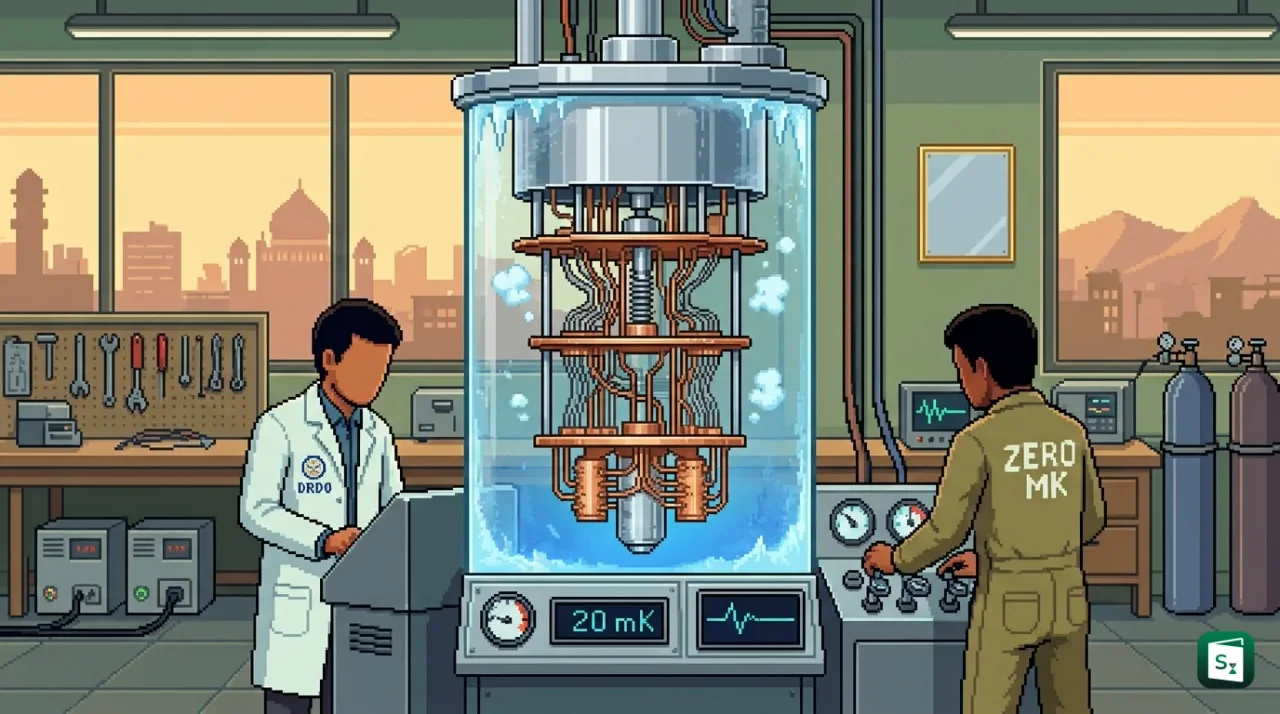
The Defence Research and Development Organisation (DRDO) signed an agreement with Zero mK India Private Limited of Alwar, Rajasthan on 24 September 2026 for the indigenous development of a 20 millikelvin dilution refrigerator for quantum applications. The pact is the first high value agreement under the special ₹500 crore deep tech corpus of the Technology Development Fund (TDF) scheme. It aims to give India a home built ultra cold system that quantum computers need to work, and to cut dependence on imported cryogenic equipment.
What Is the DRDO Agreement with Zero mK India?
The DRDO agreement with Zero mK India Private Limited is a collaborative project for the indigenous design and development of a 20 millikelvin (mK) dilution refrigerator for quantum applications. The agreement was signed in New Delhi on 24 September 2026 between the Director of the Technology Development Fund and representatives of Zero mK India. The startup is based in Alwar, Rajasthan, and works in advanced cryogenic systems.
The project is the first high value agreement under a separate ₹500 crore corpus for deep tech and cutting edge projects. Defence Minister Rajnath Singh (as of September 2026) had approved this special corpus within the TDF scheme to support complex technologies with long term strategic value. Nine deep tech projects have already been initiated under this vertical, with some routed through DRDO Industry Academia Centres of Excellence, but this is the first formal high value signing with industry.
The project will be monitored, mentored and supported by the Director of the Solid State Physics Laboratory (SSPL) and his team. SSPL is a Delhi based laboratory of DRDO that works on semiconductors, quantum materials and solid state devices. This mentoring link is important because dilution refrigerators need deep knowledge of materials, low temperature physics and precision engineering.
| Project Fact | Detail |
|---|---|
| Partner startup | Zero mK India Private Limited, Alwar |
| System to be built | 20 mK dilution refrigerator for quantum use |
| Funding route | Technology Development Fund, deep tech vertical |
| Corpus for deep tech | ₹500 crore |
| Signing date and place | 24 September 2026, New Delhi |
| Mentoring laboratory | Solid State Physics Laboratory (SSPL) |
What Is DRDO?
The Defence Research and Development Organisation (DRDO) is the research and development wing of the Ministry of Defence. It develops defence and dual use technologies for the Army, Navy and Air Force, with a focus on self reliance in critical systems. DRDO works through a large network of laboratories across India and partners with industry, startups and academic institutions.
DRDO was formed in 1958 by merging the Technical Development Establishment, the Directorate of Technical Development and Production and the Defence Science Organisation. It functions under the Department of Defence Research and Development of the Ministry of Defence and is headquartered at DRDO Bhawan on Rajaji Marg in New Delhi. The organisation has a motto in Sanskrit, Balasya Mulam Vigyanam, which means the origin of strength is in science.
Over the years DRDO has developed strategic systems such as the Agni and Prithvi series of missiles, the Tejas Light Combat Aircraft, the Pinaka multi barrel rocket launcher and the Akash air defence system. Today it runs around 50 laboratories covering fields such as aeronautics, armaments, electronics, naval systems, advanced computing and life sciences. Its growing work with private firms and startups reflects a shift from only in house development to an ecosystem model.
What Is the Technology Development Fund Scheme?
The Technology Development Fund (TDF) is a programme of the Ministry of Defence executed by DRDO to fund Indian industry to design and develop defence and dual use technologies that are not yet available in the country. The scheme mainly supports Micro, Small and Medium Enterprises (MSMEs) and startups, along with academic and scientific institutions, through grant in aid. It is a central part of the Make in India push for self reliance in defence technology.
The TDF scheme was launched to create a bridge between the armed forces, research organisations, academia and private firms. It invites project requirements from the three Services and DRDO laboratories, and eligible firms apply through the online TDF portal. Projects focus on niche technologies that are being developed for the first time in India, or on upgrading existing systems to improve quality and reduce cost.
Only Indian owned and controlled firms can apply. The applicant must generally be a public limited company, private limited company, partnership firm, limited liability partnership or sole proprietorship registered under Indian law, with at least 51 percent shareholding by resident Indian citizens. Firms with foreign investment of more than 49 percent are not eligible. Startups must usually hold recognition from the Department for Promotion of Industry and Internal Trade and from Startup India or as an MSME on the portal.
Funding is released in stages linked to milestones, with a maximum of five milestones per project. Support can come as reimbursement after a milestone is achieved, or as advance funding against a bank guarantee of the same amount. Standard TDF projects earlier had a cost ceiling of around ₹10 crore and a development period of about two years, which suited components and subsystems. The new deep tech vertical is different because it allows much larger funding for complex systems like quantum hardware, high power microwaves, artificial intelligence and photonics.
Till mid 2024, a total of 77 projects with a commitment of more than ₹300 crore had been sanctioned under TDF, and 27 defence technologies had been successfully realised. The government had allocated ₹260 crore to the scheme since its start in 2016, with ₹64.35 crore disbursed as grant in aid in the early years. The additional ₹500 crore corpus for deep tech now gives DRDO room to back high risk, high reward projects that private startups alone cannot finance.
What Is a Dilution Refrigerator?
A dilution refrigerator is a special cryogenic device that produces continuous cooling to extremely low temperatures in the millikelvin range, colder than outer space. It can reach below 10 millikelvin and, in advanced models, close to 2 millikelvin. Such cold conditions are needed to run and test many types of quantum computers and associated quantum devices.
Millikelvin means one thousandth of a kelvin. Zero kelvin, or minus 273.15 degrees Celsius, is absolute zero, the coldest temperature possible in physics. A 20 millikelvin system therefore works at just 0.02 degrees above absolute zero. At this level, tiny heat vibrations that disturb delicate quantum states almost disappear.
Most dilution refrigerators in use today are dry systems. Older wet systems used liquid nitrogen at 77 kelvin and liquid helium at 4.2 kelvin for pre cooling, and needed regular supply of cryogenic liquids. Modern dry systems use a mechanical pulse tube cooler to reach about 50 kelvin and 4 kelvin first, so they need no external liquid top ups and can run with high automation.
How Does a Dilution Refrigerator Work?
A dilution refrigerator cools by using the heat of mixing of two stable forms of helium, helium-3 and helium-4. When a mixture of these two forms is cooled below about 870 millikelvin, it separates into two layers. The upper concentrated phase is almost pure helium-3, while the lower dilute phase holds about 6.6 percent helium-3 dissolved in helium-4.
In the coldest part, called the mixing chamber, helium-3 atoms move from the concentrated layer across the boundary into the dilute layer. This movement absorbs heat from the surroundings, and that absorption is the useful cooling power. The helium-3 is then pumped away from a part called the still, purified in a gas handling system at room temperature, cooled again through heat exchangers and sent back to the mixing chamber. The cycle runs continuously with no moving parts in the coldest zone.
The still is kept at about 500 to 700 millikelvin and at very low pressure, so mainly helium-3 evaporates. Heat exchangers cool the incoming helium-3 using the outgoing cold stream. At very low temperatures a special challenge called Kapitza resistance appears, which is heat resistance at the surface between liquid helium and metal. To beat it, engineers use very large surfaces made of fine sintered silver powder. Larger flow gives more cooling power, but only if the exchangers can handle it.
What Is Quantum Computing and How Does a Quantum Computer Work?
Quantum computing is a new way of computing that uses the rules of quantum mechanics, the physics of atoms and tiny particles, to process information. A normal computer uses bits that are either 0 or 1, while a quantum computer uses quantum bits or qubits that can hold 0, 1 or a mix of both at the same time. This property allows certain problems to be solved far faster than present supercomputers can manage.
A qubit can show superposition, which means it can exist in a mix of states until it is measured. Qubits can also show entanglement, which means the state of one qubit is linked to the state of another even when they are separate. Together these effects let a quantum processor explore many paths at once. That is why quantum computing is seen as powerful for tasks such as secure communication, drug discovery, new materials, financial modelling and complex optimisation.
A quantum computer works only when its qubits stay stable long enough to complete a calculation. This stable period is called coherence time. Even tiny heat causes atoms to vibrate, and vibration destroys coherence through a process called decoherence. Superconducting qubits, one of the main platforms in use today, must therefore sit inside a dilution refrigerator at millikelvin temperatures where thermal noise is almost zero. Control wires bring microwave signals to the chip, and the results are read out through sensitive amplifiers, all while the chip stays ultra cold.
Quantum computing is important because it can break present encryption and also create far stronger encryption through methods such as quantum key distribution. It can improve radar and sensing, navigation without satellites through precise atomic clocks and magnetometers, and simulation of molecules that normal computers cannot model. For defence, this means safer communication, better sensors and faster data analysis, which is why DRDO is investing in the cold hardware that makes quantum experiments possible.
Quantum Computing in India and the National Quantum Mission
Quantum computing in India is now guided by the National Quantum Mission (NQM), a central mission to build research strength and industry capacity in quantum science. The Union Cabinet approved the mission on 19 April 2023 at a total cost of ₹6,003.65 crore for the period 2023-24 to 2030-31. The Department of Science and Technology implements the mission, with the aim of making India a leading nation in quantum technologies and applications.
The mission has clear technology targets. It aims to build intermediate scale quantum computers with 50 to 1,000 physical qubits in eight years using platforms such as superconducting circuits and photonics. It plans satellite based secure quantum communication between ground stations over 2,000 km within India, long distance links with other countries, inter city quantum key distribution over 2,000 km, and multi node quantum networks with quantum memory. Quantum key distribution, often called QKD, is a method that uses quantum rules to share secret keys with very high security.
The mission also supports highly sensitive magnetometers using atomic systems, atomic clocks for precise timing and navigation, and new quantum materials such as superconductors and topological materials. Single photon sources and detectors and entangled photon sources will be developed for communication and sensing. Four Thematic Hubs have been planned in top academic and national research institutes for quantum computing, quantum communication, quantum sensing and metrology, and quantum materials and devices.
| National Quantum Mission Goal | Target Detail |
|---|---|
| Total outlay | ₹6,003.65 crore, 2023-24 to 2030-31 |
| Quantum computers | 50 to 1,000 physical qubits in 8 years |
| Secure communication | 2,000 km satellite and inter city QKD |
| Sensing and clocks | Magnetometers, atomic clocks, quantum materials |
| Research base | Four Thematic Hubs in leading institutes |
The DRDO dilution refrigerator project fits directly into this national plan. India at present depends on imported cryostats from a small set of foreign makers for most quantum laboratories. An indigenous 20 mK system would give universities, startups and defence laboratories a domestic option for testing chips, sensors and communication devices, and would support the mission goal of a self reliant and quantum ready ecosystem.
Why This Indigenous Refrigerator Matters for India
The most direct gain is lower dependence on imports. Dilution refrigerators are made by only a few firms abroad, and they are costly and subject to export controls and long delivery times. A domestic system reduces that risk for Indian quantum laboratories and defence projects. It also builds skill in advanced cryogenics, vacuum engineering, precision electronics and helium handling, which are useful far beyond quantum computing.
For deep tech startups in India, the agreement is a strong signal. Deep tech means technology based on deep science and long research, such as quantum hardware, photonics and advanced materials. Such startups need large early funding and patient buyers, which are hard to find in a new market. A high value DRDO contract with milestone based support and laboratory mentoring lowers that entry barrier and can attract private capital, suppliers and skilled jobs around Alwar and other manufacturing clusters.
For the armed forces and strategic programmes, control over cryogenic hardware supports secure quantum communication, quantum radar research and ultra sensitive sensing. These tools can improve detection, navigation in denied environments and protection of classified links. For civilian research, cheaper local fridges can help more institutes start quantum experiments, train students and test Indian made chips and detectors without waiting for imported slots.
The Way Forward
The next test for Zero mK India will be to move from design to a working prototype that holds 20 millikelvin with stable cooling power and low vibration. The team will need to prove long run performance, wiring capacity for many qubits, automation and service support. Success will be measured by coherence results on real qubit chips and by repeat orders from research laboratories.
For DRDO, the project will serve as a model for the rest of the ₹500 crore deep tech vertical. If milestone funding, SSPL mentoring and industry delivery work smoothly here, similar high value pacts can follow in quantum communication, photonics and sensing. Wider success will depend on steady helium-3 supply, growth of local component makers and close links with the National Quantum Mission hubs so that the fridge and the chips it cools advance together.
Key Takeaways
- DRDO signed its first high value deep tech TDF agreement with Zero mK India Private Limited of Alwar on 24 September 2026 for a 20 mK dilution refrigerator.
- The project is funded under the special ₹500 crore deep tech corpus approved for cutting edge projects within the Technology Development Fund.
- A dilution refrigerator cools with a helium-3 and helium-4 mixture to below 10 millikelvin for operating superconducting quantum computers.
- DRDO was formed in 1958 and is headquartered at DRDO Bhawan in New Delhi under the Department of Defence Research and Development.
- The National Quantum Mission was approved on 19 April 2023 with an outlay of ₹6,003.65 crore till 2030-31 to build 50 to 1,000 qubit computers and 2,000 km quantum communication links.
- The project is mentored by DRDO’s Solid State Physics Laboratory (SSPL) to build domestic cryogenic capacity and cut import dependence.