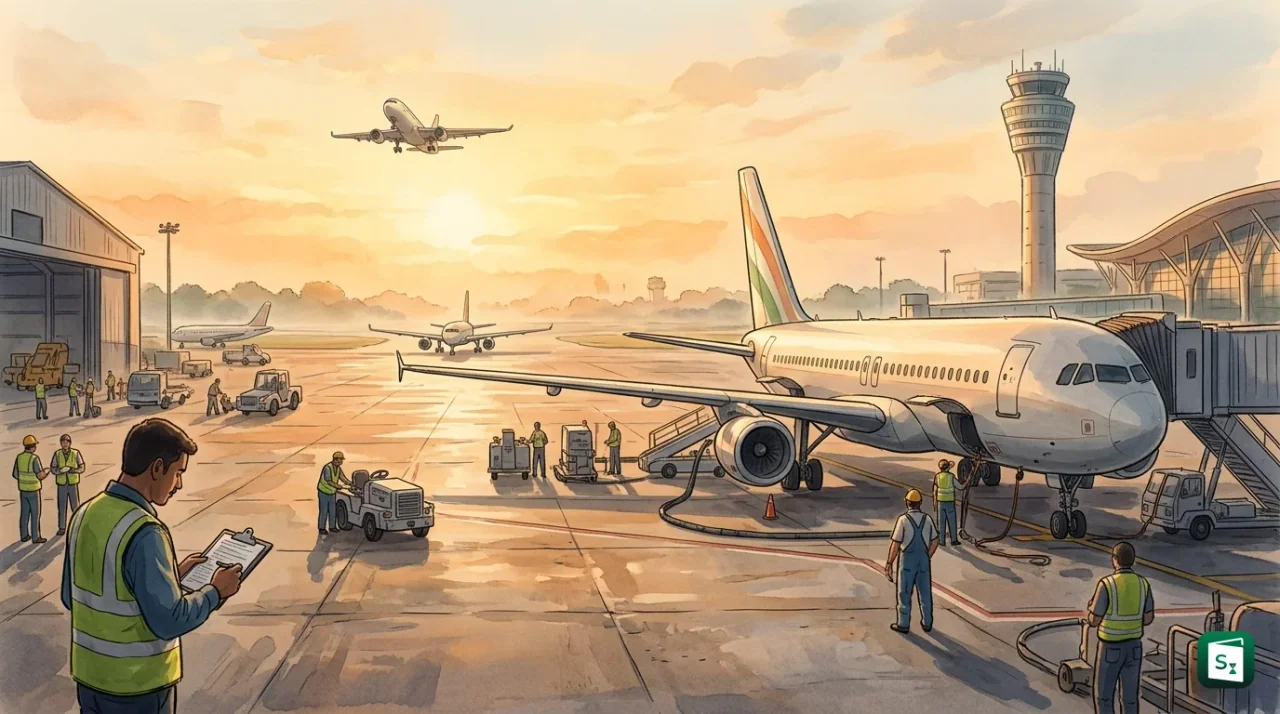
The Ministry of Civil Aviation notified the Bharatiya Vayuyan Niyam, 2026 on 26 October 2026 to replace the Aircraft Rules, 1937. The 220 rule code was published in the Gazette of India on 31 October 2026 and takes effect on 1 January 2027. It updates registration, safety, licensing and airport operations for India’s fast expanding aviation sector.
What Is the Bharatiya Vayuyan Niyam 2026?
The Bharatiya Vayuyan Niyam, 2026 is India’s new rulebook for civil aviation, which covers all non military flying including passenger flights, cargo, training and private aircraft. The word Vayuyan means aircraft in English, while Adhiniyam means Act and Niyam means Rules. The code was notified through G.S.R. 957(E) dated 26 October 2026 and contains 220 rules arranged in eight chapters and six schedules.
The Ministry of Civil Aviation first published a draft as the Bharatiya Vayuyan Niyam, 2025 in July 2025 through G.S.R. 466(E). Objections and suggestions from the public were considered before the final notification. The final Gazette file runs to 517 pages in Hindi and English.
Rule 220 repeals three older rulebooks, subject to savings for existing licences and approvals. This means pilot licences, airline permits and certificates issued under the old system do not lapse on 1 January 2027. The table below summarises the basic facts.
| Item | Detail |
|---|---|
| New rulebook | Bharatiya Vayuyan Niyam, 2026 |
| Notified by | Ministry of Civil Aviation |
| Notification number | G.S.R. 957(E) dated 26 October 2026 |
| Published in Gazette | 31 October 2026 |
| Comes into force | 1 January 2027 |
| Size | 220 rules, eight chapters, six schedules |
| Replaces | Aircraft Rules, 1937 and Part IX of Aircraft Rules, 1920 |
From the Aircraft Act 1934 to the Bharatiya Vayuyan Adhiniyam 2024
The Bharatiya Vayuyan Adhiniyam, 2024 is the parent law under which the new rules are framed. It replaces the Aircraft Act, 1934, a colonial era law enacted on 19 August 1934 to control the manufacture, possession, use, operation, sale, import and export of aircraft. That Act was amended 21 times but could no longer keep pace with modern technology, private airlines, satellite navigation and security needs.
The Bharatiya Vayuyan Vidheyak was introduced in the Lok Sabha on 31 July 2024 by Civil Aviation Minister Kinjarapu Ram Mohan Naidu. The Lok Sabha passed it on 9 August 2024 and the Rajya Sabha passed it on 5 December 2024. After assent by the President on 11 December 2024, it became Act No. 16 of 2024. The Central Government brought it into force on 1 January 2025 through notification S.O. 5646(E).
The Adhiniyam keeps the same wide scope as the old Act and adds new focus areas. It regulates design, manufacture, maintenance, possession, use, operation, sale, export and import of aircraft. It also supports domestic manufacturing under Make in India and Atmanirbhar Bharat, simplifies licensing and removes redundant provisions.
The law keeps India’s commitment to global aviation rules. India signed the Chicago Convention on 7 December 1944, the treaty that created common safety standards for international flying. The Convention led to the formation of the International Civil Aviation Organization (ICAO), a United Nations agency headquartered in Montreal, Canada with 193 member states. India ratified the Convention on 1 March 1947. The Adhiniyam empowers the Centre to make rules to carry out the Convention and its Annexes, which today contain more than 12,000 standards and practices.
What the New Rules Cover: Registration, Safety and Daily Operations
The new rules follow the full life of an aircraft, from drawing board to runway. They also set duties for owners, operators, airlines, airports and training schools. Regulatory responsibility is shared between the Central Government and the Directorate General of Civil Aviation (DGCA). The DGCA is India’s civil aviation safety regulator, headquartered opposite Safdarjung Airport in New Delhi. It became a statutory body under the Aircraft (Amendment) Act, 2020 and handles registration, airworthiness, licensing, air transport permits and safety oversight in coordination with ICAO.
How Aircraft Design, Airworthiness and Maintenance Are Regulated
The rules give a clearer framework for aircraft design and certification. They provide for acceptance of designs and authorisation for manufacture of components. This strengthens India’s position as a State of Design and supports local aerospace firms.
Registration provisions specify how aircraft are registered in India and marked with an Indian nationality mark. Owners must obtain a certificate of airworthiness, which proves the aircraft is safe to fly. Operators must follow regular inspection, repair and record keeping norms so that aircraft remain fit for service throughout their life.
Who Can Fly and Guide Aircraft: Licensing of Pilots, Engineers and Controllers
The rules list 23 categories of licences, ratings and certificates. They cover pilots, aircraft maintenance engineers, flight engineers, flight dispatchers and air traffic controllers. Each category has fixed norms for age, education, training, flying or work experience, written tests, skill checks and medical fitness.
The First Schedule details licensing norms for aircraft personnel. The Second Schedule details licensing and qualification norms for air traffic services personnel. Licences can be renewed, suspended or cancelled for stated reasons. The rules also take over the Radio Telephone Operator (Restricted) certificate process, which was earlier handled with the Department of Telecommunications, and repeal the Radio Telephone Operator (Restricted) Certificate and Licence Rules, 2025.
How Airports and Air Navigation Services Will Function
An aerodrome means any defined ground or water area used for landing, departure and surface movement of aircraft, including buildings and piers. The rules prescribe licensing norms for aerodromes, covering runway infrastructure, safety equipment and operating procedures.
Air navigation provisions cover air traffic management, communication, navigation and surveillance facilities, aviation weather services and search and rescue. Voice recordings and weather records must be preserved for at least 30 days for inquiry and investigation. Instrument flight procedures need prior DGCA approval, and rescue coordination centres must assist each other and coordinate with neighbouring states. The Third Schedule sets norms for aeronautical telecommunication facilities.
How Airline Fares Become Transparent for Passengers
The Directorate General of Civil Aviation will continue to monitor tariffs charged by scheduled Indian airlines. Under Rule 192, every airline operating scheduled services must fix its fares based on factors including the cost of operation. The airline must submit tariff details to the DGCA in the form and at the intervals specified by the regulator. It must also publish the tariffs on its website and other digital platforms.
Booking sites and tickets must show the total amount payable by the passenger. They must also show a separate breakup of base fare, taxes, fees, cancellation charges, refund conditions and any other charge. This prevents hidden charges and helps passengers compare options clearly.
The Central Government can issue written directions in the public interest if it finds that an extraordinary situation has arisen. Such directions must be proportionate and remain valid only for the stated period. The rules do not define extraordinary situation and do not set a fare cap. Airlines have fixed their own fares since deregulation in 1994, so the new norms improve transparency without direct price control.
Clearer fares matter as flying expands. Operational airports in India rose from 74 in 2014 to 166 in October 2026. With more first time flyers from smaller towns, simple and complete price display builds trust while keeping commercial flexibility for airlines.
Safety Oversight, Enforcement and Graded Penalties
Safety remains the core of the new code. Operators must put in place a safety management system to spot risks early. They must run mandatory and voluntary safety reporting programmes. DGCA officers have powers of inspection, search and enforcement to check compliance at airlines, airports, maintenance shops and training schools.
Crew fatigue rules protect alertness during flights. The rules set flight and duty time limits and minimum rest periods for pilots and cabin crew. A crew member must not consume alcohol or specified intoxicants within 12 hours before a flight or during flight duty. Duty time and rest norms also apply to air traffic controllers, who guide aircraft on ground and in air to prevent collisions.
The enforcement design is more graded and less harsh for minor lapses. The rules list 21 punishable offences that can attract imprisonment up to two years, a fine up to ₹1 crore, or both. Another 18 offences are compoundable, which means they can be settled by paying a fixed sum through a stated process. For other contraventions, there are ten severity levels with monetary penalties from ₹10,000 to ₹1 crore, based on the nature of the lapse and the size of the offender. Orders must follow a hearing, give reasons and allow appeal to higher officers and then to the Central Government.
Two sister bodies support this system. The Bureau of Civil Aviation Security (BCAS), formed as a cell in 1978 and made an independent department in 1987, oversees aviation security standards as per ICAO Annex 17. The Aircraft Accidents Investigation Bureau (AAIB), set up on 30 July 2012 as an attached office of the Ministry of Civil Aviation, investigates accidents and serious incidents independently of the regulator.
Why Leasing Aircraft Becomes Easier: Fractional Ownership and IDERA
Most Indian airlines do not own their aircraft. They lease them from foreign lessors, so quick and predictable repossession rules lower financing costs. The new rules address this concern in two ways.
First, the rules recognise fractional ownership. Under this model, multiple persons or firms can hold ownership shares in one aircraft. Day to day operation and maintenance stay with one clearly identified operator, so safety responsibility is never divided. Private aircraft cannot be used for hire or reward except as permitted under the rules.
Second, the rules work with the Irrevocable De-registration and Export Request Authorisation (IDERA) mechanism. IDERA is a presigned authorisation by the airline that allows the lessor to seek deregistration and export of the aircraft without long court delay after a default. It provides a time bound process for the DGCA, acting as registry authority, to deregister and allow export of eligible aircraft.
IDERA links to the Protection of Interests in Aircraft Objects Act, 2025. That Act gives legal force in India to the Cape Town Convention and its Aircraft Protocol, both signed at Cape Town on 16 November 2001. India acceded to them in 2008. The 2025 Act became Act No. 17 of 2025 and came into force on 1 May 2025. Together, these steps improve confidence among lessors. Over time, cheaper leasing can reduce aircraft acquisition costs and ease pressure on airfares.
When the New Aviation Rulebook Takes Effect
The Bharatiya Vayuyan Niyam, 2026 comes into force on 1 January 2027. Until then, the Aircraft Rules, 1937 remain the operative rulebook. Airlines, airports, maintenance organisations, flying schools and pilots need no fresh licences on that date, as existing approvals continue under the savings clause.
The broad regulatory approach remains familiar. Many norms on registration, airworthiness, licensing, flight operations and tariffs carry over from the old system. The change lies in consolidation. Provisions amended many times over 89 years are now placed in one updated code, with clear roles for the Central Government and the DGCA under the Bharatiya Vayuyan Adhiniyam, 2024.
The rules also keep tools for future growth. The Central Government may create a Regional Air Connectivity Fund to give viability gap funding for regional routes, with a possible levy on domestic scheduled flights and contributions from state governments. Provisions for fees, aviation security fees and permits support self sustaining oversight as traffic grows.
Key Takeaways
- The Bharatiya Vayuyan Niyam, 2026 was notified on 26 October 2026 and will replace the Aircraft Rules, 1937 from 1 January 2027.
- The rules were framed under the Bharatiya Vayuyan Adhiniyam, 2024 (Act No. 16 of 2024), which replaced the Aircraft Act, 1934 and came into force on 1 January 2025.
- The new code contains 220 rules in eight chapters and six schedules covering registration, design, airworthiness, licensing, airports, navigation and flight operations.
- The DGCA, headquartered opposite Safdarjung Airport in New Delhi, remains the safety regulator for licensing, airworthiness and tariff monitoring.
- Airlines must publish the total fare with separate breakup of base fare, taxes, fees and refund terms, while the Centre can issue directions in an extraordinary situation.