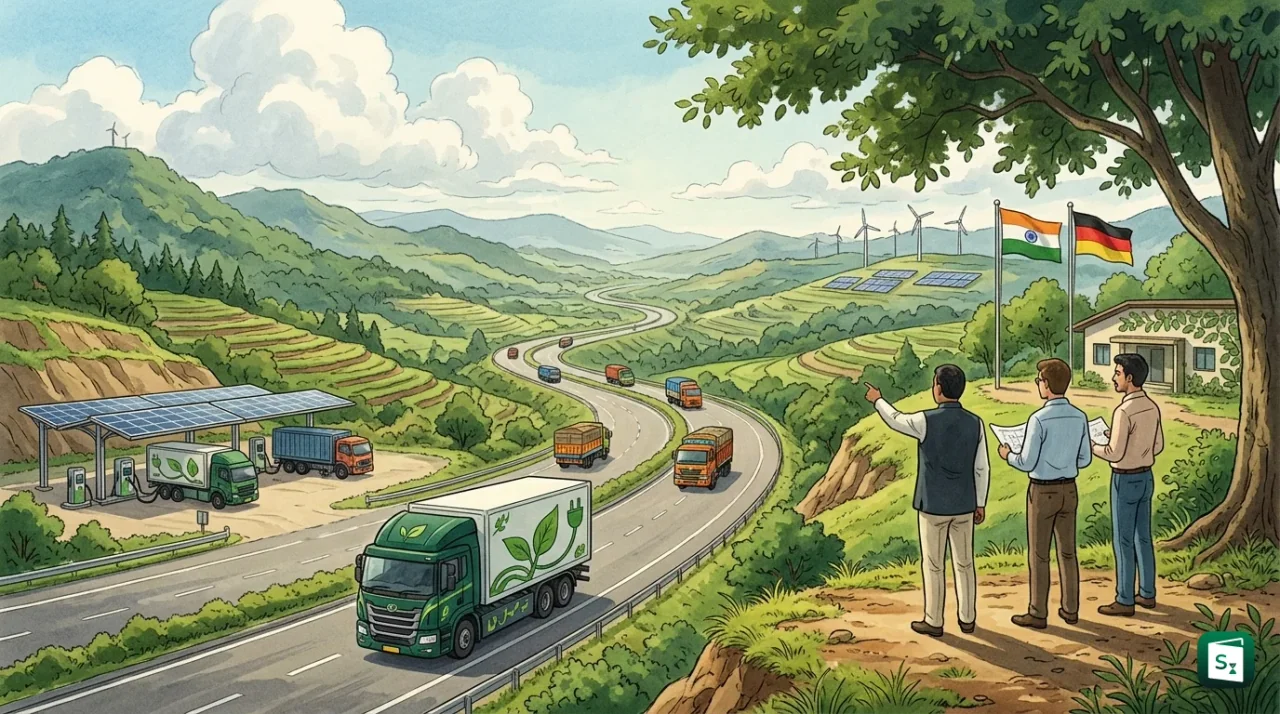
NITI Aayog and Germany’s Deutsche Gesellschaft fur Internationale Zusammenarbeit (GIZ) GmbH signed an Implementation Agreement on 3 November 2026 under the Nationally Determined Contribution Transport Initiative for Asia Phase II. The pact aims to speed up decarbonisation of India’s road freight sector through electric trucks, charging infrastructure and better financing. Road freight carries about 71 percent of India’s domestic freight and produces a large share of transport emissions, so cleaner trucking is central to India’s climate goals.
What Did NITI Aayog and GIZ Agree On?
NITI Aayog and GIZ signed the Implementation Agreement in New Delhi on 3 November 2026. NITI Aayog announced the signing on 4 November 2026. The agreement records how the partners will work together to cut emissions from trucks and heavy commercial vehicles in India.
The work will focus on three gaps that hold back electric freight in India. These are adequate charging infrastructure for medium and heavy duty trucks, innovative financing models that lower lending risk, and an enabling regulatory framework with clear standards and policies.
The partners named in the announcement are the World Resources Institute (WRI) India, the International Council on Clean Transportation (ICCT) India and Agora Energiewende. WRI India is a research body working on environment and sustainable development. ICCT India provides technical research on clean vehicle technology and emissions. Agora Energiewende is a Germany based think tank working on energy transition.
In practice, the cooperation will run through NITI Aayog’s Electric Freight Accelerator for Sustainable Transport (e-FAST India) platform. The e-FAST India platform was launched by NITI Aayog in September 2022 as India’s first national platform for freight electrification. It brings together truck makers, logistics firms, banks, charging companies and state governments to test pilots, share data and shape policy. GIZ has said the next two year work plan includes policy dialogue through e-FAST, support for zero emission trucks (ZETs) and study of dedicated routes where electric trucks can run with assured charging.
What Is NDC Transport Initiative for Asia Phase II?
The Nationally Determined Contribution Transport Initiative for Asia Phase II (NDC-TIA II) is a regional programme funded by Germany to help China, India and Vietnam cut transport emissions in line with their climate pledges under the Paris Agreement. The programme is funded by Germany’s International Climate Initiative (IKI) and implemented by GIZ. It runs from November 2024 to September 2028 with IKI funding of 4.9 million euros.
NDC stands for Nationally Determined Contribution. It is the climate action plan that each country submits under the Paris Agreement, which was adopted in 2015 to limit global warming. NDC-TIA helps partner countries add stronger transport measures to these plans and put them into action.
In each country, a national body acts as the political partner. In India, the partner is NITI Aayog. In China, it is the Ministry of Ecology and Environment. In Vietnam, it is the Ministry of Construction. The regional implementing group also includes Agora Verkehrswende, the Partnership on Sustainable, Low Carbon Transport (SLOCAT), the Renewable Energy Policy Network (REN21), ICCT and WRI.
The Phase II focus is narrow and practical. It centres on electrification of road freight and commercial vehicles, charging infrastructure, and links between transport and renewable power. It also promotes gender responsive transport, with attention to skills, jobs and representation for women in freight and logistics.
How Phase II Differs From Phase I
| Feature | Phase I (NDC-TIA) | Phase II (NDC-TIA II) |
|---|---|---|
| Period | November 2019 to August 2025 | November 2024 to September 2028 |
| IKI funding | 19.75 million euros | 4.9 million euros |
| Scope | Broad decarbonisation of transport, including urban mobility, policy processes and long term strategies | Narrow focus on electric trucks, commercial vehicles and charging |
| India work | Set up the Forum for Decarbonising Transport in India in 2021, studies on batteries, charging and grid integration, inputs for charging roadmaps | Implementation support for road freight, finance models and e-truck deployment through e-FAST |
| Partners in India | NITI Aayog with WRI, ICCT and others | NITI Aayog with WRI India, ICCT India and Agora Energiewende |
Phase I helped shape national electric mobility work in all three countries. In India, its studies informed charging infrastructure planning and inputs for subsidy design. In China, it supported work on vehicle emission standards. In Vietnam, it supported e-mobility policy and emission tracking tools.
Why Road Freight Decarbonisation Matters for India
India moves about 4.6 billion tonnes of freight every year, creating demand of about 2.2 trillion tonne km. Road carries about 71 percent of this freight. Rail carries only about 18 percent, down from about 89 percent in the early years after Independence. This heavy use of roads makes freight costly, polluting and dependent on imported diesel.
Trucks form only about 3 percent of all vehicles, yet they cause about one third of transport related carbon dioxide emissions. Heavy and medium duty trucks also cause about 53 percent of particulate matter emissions from vehicles. Particulate matter refers to tiny dust and soot particles that harm lungs and air quality.
Demand is set to rise fast. NITI Aayog estimates road freight could reach 9.6 trillion tonne km by 2050. The truck fleet could grow from 4 million in 2022 to about 17 million by 2050. Without change, freight carbon dioxide emissions could rise from 220 million tonnes in 2020 to 1,214 million tonnes by 2050, an increase of 451 percent. Road freight accounts for about 95 percent of current freight emissions.
The cost is economic as well as environmental. Road freight accounted for more than 25 percent of India’s annual oil import spending, or about ₹3.3 lakh crore in 2022-23. Studies by NITI Aayog estimate that wide use of zero emission trucks could save 2.8 to 3.8 gigatonnes of carbon dioxide cumulatively by 2050. It could also avoid about 838 billion litres of diesel use, worth more than ₹108 lakh crore in oil spending.
Electrification of trucks is still at an early stage. NITI Aayog has noted sales of only about 800 heavy duty electric trucks in 2025. Small fleet operators, who handle more than 75 percent of freight movement, face high upfront prices, limited credit, uncertain resale value and lack of charging along highways. Banks often treat electric truck loans as high risk and charge interest rates two to three percentage points higher than for diesel trucks.
What Is NITI Aayog and How Does It Work?
The National Institution for Transforming India (NITI Aayog) is the apex policy think tank of the Government of India. NITI Aayog was formed on 1 January 2015 by a resolution of the Union Cabinet and is headquartered in New Delhi. It advises the Centre and states on long term policy and promotes cooperative federalism.
NITI stands for National Institution for Transforming India. The term Aayog means commission or institution in Hindi. NITI Aayog replaced the Planning Commission, which was set up in 1950.
NITI Aayog is an executive body. It was not created by the Constitution, so it is not a constitutional body. It was also not created by a law of Parliament, so it is not a statutory body.
NITI Aayog is chaired by the Prime Minister. The current chairperson is Narendra Modi. The Vice Chairperson, appointed by the Prime Minister, is Ashok Kumar Lahiri. The Chief Executive Officer (CEO), in the rank of Secretary to the Government of India, is Anurag Jain, who took charge on 17 August 2026. The Governing Council includes chief ministers of all states, chief ministers of Delhi, Puducherry and Jammu and Kashmir, and lieutenant governors of other union territories. It also includes ex officio members from the Union Council of Ministers, full time members who are experts, and special invitees.
Its main work falls into four areas. It prepares policy and programme frameworks for national and state development. It builds cooperation between the Centre and states and encourages competition among states on good practices. It monitors schemes and evaluates outcomes. It acts as a knowledge hub that produces research, data tools such as the SDG India Index and School Education Quality Index, and innovation support through the Atal Innovation Mission.
How NITI Aayog Is Different From the Planning Commission
| Feature | Planning Commission (1950 to 2014) | NITI Aayog (2015 onwards) |
|---|---|---|
| Approach | Top down central planning with Five Year Plans | Bottom up cooperative federalism with shared vision and strategy |
| Role of states | Limited role in plan design | States are partners through Governing Council and Regional Councils |
| Financial power | Allocated funds to states and ministries | No fund allocation role, only policy advice and monitoring |
| Structure | Chairperson with Deputy Chairperson, full time members and Member Secretary | Chairperson who is Prime Minister, Vice Chairperson, full time members, ex officio ministers, CEO and secretariat |
The change reflects a shift from centralised allocation to guidance, coordination and outcome tracking, with states given a larger voice in setting priorities.
What Is GIZ and What Role Does It Play in India?
The Deutsche Gesellschaft fur Internationale Zusammenarbeit (GIZ) GmbH is the main development agency of Germany. The name means German Society for International Cooperation in English. GmbH indicates a limited liability company under German law. GIZ is a public benefit federal enterprise owned by the German government.
GIZ was formed on 1 January 2011 through the merger of three German development bodies. It is headquartered in Bonn and Eschborn in Germany and works in nearly 120 countries. It supports the German government and other public and private clients in sustainable development, energy, climate, environment, urban development and vocational training.
In India, GIZ has worked for more than 60 years. It has offices in Delhi, Bengaluru and Mumbai, besides project locations across states. Its India work covers clean energy and energy efficiency, biodiversity and natural resource management, sustainable urban and industrial development, and private sector and skills development. The agency works with central ministries, state governments and local bodies, with more than 100 ongoing projects across over 30 states and union territories in recent years.
In transport, GIZ supports charging infrastructure studies, policy advice and pilot models for electric mobility. Under NDC-TIA II, GIZ is the implementing organisation that channels IKI funds, brings technical studies and global experience, and coordinates with partners such as WRI and ICCT. A related effort, FASTR (Facilitating Adoption of Sustainable Trucking through Risk sharing Facility), focuses on a Risk Sharing Facility that offers partial credit guarantees to banks so that small carriers can get loans for zero emission trucks at better terms.
How This Pact Supports India’s NDC Targets and Net Zero Goal
India’s updated Nationally Determined Contribution, approved by the Union Cabinet on 3 August 2022 and submitted to the United Nations Framework Convention on Climate Change (UNFCCC) on 26 August 2022, sets three quantified goals for 2030. India aims to reduce the emission intensity of its GDP by 45 percent by 2030 from 2005 levels. It aims to reach about 50 percent of cumulative electric power installed capacity from non fossil sources by 2030. It also aims to create an additional carbon sink of 2.5 to 3 billion tonnes of carbon dioxide equivalent through forest and tree cover by 2030.
These updates build on the five nectar elements, or Panchamrit, announced by the Prime Minister at the 26th Conference of Parties (COP26) in Glasgow in 2021. The Panchamrit includes the long term goal of net zero by 2070. Net zero means balancing the greenhouse gases released with an equal amount removed from the atmosphere. India also submitted its Long Term Low Carbon Development Strategy in November 2022 to show pathways to that goal.
India’s NDC does not bind the country to any sector specific mitigation target. Freight electrification is therefore a voluntary but high impact route to meet the economy wide intensity goal. Cleaner trucks lower diesel use, cut carbon dioxide and improve energy security while supporting logistics growth.
The policy base for this shift is already forming. The PM Electric Drive Revolution in Innovative Vehicle Enhancement (PM E-DRIVE) scheme, notified in September 2024 and now extended to 31 March 2028 for trucks and buses, provides India’s first dedicated support for electric trucks. It sets aside ₹500 crore for about 5,643 e-trucks in the N2 and N3 categories. N2 covers trucks with gross vehicle weight above 3.5 tonnes up to 12 tonnes. N3 covers trucks above 12 tonnes up to 55 tonnes. The incentive is ₹5,000 per kWh of battery capacity, capped at 10 percent of factory price and at fixed ceilings ranging from ₹2.7 lakh to ₹9.6 lakh based on weight. Buyers must submit a scrapping certificate for an old truck and makers must give a battery warranty of five years or 5,00,000 km.
The NITI Aayog GIZ pact adds the softer systems that money alone cannot buy. These include route level studies for charging, total cost analysis for operators, risk sharing models for lenders and regulatory inputs for heavy vehicle charging standards. If these tools mature before the programme ends in September 2028, they can help turn early pilots and the PM E-DRIVE outlay into wider adoption by private fleet owners.
Key Takeaways
- NITI Aayog and GIZ signed an Implementation Agreement on 3 November 2026 under NDC-TIA Phase II for road freight decarbonisation.
- NDC-TIA Phase II runs from November 2024 to September 2028 with 4.9 million euros from Germany’s International Climate Initiative and covers India, China and Vietnam.
- Road freight carries about 71 percent of India’s freight but trucks form only 3 percent of vehicles while causing about one third of transport carbon dioxide emissions.
- NITI Aayog was formed on 1 January 2015 by Cabinet resolution, is chaired by the Prime Minister and is headquartered in New Delhi.
- India’s updated NDC targets a 45 percent cut in GDP emission intensity by 2030 and 50 percent non fossil power capacity, supporting the net zero by 2070 goal.