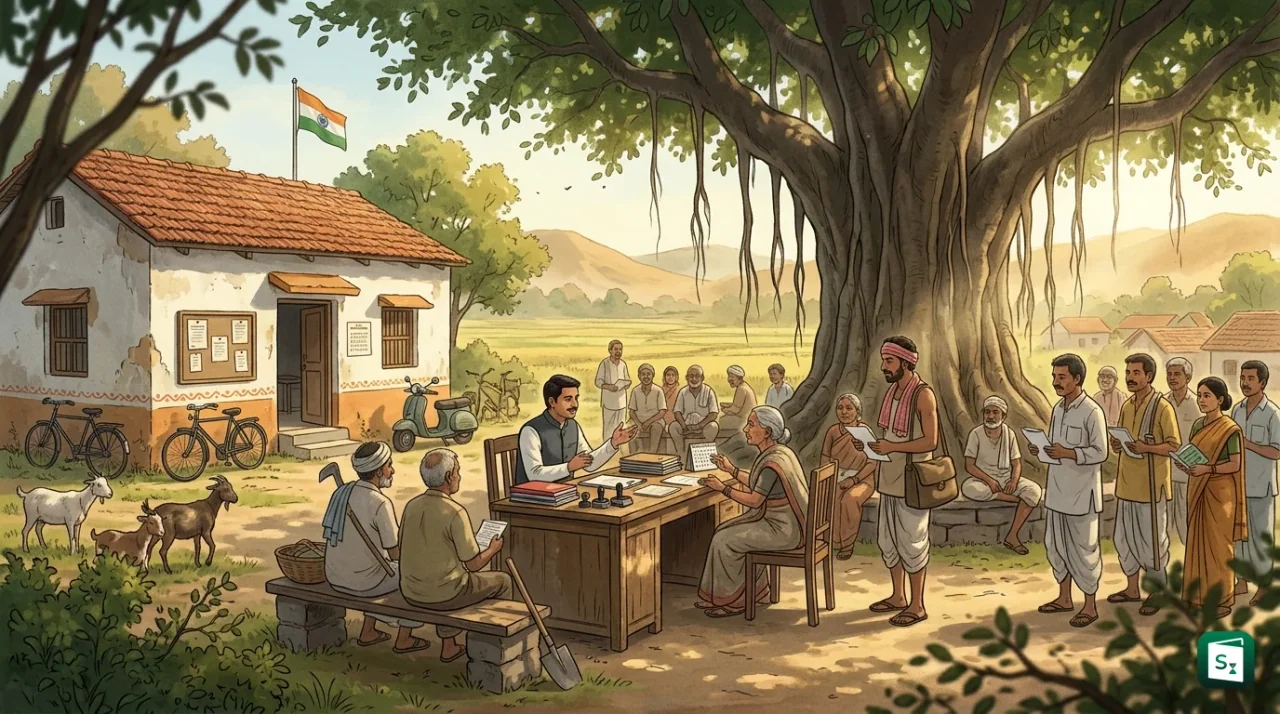
The Ministry of Rural Development notified the VB-G RAM G Grievance Redressal Rules 2026 on 2 November 2026 under the VB-G RAM G Act 2025. The rules set up a three tier redressal system at Gram Panchayat, Block and District levels. Every complaint must be inquired into within 7 working days and resolved within 15 days.
What Is VB-G RAM G and Why Was It Introduced?
VB-G RAM G stands for Viksit Bharat Guarantee for Rozgar and Ajeevika Mission Gramin. It is a national rural employment guarantee law that promises at least 125 days of unskilled wage work in a financial year to every rural household whose adult members volunteer for such work.
Parliament passed the VB-G RAM G Act 2025 in December 2025. The President gave assent on 20 December 2025. The Act came into force across rural India on 1 July 2026. From that date, the Mahatma Gandhi National Rural Employment Guarantee Act 2005, commonly called MGNREGA, stood repealed.
The new law is run as a Centrally Sponsored Scheme. The Ministry of Rural Development is the nodal ministry at the Centre. Funds are shared between the Centre and states in the ratio of 60:40 for most states. For North Eastern and Himalayan states and the Union Territory of Jammu and Kashmir, the ratio is 90:10. The Centre has stated that the scheme remains demand driven in law because a household retains the legal right to demand work and to receive an unemployment allowance if work is not given within 15 days. In practice, funding works through normative allocation, where the Centre fixes a state wise fund ceiling for the year based on objective parameters. Any spending above that ceiling must be borne by the state.
The shift from 100 days under MGNREGA to 125 days is the headline change. Four other design changes matter for daily life. States can notify an aggregate pause of up to 60 days in a year during peak sowing and harvest seasons to keep farm labour available. Works must originate from Viksit Gram Panchayat Plans and feed into the Viksit Bharat National Rural Infrastructure Stack. Permissible works focus on water security, core rural infrastructure, livelihood related infrastructure and mitigation of extreme weather events. Implementation relies heavily on digital tools such as biometric attendance, digital muster rolls, e-KYC of job cards and Direct Benefit Transfer of wages.
How Workers Can File a Complaint Under the 2026 Rules
The Ministry of Rural Development issued the draft grievance rules on 22 May 2026 for public objections. After considering suggestions, the Ministry notified the final Grievance Redressal Rules 2026 on 2 November 2026 through notification G.S.R. 966(E). The rules derive authority from Section 33 of the VB-G RAM G Act 2025.
Any person can file a grievance on any matter arising from implementation of the scheme. This covers denial of work, delay in wages, errors in the Gramin Rozgar Guarantee Card, faulty measurement of work, missing facilities at worksites and similar issues.
The rules allow four channels for filing:
- In person before the designated Grievance Redressal Officer
- Through speed post with proof of delivery
- Through the Digital Public Infrastructure for Redressal of Grievances designated by the Centre
- Through telephone, designated helplines or any other mode decided by the state government
The Digital Public Infrastructure for Redressal of Grievances is an integrated digital system set up or designated by the Centre. It allows direct online registration by citizens and end to end tracking from registration to disposal. Complaints received in physical form at Gram Panchayat, Block or District level must be entered on this platform on the same day, or by the next working day if same day entry is not feasible.
On registration, the worker gets an acknowledgement with the registration number, date of receipt and designation of the receiving authority. Electronic complaints receive electronic acknowledgement. Physical complaints receive physical acknowledgement. No grievance can be refused registration on grounds of format, language, manner of submission or procedural defect.
How the Three Tier Redressal System From Panchayat to District Works
State governments must establish a time bound, multi tier mechanism at three levels. These are the Gram Panchayat level, the Block level and the District level. Each level will have designated Grievance Redressal Officers to receive, register, inquire into and dispose of complaints.
The Gram Panchayat is the village level local body under Part IX of the Constitution. It registers households, issues job cards and allots work. The Block, also called the intermediate panchayat, covers a group of Gram Panchayats within a district. The District is the top tier of this chain under the rules.
The District Programme Coordinator oversees redressal at the district level. In most states this officer is the District Collector or an officer of equivalent rank. The Coordinator consolidates the district plan, monitors Programme Officers, inspects works and ensures that grievances move through both the physical mechanism and the digital platform as required by the rules.
State systems must be integrated with the central digital platform. The platform records the inquiry, findings and action taken. It also allows the complainant to track the case from registration to final disposal. This design links the local officer who receives the complaint with the district authority that supervises disposal.
What the 7 Day Inquiry and 15 Day Resolution Timelines Require
The Grievance Redressal Officer must examine every registered grievance and conduct the needed inquiry. The officer can call for registers, muster rolls, documents, reports and electronic data from the concerned authority. That authority must supply the material within the period fixed by the officer.
Where needed for a fair decision, the complainant must be given a reasonable chance to be heard in person or through electronic means. The inquiry must be completed within 7 working days from the date of receipt. After inquiry, the officer must record findings and take corrective or remedial action under the Act and the rules.
The grievance must be resolved within 15 days from the date of receipt. Findings and action taken must be entered on the digital platform and communicated to the complainant. If the complaint was filed physically, the outcome must also be communicated physically.
Any grievance that remains unresolved after 15 days must be escalated to the next higher level through the state mechanism and the digital platform. The higher authority must then examine the case and take action for disposal. Escalated cases remain under electronic monitoring until they are closed.
The rules also provide for appeals against orders passed in the redressal process. Such appeals will be filed and disposed of under paragraph 28 of Schedule I to the VB-G RAM G Act 2025.
How VB-G RAM G Differs From MGNREGA
The shift from MGNREGA to VB-G RAM G changes entitlement, funding and planning. The table below sets out the main points of difference. It helps place the new grievance rules in context.
| Aspect | MGNREGA under the 2005 Act | VB-G RAM G under the 2025 Act |
|---|---|---|
| Legal guarantee | 100 days of wage work per rural household in a year | 125 days of wage work per rural household in a year |
| Fund flow | Centre paid full unskilled wage cost, open ended demand based release | Normative allocation fixed by Centre, most states share costs 60:40 |
| Special funding | Centre met most costs, states met limited share | Centre and states share 90:10 for North Eastern, Himalayan states and Jammu and Kashmir |
| Work calendar | Work could be demanded through the year | States can pause works for an aggregate 60 days in peak farm seasons |
| Work choice | Broad list including water conservation, drought proofing and land development, chosen by Gram Sabha | Four focus domains and works originating from Viksit Gram Panchayat Plans linked to PM Gati Shakti |
| Job card | MGNREGA job card | Gramin Rozgar Guarantee Card, valid for three years and renewable after verification |
The grievance rules also differ from the earlier system. The final 2026 rules dropped several provisions that were present in the draft of May 2026 and in parts of the MGNREGA grievance framework.
| Provision | Position in May 2026 draft | Position in final November 2026 rules |
|---|---|---|
| First Information Report for prima facie financial irregularity | District Programme Coordinator to ensure filing after legal advice | No such express requirement |
| Action taken reports before panchayat bodies | Reports to be placed before intermediate and district panchayat meetings | No such express requirement |
| Fixed weekly grievance day and help desks | At least one designated day per week and desks at Block and District | No such express requirement |
| Penalty for delay | Failure to dispose within 7 working days to count as contravention under Section 27 | Timelines retained without that express penalty clause in the rules |
| Physical verification | Spot verification or inspection expressly required | Records based inquiry permitted, with hearing where needed |
| Monitoring reports and escalation | Quarterly reports to state and automatic digital escalation | Escalation after 15 days retained, without express quarterly report and automatic tag |
Some worker groups and opposition leaders have stated that the removal of these clauses weakens accountability and elected panchayat oversight. The government position, as stated in the official release, is that the notified framework makes redressal more accessible, transparent and accountable through mandatory registration, digital tracking and fixed timelines.
Why the Timelines Matter for Wages, Work Demand and Accountability
Delays in providing work and paying wages are the most common complaints under rural employment programmes. Under the scheme, work must be allotted within 15 days of demand for work. Wages must be paid weekly or in any case not later than a fortnight after closure of the muster roll. Direct Benefit Transfer into bank or post office accounts is the prescribed mode.
The grievance rules give a fixed clock to such complaints. A worker denied work, paid late or paid less can now point to a 7 day inquiry deadline and a 15 day resolution deadline. Escalation after day 15 creates a second chance within the system. The appeal route under Schedule I adds a further layer.
Social audit remains a separate accountability tool. Social audit units conduct village level verification of muster rolls, measurements and payments. The earlier linkage that required action on prima facie financial findings through prompt criminal proceedings no longer appears expressly in the final grievance rules. Findings must still lead to corrective action under the Act.
Access will depend on last mile capacity. Same day digital entry, helplines and speed post options reduce the need for repeated visits. At the same time, areas with weak connectivity, limited digital literacy and staff shortages may face strain in meeting the 7 day and 15 day limits. Steady staffing of Grievance Redressal Officers, clear display of contact details at panchayat offices and regular supervision by the District Programme Coordinator will shape actual outcomes.
Key Takeaways
- The VB-G RAM G Grievance Redressal Rules 2026 were notified on 2 November 2026 under the VB-G RAM G Act 2025.
- VB-G RAM G expands to Viksit Bharat Guarantee for Rozgar and Ajeevika Mission Gramin and guarantees 125 days of rural wage work.
- Grievances must be handled through Gram Panchayat, Block and District levels under supervision of the District Programme Coordinator.
- Inquiry must finish within 7 working days and final resolution must occur within 15 days, with escalation on delay.
- The VB-G RAM G Act 2025 came into force on 1 July 2026 and replaced the MGNREGA of 2005.