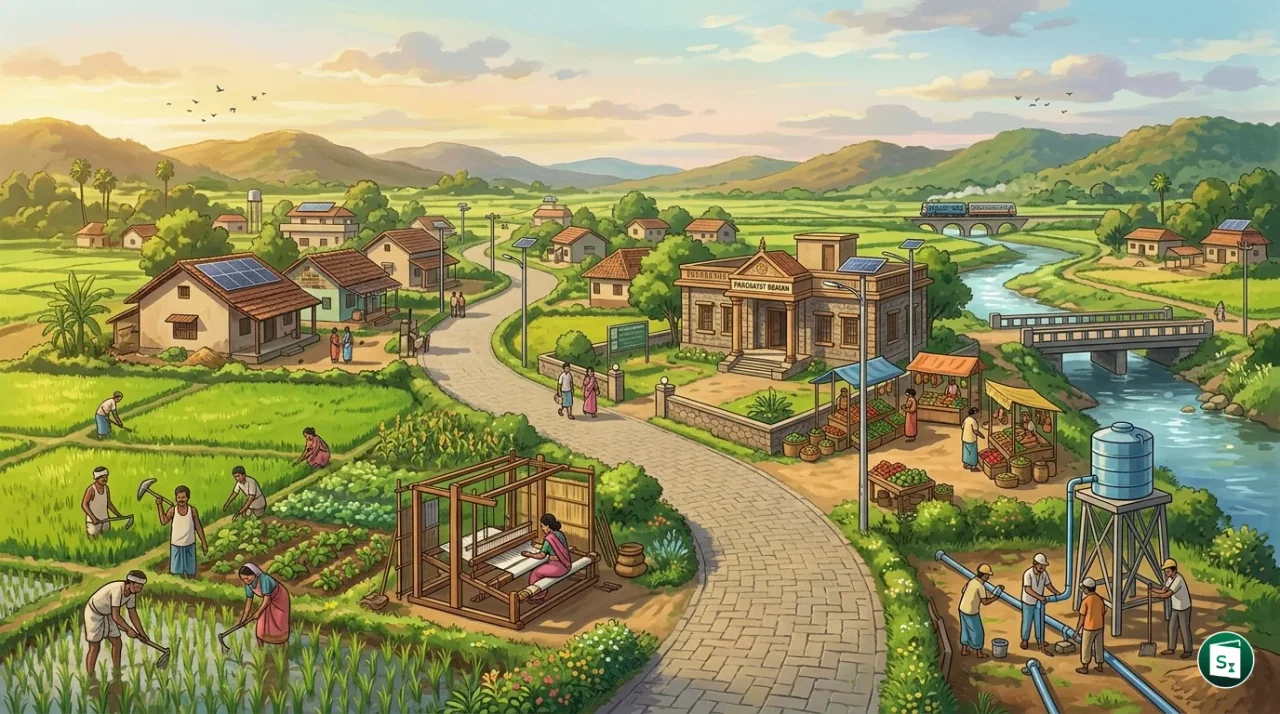
Union Minister Shivraj Singh Chouhan unveiled the framework for the Viksit Bharat – Guarantee for Rozgar and Ajeevika Mission (Gramin), known as VB-G RAM G, on June 15, 2026. This comprehensive rural development mission will replace the MGNREGA framework from July 1, 2026, with an enhanced focus on sustainable livelihoods and digital governance. With a massive outlay of ₹1.25 lakh crore, the initiative aims to transform India’s 2.8 lakh Gram Panchayats into self-reliant
Transitioning from MGNREGA: The Birth of VB-G RAM G
The Viksit Bharat – Guarantee for Rozgar and Ajeevika Mission (Gramin) represents a fundamental shift in India’s approach to rural employment. While the Mahatma Gandhi National Rural Employment Guarantee Act (MGNREGA), enacted in 2005, served as a critical safety net for nearly two decades, the new VB-G RAM G mission moves beyond simple poverty alleviation. It treats rural labor as a driver of national growth, aligning with the broader Viksit Bharat @2047 vision. This transition, effective from July 1, 2026, aims to modernize rural administration while ensuring that the shift for existing workers is seamless and worker-centric.
Key Provisions of the New Rural Framework
One of the most significant changes introduced by VB-G RAM G is the statutory increase in guaranteed wage employment. Every rural household is now entitled to 125 days of work per financial year, up from the previous limit of 100 days. To balance this with agricultural requirements, the framework includes an aggregated 60-day pause during peak sowing and harvesting seasons. This ensures that farmers do not face labor shortages during critical periods while workers still receive their full annual guarantee.
The funding model has also been restructured to improve accountability and predictability. The mission follows a 60:40 Centre-State cost-sharing ratio for most states, while North-Eastern states and Hilly states will benefit from a 90:10 ratio.
| Feature | MGNREGA (Old) | VB-G RAM G (New) |
|---|---|---|
| Guaranteed Work Days | 100 Days | 125 Days |
| Agricultural Alignment | No fixed pause | 60-day strategic pause |
| Primary Focus | Poverty Alleviation | Empowerment and Productivity |
| Planning Model | Manual or Isolated | Integrated (PM Gati Shakti) |
| Asset Tracking | Local Registers | National Infrastructure Stack |
Digital Governance and the National Rural Infrastructure Stack
Transparency and efficiency are central to the VB-G RAM G framework, which is powered by a sophisticated digital ecosystem. All rural assets created under the mission are integrated into the Viksit Bharat National Rural Infrastructure Stack. This unified digital repository aggregates data on roads, water bodies, and livelihood infrastructure into a single platform for national monitoring. The stack is further synchronized with PM Gati Shakti, the national master plan for multi-modal connectivity, ensuring that village-level projects align with broader infrastructure goals.
To eliminate leakages and ensure that benefits reach the intended individuals, the mission mandates 100% e-KYC, face authentication, and Direct Benefit Transfer (DBT) for all wage payments. Implementation is monitored through e-Gram Swaraj 2.0, an evolved platform that provides a real-time Digital Panchayat Finance Dashboard. Additionally, the government is integrating the Bhashini AI platform to allow villagers to access governance portals in their local dialects using voice commands.
Strategic Significance for Viksit Bharat 2047
The launch of VB-G RAM G is a cornerstone of the government’s Viksit Gaon (Developed Village) vision. By shifting the focus from mere wage support to the creation of durable, climate-resilient village assets, the mission aims to transform rural India into a self-sustaining economic engine. The nearly 2.8 lakh Gram Panchayats involved will now develop Viksit Gram Panchayat Plans (VGPPs). This empowers local bodies to identify and execute projects that provide long-term benefits, such as water conservation systems and rural storage facilities.
This mission also specifically addresses the seasonal dynamics of the Indian economy. By incorporating a strategic pause during agricultural peak seasons, it supports the Agriculture sector, which remains the backbone of the rural economy. Ultimately, VB-G RAM G seeks to bridge the urban-rural divide by bringing high-tech governance and robust infrastructure to the heart of India. This strategy is critical for achieving the national goal of becoming a developed nation by 2047.
Key Takeaways
- Union Minister Shivraj Singh Chouhan unveiled the VB-G RAM G mission framework on June 15, 2026.
- The mission is scheduled to replace the MGNREGA framework starting from July 1, 2026.
- The statutory guarantee for rural wage employment has been increased from 100 days to 125 days per household annually.
- The central government has allocated a massive budget of ₹1.25 lakh crore for the mission for the 2026-27 fiscal year.
- The new framework incorporates a 60-day strategic pause during peak agricultural seasons to ensure the availability of farm labor.
- Nearly 2.8 lakh Gram Panchayats will participate in decentralized planning through Viksit Gram Panchayat Plans (VGPPs).
- Digital transparency is ensured through 100% e-KYC, face authentication, and the National Rural Infrastructure Stack.