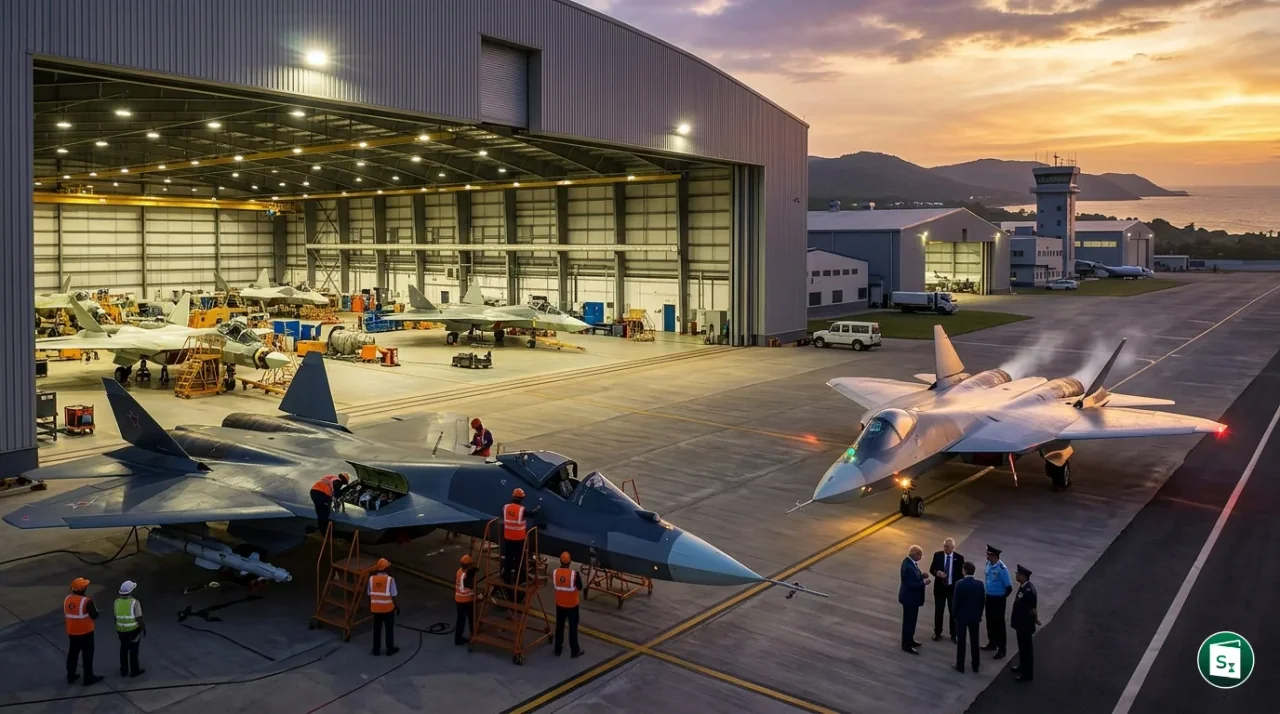
Russian President Vladimir Putin has formally offered the Su-57, Russia’s premier fifth-generation stealth aircraft, for joint production in India. Announced at the 2026 St. Petersburg International Economic Forum, the proposal includes an unprecedented full transfer of technology, including sensitive mission software source codes. This move aims to deepen the long-standing defense partnership between Moscow and New Delhi while supporting India’s push for indigenous high-tech manufacturing.
A Strategic Shift: Russia’s Unprecedented Su-57 Offer
The offer, presented during a high-level session at SPIEF 2026, represents a significant departure from traditional defense trade models. Unlike previous “buyer-seller” arrangements, Moscow has proposed a “no-limits” partnership. This includes the establishment of full-scale manufacturing facilities in India through Hindustan Aeronautics Limited (HAL) and other private strategic partners.
Central to this proposal is the transfer of the aircraft’s “brain,” which includes the mission software source codes and the architecture of its Active Electronically Scanned Array (AESA) radar. In the world of advanced aviation, such technologies are typically guarded as “black boxes” that even the closest allies rarely share. By offering these, Russia aims to provide India with complete sovereign control over the platform, allowing for future indigenous upgrades and integration of Indian-made weapons systems.
Bridging the Stealth Gap: Why the Offer Matters Now
The Indian Air Force (IAF) is currently facing a critical transition period as it seeks to maintain its qualitative edge in the region. China has already operationalized over 200 J-20 Mighty Dragon stealth fighters, and reports suggest that Pakistan is actively pursuing the Chinese J-35 fifth-generation aircraft. In contrast, India’s indigenous Advanced Medium Combat Aircraft (AMCA) project, while progressing into the industrial prototype phase in 2026, is not expected to enter full squadron service until at least 2034.
This “stealth gap” poses a strategic challenge. Procurement of the Su-57 could serve as an interim solution, providing the IAF with immediate fifth-generation capabilities. Furthermore, Russia has proposed that Indian defense firms become part of the global Su-57 supply chain, producing components not only for the IAF but also for the Russian Aerospace Forces and other international export clients. This integration would provide a massive boost to the domestic aerospace ecosystem.
Technical Capabilities: What Makes the Su-57 ‘The Felon’?
The Su-57, designated by NATO as the Felon, is a multirole air superiority fighter designed to operate in highly contested environments. Its design philosophy emphasizes supermaneuverability and high kinematics. It is equipped with 3D thrust-vectoring nozzles, allowing for extreme post-stall maneuvers that provide a significant advantage in close-range dogfights.
The aircraft features a unique radar suite consisting of five Active Electronically Scanned Array (AESA) sensors distributed across the airframe. This includes “cheek” radars for wide-angle tracking and L-band arrays in the wings specifically designed for detecting stealth aircraft at long ranges. Additionally, its 101KS Atoll infrared search and track (IRST) system allows it to track targets passively without emitting radar signals, enhancing its own survivability.
Comparison: Su-57 vs. Global Fifth-Generation Rivals
While the Su-57 excels in maneuverability and speed, it differs in its stealth characteristics compared to Western platforms like the F-22 and F-35.
| Feature | Sukhoi Su-57 (Felon) | Lockheed Martin F-22 Raptor | Lockheed Martin F-35A |
|---|---|---|---|
| Max Speed | Mach 2.0 | Mach 2.25 | Mach 1.6 |
| Supercruise | Mach 1.3 | Mach 1.82 | Limited (Mach 1.2 burst) |
| Stealth (RCS) | 0.1 to 1.0 square meters | 0.0001 to 0.0002 square meters | 0.001 to 0.005 square meters |
| Thrust Vectoring | 3D (All-axis) | 2D (Pitch only) | None |
| Philosophy | Dynamic Maneuverability | All-aspect Stealth | Sensor Fusion and Networking |
Addressing Previous Friction: Lessons from the FGFA Project
The current proposal aims to resolve long-standing issues that led to India’s withdrawal from the Fifth Generation Fighter Aircraft (FGFA) project in 2018. Initiated in 2007, the FGFA program was intended to co-develop an Indian variant of the Su-57. However, the project stalled after a decade of negotiations due to disagreements over cost sharing and Russia’s reluctance to share core technologies.
At that time, the Indian Air Force expressed concerns regarding the aircraft’s stealth performance and the delays in developing the definitive Izdeliye 30 engine. The “black box” nature of the mission software also prevented India from integrating its own indigenous missiles, such as the Astra beyond-visual-range missile. The 2026 offer of “unrestricted access” is a strategic move by Moscow to rebuild trust and provide the transparency that was missing in previous years.
The ‘Make in India’ Dimension and Future Prospects
The proposed Su-57 partnership is closely aligned with India’s Atmanirbhar Bharat (Self-Reliant India) initiative. By establishing a domestic production line, India would gain deep technical expertise in the manufacturing of stealth airframes and composite materials. While HAL remains the primary nodal agency for Russian aviation in India, the government’s shift toward involving private consortia (such as those led by Tata Advanced Systems and L&T) could see a broader industrial participation in the project.
Beyond the Su-57, this offer strengthens the broader defense ecosystem. India is already the largest operator of the Su-30MKI, which forms the backbone of the IAF. A massive modernization program, known as the Super Sukhoi upgrade, is currently underway to equip the older fleet with modern radars and avionics. The technological overlaps between the Su-57 and the Super Sukhoi program could create significant industrial synergies, reducing maintenance costs and improving the combat availability of the entire fighter fleet.
Key Takeaways
- Russian President Vladimir Putin offered the Su-57 fifth-generation stealth aircraft for joint production in India at SPIEF 2026.
- The proposal includes an unprecedented full transfer of technology, providing India with access to sensitive mission software source codes.
- The Sukhoi Su-57, designated by NATO as the Felon, features supermaneuverability enabled by 3D thrust-vectoring nozzles.
- India had previously withdrawn from the joint Fifth Generation Fighter Aircraft (FGFA) project with Russia in 2018 due to technology access concerns.
- This offer could help the Indian Air Force bridge the “stealth gap” until the indigenous Advanced Medium Combat Aircraft (AMCA) is ready by 2034.
- The partnership would involve major production roles for Hindustan Aeronautics Limited (HAL) and potentially private strategic partners under the Make in India initiative.