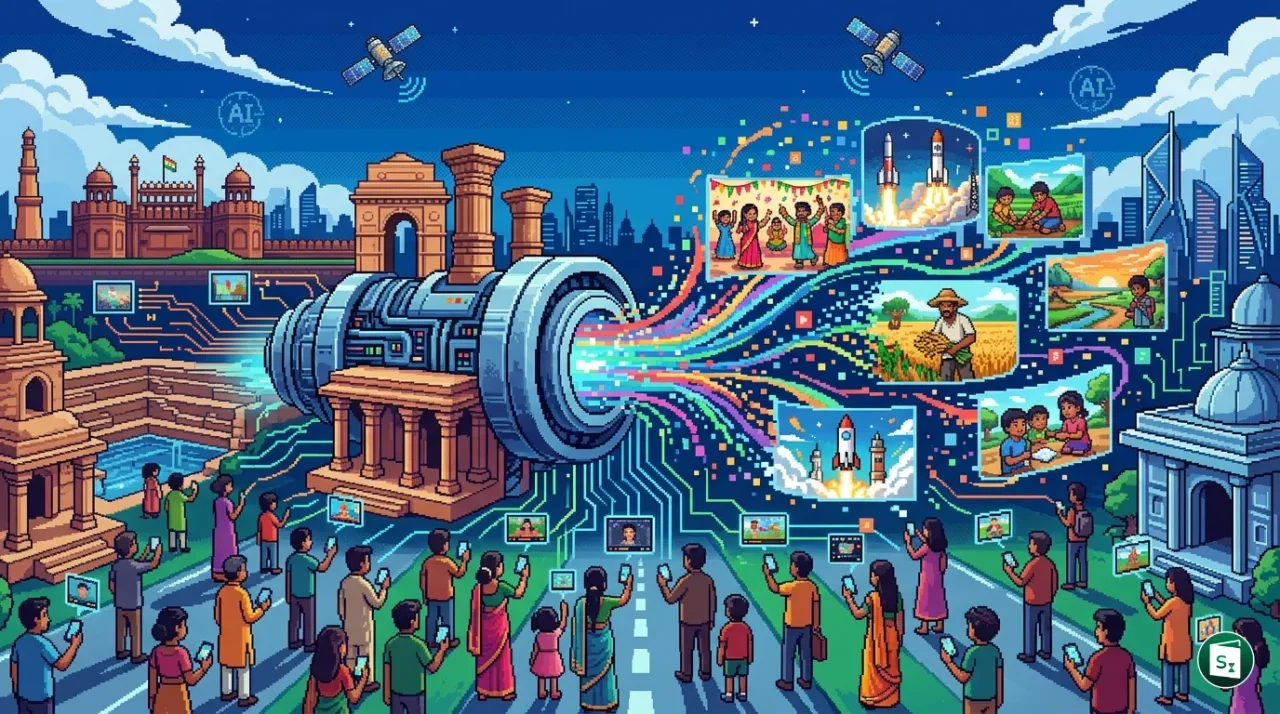
Bengaluru-based startup Avataar launched Varya, India’s first indigenous distilled video AI model, on June 15, 2026, in New Delhi. Developed in partnership with the IndiaAI Mission, the foundation model enables high-quality text-to-video and image-to-video generation at a fraction of the cost of global alternatives. This launch marks a significant milestone in India’s quest for Sovereign AI and technological self-reliance in the generative AI landscape.
What is the Varya AI Model?
Varya is a sophisticated 14-billion-parameter foundational AI model designed to convert textual descriptions and static images into dynamic, high-quality video content. Unlike many global models that are trained on Western-centric data, Varya has been trained on a massive dataset of 40,000 Indian cultural elements. This ensures that the AI can accurately represent Indian festivals, regional attire, traditional architecture, and local culinary nuances.
The model is hosted on the AI Kosh portal, a unified national platform for AI datasets and models. By making the model available with open weights, the government and Avataar aim to encourage Indian developers and startups to build specialized applications on top of this foundational layer. This approach fosters a localized innovation ecosystem where schools, small businesses, and content creators can generate professional-grade videos without expensive equipment.
Technical Innovation: The Power of Knowledge Distillation
The core innovation behind Varya is a technique known as Knowledge Distillation. In AI development, a massive and computationally heavy ‘teacher’ model is used to train a smaller and more efficient ‘student’ model. The student model learns to mimic the complex behavior of the teacher but with significantly fewer mathematical steps. For Varya, this means the video generation process has been reduced from 50 steps to just 4 steps.
Analogy · The Master Chef and the Apprentice Expand analogy
Imagine a master chef who takes hours to prepare a signature dish by following fifty complex steps. A distilled model is like a talented apprentice who has learned the essential secrets of that dish. The apprentice can produce the same high-quality result in just four quick steps, making the gourmet meal accessible to a much larger crowd in a fraction of the time.
This reduction in complexity translates into remarkable speed. While traditional non-distilled models might take over 20 minutes to generate a short clip, Varya can produce a 5-second 720p video in approximately 45 seconds. This efficiency allows the model to run on less powerful hardware, drastically lowering the entry barrier for Indian innovators who may not have access to expensive server farms.
Integration with the IndiaAI Mission
The development of Varya is a flagship outcome of the IndiaAI Mission, an ambitious national initiative approved by the Union Cabinet with a total outlay of ₹10,371.92 crore. The mission is implemented by the Ministry of Electronics and Information Technology (MeitY) through an independent division called IndiaAI. Its primary objective is to build a comprehensive AI ecosystem in India through seven key pillars, including compute capacity, innovation centres, and dataset platforms.
| Pillar of IndiaAI Mission | Focus Area |
|---|---|
| Compute Capacity | Providing access to 10,000+ GPUs through public-private partnerships. |
| Innovation Centre | Developing indigenous Large Multimodal Models (LMMs) and foundational models. |
| Datasets Platform | Creating AI Kosh, a national repository for high-quality, non-personal data. |
| Startup Financing | Providing risk capital for deep-tech startups like Avataar. |
By utilizing the mission’s subsidized national AI compute infrastructure, Avataar was able to train Varya efficiently. The partnership ensures that the model remains aligned with national priorities, such as digital inclusion and the promotion of local languages. This collaborative model demonstrates how the government can act as a catalyst for high-tech innovation by providing the necessary digital infrastructure for private-sector research.
Economic Impact and Accessibility
One of the most critical aspects of Varya is its potential to democratize video creation. Global video AI models often come with high subscription costs and expensive per-second generation fees. In contrast, Varya is designed for structural affordability in the Indian market. The model can generate video at a cost of approximately ₹0.48 per second, which is between 10 to 20 times cheaper than prominent global alternatives.
This cost efficiency is vital for achieving population-scale impact. For every ₹100 spent, users can generate roughly 211 seconds of high-quality video. Such low costs make the technology accessible to school teachers for creating educational content, MSMEs for product marketing, and individual creators for storytelling. By reducing the financial burden of high-end AI, Varya enables a wider section of society to participate in the digital economy, aligning with the broader goals of the Digital India initiative.
Toward AI Sovereignty: The Strategic Why
The launch of Varya is more than a technical achievement. It is a strategic move toward AI Sovereignty. By building foundational models within the country, India reduces its reliance on foreign technology giants for critical digital tools. This is particularly important for data security and cultural preservation. When an AI model is built and trained domestically, the underlying data remains within the national jurisdiction, and the outputs are more likely to reflect local values rather than external biases.
Furthermore, indigenous models like Varya allow India to set its own standards for responsible and ethical AI. As generative AI becomes more integrated into governance, education, and commerce, having a homegrown alternative ensures that the digital infrastructure is resilient and adaptable to India’s unique socio-economic needs. This development positions India not just as a consumer of global AI products, but as a significant creator of foundational technology that can be exported to other emerging economies facing similar cost and cultural challenges.
Key Takeaways
- Varya was launched on June 15, 2026, as India’s first indigenous distilled video AI foundation model.
- The model was developed by Bengaluru-based startup Avataar in partnership with the IndiaAI Mission.
- Varya features 14 billion parameters and was trained on over 40,000 Indian cultural datasets to ensure regional accuracy.
- The model utilizes Knowledge Distillation, reducing the video generation process from 50 steps to just 4 steps.
- Video generation using Varya costs approximately ₹0.48 per second, making it 10 to 20 times cheaper than global alternatives.
- The IndiaAI Mission is implemented by MeitY with a total financial outlay of ₹10,371.92 crore.