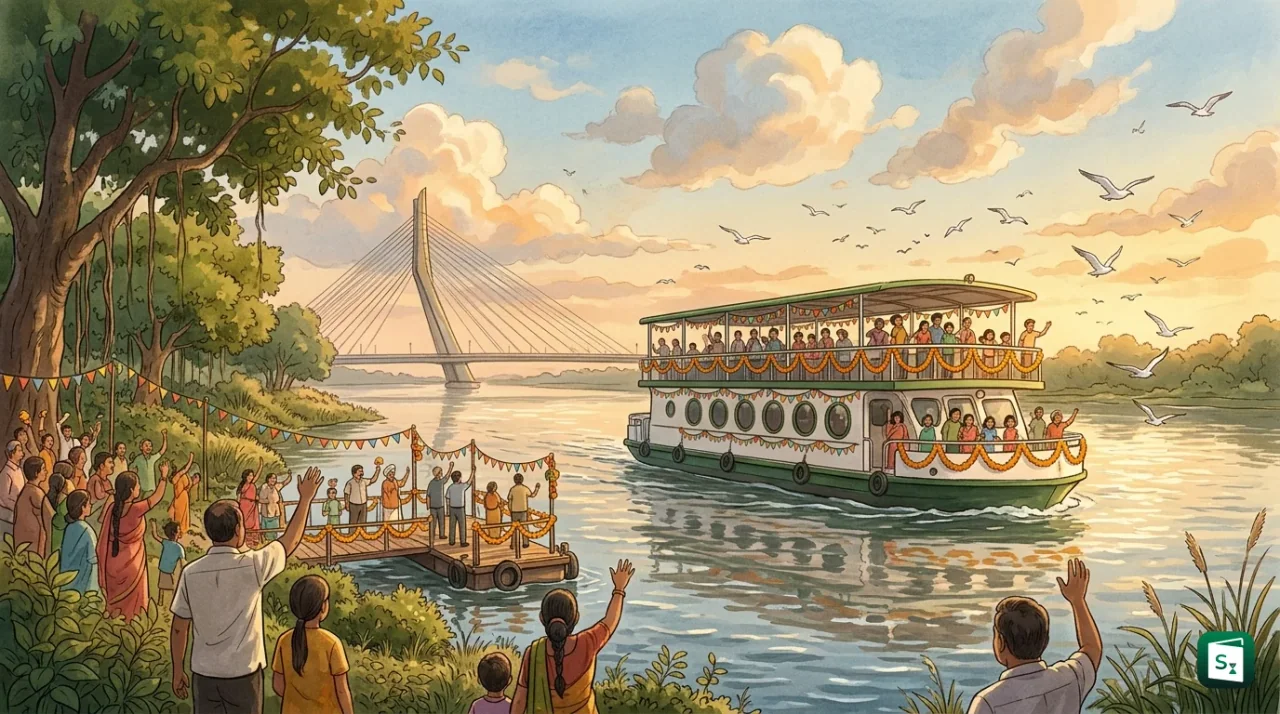
Union Minister for Ports, Shipping and Waterways Sarbananda Sonowal and Delhi Chief Minister Rekha Gupta inaugurated Delhi’s first recreational river cruise, the Namo Yamuna River Safari, at Sonia Vihar on 10 November 2026. The service uses a 30-seater electric boat for a six kilometre round trip between Sonia Vihar and Jagatpur that lasts about 40 minutes. The launch opens the cleaner upper stretch of the Yamuna in Delhi for tourism and riverfront recreation.
What Is the Namo Yamuna River Safari?
The Namo Yamuna River Safari is Delhi’s first recreational cruise service on the Yamuna river. It was inaugurated at Sonia Vihar in northeast Delhi on 10 November 2026. Union Minister Sarbananda Sonowal led the launch in the presence of Chief Minister Rekha Gupta, Lieutenant Governor Taranjit Singh Sandhu, Minister of State Shantanu Thakur, Tourism Minister Kapil Mishra and Public Works Minister Parvesh Sahib Singh Verma.
The service uses an electric-powered cruise vessel that carries 30 passengers per trip. The vessel has an air conditioned lower deck and an open upper deck. It is fitted with life jackets, a public announcement system and inboard bio toilets with zero discharge, which means no toilet waste is released into the river.
The project is presented as eco tourism, not just transport. It combines a short river ride with a riverfront destination for families. The Chief Minister described it as a reflection of public faith in Maa Yamuna. After the inauguration, the ministers took the maiden cruise ride on the river.
Where Does the Sonia Vihar to Jagatpur Cruise Operate?
The Delhi Yamuna cruise operates on the Sonia Vihar to Jagatpur stretch in northeast Delhi. This section lies upstream of the Wazirabad barrage. A barrage is a low wall built across a river to hold back water and raise its level. The stored pool behind Wazirabad provides the depth and steady level that a cruise boat needs.
The boat starts at Sonia Vihar, near the Wazirabad ghat, travels toward Jagatpur village near the Shani Mandir ghat, and then returns to the starting point. Officials describe the designated route as a six kilometre round trip. Each ride lasts 35 to 45 minutes. Trial runs on this route were completed in October 2026 before the launch.
| Cruise fact | Detail |
|---|---|
| Route | Sonia Vihar to Jagatpur and back, upstream of Wazirabad barrage |
| Round trip distance | About 6 km |
| Ride time | About 40 minutes |
| Boat capacity | 30 passengers per trip |
| Cruise fare | ₹500 per person for full ride |
| Entry to premises | ₹50 per person without cruise ride |
| Daily timing | 9 am to 9 pm, last cruise at 8 pm |
| Minimum trips | At least four trips per day |
| Monsoon closure | Closed from 1 July to 30 September every year |
Tickets are available through the Delhi Tourism website. A second electric vessel with the same 30 passenger capacity is planned by February to March 2027.
What Facilities Are Available at the Sonia Vihar Riverfront?
The Sonia Vihar site has been developed as a riverfront leisure destination, not only a boarding point. It has two floating jetties made of high density polyethylene for safe boarding. On shore, there are ticket counters, waiting areas, restrooms and lit pathways for evening visitors.
Families get a food court, shopping area, children’s play zone and gaming zone. Ecological trails and walking trails let visitors see the natural surroundings of the Yamuna. Adventure facilities such as skating and rock climbing are part of the plan.
The main evening attraction is a theme based musical fountain with a coordinated light and sound show. The show runs between 5 pm and 7 pm and narrates stories linked to the Yamuna. These include the legend of Kaliya Daman from the life of Shri Krishna, and the river’s link with Surya Dev, the sun god, and Yama. In Hindu tradition the Yamuna is worshipped as a goddess, the daughter of Surya and sister of Yama, and is also called Kalindi.
The site is within walking distance of the Sonia Vihar metro station. Officials said more boats and water sports activities will be added in future.
How Is the Cruise Service Being Implemented on National Waterway 110?
The Yamuna from Jagatpur in Delhi to Sangam in Prayagraj is notified as National Waterway 110 (NW 110). A national waterway is an inland water route declared by Parliament for shipping and navigation. The declaration was made under the National Waterways Act, 2016. That law retained the first five waterways and added 106 more, taking the total to 111 waterways across the country. The NW 110 stretch is about 1,089 km long and passes through Delhi, Haryana and Uttar Pradesh.
The Delhi cruise uses only a short part of this long waterway. The Inland Waterways Authority of India (IWAI) is the central agency that builds and regulates national waterways. IWAI was set up under the IWAI Act of 1985 and started work in 1986. It works under the Ministry of Ports, Shipping and Waterways and has its head office at Noida in Uttar Pradesh.
IWAI signed a memorandum of understanding with Delhi government agencies on 11 March 2025 to develop cruise tourism on a four kilometre stretch between Sonia Vihar and Jagatpur. The Delhi partners include the Delhi Development Authority (DDA), the Delhi Tourism and Transportation Development Corporation (DTTDC), the Delhi Jal Board (DJB) and the Irrigation and Flood Control Department. IWAI provides the floating jetties, hydrographic surveys to map depth, navigation aids to mark the safe channel and the electric solar hybrid boats.
The boats are designed for clean mobility. Each boat can carry 20 to 30 passengers and needs a maximum draft of only 1.2 metres, which means it can run in shallow water. The operator must use vessels that are not more than two years old and must run at least four trips a day. The operator is also responsible for the safety of passengers, crew and other river users. The project follows the centre’s Harit Nauka guidelines for green boats, under which electric catamarans have already been introduced in Varanasi and Ayodhya.
What Is the Yamuna River System?
The Yamuna is the longest tributary of the Ganga and the second largest tributary by water flow. A tributary is a smaller river that joins a larger river. The Yamuna rises from the Yamunotri glacier on the southwestern slopes of the Bandarpunch peaks in Uttarkashi district of Uttarakhand. The glacier lies at a height of about 6,387 metres.
The river travels 1,376 km before it joins the Ganga at Triveni Sangam in Prayagraj in Uttar Pradesh. Prayagraj hosts the Kumbh Mela at this confluence every 12 years. The Yamuna basin covers about 366,223 sq km, which is more than 40 percent of the entire Ganga basin. Nearly 57 million people depend on its waters, and it supplies more than 70 percent of Delhi’s drinking water.
The Yamuna flows through five states.
| Fact | Detail |
|---|---|
| Origin | Yamunotri glacier, Bandarpunch peaks, Uttarakhand |
| Length | 1,376 km |
| States on main course | Uttarakhand, Himachal Pradesh, Haryana, Delhi, Uttar Pradesh |
| End point | Triveni Sangam, Prayagraj, Uttar Pradesh |
| Other name | Kalindi, also called Jumna in old records |
| Delhi stretch | Enters at Palla village, exits at Jaitpur, total 52 km, with 22 km of urban stretch from Wazirabad barrage to Okhla barrage |
Its largest tributary is the Tons, which joins below Kalsi near Dehradun and carries more water than the main stream in the upper hills. Its longest tributary is the Chambal, which travels about 960 km through Rajasthan and Madhya Pradesh before joining the Yamuna at Sahon village in Etawah district. Other major right bank tributaries from the peninsular plateau are the Sind, Betwa and Ken. The main left bank tributary in the plains is the Hindon. Between the Ganga and the Yamuna lies the fertile Ganga Yamuna Doab, a plain known for basmati rice and dense farming.
Why Is the Delhi Stretch of the Yamuna Highly Polluted?
The Delhi stretch is only about 2 percent of the Yamuna’s length but carries more than 76 percent of its total pollutant load. Upstream of the Wazirabad barrage at Palla, the water still meets drinking water standards after treatment. The river turns dark and frothy after Wazirabad because 22 city drains release treated and untreated sewage into the 22 km urban reach between Wazirabad and Okhla. Low freshwater flow in the dry season worsens the problem, since most water is diverted at Hathnikund for irrigation and drinking supply through the Western and Eastern Yamuna canals.
White foam over the river near Delhi, often seen in October and November, forms when detergents and organic waste churn in the water. Black colour comes from heavy sewage and low oxygen.
Cleaning efforts have run for three decades under the Yamuna Action Plan (YAP). YAP Phase I started in 1993 and Phase II in 2003 with loan help from Japan. Together they spent about ₹1,514.7 crore to create 942 million litres per day (MLD) of sewage treatment capacity in Haryana, Delhi and Uttar Pradesh. MLD means the volume of sewage a plant can treat in one day. Phase III, approved in 2012 at a cost of ₹1,656 crore, focuses on Delhi and is run by the Delhi Jal Board with support from the Japan International Cooperation Agency. It includes the new 564 MLD plant at Okhla, one of India’s largest, and upgrades at Kondli and Rithala.
On 22 October 2026, projects worth ₹8,941 crore for Yamuna rejuvenation in Delhi were inaugurated and launched, with 10 projects opened and 33 started. The works include new and upgraded sewage treatment plants, decentralised pumping stations, sewer connections to homes and drain tapping. The stated target is to clean the river before May 2029.
The cruise was placed upstream of Wazirabad precisely because that water is cleaner than the downstream city reach.
Key Takeaways
- The Namo Yamuna River Safari was inaugurated on 10 November 2026 at Sonia Vihar by Sarbananda Sonowal and Rekha Gupta.
- The Delhi cruise runs a six kilometre round trip between Sonia Vihar and Jagatpur in about 40 minutes on a 30-seater electric boat.
- The cruise fare is ₹500 per person, while entry to the riverfront premises costs ₹50.
- The Sonia Vihar to Jagatpur stretch is part of National Waterway 110, developed by IWAI with DDA, DTTDC, DJB and the Irrigation and Flood Control Department.
- The Yamuna rises at the Yamunotri glacier in Uttarakhand, flows 1,376 km through five states and joins the Ganga at Prayagraj.