
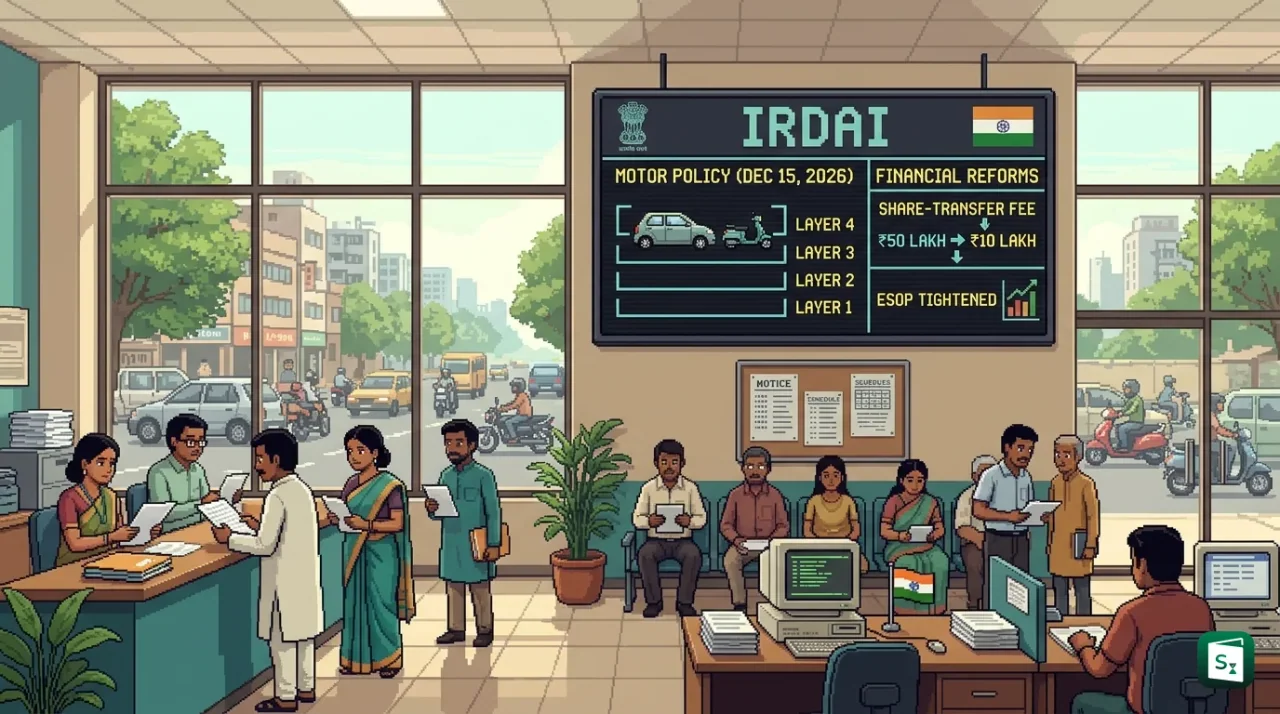
The Insurance Regulatory and Development Authority of India (IRDAI) has ordered a four layer motor insurance structure for private cars and two wheelers from 15 December 2026. IRDAI issued the direction through a circular dated 2 November 2026 after the Supreme Court order in National Insurance Company Ltd versus Thungala Dhana Laxmi. In a separate master circular dated 2 November 2026, IRDAI also tightened checks on Employee Stock Option Plans (ESOPs) and cut the share transfer approval fee under Regulation 22(4) to ₹10 lakh.
What Is IRDAI in Insurance?
The Insurance Regulatory and Development Authority of India (IRDAI) is the statutory regulator for insurance and reinsurance business in India. IRDAI licenses insurers, frames rules for policyholder protection and promotes orderly growth of the sector. It functions under the Ministry of Finance.
IRDAI was set up under the Insurance Regulatory and Development Authority Act, 1999. It was constituted in April 2000 and is headquartered at Nanakramguda in Hyderabad, Telangana. The office moved to Hyderabad from Delhi in 2001.
The creation of IRDAI followed the R N Malhotra Committee. The committee was set up in 1993 under former Reserve Bank of India Governor R N Malhotra to suggest insurance sector reforms. It submitted its report in 1994 and recommended entry of private players and an independent regulator answerable to Parliament.
IRDAI is a ten member body with a chairperson, five full time members and four part time members appointed by the central government. Ajay Seth is the present chairperson of IRDAI. The Authority draws powers from the Insurance Act, 1938 and the IRDA Act, 1999. It regulates life insurers, general insurers, health insurers, reinsurers and intermediaries such as agents and brokers.
What Is Motor Insurance and What Are Its Types?
Motor insurance is a contract that protects a vehicle owner against financial loss from road accidents. The insurer pays compensation for covered losses in return for a premium. In India, motor insurance is governed by the Motor Vehicles Act, 1988.
Third party motor insurance covers the legal liability of the vehicle owner for death, injury or property damage caused to another person in an accident. Third party motor insurance is compulsory. A vehicle cannot run on a public road without at least this cover.
Own damage motor insurance covers loss of or damage to the insured vehicle itself from accident, theft, fire and other insured events. Comprehensive motor insurance combines third party liability with own damage cover in one package. Own damage cover remains optional under Indian rules, while its pricing is set by insurers based on market conditions.
What Is the Four Layer Motor Insurance Structure for Private Cars and Two Wheelers?
The four layer structure divides a motor policy for private cars and two wheelers into four separate sections. Each section has standard policy wording framed by IRDAI after draft inputs from the General Insurance Council. The structure applies to all policies issued from 15 December 2026.
IRDAI issued the framework in circular IRDAI/CIR/MOT/10/2026 dated 2 November 2026. The circular gives effect to the Supreme Court order in National Insurance Company Ltd versus Thungala Dhana Laxmi. The court asked IRDAI, in consultation with the General Insurance Council and insurers, to create clear and uniform options so buyers can choose suitable protection.
The circular applies to all general insurers that sell motor insurance, except standalone health insurers and specialised insurers. The four sections are set out below.
| Section | Cover | Status |
|---|---|---|
| Section I | Liability to third parties | Mandatory |
| Section II | Legal liability to occupants or pillion rider, including employees of the insured | Optional |
| Section III (i) | Personal accident cover for the owner insured | Mandatory, subject to existing exemption rules |
| Section III (ii) | Personal accident cover for occupants, pillion rider and driver other than the owner driver | Optional |
| Section IV | Loss of or damage to the insured vehicle | Optional |
Section I pays for the legal liability of the owner for death, injury or property damage caused to a third party. Section II covers legal liability for death or injury to passengers in a private car or a pillion rider on a two wheeler. A pillion rider is the person seated behind the driver. This section also covers employees travelling in the insured vehicle, up to the registered seating capacity.
Section III is personal accident cover. It pays a fixed benefit for accidental death or disability of the insured person. The owner insured must hold this cover on at least one vehicle, subject to current exemptions for companies and for owners who already hold it. Cover for other occupants and drivers is optional and separate from Section II.
Section IV is own damage cover for the insured vehicle. A buyer who takes only third party cover will not get payment for repair of the insured car or bike. Insurers may design extra features in own damage cover and fix its price as per market conditions, but they cannot reduce the basic protection fixed for the four layers.
How Will Customers Select Covers and See Premiums?
IRDAI has made the choice of covers documented and transparent. Every buyer of a private car or two wheeler policy must fill a customer option form. The buyer ticks the chosen sections online or offline. The completed form will form part of the policy.
Insurers must issue a Customer Information Sheet at the point of sale. The sheet explains the cover under each section in simple terms. The policy schedule must show the actual cover and the premium charged for each section separately. The certificate of insurance must follow the Central Motor Vehicles Rules, 1989.
Existing third party policyholders can add Section II cover during the policy period by paying extra premium. They must approach the same insurer that issued the third party policy. No cancellation of the current policy is needed. The extra cover starts only from the date and time noted in the endorsement. An endorsement is a written record of a change in the policy.
IRDAI has also told insurers to complete integration of the new structure with Bima Sugam by 15 December 2026. Bima Sugam is the national digital insurance marketplace set up under the IRDAI (Bima Sugam Insurance Electronic Marketplace) Regulations, 2024. It is run by the not for profit Bima Sugam India Federation. It lets customers compare, buy, service and claim policies on one platform. General insurers have warned that buyers should not drop optional covers only to save premium, since repair costs and passenger liability will then fall on the owner.
What Are the New Rules for ESOPs, Share Transfers and IPOs?
An Employee Stock Option Plan (ESOP) gives employees the right to buy shares of the company at a fixed price after a set period. ESOP shares are a common way to reward staff and senior managers. IRDAI has now clarified that ESOP allotments must also follow the same prior approval rules as other share transfers.
IRDAI issued these norms in Master Circular IRDAI/F&I/CIR/MISC/142/11/2026 dated 2 November 2026. The master circular explains the IRDAI (Registration, Capital Structure, Transfer of Shares and Amalgamation of Insurers) Regulations, 2024 as amended in 2026. It is effective from the date of issue. It applies to all insurers, except branches of foreign reinsurers, and to applicants seeking registration.
Equity issued to an employee trust for ESOPs is now covered under Regulation 21. Exercise of options by one or more employees, key managerial personnel or directors needs prior IRDAI approval if the holding crosses the prescribed limits. Listed insurers must set up systems with stock exchanges, registrars and depositories to track holdings on a continuous basis. The insurer must ensure compliance at all times.
Prior approval is needed in two types of cases. First, based on the holding of the buyer. Approval is needed where a buyer holding 5 percent or less is likely to cross 5 percent after the transfer. Approval is also needed where a buyer holding more than 5 percent is likely to cross 10 percent, 25 percent, 50 percent or 75 percent, or is likely to become the single largest shareholder. Second, based on the shares transferred, approval is needed where shares with nominal value above 5 percent of paid up equity are transferred in a financial year by a person, firm, group or bodies under the same management. Transfers among group entities also need prior approval. If an insurer suspects split purchases below 5 percent to hide control, it must refer the matter to IRDAI.
IRDAI has cut the processing fee for share transfer approvals under Regulation 22(4) by 80 percent. The fee has fallen from ₹50 lakh to ₹10 lakh plus taxes. Fees paid before the 2026 amendment will not be refunded. Applications for a no objection certificate filed before the 2026 amendment will not attract the new ₹10,000 fee, but later applications must pay it.
For IPOs, an insurer seeking prior approval must disclose the purpose and size of the offer, the fresh issue part and the offer for sale part, and the shareholding before and after listing. Shareholders with more than 1 percent of paid up equity must be shown separately. The managing director or chief executive officer must sign a declaration that offer documents carry correct information, that IRDAI actions have been disclosed, that law has been followed and that policyholder interests will stay protected.
For amalgamation, the transferee insurer must file board and shareholder resolutions, audited accounts, the draft scheme and details of information technology, distribution, products and reinsurance. A report by an independent actuary must assess the impact on technical reserves, solvency, product pricing and financial condition. The transferee insurer must also show that policyholder funds will not meet amalgamation liabilities and that solvency will stay above the control level.
Key Takeaways
- The four layer motor insurance structure for private cars and two wheelers will apply to all policies issued from 15 December 2026.
- Section I third party liability and owner insured personal accident cover are mandatory, while occupant liability, other personal accident covers and own damage are optional.
- Insurers must collect a customer option form and issue a Customer Information Sheet, with separate premium disclosure for each section and integration with Bima Sugam.
- ESOP allotments, including through employee trusts, need prior IRDAI approval if exercise by staff, key managerial personnel or directors crosses the 5 percent, 10 percent, 25 percent, 50 percent or 75 percent limits.
- The processing fee under Regulation 22(4) for share transfer approval was cut from ₹50 lakh to ₹10 lakh, under the master circular dated 2 November 2026.