Researchers in the Electrical Engineering Department of the Indian Institute of Technology (IIT) Delhi have designed and demonstrated India’s first working indigenous micro graphics processing unit (GPU) on 24 September 2026. The IIT Delhi team showed programmable graphics rendering using a custom floating-point engine built fully in-house. The compact chip targets low cost embedded displays and marks a practical step toward cutting India’s complete dependence on imported GPUs for graphics, artificial intelligence (AI) and machine learning.
What Is a Graphics Processing Unit?
A graphics processing unit (GPU) is a special electronic circuit that performs many mathematical calculations at the same time to create images, videos and graphics on a screen. A GPU carries out rendering, which is the process of turning shapes, colours, textures and lighting data into the final picture. The same ability to run thousands of small tasks in parallel also makes the GPU useful for AI model training, machine learning, video editing and scientific simulation.
The term GPU became widely known after the company Nvidia launched its GeForce 256 card in 1999. A GPU chip itself is not the full card. The chip does the calculation, while the graphics card is the larger board that holds the GPU along with memory, power circuits, display ports and cooling. A micro-GPU is a smaller and simpler version of this design. It gives basic but programmable graphics power while using less area, less energy and lower cost, which suits small devices.
How Is a GPU Different From a CPU?
A central processing unit (CPU) is the main manager of a computer that handles general tasks one after another using a few powerful cores. A graphics processing unit (GPU) uses hundreds or thousands of smaller cores to do many similar calculations at the same time. This parallel design lets the GPU render images fast and train AI models efficiently.
The CPU receives instructions from programs and controls logic, input, output and memory. The GPU takes over heavy repetitive work from the CPU. For example, to draw a 3D scene, the GPU changes the position of millions of points, adds colour and light, and then decides the colour of each pixel on the screen. Each pixel can be calculated separately, so thousands of cores can work together without waiting for each other.
| Feature | CPU | GPU |
|---|---|---|
| Main role | General control and management of the system | Fast parallel calculation for graphics and AI |
| Number of cores | Few complex cores, often 4 to 16 | Hundreds to thousands of simple cores |
| Working style | Sequential, one task after another | Parallel, many tasks at once |
| Best use | Operating system, apps, logical decisions | Gaming, rendering, AI training, simulation |
| Memory | Uses main system memory | Uses fast onboard memory called VRAM |
The same parallel power explains the link between GPU for AI and modern computing. Training an AI model needs lakhs of matrix multiplications with decimal numbers. A CPU would do them slowly in line, while a GPU spreads them across its cores. This is why data centres, supercomputers and the IndiaAI Mission graphics portal all depend heavily on access to GPUs.
What Has IIT Delhi Demonstrated?
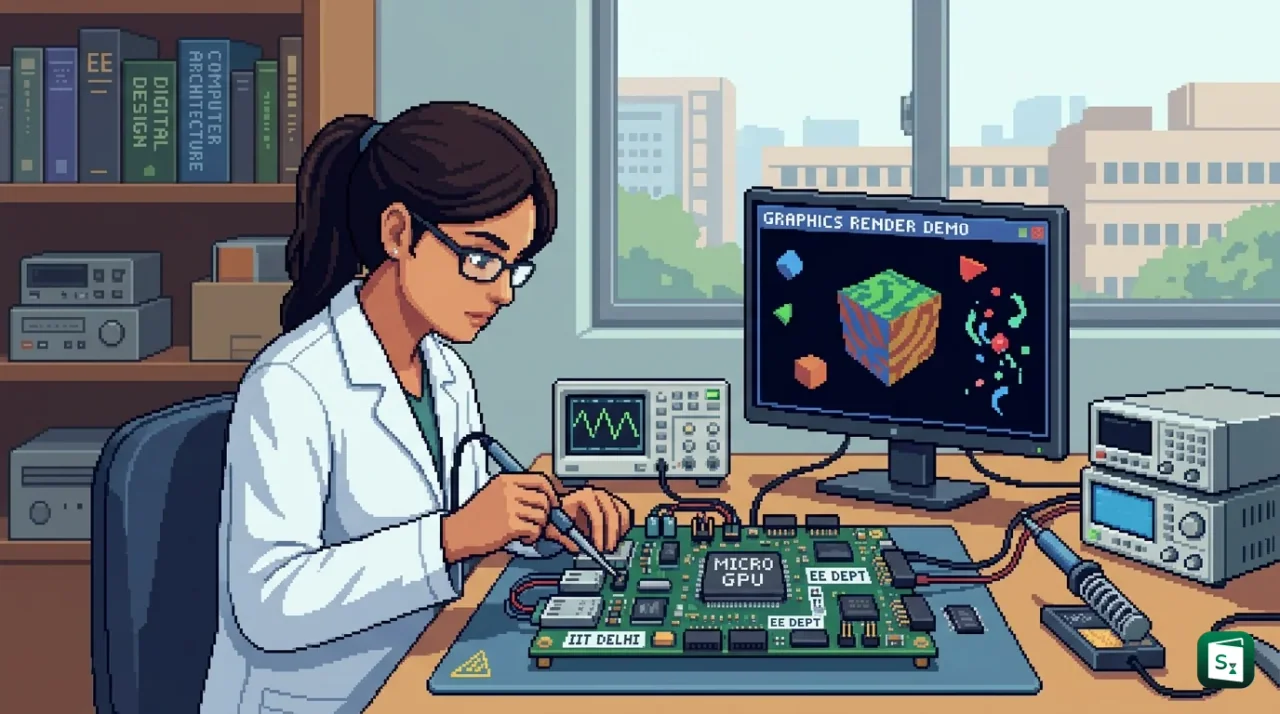
The IIT Delhi demonstration proves that the micro-GPU is not only a paper design but a working chip that produces real graphics output on hardware. MTech students Nammi Akash and M Ravi Teja, working under professors Jayadeva and Kaushik Saha in the Electrical Engineering Department, built a compact programmable processor that can run graphics instructions and draw images. The team described it as the first working and demonstrable indigenously designed micro-GPU from a university in India.
The IIT Delhi team demonstrated programmable graphics rendering with a custom floating-point GPU engine. Floating-point means the chip can directly calculate decimal numbers, which are needed to fix the exact position, shape, shade and movement of objects on a screen. Programmable means users can write different graphics programs for it, instead of being locked to one fixed image function. The engine was written fully in Register Transfer Language (RTL) and then loaded onto a Spartan-7 Field Programmable Gate Array (FPGA) board, where it successfully produced display output.
| Project element | Detail |
|---|---|
| Institute and department | Electrical Engineering Department, IIT Delhi |
| Student researchers | Nammi Akash and M Ravi Teja |
| Faculty guides | Jayadeva and Kaushik Saha |
| Demonstration date | 24 September 2026 |
| Core achievement | Custom floating-point GPU engine with programmable rendering |
| Design method | Entirely in RTL |
| Hardware platform | Spartan-7 FPGA |
| Design form | Scalable programmable graphics processor intellectual property (IP) |
The design is kept as reusable intellectual property (IP). It can be used on programmable FPGA boards today and can later be converted into a fixed silicon chip called an application specific integrated circuit (ASIC). This flexibility lets the same basic design serve both lab testing and future mass production.
How Was the Chip Designed Using RTL and FPGA?
The IIT Delhi micro-GPU was written fully in Register Transfer Language (RTL), which describes how data moves and changes between storage blocks inside a chip in every clock cycle. RTL code, usually written in languages such as Verilog or VHDL, defines the processor, memory links, floating-point units and control logic. Chip tools then convert this code into real logic gates.
The RTL design was mapped to a Field Programmable Gate Array (FPGA), which is a chip whose internal circuits can be rewired after manufacturing. A Spartan-7 FPGA board is a low cost development board from this family that lets engineers test a new processor without making a factory chip first. In simple terms, an FPGA works like reusable Lego blocks for circuits, while an ASIC works like a fixed mould that is cheap only when made in lakhs.
The choice of Spartan-7 matters for India because it belongs to a cost optimised 28 nanometre family widely used for bridging, control, sensor linking and display tasks. It offers good logic density, digital signal blocks and memory in a small size with low power use. By proving the micro-GPU on this standard board, the IIT Delhi team showed that indigenous graphics hardware can work without costly fabrication in the first stage, which lowers the entry barrier for students, startups and labs learning RTL design and verification.
Why Does the Micro-GPU Matter for India?
The IIT Delhi micro-GPU matters because India currently imports all GPUs used in computers, phones, servers and AI systems. Import dependence raises cost, creates supply risks and limits design freedom for local device makers. A small indigenous graphics processor gives Indian firms a home grown option for products where a large foreign GPU would be too costly, too power hungry or simply unnecessary.
The IIT Delhi architecture is built for embedded applications, which are small computers fixed inside machines to control screens and functions. The team has identified low cost and socially useful uses where clear display matters more than gaming speed.
| Application area | How the micro-GPU helps |
|---|---|
| Industrial control displays | Shows machine status and controls in factories at low cost |
| Human-machine interfaces | Lets workers operate equipment through simple touch screens |
| E-rickshaw dashboard navigators | Gives drivers affordable maps, battery and fare displays |
| Inland water navigation terminals | Helps small fishing boats with route and safety visuals |
| Educational e-book readers | Supports readable digital books for students in low income settings |
Together, these uses support affordable digital access and help bridge the digital divide. A compact Indian graphics IP can also reduce the price of future learning devices, rural service terminals and clean mobility dashboards, while keeping design knowledge and jobs inside the country.
How Does It Fit Into the India Semiconductor Mission?
The IIT Delhi micro-GPU fits directly into the India Semiconductor Mission (ISM), which is the nodal programme for building chip design and manufacturing in India. The ISM works as an independent business division within the Digital India Corporation under the Ministry of Electronics and Information Technology (MeitY). It guides strategy, supports design startups with tools and foundry access, promotes Indian intellectual property and builds research links between industry and academia.
The Union Cabinet approved ISM Phase 1 in December 2021 with an incentive framework of ₹76,000 crore, offering up to 50 percent fiscal support for silicon fabs, compound semiconductor units, assembly and testing plants and design. By December 2025, 10 projects worth ₹1.60 lakh crore across 6 states had been approved, covering silicon fabrication, silicon carbide, packaging and testing. The Union Budget 2026-27 announced ISM 2.0 with ₹1,000 crore in 2026-27 to build equipment and materials, full stack Indian design IP, supply chains and industry led training centres.
| Phase | Focus and scale |
|---|---|
| ISM 1.0, from December 2021 | Create base ecosystem with ₹76,000 crore support for fabs, packaging and design |
| ISM 2.0, from Budget 2026-27 | Deepen capability in machines, materials, design IP, supply chains and talent |
The micro-GPU adds to other indigenous milestones. On 5 March 2025, the Vikram Sarabhai Space Centre and the Semiconductor Laboratory (SCL), Chandigarh handed over the first lots of VIKRAM3201, India’s first fully home made 32 bit space grade microprocessor made in 180 nanometre technology for launch vehicles. The Centre for Development of Advanced Computing (C-DAC), set up in 1988, is separately working toward an indigenous GPU chip for AI workloads by around 2029 and a fully indigenous high performance system by 2030. The IIT Delhi prototype shows that universities can also feed this national pipeline with tested RTL IP and trained chip designers.
The Way Forward
The IIT Delhi team is now working toward an 8 to 16 core vector style graphics processor. A vector design lets many cores handle large blocks of image and number data together, which raises speed for richer graphics and small AI tasks. The team also plans to build an optimised compiler and graphics software toolchain, which is the software that lets programmers write apps that the new hardware can understand and run efficiently.
The next hardware goal is a proof of concept in 65 nanometre ASIC technology. A nanometre is one billionth of a metre and measures how small the transistors on a chip are. The mature 65 nanometre node is cheaper and more practical than cutting edge nodes for embedded chips, so it can deliver usable Indian graphics silicon at viable cost. The researchers plan to seek funding for ASIC fabrication, system integration and eventual commercial use, which will test performance, power, cost and industry adoption.
Key Takeaways
- IIT Delhi demonstrated India’s first working indigenous micro-GPU on 24 September 2026 with programmable graphics rendering.
- The project was led by Nammi Akash and M Ravi Teja under Jayadeva and Kaushik Saha in the Electrical Engineering Department.
- The custom floating-point GPU engine was written fully in RTL and mapped to a Spartan-7 FPGA platform.
- The design is a scalable graphics processor IP usable on FPGA boards today and convertible to ASIC silicon later.
- The team’s roadmap targets an 8 to 16 core vector processor with a new compiler toolchain and a 65 nanometre proof of concept.
- The work supports the India Semiconductor Mission, approved in December 2021 with ₹76,000 crore support and extended through ISM 2.0 in Budget 2026-27.